
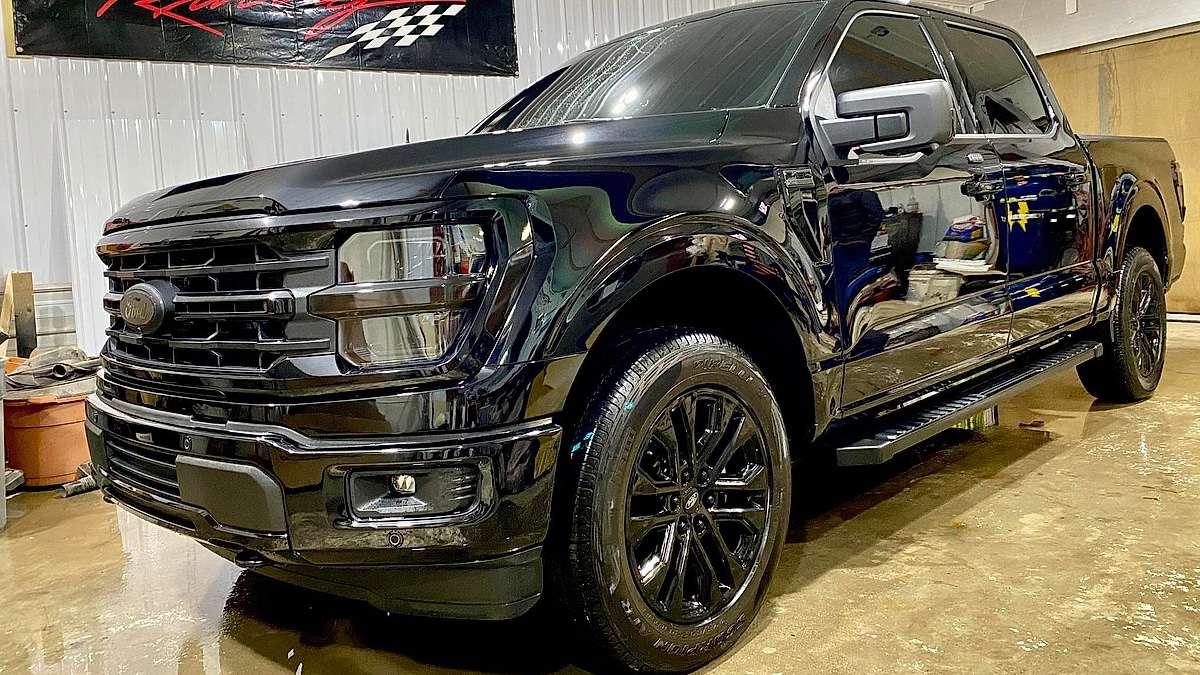

The 2025 Ford F-150 is the target of a new, highly specific federal compliance push that has many owners questioning the value of their investment. Ford Motor Company, through its contractor Roush Industries, is currently issuing formal requests to F-Series owners to surrender their trucks for a 30-day "In-Use Vehicle Emissions Program."
While these programs are a standard part of EPA regulatory oversight, the current $200 compensation is meeting fierce resistance from the enthusiast community. This report analyzes the technical risks of dynamometer testing, the disparity in compensation compared to previous years, and the critical "Information Gain" owners need before signing over their keys to a third-party testing facility.
I have covered the automotive industry for over 30 years, and I’ve seen my share of "voluntary" manufacturer requests, but the latest letter hitting 2025 Ford F-150 mailboxes is causing a genuine stir. Ford is asking owners to give up their trucks for up to four weeks for emissions testing in exchange for a meager $200, a figure that feels like a slap in the face to anyone who just dropped $60,000 or more on a new pickup.
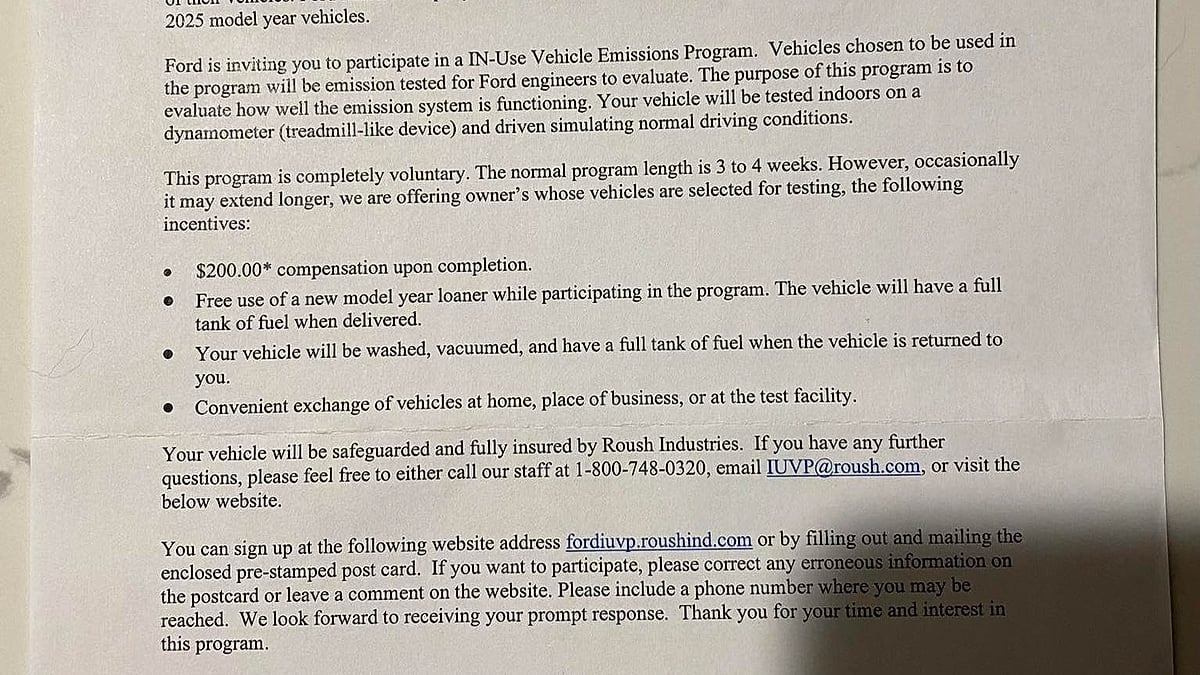
Kyle Gierman, an owner from Michigan, recently shared his frustration on the Ford F-150 Owners Facebook page, stating: “What a joke! I received a letter from Ford Motor Company asking me to be involved in an In-Use Vehicle Emissions Program... They would keep it 3-4 weeks and pay me $200. Who knows who would be driving and how many miles they would rack up. I would never let anyone else drive, let alone wash my truck.”
This isn't the first time I've seen Ford struggle with maintaining owner trust during service campaigns. In my recent investigation into Ford's quality control, I noted how recurring issues with hybrid systems have left many owners feeling like beta testers, and this emissions request only adds to that sentiment. Furthermore, I’ve tracked how Ford’s aggressive recall schedule has already strained the relationship between the brand and its most loyal buyers, making a voluntary 30-day "towing" of your truck to a lab a very hard sell.
The Who, How, and Why
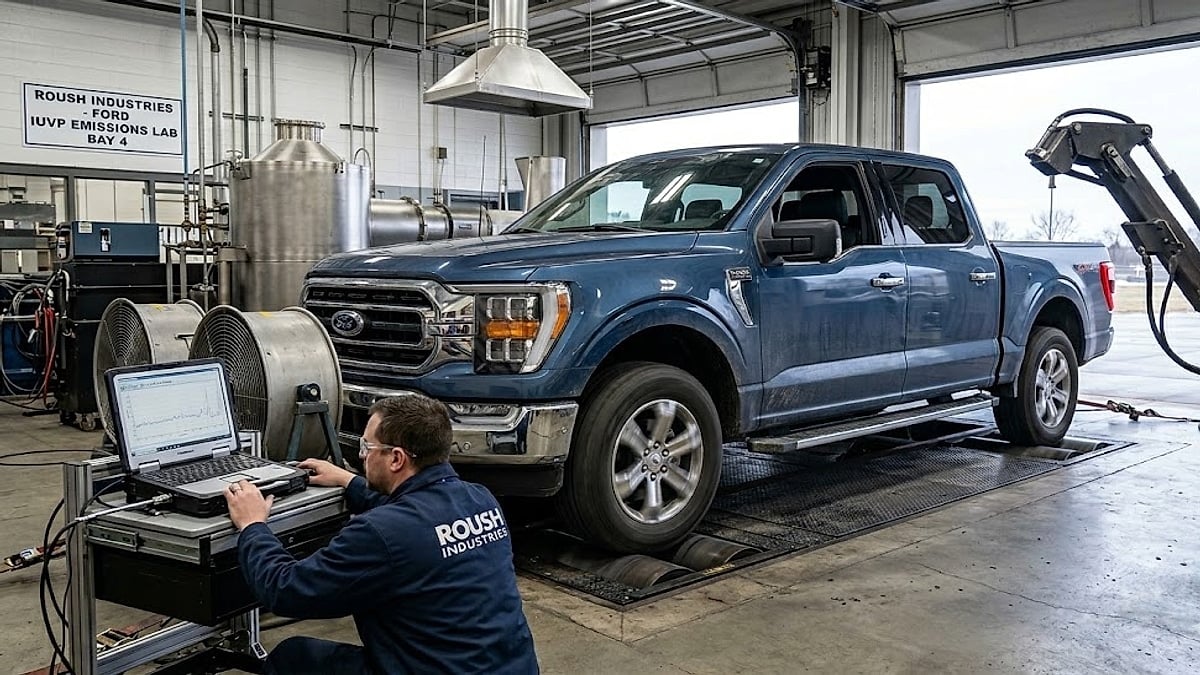
To understand why this is happening now, we have to look at the "Who." The program is run by Roush Industries on behalf of Ford. As for the "How," your truck is placed on a dynamometer, a treadmill for cars, to simulate "normal driving conditions" while sensors measure tailpipe output. The "Why" is simple: the EPA requires automakers to prove that vehicles in the "real world" actually meet the emissions standards they promised during the initial certification.
However, the $200 incentive is a major sticking point. Expert analysis from independent regulatory watchers at the International Council on Clean Transportation (ICCT) suggests that maintaining real-world compliance is becoming more difficult for manufacturers as standards tighten, which is why these "In-Use" programs are becoming more aggressive. Additionally, the EPA’s own documentation on In-Use Surveillance Testing explains that these programs are vital for identifying "defeat devices" or component failures, yet the burden of participation falls squarely on the owner's shoulders.
Watch: A rare look inside the Roush Advanced Durability Lab. This is the industrial environment where your 2025 F-150 would spend its 30-day 'In-Use' testing period, subjected to the dynamometer cycles discussed below.
From My View: A $200 Gamble?
I’ve spent three decades talking to engineers and owners, and I can tell you that a truck on a dynamometer isn't just "parked." It is being run through rigorous cycles. While Roush is a professional outfit, Kyle Gierman’s concern about "who is driving" and "how many miles" is valid. When I hear that an owner was offered $1,500 for a similar program for a different car, it makes the $200 Ford offer look even worse. If I were sitting across from you at a coffee shop, I’d tell you that your 2025 F-150 is a precision machine; letting a lab tech redline it on a treadmill for a month for a couple of hundred bucks and a car wash doesn't make financial sense.
What You Need To Know
- Insurance Coverage: While the letter states the vehicle is "safeguarded and fully insured," your personal insurance may still consider a month-long laboratory stay a "commercial use" or "non-standard" event. Always call your agent first.
- The Dynamometer Factor: Unlike the open road, a dyno doesn't provide the same airflow across the entire chassis. While modern labs are great, I’ve seen cases where cooling fans don't perfectly replicate 70-mph highway gusts, leading to heat soak.
- Depreciation vs. Compensation: A 2025 truck is in its highest depreciation phase. Adding 500 to 1,000 "simulated" miles for $200 is essentially paying Ford to depreciate your asset.
- The Loaner Catch: You get a new loaner, but it won't be your truck. If you use your F-150 for specific work tasks or have custom equipment installed, a standard rental won't cut it.
My Take: Why The Outrage Is Justified
I see a lot of "corporate-speak" in the letter Ford sent to Mr. Gierman. They mention a "convenient exchange" and a "full tank of fuel," but they fail to acknowledge the emotional and functional value of the F-150 to its owner. For many of my readers, their truck is their office. Taking it away for a month is a massive disruption.
Field Observations from Owner Communities
The consensus among the "wrench-turners" and long-term owners is clear: the risk-to-reward ratio is skewed. From my experience, Ford is likely targeting specific VIN sequences that represent high sales volume to meet EPA quotas. If your truck is part of that "average" use case, they want your data. But as a reporter who has investigated countless "minor" service visits that turned into "major" headaches, I recommend extreme caution.
The community is already talking about the risks of these programs. On r/F150, one owner shared their skepticism, noting: "I've done these before with other brands, and the 'free wash and vacuum' usually results in swirl marks on the paint from a cheap automatic car wash," which is exactly what a guy like Kyle, who doesn't even want others washing his truck, is afraid of.
Another user in the r/Trucks community highlighted the technical concern, saying: "The amount of stress a dyno puts on the transmission without the natural cooling of moving air is something I'd never subject my daily driver to for a couple of hundred bucks," which aligns with my observations on how sensitive the new 10-speed transmissions can be to thermal management issues.
Key Takeaways for My Readers
- It is Voluntary: You are under no legal obligation to participate. Your warranty will not be voided if you say no.
- Negotiate the Rate: If Ford wants your data, they should pay market value. $200 is 2010 money; in 2026, the inconvenience fee should be significantly higher.
- Document Everything: If you do choose to participate, take 50+ photos of the exterior, interior, and the odometer before the keys leave your hand.
- Check the Fine Print: Ensure the "safeguarded" clause includes "diminished value" protection if the truck is damaged during testing.
Next Question: Is Your Warranty Impacted if You Refuse the EPA Emissions Testing?
The most pressing concern for 2025 Ford F-150 owners receiving this letter is whether declining the "voluntary" request will jeopardize their factory warranty or trigger a "red flag" in Ford’s corporate database. To be clear: No, refusing to participate in the In-Use Vehicle Emissions Program will not void your warranty or affect your coverage. Under the Magnuson-Moss Warranty Act, a manufacturer cannot deny a warranty claim simply because an owner declined to participate in a non-mandatory third-party data-collection study.
While Ford and Roush Industries require these VIN-tracked vehicles to satisfy EPA "in-use" compliance quotas, the legal burden of providing a testing fleet rests on the manufacturer, not the individual consumer. You are well within your rights to ignore the letter, and doing so has zero impact on your truck’s "Goodwill" standing or future service eligibility at your local dealership.
$200 and a Car Wash Aren't a Fair Trade
Ford is in a tough spot with emissions compliance, but that doesn't mean you have to be the one to bail them out at a discount. The 2025 F-150 is a masterpiece of engineering, but it is also an expensive asset that deserves to be treated with respect. A $200 check and a car wash aren't a fair trade for a month of your truck's life and the potential mechanical stress of laboratory testing. I’ve always stood for the owner's right to know exactly what they are getting into, and in this case, the "deal" looks more like a liability.
What Would You Do?
Would you give up your new F-150 for a month just to help Ford’s engineering team for $200? Or do you agree with Kyle that this offer is a complete joke? It’s Your Turn: Leave a comment in the red “Add new comment” link below and let me know if you’ve received one of these letters!
About The Author
Denis Flierl is a 14-year Senior Reporter at Torque News and a member of the Rocky Mountain Automotive Press (RMAP) with 30+ years of industry experience. Based in Parker, Colorado, Denis leverages the Rockies' high-altitude terrain as a rigorous testing ground to provide "boots-on-the-ground" analysis for readers across the Rocky Mountain region, California EV corridors, the Northeast, Texas truck markets, and Midwest agricultural zones. A former professional test driver and consultant for Ford, GM, Ram, Toyota, and Tesla, he delivers data-backed insights on reliability and market shifts. Denis cuts through the noise to provide national audiences with the real-world reporting today’s landscape demands. Connect with Denis: Find him on LinkedIn, X @DenisFlierl, @WorldsCoolestRides, Facebook, and Instagram.
Photo credit: Denis Flierl via Kyle Gierman
Set Torque News as Preferred Source on Google
Follow us today...



Comments
If they want to understand…
Permalink
If they want to understand emissions and fuel consumption "in the real world" EPA and vehicle manufacturers should design a system to measure the loads, environmental conditions, speed, acceleration, and braking dynamics of vehicles in use. Majority of those criteria are already being measured and available to the manufacturers.
Really? It’s a new truck! It…
Permalink
Really? It’s a new truck! It takes a month or two to break in an engine. My 2025 F150 5L had terrible mileage to begin with. Now it’s getting 22-24 mpg on highway at 65mph. It also depends on the gas you feed it.