

We’ve all seen the fake or exaggerated posts about EVs needing new batteries. So many that the radical EV-advocacy media works day and night to tell you a lot of also untrue facts to bring balance to the force. They say that EVs are more reliable, despite literally every reliability expert ranking EV brands last in reliability. They reason they say EVs will be reliable because they are “simpler” and have “fewer moving parts." We need only look at owner surveys of those who actually own EVs to know this is false.
Now we have a stunning new post from The Ioniq Guy. I love The Ioniq Guy. I follow him on social media, learn a LOT from what he presents, and I am an active member on a Facebook group that he is the admin for. To say he is a leading, trusted source of EV information would be an understatement.
Here’s what The Ioniq Guy posted today:
(Heavy sigh) My 2025 Ioniq 5 needs a new battery pack. That’s right. My car that has only 8,500 miles on it, is now in for repairs, and I likely won’t have it for many weeks.
It would be very hard to have owned more Ioniq EVs than The Ioniq Guy. He has had a 2022 Ioniq 5, a 2024 Ioniq 6, and now this 2025 Ioniq 5. Like most owners, The Ioniq Guy says that his three Ioniq EVs from Hyundai have had “Relatively few issues.” He listed them for us. Here are the relatively few issues:
- The radar unit on the 2022 Ioniq 5 failed
- The charge port on the 2022 Ioniq 5 overheated
- The high-voltage battery on the 2025 has failed
Just a Few Failures - Really?
It’s debatable if these three issues amount to a lot of failures or a few failures. Until you factor in that The Ioniq Guy has only traveled a total of about 50,000 miles in all of his Ioniq EVs combined. Three pretty big failures, none of which were “easy over-the-air fixes.” If you owned any car and it had three failures like these, would it inspire confidence in your choice of vehicle to drive past the warranty? I would either buy an extended warranty, which can cost up to $5,000, or ditch the vehicle and never shop that brand again. Tell us in the comments what you would do.
Battery Pack Replacement Cost - According to Hyundai Dealers
The battery pack in an EV is the single most expensive part of the car, and the most important part of the powertrain. If it doesn’t work, the car won’t move. Battery pack replacements for Hyundai Ioniq 5s can cost over $60,000, including labor. Yup, we know. You are justifiably calling BS on this statement, but the info is not something we made up. Hyundai dealers provided those estimates to an owner in writing. And then a second Hyundai dealer did so. The crazy battery replacement cost number comes directly from Hyundai’s authorized dealers - the only people who can replace your Hyundai EV battery safely and under warranty if needed.
Other Owners Are Also Reporting Catastrophic Powertrain Failures
It didn’t take more than a few hours for fellow owners of Ioniq EVs to start chiming in under The Ioniq Guy’s post. Here are a few of the more relevant ones that highlight that this owner is not alone in having EV powertrain failures:
JGS - “Same thing happened to my 2025 IONIQ 5 Limited RWD this past Sunday! Within a minute of getting in the car and driving, I heard a loud pop from the rear of the vehicle, immediately followed by a warning on the driver information display saying “CHECK ELECTRIC VEHICLE SYSTEM”. “
CG - “MY25 I5N threw me this exact issue at 1333km 10 days into ownership. Took 36days from dropoff to pickup (sept/oct) with brand new BSA.”
MD - “Our 2024 Kia Niro EV had a similar issue last December when we bought it (issue showed in < 200 miles). However, it took them MONTHS to get the pack. I hope you get it replaced much sooner.”
A Perfect Storm Of EV Failure
Having a failure in your driveway is one thing, but the Ioniq Guy was on a long holiday road trip on Thanksgiving Day. The battery failure occurred while the vehicle was stopped at a DC charger. Who doesn’t love spending the better part of an hour charging when taking the family to see relatives on Thanksgiving? “This totally screwed up my plan for getting down to Philadelphia. I was planning one more charging stop. That would be good enough to get us to (the destination) and back to the original charger on the way (home.)” We took out the specifically named places to give The Ioniq Guy some privacy, but you can see his route on the video.

A Perfect Example Of Hybrids and Why They Are More Popular Than EVs
Aside from the crazy battery failure reported by the Ioniq Guy, his post also illustrates perfectly why EVs are capturing less than 6% market share right now. His holiday journey to see family was only 300 miles each way. A 2025 Toyota Prius hybrid can make that loop without stopping for energy at all. Its range is 644 miles. A RAV4 hybrid has a range of over 500 miles and can be refueled in just 87 seconds, virtually anywhere on the ride from Boston to Philadelphia. No lines, no waiting. Take five minutes to use a bathroom, and on you go.
What’s Your Take?
We’ve done top-level stories recently highlighting how EV brands are ranked the lowest in reliability. Now we have done a very focused story around a report from an EV advocate who has the trust of the EV community. Tell us in the comments below if you think the reliability of EVs is a reason that 95% of American shoppers don’t buy one.
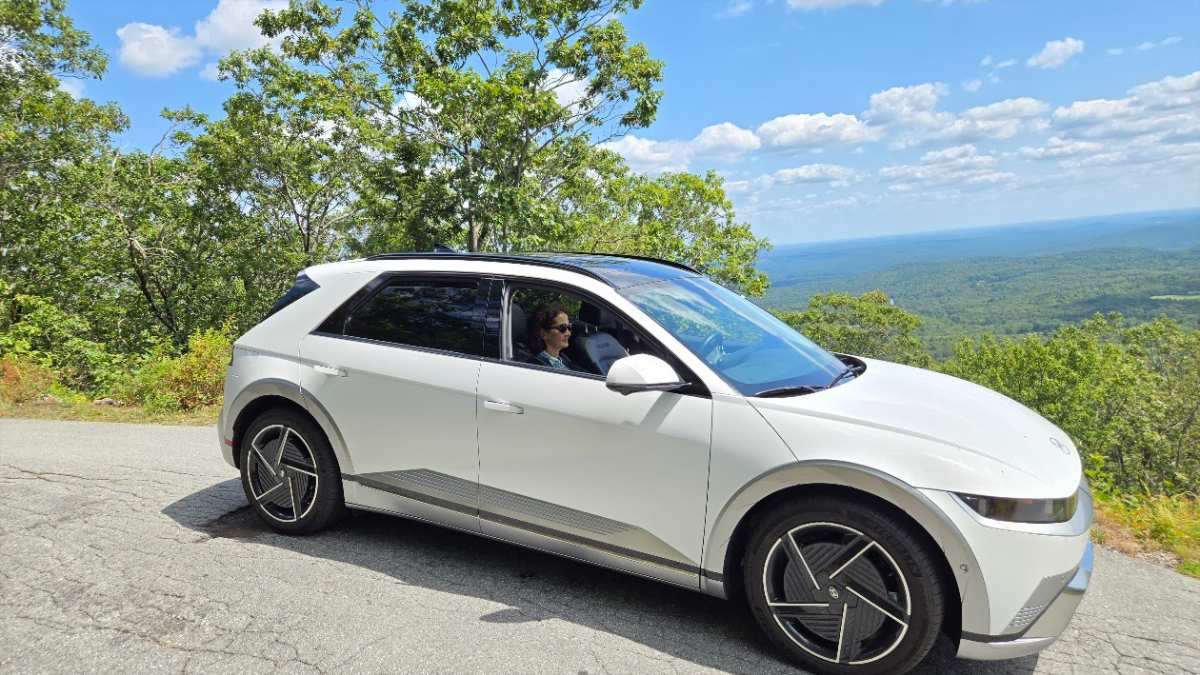
Image of a 2025 Hyundai Ioniq 5 Limited atop a serene mountain by John Goreham.
In case you missed the direct link at the start of our story, here is the source of this story:
John Goreham is the Vice President of the New England Motor Press Association and an expert vehicle tester. John completed an engineering program with a focus on electric vehicles, followed by two decades of work in high-tech, biopharma, and the automotive supply chain before becoming a news contributor. He is a member of the Society of Automotive Engineers (SAE int). In addition to his fourteen years of work at Torque News, John has published thousands of articles and reviews at American news outlets. He is known for offering unfiltered opinions on vehicle topics. You can connect with John on LinkedIn and follow his work on his personal X channel or on our X channel. John employs grammar and punctuation software when proofreading, and he sometimes uses image generation tools.
Set Torque News as Preferred Source on Google
Follow us today...






Comments
Do comments go anywhere here?
Permalink
Do comments go anywhere here?
Yes. Please do add one…
Permalink
In reply to Do comments go anywhere here? by Gibb (not verified)
Yes. Please do add one. Thank you.
Yes those can be troublesome…
Permalink
Yes those can be troublesome issues. But to be fair, similar issues arise on ICE (gas) vehicles. I've had transmissions go, head gaskets go and other issues that made the car inoperable. I've had good success with my Ioniq 5 for what it's worth. Charging only takes 15 minutes.
The difference between the…
Permalink
In reply to Yes those can be troublesome… by Ian (not verified)
The difference between the ICE vehicle component failures, which of course do happen, and the Ioniq 5 is that my story has two links to owners with paperwork from their dealers saying the battery replacement cost was $60K. There is nothing mechanical that can go wrong with ICE cars that cost the same price as the car when new. Can you charge an Ioniq 5 from near zero SOC to 100% SOC in 15 minutes? Tell us how much range you can add to an Ioniq 5 in 15 minutes under ideal circumstances. When we charge the Ioniq 5 on 350kW-capable DC chargers and Superchargers, we gain from 100 miles to about 150 miles in 15 minutes, depending on a huge list of factors. A Toyota hybrid SUV can add 500 miles of range in 87 seconds. We've done it repeatedly. Sometimes it's faster with the hybrid, but that's the slow average.
Although I am not a Hyundai…
Permalink
Although I am not a Hyundai owner, I've owned a 2020 Tesla model 3 SR+ for almost 6 years. This past summer at 45,000 miles, I received a warning on my screen about the battery not being able to be charged. (was at 41%) To make a long story short the battery was replaced under warranty in about 2 weeks. Before this happened, I figured I would be driving this car maybe for the rest of my life (I'm 70). Now, although I'm still very pro EV, this car will be replaced at 7 1/2 years, just before the battery warranty expires. I'm sure many other EV owners feel the same.
Then there are studies like…
Permalink
Then there are studies like this that say the opposite. Search Youtube for "study analysing 10 million cars finds evs more reliable than gas cars".
Battery failures in modern EVs are actually rare. And most of the time even when they do occur the battery replacement is free if it occurs within the warranty period, which is generally 8 to 10 years (in the us, Hyundai and Kia are even more generous. If you are the original owner, the battery is guaranteed life). And denying that EVs are mechanically more simple with fewer parts is silly since that can easily be proven. Electric motors have significantly fewer parts than a typical internal combustion engine (less than a tenth as many). FUD (fear, uncertainty and doubt) will only get you so far, guys.
Thanks for commenting,…
Permalink
In reply to Then there are studies like… by Russell (not verified)
Thanks for commenting, Russell. Yes, there are certainly a lot of publications that want us to think EV batteries don't fail. But then there are failures of the Bolt, Niro, and Kona, in which all were recalled, and a huge percentage were replaced. Use a browser to search "Battery problems with my EV." Plenty of reading material there.
I own a 2023 Ionic 5. It is…
Permalink
I own a 2023 Ionic 5. It is unquestionably the best car I have ever driven in my 37 years of driving. There were 2 minor recall issues, which were resolved, each only a couple of hours at the dealership and I was on my way. Every one I have spoken with who has an Ionic 5, loves their car. The "Ionicguy" in my opinion is clueless.
Thank you for this comment,…
Permalink
In reply to I own a 2023 Ionic 5. It is… by Bob (not verified)
Thank you for this comment, Bob. What I like about it is that it illustrates that EVs are much loved by their owners. That is unquestionable. Consumer Reports, JD Power, and others have the data, and it is universal. There is no greater fan of EVs than The Ioniq Guy, who works tirelessly to promote EVs across a wide range of platforms (YouTube and others). Reliability is a different issue, and the same owners truthfully list their EV problems in owner surveys conducted by the same people who do the owner satisfaction studies. Your Ioniq 5 is only two years old or so. Shouldn't every $45K to $65 model be reliable during its honeymoon period?
Sadly, this happened to me. …
Permalink
Sadly, this happened to me. I bought my 2025 Ioniq 5 in February. Over the summer, a battery warning came up and I brought the car back to the dealership for service. After a few weeks, the service department couldn’t find anything wrong. In late August, the battery warning came on again. I brought the car back to service, where I was told that the batteries were back ordered and no date when they would be available. My vehicle had just under 8000 miles on the odometer. In November, I requested that Hyundai buy back my vehicle. Hyundai agreed but then gave me the runaround about when approval would take place. I had to get the BBB to mediate (after six weeks). Also, I had purchased the EV battery warranty and had to send information separately in order to be refunded. Everything was approved yesterday, and I have to wait another 4-6 weeks to be refunded for the car. Very disappointing as I had heard really good reviews about the Ioniq5.
Thank you for commenting,…
Permalink
In reply to Sadly, this happened to me. … by Cassie Doyon (not verified)
Thank you for commenting, Cassie. Hope the buy-back goes well for you.
Yet another reason…
Permalink
Yet another reason explaining why the EV fad is in fade mode in the US.
I had a Ford Fusion plug in…
Permalink
I had a Ford Fusion plug in hybrid and it was a nightmare. The hybrid battery failed slowly and consistently over 3 years of ownership, getting worse and worse range, then finally started throwing weird error messages and causing the car to drive erratically. It took me like 6 months to convince Ford to replace it, which they finally did (and that process took another 2 months - to their small credit they paid for a rental in that 2 month period).
I bought an Ioniq 5 shortly after Ford offered to buy them back at above market value because they couldn’t actually fix these cars to prevent the issue I had - it became a recall on all of my Fusion’s model year cars.
I’ve had an Ioniq 5 for 18 months or so and I love it. I did have the regular 12v battery failed slowly, and Hyundai replaced it same day. My wife got an Ioniq 5 about 6 months ago and she’s had zero issues.
Anyway hybrids can be challenging too. I’m very happy driving electric now. They’re much more mechanically simple.
The plural of "anecdote" is…
Permalink
The plural of "anecdote" is not "data".
I've been an EV owner since 2011 and haven't had a single major issue with any of my cars. In those past 14 years: 2011 Leaf. 2016 Tesla S. 2018 Tesla 3. 2022 Tesla S. 2x2025 Ioniq 5's.
Not one issue with any of the electronics. The 2016 S had a defect with the control rod, but that can happen in literally any car. The Leaf's range sucked, but I bought it knowing that so I just planned my day and it wasn't a huge issue. Other than that, zero complaints. Now, my anecdote's aren't "data" either. But they do contrast strongly against the author's fearmonging.