
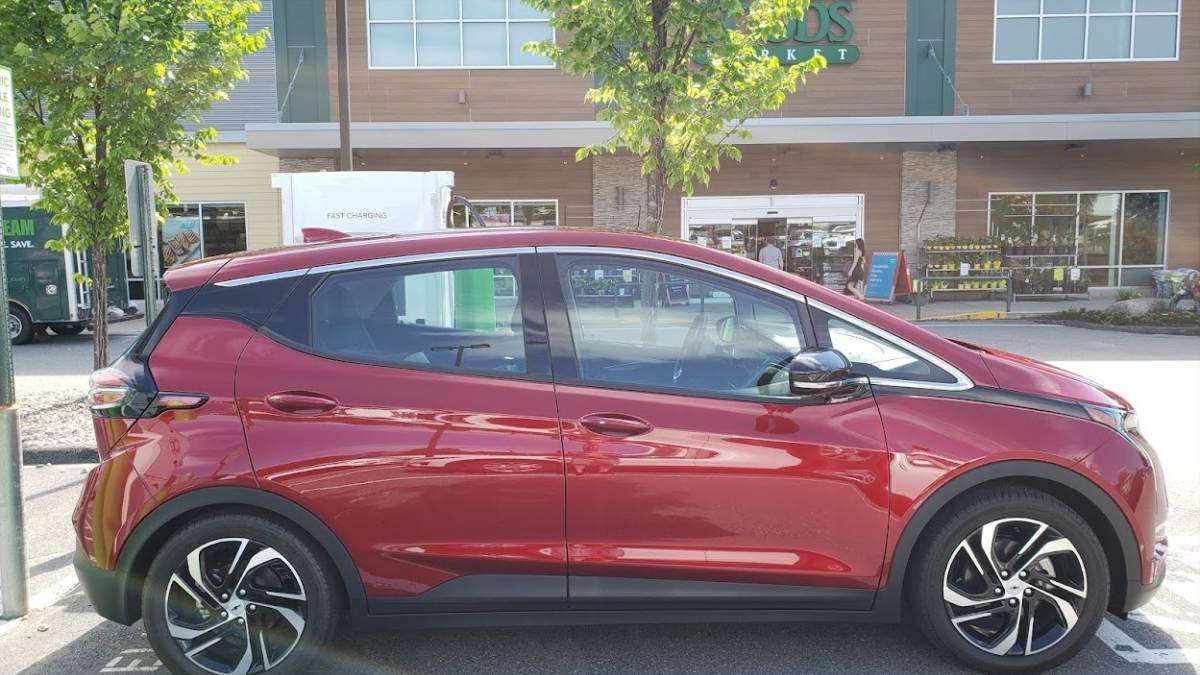

A veteran Chevy Bolt owner recently tried to charge the car at America’s very best DC charging network and had difficulty doing so. After asking for help, it took literally hundreds of comments to sort this mess out.
Sure, discount me as an EV hater if you like, but I’m the guy who’s driven virtually every EV made, listed their positives in glowing reviews, and has four EV chargers in my garage. I’m not a Luddite or in the pocket of Big Oil; I’m a former engineer and business manager from Fortune 500 instrumentation and healthcare equipment companies who started testing cars and EV chargers fifteen years ago. So when I spot a Facebook post by a veteran EV owner that says they couldn’t charge their car, my ears perk up. Why? What was the problem this time? I want to know why, in 2026, after 30 years of modern EVs, we still can’t charge the silly things.
Sadly, many people act online as if charging an EV is super easy. It is not. There are four different EV charging handles in use right now in America. No single EV can use all four. Some of the highest-rated plug-in cars can’t charge at all on DC chargers, roughly a quarter can’t charge on the nation’s best DC charger network, and that very network has some locations that will charge certain brands and not others. To call it a mess is an insult to messes.
This story was inspired by Chevy Bolt owner R.U., who is a frequent poster at one of the better Chevy Bolt Facebook fan clubs. This person has owned the car for a long time and posts frequently about living the electric life. They are a Top Contributor in the club. Let’s look at one of two recent posts by this veteran EV owner:
This DC charging station says it can charge up to 350 kW speed, but the highest I have seen is 32kW on my Bolt, starting from 40% and up. Why? Where is my advertised 55kW?
Now, if you are a savvy EV driver, like I am, you already know about the five most common reasons why the charger is not delivering its promised rating, starting with the fact that its capability is an imaginary top speed in this case, since the car limits charging to the best possible rate of 55 kW. We got it. R.U. is not dumb and knows that too. What R.U. is actually asking is a question I have asked in multiple stories and have suffered being called an idiot and “Big Oil Shill” in the comments section. R.U. wants to know why, when charging at just 40%SOC, the car won’t accept charge at its advertised speed of 55 kW. I think the question is more than fair. I also know about a dozen reasons why the car doesn't do what it promises. Cold weather, shared charger, full moon, bad juju, even numbered day, odd numbered day, day ending in Y, heck, there is such a long list of reasons why a car won't charge as quickly as promised on a DC charger it sort of makes you wonder why automakers and EV advocates overstated the actual speed. Does it seem like false advertising to you?
Just a few of the 114 suggested reasons fellow EV owners offered include these, and we will make our own note after each:
1) “Next time, start charging at 10%, and you might see 50kW for a brief moment.” Here we see that a fellow Bolt owner is ready to concede 10% of their charging speed without even thinking about it as a sacrifice. And why just for a brief moment?
2) “Is it cold there? Also, starting at 40% probably isn't quite low enough to see max speeds.” Here is one comment that pulls in two reasons owners are ready to accept low charging speed without wondering why they don't deserve the full speed that is advertised.”
3) "Below 50°F? Are other cars nearby being charged? More than one car is being charged? Some stations just stink (profanity edit)?" Here, a fellow owner quickly rattles off four reasons why DC charging is not all it’s cracked up to be.
Unfortunately, I feel I must also include comments that effectively call this EV owner stupid for posting a question about charging in the first place. Sadly, this type of attitude is not uncommon in EV clubs. There are those who are so radical in their EV fanaticism that they think any issue is the fault of the person not smart enough to own one. Here’s a couple to illustrate the group of nasty EV owners:
1) “It's not a machine problem, it's a human problem.” The implication here is that an EV owner whose EV charges dramatically slower than advertised is the problem. Sad.
2) “Unless it’s the only option, a Bolt should never plug in at a 350kW. You’re just being rude to cars that can actually charge.” This is simply elitism. Since R.U. owns an affordable EV, they should just avoid DC chargers to let the rich folks have them. Terrible.
3) “If you want high-speed charging, get a proper EV vehicle.” Again, elitism. Car Talk named the Bolt the best overall EV three years in a row. The Bolt has won endless awards. R.U. is only asking for what R.U. was promised would be the charging speed. Should EV owners settle for being sold a fantasy?
4) “Time to start learning the issues of charging speed.” This comment may not be intended as nasty, but it is one owner calling another veteran owner dumb. Plain and simple.
Slow charging is not the only problem veteran electric vehicle owner and operator, R.U., has struggled with. In a post from last month, R.U. explained that they could not get a DC charger to work AT ALL. To charge, R.U. needed to move to a different charger, which was luckily unoccupied. Here’s what R.U. posted:
Trying to charge at the Electric Vehicle Institute, and service was interrupted - twice.
Fellow owners offered sympathy and asked for updates as to the resolution, which R.U. did offer. Here is one comment that we think sums up what many EV owners might say when they see a post about not being able to charge: “I’ve had the same issue happen.”
R.U. is not a Debby Downer poster in this club. Many of the posts offered by this owner are entirely positive and also informative. One starts, “Just discovered this cool feature.” Another is titled, “Just found this station yesterday as well and appreciated the experience!”
So, What’s Our Point?
Stepping back from the details of this veteran owner’s posts about having difficulty charging an award-winning, very popular electric vehicle, we want to offer our analysis on EVs and why they are not succeeding the way many advocates hoped.
A) New car shoppers are not stupid. They understand EVs have upsides like great torque, quiet operation, and that they offer a mode of transport with no local emissions. However, those are not priorities for about 94% of American shoppers. They value other things. Reliability. Usability. Predictability. Affordability. They just want to get to work, pick the kids up after work, and go out on the weekends without vehicle hassles. As R.U. clearly illustrates, even veteran owners driving award-winning EVs are hassled by them.
B) EVs positives are over-hyped, and many promises are not kept. Slapping the words “Ultra Fast Charging" on the side of a box that either will not charge at all or charges your award-winning EV at literally a tenth of that speed does not go unnoticed. People talk. Like R.U. here. People say, “What else isn’t true about owning this type of car?”
C) Declining EV adoption is not due to complex factors. Every EV publication pumps out story after story every day along the lines of "This big breakthrough COULD be what we have all been waiting for.” Why are we still waiting exactly? It’s been 30 years since the GM EV-1 and four generations of subsequent EVs.
GM’s not the only brand with a long history of EV development. Toyota had battery-electric RAV4s running around California six years before Tesla was incorporated, and the top-selling green vehicle brand in America is now on its fourth generation of American-market EVs. Tesla has also had four EV generations. Ford has seen EV trucks come and go already.
D) The time to work out the bugs on EVs was twenty years ago, not next year. American shoppers are eagerly gobbling up hybrids from brands like Toyota, Lexus, Ford, Hyundai, and Kia because they are green vehicles that offer significantly reduced carbon footprints without the hassles and false promises of EVs. That’s why, heading into 2026, EVs are being skipped over by 94% of new car shoppers.
What's your take? Is the reason that EVs are barely selling in America as simple as broken promises and hassles? Tell us in the comments below.
Top of page image by John Goreham.
John Goreham is the Vice President of the New England Motor Press Association and an expert vehicle tester. John completed an engineering program with a focus on electric vehicles, followed by two decades of work in high-tech, biopharma, and the automotive supply chain before becoming a news contributor. He is a member of the Society of Automotive Engineers (SAE int). In addition to his fourteen years of work at Torque News, John has published thousands of articles and reviews at American news outlets. He is known for offering unfiltered opinions on vehicle topics. You can connect with John on LinkedIn and follow his work on his personal X channel or on our X channel. John employs grammar and punctuation software when proofreading, and he sometimes uses image generation tools.
Set Torque News as Preferred Source on Google
Follow us today...




Comments
The adage about your mileage…
Permalink
The adage about your mileage may vary can most certainly be applied to your charging rate may vary as well.
I seen it as high as 170Kwh on an UltraFast EA Charger (22 F-150) under ideal temperature, starting SOC and co-sharing of chargers.
In my oldest, 14 MS P85D, I'll be lucky to get 50Kwh in ideal conditions. A little better with my 16 MX P90D.
What can I chalk it up to? Age, Different battery chemistry and degradation. At this stage, just happy that EVERY TIME I plug in, they take a charge.
Well said, Leslie! I feel…
Permalink
In reply to The adage about your mileage… by Leslie Tan (not verified)
Well said, Leslie! I feel the same way when I test a new EV. I'm thrilled when the charge goes in, and it actually works. It took me about 15 minutes of hassles with the Chargelab app, and I finally got the last EV I tested to start charting. Whether it's 50 kW or 170 kW, the rate is fine. What is very frustrating is when the vehicle's SOC is low, you've preconditioned, the charger is empty on the other side, and the charge rate is just a fraction of what the manufacturer advertises. Thank you for your first-hand comment, and thanks for reading.