
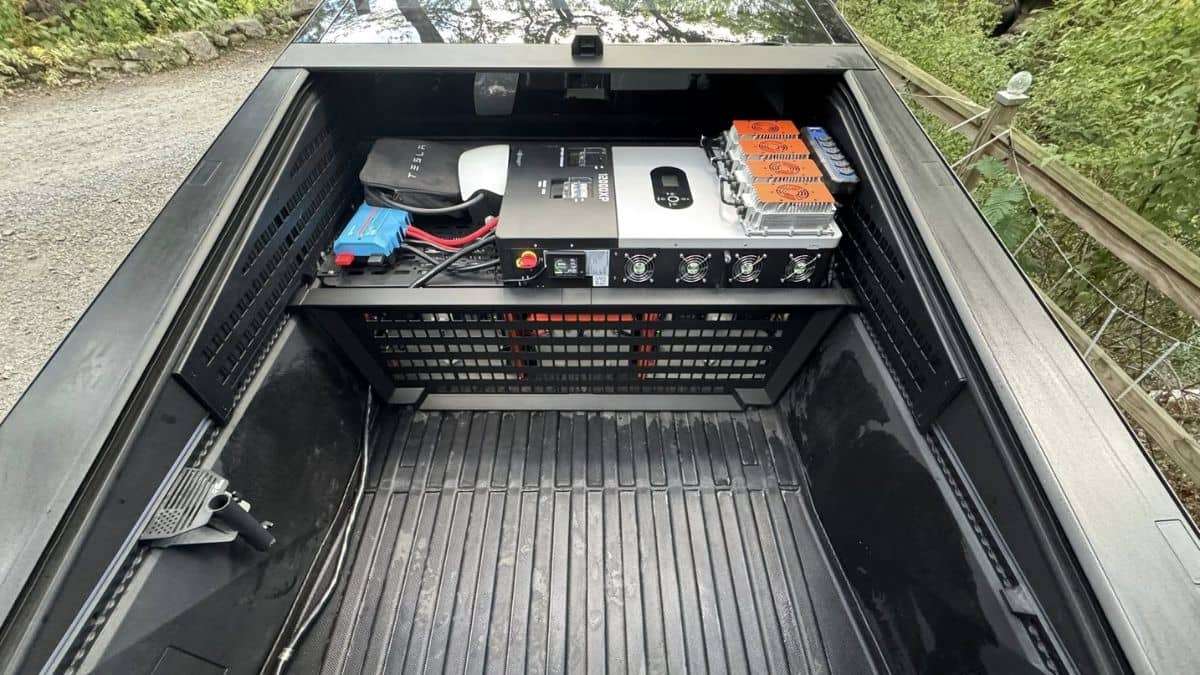

Every once in a while you stumble across a post in a Facebook group that makes you stop scrolling, tilt your head, and read it twice. Today that happened to me inside the Tesla Cybertruck Owners group. What I found was a story about one Cybertruck owner who decided not to wait for Tesla to solve his problem with the range extender. Instead, he went into his garage, spent four months experimenting with cables, inverters, and chargers, and came out the other side with something Tesla refused to sell him: a working range extender. And not just a prototype or a gimmick, but a system that actually gives him nearly 100 miles of additional driving range. That got my attention, and I think it will get yours too.
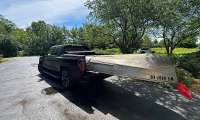
“Tesla wouldn’t sell me a range extender… so I built my own for my Cybertruck! 40kw gives me just short of 100 miles of extra range. Charging at 48amps to the truck. I can recharge the range extender via: Tesla wall charger, Cybertruck Outlets, Solar up to 24kw, Old school generator from 1kw to 18kw (gas and propane), Household outlets 110v or 220v from 1kw to 18kw. Took me 4 months to perfect the combination of inverters, chargers, batteries, and cables. The total cost of parts for the Cybertruck range extender was around $11k, and I can completely uninstall it myself in less than 45 minutes. Zero impact on my Warranty. I’m thinking of making a YouTube video of how I did it to help others build their own. Next project is to build a range extender for the Model 3 and Model Y - should be much easier and cheaper (3k - 6k) for similar mileage. What you guys think?”
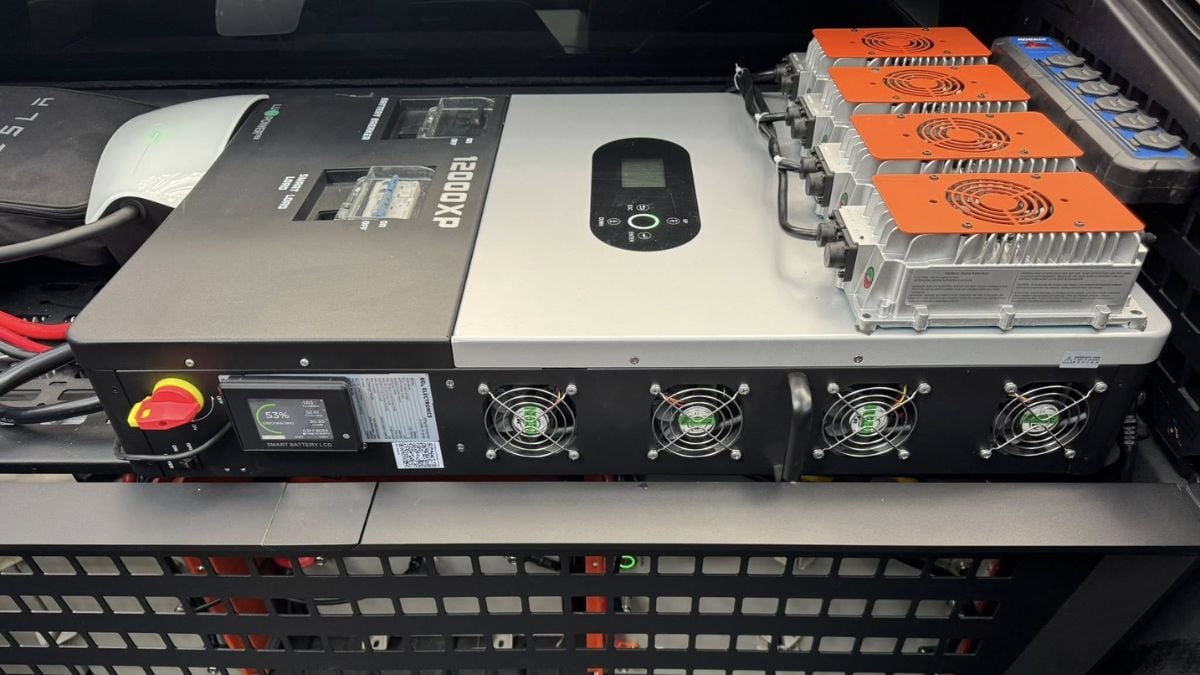
That’s Neil Dillingham, and he’s the Cybertruck owner behind the project, who posted his story on his Facebook page. His post stirred up a lot of conversation because it strikes right at the heart of a bigger issue. Tesla teased its own official Cybertruck range extender pack, but when it came time to offer it, many owners realized they couldn’t actually get one. Some people even felt blindsided when Tesla removed features they expected would make their six-figure truck more useful, as I explained in a piece on how Tesla just removed one feature that sold me the Cybertruck and I wouldn’t have bought a 100k truck without it. Neil’s project feels like a response to that kind of unchecked corporate decision making.
When you dig into what he built, the details become even more intriguing. His system charges at 48 amps into the Cybertruck, can pull energy from multiple sources, and packs 40 kilowatt-hours of capacity. That is no small project. He says it adds almost 100 miles of range, which is a number you cannot ignore, especially if you are someone who tows or travels outside the Supercharger bubble. Neil said the total cost was about $11,000 in parts, which is a serious investment, but he also emphasized that the entire unit can be removed in less than 45 minutes, leaving no trace and, as he claims, no impact on his warranty.
Jason Owen jumped in with a very practical question: “Can you charge the truck while on the go? If so, how did you connect it?” Neil replied, “No I have to charge when parked (for now).” Another group member added, “I hope to see you or someone build something to tie in for charging on the move.” That’s the dream, right? Imagine a Cybertruck sipping extra miles while rolling down the highway. That would put it into a whole new category of capability.
Adam Drover summed up what many of us were thinking when he wrote, “I am super impressed but if it charged while driving would be awesome. Tesla should allow it.” That comment shines a light on something Tesla may not want to confront. Owners are hungry for more range, more flexibility, and they are willing to spend their own money to solve it. Tesla’s official pack was supposed to give the truck up to 470 miles of range, as we discussed in a deep dive into the Cybertruck range extender and how it works. But here’s Neil, doing it in his garage without waiting for permission.
And it gets better. Arnold Gregorio asked the obvious technical question: “How much impact did the additional weight affect the kWh/mi?” Neil’s response was surprising. “I’m shocked to report that after more than 2000 miles it’s made no noticeable difference. I suspect it’s because I don’t typically drive above 70mph and I drive it conservatively. I travel 70 miles a day to and from work.” Think about that. Here is a guy adding a massive pack, hauling it around every day, and he doesn’t see a penalty in efficiency. That is not what many of us would expect.
Why Is The Tesla Cybertruck Range Extender Useful At Such a High Cost?
Of course, not everyone in the group was convinced this was worth the money. A member named Dags TK questioned the value, writing, “Superchargers are basically everywhere, cost is very minor compared to $11k. To gain 100 miles on a supercharger is 10-20 mins. I do not get the value in this at all.” That’s a fair point if you live in a region where chargers are dense and you rarely leave the beaten path. But another member countered that usefulness depends on how you use the truck. If you tow, or if you go into remote areas where chargers do not exist, then the extra 100 miles can make the difference between completing a trip or turning around.
I know this feeling personally because I recently wrote about someone who strapped a gas-powered generator into their Cybertruck bed to create the first hybrid Tesla Cybertruck. That solution was less elegant but it speaks to the same underlying need. People want range security, and they are willing to get creative.
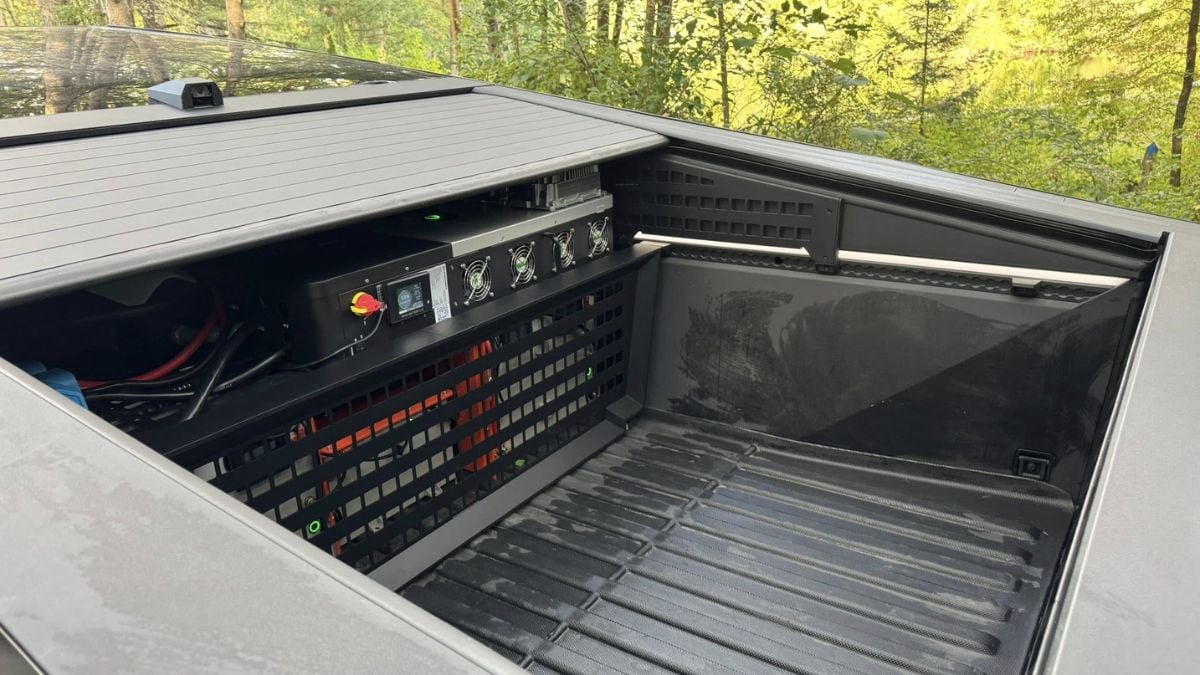
Another member, Aaron Eastman, added his voice: “Great idea, but if I’m not mistaken this cannot add kwh while driving? Only when parked can you use the pack to charge the Cybertruck pack?” Neil responded with a technical teaser: “Correct, until I find out how to connect to the main pack via the inductive charging port or the auxiliary battery ports, I’m looking for anyone who can give me advice here, maybe I could even do away with the inverter if either of those ports will accept 48v.” That is the spirit of innovation right there. He is already thinking about version two.
What makes this story even more compelling is the broader context. Tesla sold the Cybertruck as the ultimate adventure EV, but many buyers have since realized the range is not enough when towing or traveling in remote areas. One owner even shared how Tesla killed his plans to pull an RV because the Cybertruck simply doesn’t have enough range, leading him to sell the truck altogether. That story mirrors the same frustration Neil set out to solve, only he did not give up. He rolled up his sleeves and found a way to extend the dream.
Tesla Doesn't Offer a Range Extender for The Cybertruck
Here’s the part where we need to pause and think about the ethics of all this. Tesla does not offer this accessory. Owners like Neil are building them in their garages. Should Tesla be the gatekeeper of what we can or cannot add to our trucks? Or should a community of tinkerers be encouraged to innovate, especially when they are solving real problems? Commercializing a DIY range extender could raise safety concerns, liability questions, and even regulatory hurdles. Yet the underlying need is clear. People do not feel secure with the existing range, and they are finding ways to fix it themselves.
There is also a moral lesson here. Neil spent his own time and money to solve a problem not just for himself but potentially for other owners. He is even considering making a YouTube video so others can learn. That is generosity in action. It reminds us that progress often happens because individuals share their knowledge rather than keeping it locked away. As readers and as a community, maybe the takeaway is to be more willing to share what we learn, to help others solve problems rather than keeping our solutions to ourselves.
Some people will say this is a waste of money, others will say it is a brilliant idea. Both can be true depending on your circumstances. If you live near Superchargers and rarely go off grid, you will see little value. If you tow, work in remote areas, or want the flexibility to camp without range anxiety, then an extra 100 miles can be priceless. That is why Neil’s project resonates so strongly. It challenges the assumption that Tesla alone decides what the Cybertruck can and cannot do. Owners are finding ways to extend the truck’s usefulness in ways that are surprisingly pleasant and practical.
How the Tesla Cybertruck Range Extender Impacts Towing Capacity
One of the biggest questions prospective owners have is whether the Cybertruck’s range extender makes towing practical. Towing with an EV often slashes range in half or worse, depending on trailer weight, speed, and terrain. Tesla’s optional range extender is designed to address this issue by adding substantial battery capacity for long-haul towing. According to Tesla’s own estimates, the extender can bring total range up to around 470 miles in certain configurations, making towing with the Cybertruck far more realistic than with a standard battery setup.
Still, it’s important to note that towing efficiency will depend heavily on conditions. Hauling a large camper up mountain passes is very different from towing a small boat across flat highways. Buyers interested in real-world Cybertruck towing performance will need to weigh the extender’s benefits against added weight, cost, and installation logistics. This is why terms like “Tesla Cybertruck towing with range extender” are already climbing in search popularity among EV shoppers.
Tesla Cybertruck Range Extender vs. Aftermarket EV Battery Upgrades
Another area readers are curious about is whether aftermarket EV battery upgrades can compete with Tesla’s official range extender. Historically, EV owners who wanted more range often had to rely on third-party solutions, though these frequently void warranties or require custom modifications. With the Cybertruck, Tesla is offering an integrated system that not only boosts range but also maintains vehicle compatibility and warranty coverage. That’s a huge distinction.
For shoppers, the key comparison comes down to cost, convenience, and peace of mind. While third-party solutions might offer more flexibility, Tesla’s own extender is likely to retain resale value and avoid compatibility headaches. Many are already searching for “Cybertruck aftermarket battery vs Tesla extender” to weigh whether Tesla’s solution is worth the investment. In most cases, sticking with the manufacturer option provides stronger long-term benefits, especially for an all-new vehicle platform like the Cybertruck.
Charging the Tesla Cybertruck with a Range Extender Installed
A lesser-discussed but practical concern is how the range extender affects charging times and compatibility with Tesla’s Supercharger network. Adding significant battery capacity can increase total charging time, which means long road trips could take longer despite the extra range. Owners will want to understand whether charging the Cybertruck with a range extender will require special steps, or if it integrates seamlessly with existing infrastructure.
Tesla has suggested the extender is removable, meaning it may not always be necessary to keep it installed for daily driving. This flexibility could help owners avoid longer charging sessions when not needed. Searching for “charging Tesla Cybertruck with range extender” will only grow as early adopters begin to share their firsthand experiences. The big question will be whether Tesla has optimized software and Supercharger management to handle the extender smoothly, or if owners will need to adapt their charging habits.
So now I want to hear from you. Do you think Neil’s Cybertruck range extender is a smart investment or an overbuilt solution to a problem Superchargers already solved? And if Tesla offered an official range extender at a similar price, would you trust their version more, or do you admire the DIY approach? Share your thoughts and your personal experiences in the comments below.
Armen Hareyan is the founder and Editor-in-Chief of Torque News. He founded TorqueNews.com in 2010, which since then has been publishing expert news and analysis about the automotive industry. He can be reached at Torque News Twitter, Facebook, Linkedin, and Youtube. He has more than a decade of expertise in the automotive industry with a special interest in Tesla and electric vehicles.
Images by Neil Dillingham
Set Torque News as Preferred Source on Google
Follow us today...





Comments
Should have it run on…
Permalink
Should have it run on renewable biofuel. Ethanol or biodiesel/renewable diesel
Neil should definitely make…
Permalink
Neil should definitely make that YouTube Video on how he built the range extender. I believe there would be interest from people who other Tesla owners as well as people who convert ICE Vehicles to EV.
Ok I like the idea, if you…
Permalink
In reply to Neil should definitely make… by Allan Bowers (not verified)
Ok I like the idea, if you want to figure out how to make it work while driving. Get ahold of an older BMW I3 Rex. I owned one for 4 yrs it got100 miles of range but the extender gave you 70 miles from 2 gallon gas tank to run the geni. You could come tinually get gas to keep going also. If you could get a say 2014 and get into it to see how they made it work while driving you might be in business. Also the I3 would switch to the geni like once a few weeks for 10 min or so to make sure it is in working order. Good car but at the time it definitely needed te REX. Good luck
Its on You tube - Search for…
Permalink
In reply to Neil should definitely make… by Allan Bowers (not verified)
Its on You tube - Search for "Home made Tesla Cybertruck Range extender (and total home backup)"
The diesel upgrade on most…
Permalink
The diesel upgrade on most ICE trucks costs less and nets a lot more range! My 19 year old ram has over 500 mile range.
Wait let me get this…
Permalink
In reply to The diesel upgrade on most… by Mark Geelan (not verified)
Wait let me get this straight you spend $100,000 for a Tesla cyber truck. You wind up towing less and get a shorter range and we don't have an infrastructure where you can charge them as much as you have an infrastructure to fill up any traditional truck. And this truck has more problems than any ice truck in the market. Oh and you put a range of standard in the back where you should be putting cargo not to range extenders.
WHY???
THIS TRUCK IS A GIMMICK. IT IS A COOL TRUCK BUT IT'S A GIMMICK. BE HONEST WITH YOURSELF.
Tesla makes some great cars but this truck is a joke. They're using the market to test the gimmick..
It is not a real truck. So many people who have reviewed this truck and try to use it like a real truck have given up. There's someone in our area that uses it like a contractor and he went back to his Ford 250. It's ridiculous. People are driving these around as big fancy show off vehicles and not as an actual truck. Tessa needs a wake up and actually make a truck like they make their model 3. Affordable sensible but for the love of God please put buttons inside of your truck. You shouldn't have to use your phone just to use your vehicle..
If anyone who wants to argue about the details of towing and range....
3/4-Ton (F-250, Ram 2500, Silverado 2500HD): 550–750 miles
1-Ton (F-350, Ram 3500, Silverado 3500HD): 500–750 miles
Tesla Cybertruck (11,000 lbs towing) tows **less** than all listed trucks. Less by 9,000–11,000 lbs for 3/4-ton (20,000–22,000 lbs max); 25,000–29,000 lbs for 1-ton (36,000–40,000 lbs max).
You can have to test those cybertruck could tow more you have extreme drop in range when carrying pillows and towing. Then you have to figure out where you're going to possibly recharge and then you have to sit longer to refuel.
This is completely unreasonable for RV towing, planning your work trips when you need to haul loads etc.
Oh wait that's right no one with a real business is using this as a truck because it doesn't make any sense we're not there yet..
Looks great Tesla should…
Permalink
Looks great Tesla should hire you!
Why is it needed? Tesla…
Permalink
Why is it needed? Tesla charging system of Superchargers makes travel easy. Charging faster in my M3LR might come in handy but stopping every 3 hours or so is almost a necessity.
The 'need' question is…
Permalink
In reply to Why is it needed? Tesla… by Kurt Wolters (not verified)
The 'need' question is irrelevant, as the stuff I need will hardly correspond to even half the owner subset. I admit it - the range extender tipped the scales when I made the decision 2 years in advance to buy the most expensive vehicle I've ever owned. I make routine trips in excess of 400 miles, and rarely stop other than for bodily necessities.
Range anxiety is the #1 reason for slow EV sales. #2 is lagging infrastructure buildout.
But foremost is the fact that, even with 3rd party chargers, there are dead-spots in the charging network map. If you NEED to go through or have destinations in those areas, you must plan accordingly.
Car route planning for charging purposes is excellent, but in high EV ownership areas, you could still wait for a charging slot.
So, sure. As long as you never go anywhere, you personally don't need one. For the rest of us, well, we do. And a significant fraction of us solve problems on our own.
Most important question, how…
Permalink
Most important question, how do you interface with the truck ? You can’t drive while plugged in, so… ?
How much does it weigh, what…
Permalink
How much does it weigh, what's the reduced regular range and payload rating with it installed?
So, how many miles per…
Permalink
So, how many miles per kilowatt dollar?
Pro tip, just add another…
Permalink
Pro tip, just add another easy fast charging stop or take a 30 mph back way and have like 600 miles of range.
This is awesome but that’s…
Permalink
This is awesome but that’s the exact sweet spot where water comes thru the tonneau. I hope everything is waterproof.
Technically true, but this…
Permalink
In reply to This is awesome but that’s… by Stefan De La Rosa (not verified)
Technically true, but this is also an easily corrected service issue. I have already had it addressed at my first service session.
Imagine having to do this…
Permalink
Imagine having to do this because the car manufacturer bailed on a promised range extender.
You're going to damage your…
Permalink
You're going to damage your EVs onboard charger by using that low cost high frequency transformerless inverter. It doesn't offer any galvanic isolation between its DC boost stage and its AC output, so when its MOSFETs fail, it will pass high amperage DC current through to its AC output and will fry your Tesla's onboard charger.
What more u need to know…
Permalink
What more u need to know this thing is a POS?
11K? Yikes, bless your heart…
Permalink
11K? Yikes, bless your heart. The truth is that there are many small technologies that can be added to EVs to reduce the amount of energy they use. But range extenders are one of the most useless add ons that I can think of. Make it more efficient, not less.
Cyber truck douchebag eat a…
Permalink
Cyber truck douchebag eat a bag of dicks
All this speculation about…
Permalink
All this speculation about the range extender is quite funny. I know the real rain why tesla canned the project and it's for safety and serviceability reasons. This homemade range extender seems cool but it can't make a handshake with a supercharger so really, it is moot but a fancy expensive option to extend your range maybe 70 miles in the winter.
No affect on warranty until…
Permalink
No affect on warranty until Tesla realizes what you're doing and says haha unauthorized modification, your warranty is now void and we are locking you out of your car because we feel it is unsafe. Brought to you by the same people who said you shouldn't put your truck through a car wash.
What is with this article? …
Permalink
What is with this article? It's worded as if a range extender from Tesla is actually a thing that exists. Wtf?
Math ain't mathing bro…
Permalink
Math ain't mathing bro. Cyberjunk gets 2 miles/kwH so 40 kwH nets you 80 extra miles TOPS without even accounting for the added weight. You're almost as big of a liar as Elon/Tesla.
Why not dc charge and avoid…
Permalink
Why not dc charge and avoid the inverter?