
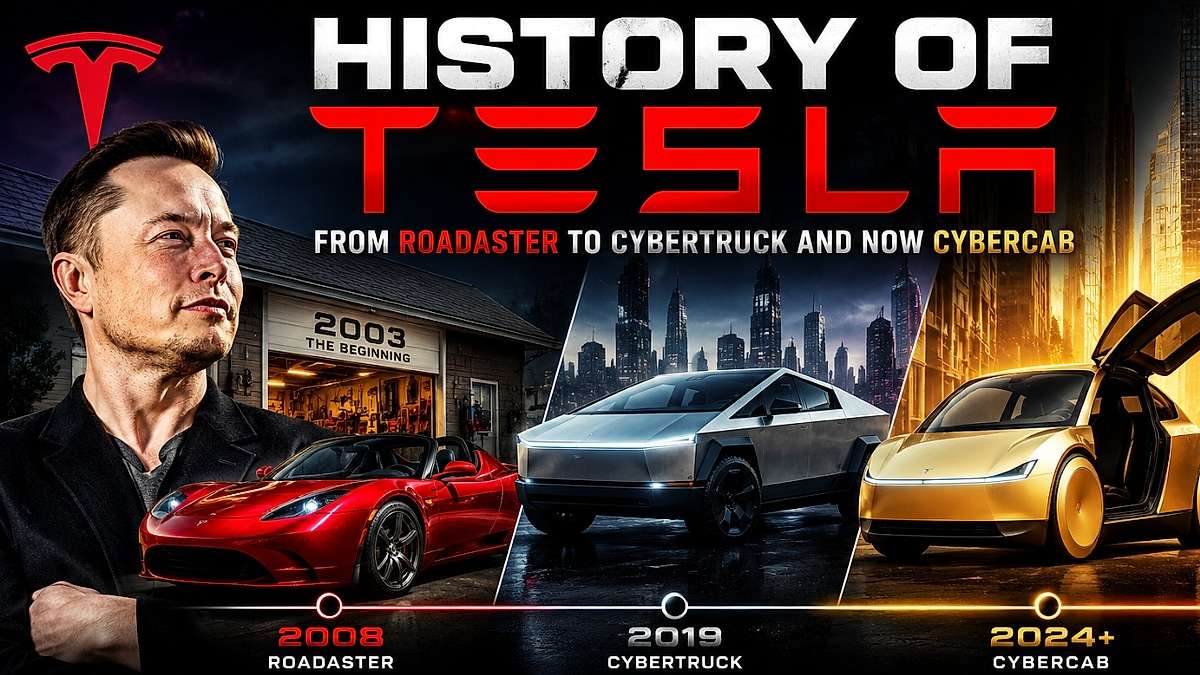

Let me tell you a story about the most disruptive company in automotive history. It starts with two engineers in a garage, a Christmas Eve miracle, and an idea that every major automaker laughed at. And it ends, at least for now, in a world where a car has no steering wheel and nobody is sitting in the driver seat. Buckle up.
Back in 2003, the idea of building a successful electric car company from scratch was, to put it politely, considered crazy. The auto industry had been running on gasoline for a century. Billions of dollars of infrastructure, engineering expertise, and manufacturing know-how were all pointed in one direction. Electric vehicles? People remembered the General Motors EV1, recalled and crushed, and moved on.
But two engineers named Martin Eberhard and Marc Tarpenning saw something everyone else missed: lithium-ion battery technology, the same cells charging your laptop, was finally good enough to power a real car. They founded Tesla Motors in San Carlos, California, and the rest, as they say, is a wild ride. If you want to understand how deeply unusual this company's trajectory really is, take a look at what actually changed when Tesla entered the game and how it compares to the historical rise of gasoline. History, it turns out, really does repeat itself in the strangest ways.
Elon Musk Shows Up, and Everything Gets Bigger and Riskier
Enter Elon Musk. Fresh off cashing out from the PayPal sale, Musk provided crucial early funding and eventually took over as CEO, infusing Tesla with a philosophy that can best be described as: aim for the impossible, then figure out how to make it happen. Tesla's opening move was not a mass-market family car. No, they went in the opposite direction entirely. They built the original 2008 Tesla Roadster, a low-volume sports car built on a modified Lotus Elise chassis. Think of it as a proof of concept wrapped in a beautiful body.
And the Roadster nearly killed the company before it could prove anything. Production delays stacked up. Development costs ballooned. The transmission had to be fundamentally redesigned. By late 2008, with a global financial crisis raging, Tesla was weeks away from bankruptcy. The company was saved, literally, by a forty-million-dollar emergency investment that landed on Christmas Eve. That is not a metaphor. That is what actually happened. When the Roadster finally reached customers, it did what Tesla needed it to do: it proved that an electric car could sprint from zero to sixty miles per hour in under four seconds, look stunning, and travel more than two hundred miles on a single charge. The true story of how the Roadster changed perceptions and set Tesla on its long road toward changing the entire automotive game is something every car enthusiast should understand, because without that early gamble, none of what followed happens.
The Master Plan Was Always About Volume, Not Glamour
Here is something that gets lost in all the Elon Musk drama: the strategy was written down in 2006 and it was elegant in its simplicity. Build a sports car. Use that money to build an affordable car. Use that to build an even more affordable car. Provide zero-emission energy options along the way. The Roadster was step one. Step two was the Model S, and step two changed everything.
In 2012, Tesla dropped what many automotive historians will look back on as one of the most consequential cars ever built. The Model S was engineered entirely from scratch. Tesla designed it around a flat battery pack running the full length of the floor, what they called the "skateboard" platform, giving the car an incredibly low center of gravity and freeing up enormous interior space. But the real revolution was not the engineering. It was the software. The Model S was a computer on wheels. It could receive over-the-air updates that improved performance, added features, and fixed problems while the car sat in your driveway. The full history of how the Model S evolved from its debut to becoming one of the most decorated cars in automotive history is a story worth knowing, especially now that the Model S is winding down production after 13 remarkable years.
The mainstream automotive press was floored. MotorTrend named the Model S its 2013 Car of the Year by unanimous vote, and years later went further, naming it the Ultimate Car of the Year across the entire history of the award. MotorTrend wrote at the time that "no vehicle we've awarded can equal the impact, performance, and engineering excellence" of the Model S. That is not praise for an electric car. That is praise for the best car, full stop. The traditional auto industry had been caught completely flat-footed.
Someone was so committed to preserving the significance of that moment that they spent $17,000 restoring one of the very first nine Model S cars ever built, then drove it 600 miles from Austin to watch a Starship launch. That remarkable story of early Tesla preservation and what it tells us about how quickly automotive history is being made is a reminder that we are living through something genuinely historic, and it is moving faster than most people realize.
Production Hell: The Dark Years That Almost Ended Everything
Tesla followed the Model S with the Model X SUV in 2015, those iconic falcon-wing doors and all, but the real challenge was coming. In 2016, Musk announced the Model 3, a mass-market sedan with a starting price that finally brought Tesla within reach of mainstream buyers. Four hundred thousand reservations flooded in within weeks. The world was ready.
What the world was not ready for was the chaos of actually building those cars. Tesla entered what Musk publicly called "Production Hell" between 2017 and 2019. In trying to build a hyper-automated factory, Tesla actually automated things that robots were not yet capable of handling reliably. Assembly lines jammed. The Gigafactory in Nevada bottlenecked. The company burned through billions of dollars. Engineers slept on factory floors. An entire backup assembly line had to be built under a tent in the Fremont parking lot just to keep output going. The behind-the-scenes story of Tesla going from Production Hell straight into Logistics Hell during the Model 3 crisis gives you a real sense of how close this company came to imploding, not once but multiple times.
The lesson Tesla learned the hard way during Production Hell is one that applies to any serious endeavor in life: technology alone cannot replace human judgment. You have to find the balance. Tesla did. They restructured the manufacturing process, leaned back on skilled human workers where robots failed, and eventually got the Model 3 into customers' hands at scale.
The Model Y Changes the Game Worldwide
Using the Model 3 platform as a foundation, Tesla launched the Model Y crossover in 2020. The timing was almost perfect. The company had quietly built a global network of Gigafactories in Shanghai, Berlin, and Austin, Texas, and was ramping production across all of them simultaneously. What happened next genuinely shocked the automotive world. The Tesla Model Y became the best-selling car on Earth, not just the best-selling EV, but the best-selling vehicle of any kind, gas or electric, a milestone many industry analysts said was impossible for an electric vehicle to reach this quickly.
The Supercharger network, Tesla's proprietary fast-charging infrastructure now spanning more than 7,900 stations and 75,000 connectors worldwide, gave Tesla owners a reliable road-trip capability that most other EVs simply could not match. That network, combined with the Model Y's practical crossover design, long range, and seamless software integration, made it a genuinely compelling choice for millions of mainstream buyers. Tesla had won the volume war. The master plan, all four steps of it, was essentially complete.
So here is the question that changes the whole story: what do you do when you have already won?
The Cybertruck: Art, Engineering Risk, or Both?
In November 2019, Tesla answered that question with the most polarizing vehicle reveal in automotive history. The Cybertruck, unveiled at Tesla's design center in Los Angeles, looked less like a pickup truck and more like someone had imported a vehicle from a parallel universe. Angular, brutalist, made of cold-rolled stainless steel that could not be painted in any conventional way. During the live reveal, the armor glass that was supposed to resist a steel ball was thrown at the window and cracked. It was not a great moment.
Four years later, deliveries finally started in late 2023. The Cybertruck is, from an engineering perspective, genuinely remarkable. It introduced a 48-volt electrical architecture that replaced miles of heavy traditional wiring. It used steer-by-wire mechanics, meaning there is no physical connection between the steering wheel and the front wheels. It is a structural exoskeleton vehicle, meaning the body is the frame. But that same stainless steel that makes it visually arresting is an industrial nightmare to manufacture. It resists bending, dulls stamping dies, and shows every microscopic panel gap misalignment.
What happens when a Tesla Cybertruck owner discovers that Full Self-Driving can handle a highway but absolutely cannot handle a flock of wild turkeys blocking a narrow dirt road is actually a fascinating window into where autonomous technology stands right now: impressive, but still wrestling with the unpredictable messiness of the real world. And that tension is at the center of everything Tesla is betting on next.
The Pivot: Tesla Is No Longer Just a Car Company
Here is where the story gets either very exciting or very uncertain, depending on your perspective. By the mid-2020s, Tesla had begun deliberately shifting its identity. The company was no longer primarily positioning itself as an automaker. It was positioning itself as an artificial intelligence and robotics company that also happens to make cars. The pivot became unmistakable with the announcement of the Cybercab, a two-seat robotaxi designed with no steering wheel and no pedals at all.
At Gigafactory Texas, production of the Cybercab began in 2026. The vehicle runs entirely on Tesla's vision-only Full Self-Driving system, which uses cameras and neural networks trained on billions of miles of real-world driving data. No radar. No lidar. Just cameras and software, which is either an insanely elegant solution or an insanely risky one, depending on which engineers you ask. The story of Tesla's autonomous Cybercab getting into its first minor accident while on display at the Petersen Automotive Museum raises exactly the questions the industry is wrestling with: who is responsible when a car with no driver makes a mistake?
The economics of the Cybercab are central to Tesla's entire autonomous vision. Tesla has been working on getting the cost of the Cybercab down to around $15,000 through unibody construction, software-driven functionality, and manufacturing efficiencies, which would make it one of the most affordable vehicles on the market while simultaneously serving as the hardware backbone of a nationwide robotaxi network. Whether that math actually works at scale is the defining question of Tesla's next chapter.
What This Story Actually Teaches You
Here is the moral of Tesla's history, and I mean this sincerely because it applies far beyond the automotive world. Tesla did not succeed because Elon Musk is some kind of genius who cannot make mistakes. Tesla succeeded because the founding vision was genuinely honest: build something that is objectively better for people, accept that the path there will be brutal, and keep moving anyway.
Every time Tesla faced a crisis, from the Christmas Eve bailout to Production Hell to Cybertruck panel gaps, the company survived by choosing to keep learning over choosing to protect its pride. That is a mindset worth carrying into your own decisions. The biggest mistake most people make, in buying a car, starting a business, or choosing a career path, is letting the sunk cost of past choices prevent them from adapting. Tesla kept adapting. The question for the company now is whether it can keep adapting fast enough as competition from BYD, Rivian, and established automakers intensifies. And the question for you is whether you are applying that same honest, adaptive approach to the big decisions in your own life.
Now I want to hear from you, and your experience matters here.
Do you believe Tesla's all-in bet on vision-only Full Self-Driving, with no radar and no lidar, is the right approach to achieving true autonomous driving, or do you think the company is taking a risk that could seriously undermine its robotaxi ambitions? Share your thoughts in the comments section below.
And here is a more personal question: if you could go back and buy one specific Tesla model from any point in the company's history, whether that's the original Roadster, an early Model S, the first Model 3, or something else entirely, which would it be and why? Tell us about it in the comments.
About The Author
Armen Hareyan is the founder and Editor-in-Chief of Torque News and an automotive journalist with over 15 years of experience writing car reviews and industry news. Now based in the Charlotte region (Indian Land, SC, he founded Torque News in 2010, which since then has been publishing expert news and analysis about the automotive industry. He can be reached at Torque News on X, Linkedin, Facebook, and Youtube. Armen holds three Masters Degrees, including an MBA, and has become one of the known voices in the industry, specializing in the landscape of electric vehicles and real-world stories of actual car owners. Armen focuses on providing readers with transparent, data-backed analysis bridging the gap of complex engineering and car buyer practicality. Armen frequently participates in automotive events throughout the United States, national and local car reveals and personally test-drives new vehicles every week. Armen has also been published as an automotive expert in publications like the Transit Tomorrow, discussing how will autonomous vehicles reshape the supply chain, and emerging technologies in vehicle maintenance.
Set Torque News as Preferred Source on Google
Follow us today...






