
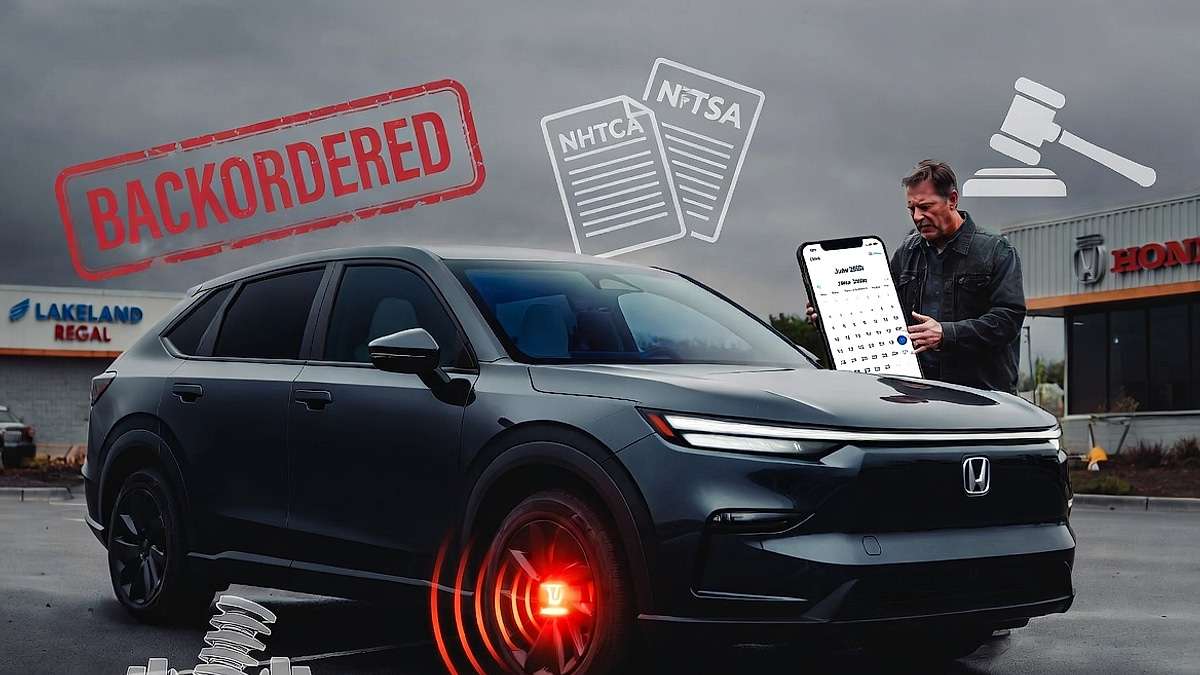

If you have been reading our ongoing coverage of Honda Prologue reliability problems reported by real owners in Facebook groups and comment sections, you already know the pattern. Someone buys the car with high hopes, something clicks or clunks or fails, and then the real story begins, which is not a story about the car itself but about what happens when you try to get it fixed. A Torque News reader who goes by the name PT left a comment under reporter Aram Krajekian's recent article about Honda Prologue frustrations, and this comment stopped me cold. Not because it is unusual, but because it is so thoroughly documented, so painfully specific, and so perfectly illustrative of a system that is failing the very customers it is supposed to serve. PT gave us permission to share the full account, and I want you to read every word of it.
PT's Full Account, As He Wrote It
"Shortly after purchasing my new Honda vehicle in June 2024, I identified a distinct clicking or thumping sound originating from the steering mechanism during wheel rotation. This anomaly was immediately reported to Lakeland Regal Honda's service department. During my initial visit, a service technician confirmed the issue, attributing it to a specific component. I was informed of a parts unavailability and assured that I would be notified upon the arrival of the necessary replacement. This notification was never received, and the issue continued.
A subsequent visit to the same dealership later in 2024 resulted in the service department acknowledging the persistent problem, noting it as a recurring concern among several customers. I was advised that the component, believed to be part of the axle assembly, was on backorder, awaiting a factory shipment from Honda. Despite assurances of a follow-up, no further communication was provided.
The issue remains unaddressed as of April 8, 2026, nearly two years following its initial report. A recent inquiry to Lakeland Regal Honda resulted in the dealership stating they were no longer authorized to source the required parts for this specific defect and directed me to Honda corporate services. This redirection was particularly concerning, given that I had previously engaged Honda corporate regarding this matter, only to receive a similar response about parts being on backorder with a promise of contact, which never materialized. On April 8, 2026, I re-contacted Honda corporate, where a representative initiated a case and assured me of escalation to a specialist. To date, however, I have not received a substantive resolution or a clear timeline for the repair.
This persistent defect significantly compromises my confidence in the vehicle's operational reliability and raises questions regarding the expected durability and post-purchase support for a new Honda product. It is particularly troubling in light of public information, specifically a class action lawsuit alleging a serious safety risk associated with defective front drive axles in 2024 to 2026 Honda Prologue vehicles. I have also filed a formal complaint with the National Highway Traffic Safety Administration (NHTSA) and a complaint with the Federal Trade Commission (FTC) concerning this matter."
Why This Comment Matters to Every Prologue Owner and Every EV Buyer
Let me tell you what stands out here. PT is not someone venting after a bad day. This is a structured, methodical, almost legal-grade account of a nearly two-year saga of total institutional failure.
The dealership confirmed the problem and promised a follow-up. The follow-up never came, according to him. Honda corporate confirmed the problem and promised escalation. The escalation produced nothing. And now, nearly 24 months after PT first reported that clicking sound, the vehicle is still broken, the parts are still unavailable, and PT has had to file complaints with both the NHTSA and the FTC just to be heard. That is extraordinary, and not in a good way.
Here is something that should concern every Prologue owner reading this right now. The class action lawsuit PT references is real, and it is recent. Filed in the U.S. District Court for the Eastern District of Pennsylvania in early March 2026, the lawsuit alleges that 2024 to 2026 Honda Prologue vehicles are equipped with defective front drive axle assemblies. The lawsuit claims that Honda was aware of the defect and that the company has been unable to provide a genuine fix, allegedly replacing defective axles with the same defective components. Plaintiffs describe the issue as causing impaired propulsion, steering response, and drivability, particularly during low-speed turning maneuvers, and they argue it constitutes a serious safety risk. Carscoops reported that Honda issued a Tech Line to dealerships in December 2025 acknowledging clicking or ratcheting sounds from the drive axles, but instructed dealers not to attempt repairs unless physical damage was visible, effectively telling owners to keep driving a car making noises that the company itself could not fix.
PT's experience fits this pattern with uncomfortable precision. That is not coincidence. That is a systemic defect playing out across a population of owners who trusted the Honda name. And in our coverage of another Prologue owner who spent more than five months in the shop dealing with repeated axle replacements and a wire harness teardown, we saw the same cycle of temporary fixes followed by returning problems, a loop that grinds an owner down emotionally and financially.
The Dealership Accountability Question
There is something specific in PT's account that I want to flag, because it reveals a troubling dynamic in how warranty service works in the EV era. Lakeland Regal Honda, after nearly two years of backorder excuses, told PT they were no longer authorized to source the parts needed for this specific defect. Think about that for a moment. The authorized service facility for a new vehicle under warranty is now pointing the customer to corporate. And corporate is pointing the customer back to the case number and a promise of a specialist who never calls. This is not a service failure. This is a structural failure, the kind that questions about Honda reliability relative to Toyota have been circling for years now, and which becomes especially acute when a complex EV platform is involved.
The Prologue, it must be said, is built on General Motors' Ultium platform. That cross-brand architecture was designed to accelerate Honda's entry into the EV market by leveraging GM's existing investment. As we have reported, some owners feel that decision transferred GM's quality control struggles directly into a car wearing a Honda badge, and the axle defect, which also appeared in related GM Ultium platform vehicles like the Chevrolet Blazer EV, lends weight to that concern.
What PT Did Right, and What You Should Do Too
Here is where PT's story becomes genuinely instructive for any Prologue owner in a similar situation. PT documented everything in writing, escalated to both Honda corporate and the dealership on record, and then took the next logical step of filing formal government complaints. Those are exactly the right moves, and here is why they matter.
When you file an NHTSA complaint about a steering or drivetrain issue on your new EV, you are doing two things simultaneously. You are creating a paper trail that supports your personal legal position, and you are contributing data to a federal database that regulators use to determine when a problem is widespread enough to mandate a recall. The more complaints filed, the stronger the case for a recall. PT filing with the FTC is an additional layer that signals to the manufacturer that the consumer is treating this as a potential violation of consumer protection law, not just a warranty inconvenience. Owners in similar situations, such as a new Pilot Elite buyer who saw warnings ten miles after leaving the dealership, were advised to document everything early and never clear codes themselves, precisely because that documentation becomes critical if things escalate.
If you are a Prologue owner experiencing the same clicking or thumping that PT described, here is what I would tell you based on fifteen years of covering the automotive industry. Do not rely on verbal assurances from any service advisor. Request written repair orders every single visit. Put your complaints to Honda corporate in writing, via email or certified letter, so there is a timestamp. File your NHTSA complaint at nhtsa.gov. And consult a lemon law attorney if you have had three or more repair attempts for the same issue, or if the car has been out of service for a significant cumulative period. Most lemon law consultations are free, and the legal standard for lemon protection has been invoked successfully against Honda before.
The Bigger Picture for the Prologue and for EV Trust
I have been following the Prologue story for a while now, and the truth is that this is not a car without merit. Some owners have reported outstanding efficiency, with one cutting monthly fuel costs by 84% after replacing a Toyota Highlander, and others have praised its ride quality and highway comfort. Even owners who chose the Prologue over the Tesla Model Y reported feeling the Honda was more solidly assembled, if less technologically advanced. The problem is not the concept of the Prologue. The problem is what happens when the concept meets a mechanical defect that the manufacturer cannot fix, and a service system that has no answer to give the customer who keeps showing up.
A 2025 Prologue owner reported a frightening sudden loss of control crash at just 4,500 miles and wondered whether faulty suspension or control arm issues played a role, and that incident underscores why an unresolved axle defect is not a minor annoyance. These are drivetrain components. They bear load and transmit power. When they deteriorate, the consequences can go well beyond a clicking sound during a slow turn in a parking lot.
A Moral Worth Carrying Beyond This Article
There is something deeper here worth naming. PT did everything a responsible car owner is supposed to do. Reported the problem immediately. Returned for follow-up. Contacted corporate. Gave both the dealership and Honda every reasonable opportunity to make things right. And nearly two years later, the car still clicks. The lesson is not cynicism. The lesson is this: patience and good faith are virtues, but they are not substitutes for documentation and formal action. The most selfless thing a frustrated owner like PT can do is not just protect himself but file those NHTSA and FTC complaints, because doing so protects every other owner of a 2024 to 2026 Prologue who may be driving a car with the same unresolved defect, perhaps without even knowing the problem exists. When you report, you are not just fighting for your own repair. You are building the record that could trigger a recall that keeps someone else safe.
Honda built its reputation over decades on reliability and on being the car brand that does not let you down. The Prologue, in too many of these accounts, is testing that reputation in ways the company needs to take seriously before the legal and regulatory pressure makes the decision for them.
Your Turn
If you own a 2024, 2025, or 2026 Honda Prologue, have you experienced a clicking, thumping, or ratcheting sound from the front axle area, and how did your dealership or Honda corporate respond to your complaint? And for those who are considering the Prologue right now, does a known unresolved axle defect tied to a class action lawsuit change your buying decision, or are the incentives and ownership costs still compelling enough to move forward? Tell us in the comments section below.
About The Author
Armen Hareyan is the founder and Editor-in-Chief of Torque News and an automotive journalist with over 15 years of experience writing car reviews and industry news. Now based in the Charlotte region (Indian Land, SC, he founded Torque News in 2010, which since then has been publishing expert news and analysis about the automotive industry. He can be reached at Torque News on X, Linkedin, Facebook, and Youtube. Armen holds three Masters Degrees, including an MBA, and has become one of the known voices in the industry, specializing in the landscape of electric vehicles and real-world stories of actual car owners. Armen focuses on providing readers with transparent, data-backed analysis bridging the gap of complex engineering and car buyer practicality. Armen frequently participates in automotive events throughout the United States, national and local car reveals and personally test-drives new vehicles every week. Armen has also been published as an automotive expert in publications like the Transit Tomorrow, discussing how will autonomous vehicles reshape the supply chain, and emerging technologies in vehicle maintenance.
Set Torque News as Preferred Source on Google
Follow us today...




Comments
This problem has steered me…
Permalink
This problem has steered me away from potential fantastic deals on used Prologues. Too bad, as it seems like a great design otherwise.