
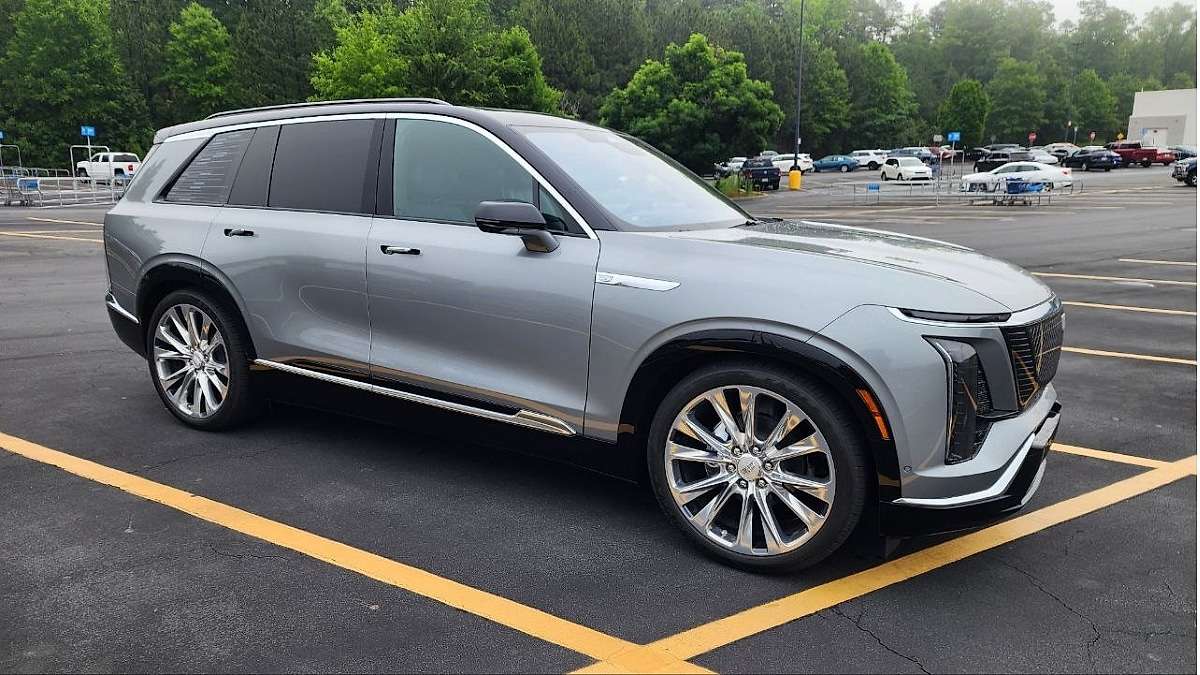

I just spent seven days behind the wheel of the 2026 Cadillac Vistiq Premium Luxury. Seven days of school pickups, a highway road trip south of Charlotte, grocery runs, and one long-haul Saturday drive with the whole family loaded up. And I want to tell you something that most EV reviews miss entirely:
The Vistiq isn't trying to beat Tesla. It's trying to convince a BMW X7 or Lexus TX buyer that they don't need gasoline anymore. I think that's is a completely different assignment, and after a full week, I think Cadillac finally understands it.
The Vistiq is a brand new nameplate for Cadillac, sitting between the two-row Lyriq, which has become critical to Cadillac's all-electric future, and the enormous Escalade IQ whose arrival was a game-changer for the brand's electric strategy. The Vistiq fills a gap those two couldn't fill: three rows of genuine luxury in a footprint that doesn't require a commercial parking space. With commendable power, a legitimate 305-mile range, and an interior that makes you feel like the car was designed around people rather than around a battery pack, this is the most family-focused luxury EV Cadillac has ever built.
What Does the 2026 Cadillac Vistiq Look Like Outside?
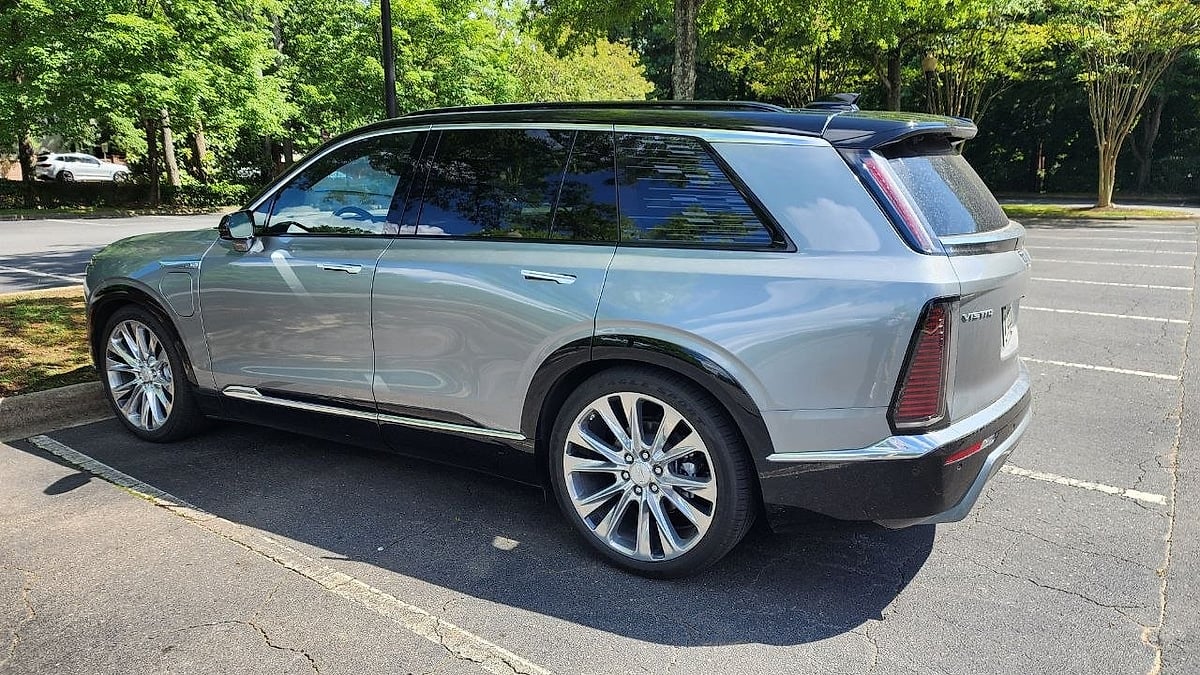
Pull the Vistiq up in a school parking lot and heads turn. This is not the sleek, sloped-back coupe silhouette of the Lyriq. It is a proper, upright three-row SUV, and it wears that shape with confidence. The front end carries Cadillac's signature vertical LED daytime running lights and the largest Black Crystal Shield illuminated grille in the entire Cadillac EV portfolio. At night, the light show is genuinely theatrical without being tacky.
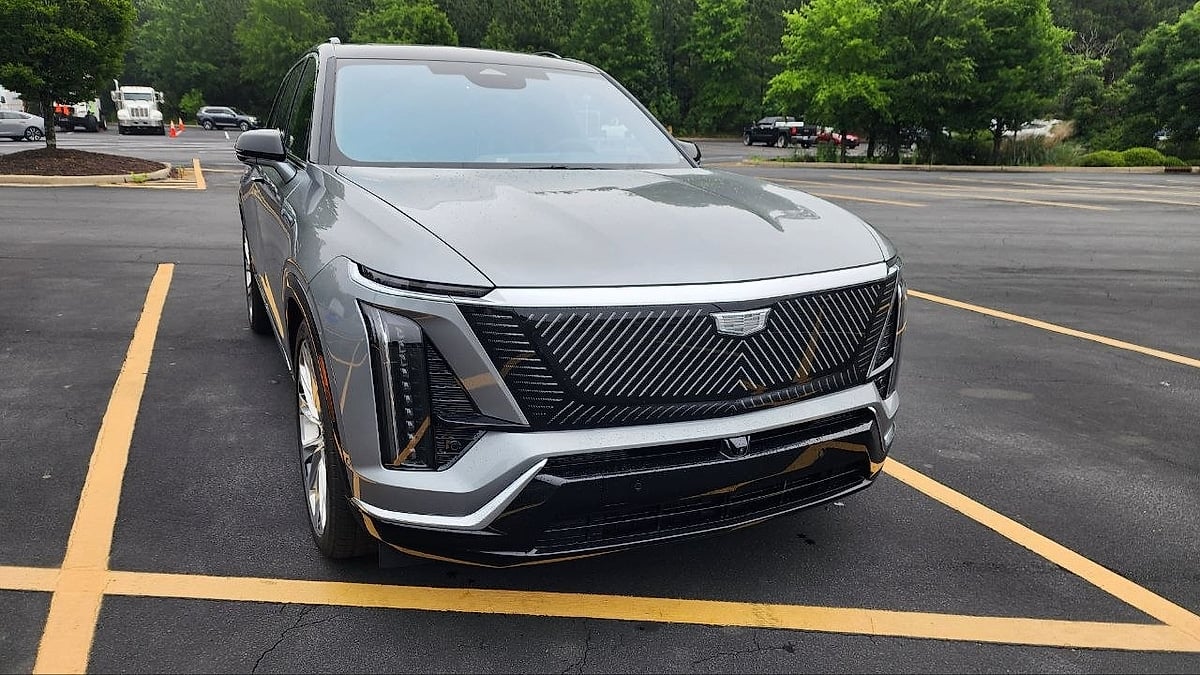
At 205.6 inches long, this is a big vehicle. But Cadillac's designers did something smart: they added sharp character lines along the flanks, standard 21-inch wheels (with 22s and 23s available), and motorized door handles that extend and retract like a luxury watch. The result is a boxy shape that reads as purposeful rather than blobby. Think baby Escalade IQ rather than oversized crossover. If you're coming from an Acura MDX or Infiniti QX60, this exterior will feel like a significant upgrade in presence without crossing into the "I need a football field to park" territory of the full Escalade.
Eight exterior colors are available, including the Cadillac-exclusive Emerald Lake Metallic, which looks absolutely stunning in Charlotte afternoon sun. Panoramic dual-pane sunroofs with a third-row fixed glass panel let light pour into all three rows, which matters more than you'd think when you're convincing a skeptical spouse.
How Is the Interior Cabin Quality and Technology?
Walk inside the Vistiq Premium Luxury and the first word that comes to mind is quiet. Not just acoustically quiet, though it is remarkably hushed at highway speeds, but visually quiet too. Cadillac resisted the urge to stuff every surface with screens and instead created a cabin that feels curated. The centerpiece is a 33-inch curved LED display that spans the driver's gauge cluster and infotainment screen in one elegant arc. Below it sits an 8-inch secondary touchscreen on the center console that handles climate and seating functions, keeping those controls from cluttering the main display.
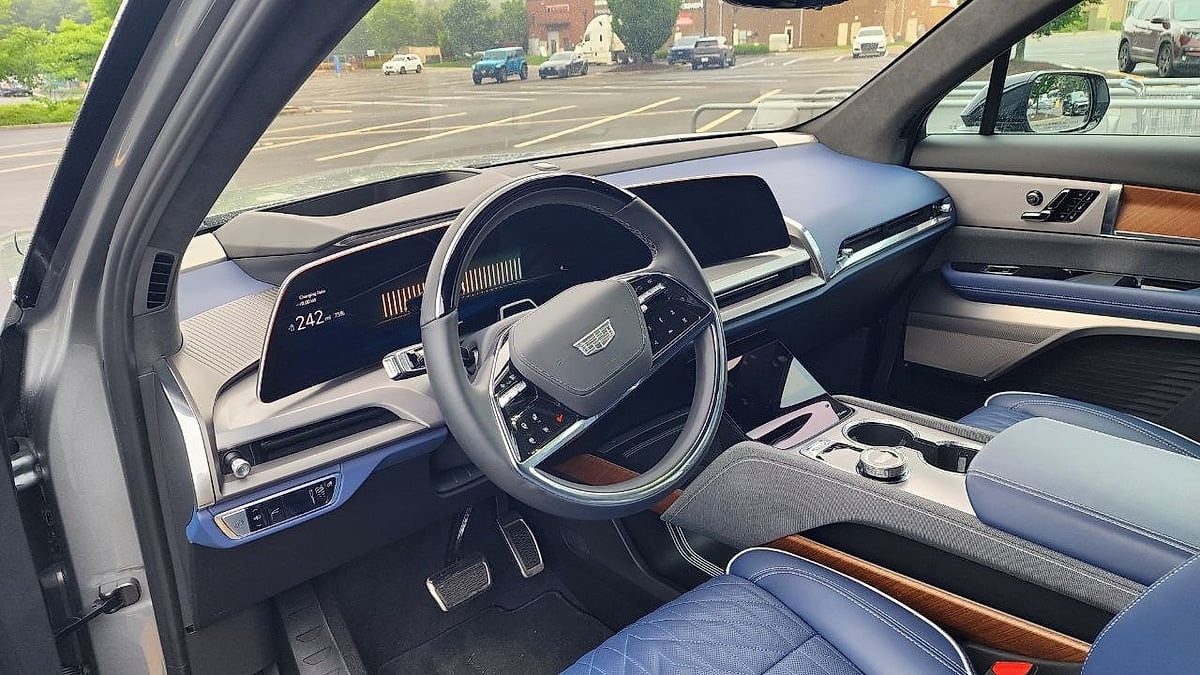
The Premium Luxury trim I tested adds the available Air Ride Adaptive Suspension and rear-wheel steering, which costs roughly $14,500 over the base Luxury trim. It also brings second-row captain's chairs, Night Vision, and the augmented-reality head-up display. That price jump stings, but after driving both versions back to back, I'll say this: the air suspension transforms the ride quality in a way that's immediately noticeable. More on that in a moment. For buyers considering whether the entry Luxury trim is enough, I actually think it may be. The standard equipment list is extraordinarily generous: Super Cruise hands-free highway driving, heated and ventilated front seats with massage, a 23-speaker AKG Studio sound system with Dolby Atmos, five-zone climate control, and Nouveauluxe quilted synthetic upholstery. That 23-speaker AKG system, by the way, is not a checkbox item. It is genuinely excellent.
The Cadillac does not offer Apple CarPlay or Android Auto, relying instead on Google Built-In. I found it easy to navigate and responsive, though buyers migrating from Lexus or Audi should expect a brief adjustment period. The driver assistance tech suite here is class-leading. Super Cruise, which I've been tracking since Cadillac started expanding the system, remains the best hands-free highway driving technology available. It changes lanes automatically to pass slower traffic and requires less driver intervention than any competing system.
How Does the 2026 Cadillac Vistiq Ride and Handle?
This is where the story gets interesting, and where the Vistiq separates itself from pure performance EVs. The powertrain is spectacular on paper: dual electric motors producing 615 horsepower and 650 lb-ft of torque, a 102 kWh Ultium battery, and a 0-60 time of 3.7 seconds in Velocity Max mode, which you activate via a red V button on the steering wheel. Yes, that button is extremely entertaining at highway on-ramps. No, your family won't need to use it to enjoy this vehicle.
In normal driving, the Vistiq feels powerful without feeling aggressive. It is smooth, deliberate, and confidence-inspiring in a way that reminds me of why people buy large luxury SUVs in the first place. You're not trying to feel the road. You're trying to be insulated from it. The Premium Luxury trim's Air Ride Adaptive Suspension delivers precisely that insulation, soaking up Charlotte's patchwork highway surfaces with an ease that impressed me every single day.
The available Active Rear Steer is a genuine engineering achievement. A vehicle this large, at 205.6 inches, has no business feeling as maneuverable as this. Tight parking lots, u-turns on two-lane roads, and narrow downtown streets all felt manageable. Cadillac's engineers told us during the vehicle's introduction that the Vistiq was designed to handle like a much smaller vehicle, and they delivered on that promise. Without rear steering, the turning diameter is 41 feet. With it, the Vistiq tightens up noticeably. The curb weight is 6,326 pounds, which you will forget while driving it. That is the best compliment I can give a heavy EV SUV.
Sport mode firms up the steering and throttle response nicely for more engaged driving. Tour mode is where this car lives best, providing the floating ride quality that luxury families want on road trips. The Vistiq is not the Rivian R1S for off-road adventurers, and it's not the Volvo EX90 for sharp corner carvers. It is the vehicle for the family that wants to drive from Charlotte to the Outer Banks in absolute comfort without stopping twice to charge.
What Is the Cadillac Vistiq Engine and Electric Range?
Let's talk numbers, because this is where the Vistiq needs to make its case to gasoline-loyal buyers. The 102-kWh Ultium battery delivers an EPA-estimated 305 miles of range. Over my seven days, I consistently saw real-world estimates that tracked close to that figure in mixed driving, though pure highway miles at 75 mph pulled it lower, as they do with every EV. DC fast charging accepts up to 190 kW, adding up to 79 miles in about 10 minutes, which means a 20-minute charging stop on a road trip is genuinely practical.
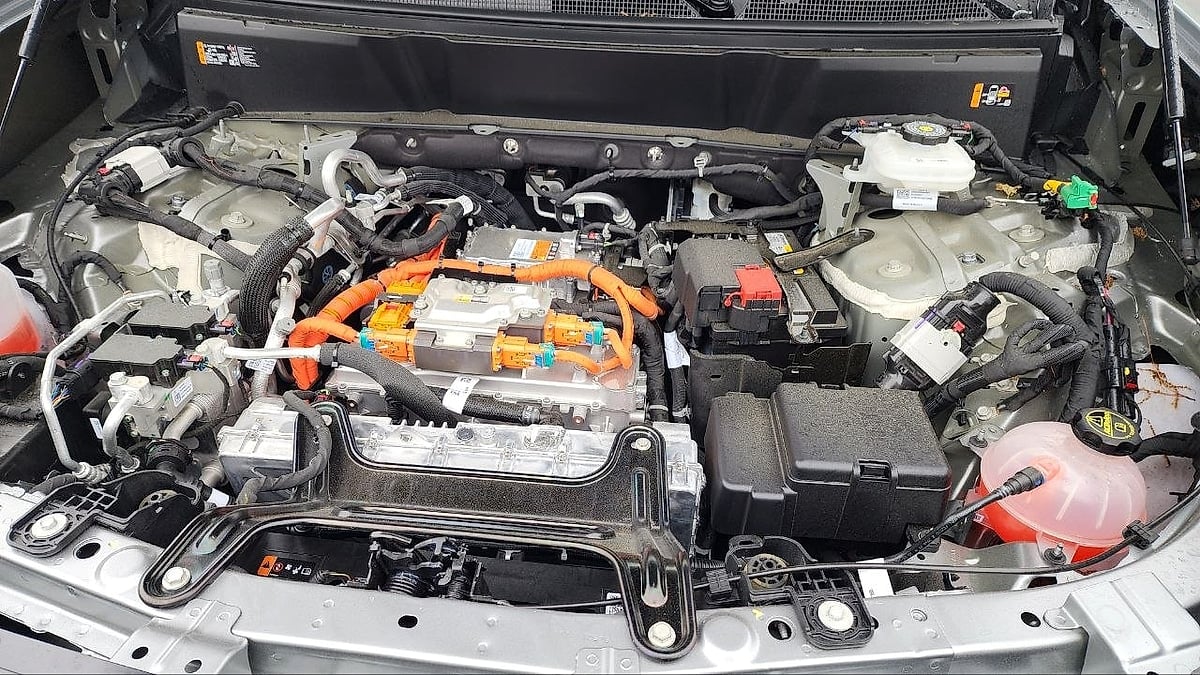
Compare this to the Cadillac Escalade IQ's massive 205-kWh battery, which Torque News covered when discussing why the Escalade IQ is Cadillac's most important EV and its unique charging challenges. The Vistiq's smaller pack is actually a practical advantage for most families. You still get over 300 miles. Your home charging time on a 240V outlet is 7 to 11.2 hours depending on the charging module you choose. And the vehicle weighs about 3,000 pounds less than the Escalade IQ, which means the efficiency equation tilts in your favor every day.
Cadillac also includes a NACS adapter for Tesla Supercharger access, which solves what was the single biggest practical anxiety for buyers considering the jump from a gas-powered Lexus or BMW. The charging network problem, at least for most of the southeastern United States, is largely solved.
How Is the Second Row in the Vistiq?
The Premium Luxury trim comes standard with second-row captain's chairs, and they are legitimately excellent. Heated outboard seats, generous legroom at 40.16 inches, and easy access to USB-C ports and dedicated HVAC vents make the second row a destination rather than just a transfer zone. Adults are comfortable here on long drives. Taller passengers will find the headroom respectful at any height up to about 6-foot-2.
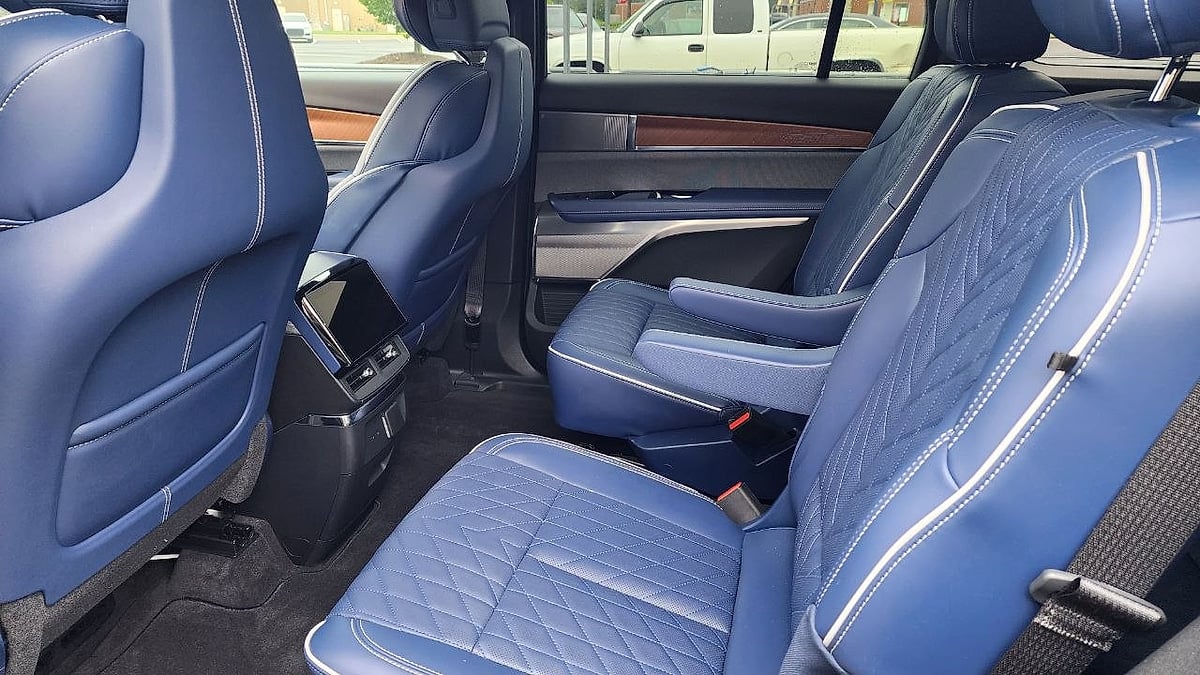
The 60/40 split bench available on the base Luxury trim gives you seven-passenger capacity, which is the better value configuration for family buyers. Families cross-shopping vehicles like the Acura MDX, Volvo XC90, BMW X7 or Audi Q7 who are evaluating luxury three-row options will find the Vistiq's second row competitive with anything in the segment. The five-zone climate control means the second row has its own temperature zone, which any parent of children with conflicting climate preferences will immediately appreciate.
Can Adults Actually Sit in the Vistiq's Third Row?
Here is the honest answer: adults can, but for short trips. Legroom in the third row measures 30.63 inches. I personally tried it. It's OK, and better than some other average 3-row SUVs. The floor is raised by the battery architecture underneath, which means a high knees-up seating position that becomes uncomfortable on drives over an hour. Cadillac does equip the third row with amenities you don't usually find back there: padded armrests, smartphone storage pockets, cupholders, and USB-C chargers. That thoughtfulness matters. It tells you Cadillac designed this row for real passengers rather than for regulatory compliance.
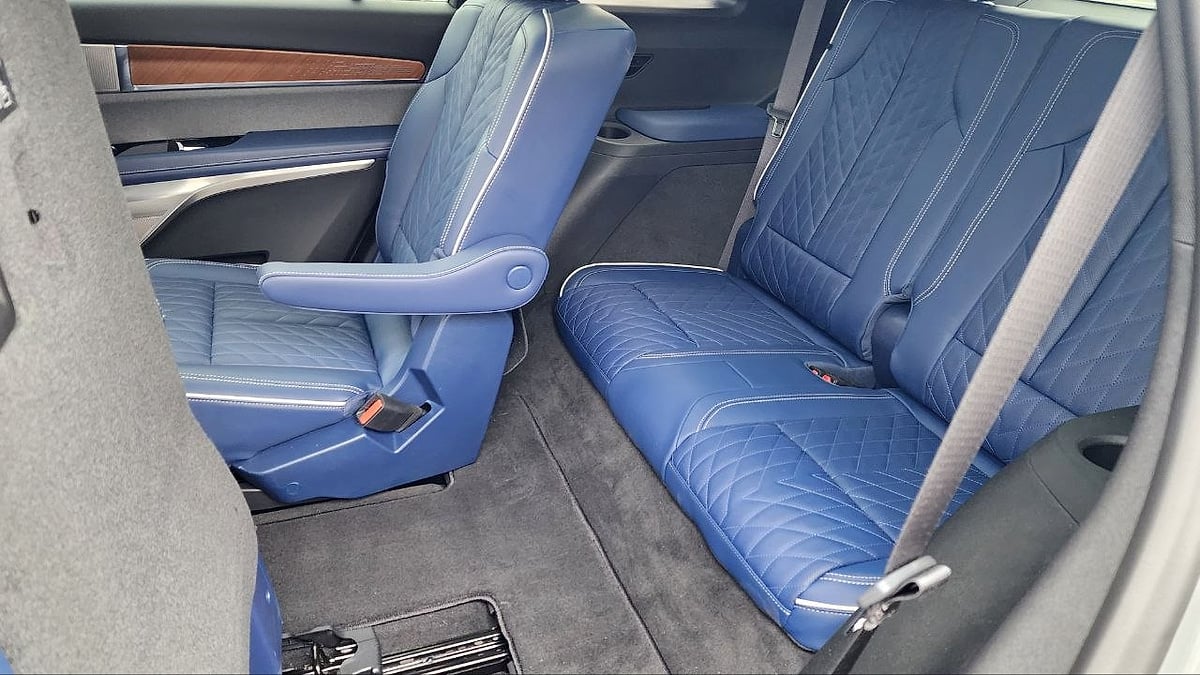
For children up to early high school age, this row is genuinely comfortable. For teenagers and adults on short commuter trips, it works. For a four-hour road trip? You'll want to negotiate for the second row before you leave the driveway. The Vistiq is honest about its limits here, and I appreciate that. A vehicle that tries to pretend its third row is first-class always disappoints.
How Much Cargo Space Does the Vistiq Offer?
Behind the third row, you get 15.2 cubic feet of cargo, which is modest. Fold the third row into the floor using the power-fold buttons in the cargo compartment and you jump to 43 cubic feet. Fold both rear rows flat and the Vistiq opens up to 80.2 cubic feet, which is genuinely impressive and handles strollers, sports equipment, or a Costco run without negotiation. The power liftgate is standard across all trims.

There is no front trunk. I noticed this, and while it does not affect functionality in any meaningful way, the empty frunk space is one area where EV competitors like the Rivian R1S and some Tesla configurations have a practical edge. The Vistiq makes up for it with its total cargo flexibility in the rear. The towing capacity is 5,000 pounds, which handles a mid-size boat or camper trailer without difficulty.
How Does the Vistiq Compare to Its Real Competitors?
Most automotive reviews compare the Vistiq to the Tesla Model X, Rivian R1S, and Kia EV9. But when affluent families walk into a Cadillac showroom, they're often cross-shopping the Acura MDX, Infiniti QX60, Lexus TX, or Volvo XC90. Many aren't even committed to buying an EV. They want three rows, luxury materials, a smooth ride, and enough technology to feel modern without feeling like a video game. That's the Vistiq's actual sales pitch.
This is fundamentally the same challenge that the Cadillac Lyriq faced when convincing entry-level luxury buyers to go electric, and the Vistiq carries that responsibility to a larger and more conservative buyer segment. The Lyriq succeeded in part because it looked luxurious without being alienating. The Vistiq needs to do the same thing with buyers whose biggest objection isn't horsepower, it's range anxiety and charging inconvenience. The 305-mile range and NACS charging access answer both directly.
The Volvo EX90 has a more richly finished interior in some respects and adds Apple CarPlay. The Rivian R1S is faster and more capable off-road. But the Vistiq is roomier than the Volvo, smoother-riding than the Rivian, and priced to compete with both. Motorweek, a well-established automotive testing outlet, noted the Vistiq "certainly feels like a modern Cadillac when you're behind the wheel; it's big and powerful yet also very smooth and quiet." That observation matches my seven days exactly.
What Are the Trim Levels and Pricing?
Four trims are available. The base Luxury starts at $79,090 and includes an exceptional standard equipment list. The Sport trim adds $500 and delivers blacked-out exterior trim, appealing to buyers who want a more aggressive visual presence. The Premium Luxury adds roughly $14,500 over Luxury, bringing air suspension, rear-wheel steering, Night Vision, the augmented-reality head-up display, and standard captain's chairs. The top Platinum trim pushes past $98,000.
My recommendation mirrors what I said at the top: the base Luxury trim may be all most families need. The standard equipment list includes Super Cruise, the 23-speaker AKG system, five-zone climate control, and the full technology suite. The air suspension on the Premium Luxury is genuinely transformative, so if you drive long distances regularly, it's worth the premium. But if most of your miles are in the suburbs, the standard sport suspension with continuous damping control is more than competent.
For buyers watching how the broader Cadillac EV lineup is performing, it's worth noting that Cadillac recently overtook BMW and Mercedes-Benz in the luxury EV segment, which tells you something meaningful about the brand's momentum right now.
The Vistiq also sits within a rapidly expanding Cadillac EV family. The smaller Optiq offers an entry-level luxury EV for buyers who don't need three rows, while buyers who want maximum space and are ready for a six-figure investment can step into the Escalade IQ, which MotorTrend named 2026 SUV of the Year. The Vistiq lives comfortably in the middle of that family, and it's genuinely the sweet spot.
Is the 2026 Cadillac Vistiq Premium Luxury Worth Buying?
After seven days, here is where I land. The Vistiq is the best evidence yet that Cadillac understands what it means to build a luxury family EV rather than an EV with luxury features added. The distinction matters. The quietness, the ride quality, the visibility from the elevated seating position, the way every adult in the cabin feels accommodated rather than tolerated: these are family vehicle virtues, not EV virtues. The electric powertrain delivers them silently, efficiently, and with surprising capability.
The top trims are expensive, and the Premium Luxury trim I tested sits at a price point that demands serious consideration. The entry Luxury trim at $79,090, though, is an extraordinary value given everything it includes. If I were writing a check today, I would start there. The Vistiq's biggest challenge is not beating Tesla. It's convincing the BMW X7 buyer standing in the Cadillac showroom that a vehicle without a tailpipe can deliver everything they've always wanted from a luxury family SUV. Based on my week with it, the answer to that challenge is yes, but you have to see it yourself, and decide according to your needs and budget.
Tell me what you think: After spending time with the Vistiq, the first question I want to ask you is: Would the 305-mile range be enough for your family's longest regular trips, or is range still your primary reason for hesitating on a luxury EV like the Vistiq? And second: If you are currently driving a BMW X7, Lexus TX, or Acura MDX, what specific feature would Cadillac have to nail to get you to seriously consider switching to an EV for your next family SUV? Drop your answers in the comments below. I read every one.
Images by Armen Hareyan.
About The Author
Armen Hareyan is the founder and Editor-in-Chief of Torque News and an automotive journalist with over 15 years of experience writing car reviews and industry news. Now based in the Charlotte region (Indian Land, SC, he founded Torque News in 2010, which since then has been publishing expert news and analysis about the automotive industry. He can be reached at Torque News on X, Linkedin, Facebook, and Youtube. Armen holds three Masters Degrees, including an MBA, and has become one of the known voices in the industry, specializing in the landscape of electric vehicles and real-world stories of actual car owners. Armen focuses on providing readers with transparent, data-backed analysis bridging the gap of complex engineering and car buyer practicality. Armen frequently participates in automotive events throughout the United States, national and local car reveals and personally test-drives new vehicles every week. Armen has also been published as an automotive expert in publications like the Transit Tomorrow, discussing how will autonomous vehicles reshape the supply chain, and emerging technologies in vehicle maintenance.
Set Torque News as Preferred Source on Google
Follow us today...





Comments
X7 is not electric not…
Permalink
X7 is not electric not competitive at all.
Exactly. Did you read the…
Permalink
In reply to X7 is not electric not… by Cleshawn Monteque (not verified)
Exactly. Did you read the article? Cadillac isn't targeting EV competitors. The article explains why. It's a very unique angle you won't see in other publications.
The Vistiq is in a very odd…
Permalink
The Vistiq is in a very odd position.
Its real competition is:
LUCID GRAVITY
MAZDA CX90
Rivian R1s
KIA EV9
Hyundai ionic 9
The BMW X7 isn’t electric so it isn’t competitive for the Vistiq.
Most reviews compare Vistiq…
Permalink
In reply to The Vistiq is in a very odd… by John Smith (not verified)
Most reviews compare Vistiq to:
But when affluent families walk into a Cadillac showroom, they're often cross-shopping:
Many aren't even committed to buying an EV.
I have both. My wife’s car…
Permalink
I have both. My wife’s car is the VISTIQ, and my car is the BMW X7. Both are great vehicles.
I’ll add the EX90 from Volvo
Permalink
I’ll add the EX90 from Volvo
Ionic 9 and EV9 can be…
Permalink
Ionic 9 and EV9 can be bought with rear heated/ventilated seats and headrest smart TV monitors.
Cadillac needs that option.
Cadillac needs to…
Permalink
Cadillac needs to significantly increase the Vistiq’s range to justify its premium positioning. The Vistiq sits higher in Cadillac’s lineup than the Lyriq yet offers less range at 305 miles compared to the Lyriq AWD’s 319 miles. This creates a difficult value proposition—why pay more for less range when the only real difference is third-row seating?
While the Vistiq does offer more horsepower and three-row seating, Cadillac should have designed the Vistiq to be more efficient in range than its lower counterpart like the Cadillac Lyriq. Given its premium positioning, Cadillac could have offered a larger 130-150 kWh battery to achieve superior range rather than the current 102 kWh pack that results in shorter range than the Lyriq.
An unexpected omission at this price point is the lack of Apple CarPlay and Android Auto support.
To make the Vistiq compelling enough to attract buyers, Cadillac should implement several key improvements. First, they need to deliver 350+ miles of range to match competitors and justify the higher price. Second, they should add rear-seat entertainment displays similar to China-market models.
The bottom line is that additional horsepower and third-row seating alone aren’t enough to overcome the range deficit and feature fragmentation across trim levels. Cadillac needs to address these issues to make the Vistiq a truly competitive flagship electric SUV.
Thre are more differences…
Permalink
In reply to Cadillac needs to… by Rich B (not verified)
Thre are more differences than just a 3rd row. Foremost is more power. The Vistiq actually utilizes the same power train as the Lyriq V, which is considerably more than the base Lyriq model trims and much more comparable on pricing for that feature alignment alone. It also provides a higher seating position, smoother ride, soft close doors, larger panoramic sunroof, and yes that 3rd row which also means a lot more cargo space when the 3rd row is not occupied.
I went to the dealership last July wanting the Lyriq. I loved the test drive and was ready to pull the trigger until I saw the Vistiq...a vehicle I didn't even know existed at the time. Nearly a year later, and I'm thrilled with this vehicle. It has met or exceeded my expectations in nearly every conceivable way. That's also considering we have driven 15,000+ miles made up mostly of daily in town commuting and youth sports, but also includes several 5 hour road trips and even a family trip from Indiana to Maryland and back last Labor Day weekend.
We have the "base" Luxury trim with 2nd row bucket seats and it feels like anything but a "base" model. Kudos to those with a higher trim that includes air ride and 4-wheel steering, but I don't feel like we are missing out on anything of substance, especially given the price difference for those features.
I feel like the range is…
Permalink
In reply to Cadillac needs to… by Rich B (not verified)
I feel like the range is just about okay if you don't expect to deal with a lot of bad weather. Where I live, in Texas, I think it would be okay. What really puzzles me is the 190 kW charging rate. For an expensive vehicle with a full-sized battery in today's scene, that's weak. I mean, my 2020 Model S can hit higher peak rate than that, and it's starting to feel outdated IMO.
"less range at 305 miles…
Permalink
In reply to Cadillac needs to… by Rich B (not verified)
"less range at 305 miles compared to the Lyriq AWD’s 319 miles. This creates a difficult value proposition—why pay more for less range when the only real difference is third-row seating?"
On occasion, people have more than two children. I's give up 14 miles for the extra space in a heartbeat to handle my four.
I came out of a Model X…
Permalink
In reply to Cadillac needs to… by Rich B (not verified)
I came out of a Model X Plaid and a Model S Long Range into a Vistiq Sport.
The Vistiq is hands down a better car - the only place it falls short is the music apps are unusable while driving
Ive taken many road trips in both the Model X and the VIstiq and range is theory on the Model X +S where as on the Vistiq it is real world. Charging is just as fast even though it has a lower Kw limit - the charge curve is flatter in the Cadillac
A trip from Los Angeles to Sacramento in ALL cars required 2 stops and charge times are very similar. Teslas stated range vs real world are VASTLY different.
Just because a manufacturer tells you the have a certain range doesnt mean you will get that - in Teslas case YOU WILL NOT
Just because a charge speed limit is lower doesn't mean the battery wont charge as fast as a higher limit system
Maybe Cadillac doesn't want to be seen as a snake oil salesman and provides accurate numbers. Maybe someone needs to run a full EV comparison test around range and charging speeds for the various platforms.