
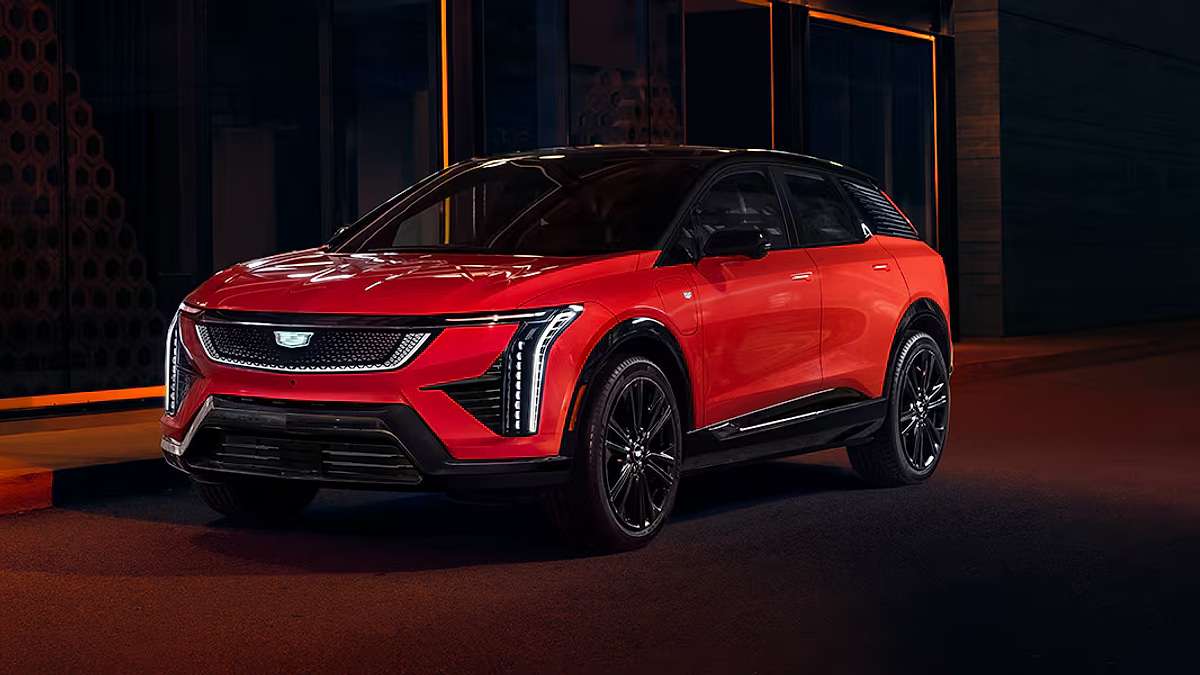

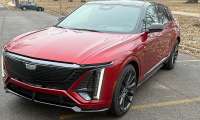
A cross-country trip in a Cadillac Optiq EV recently cost one owner $496.The $496.76 in charging fees for a round trip from NE Kansas to Florida immediately challenges the promised cost savings of electric vehicles. This journey, covering over 2,600 miles, was plagued by navigation failures, charging network inconsistencies, and a five-hour highway stoppage, revealing a stark reality for long-distance EV travel. The owner's detailed account exposes a critical disconnect between the seamless experience manufacturers advertise and the frustrating reality on the road.
This is a pattern of infrastructure shortcomings and software integration failures that continue to erode consumer confidence. The expectation that a premium EV like the Optiq would offer a refined, hassle-free touring experience is routinely undermined by unreliable charging networks and navigation systems that fail to adapt to real-world conditions. When a vehicle's core functionality is reliant on external services, those services must perform flawlessly.
The current state of EV charging infrastructure and integrated navigation systems is not meeting the basic demands of long-distance drivers, and manufacturers like Cadillac are failing to adequately prepare their customers for this reality.
One owner went to Facebook to talk about it:
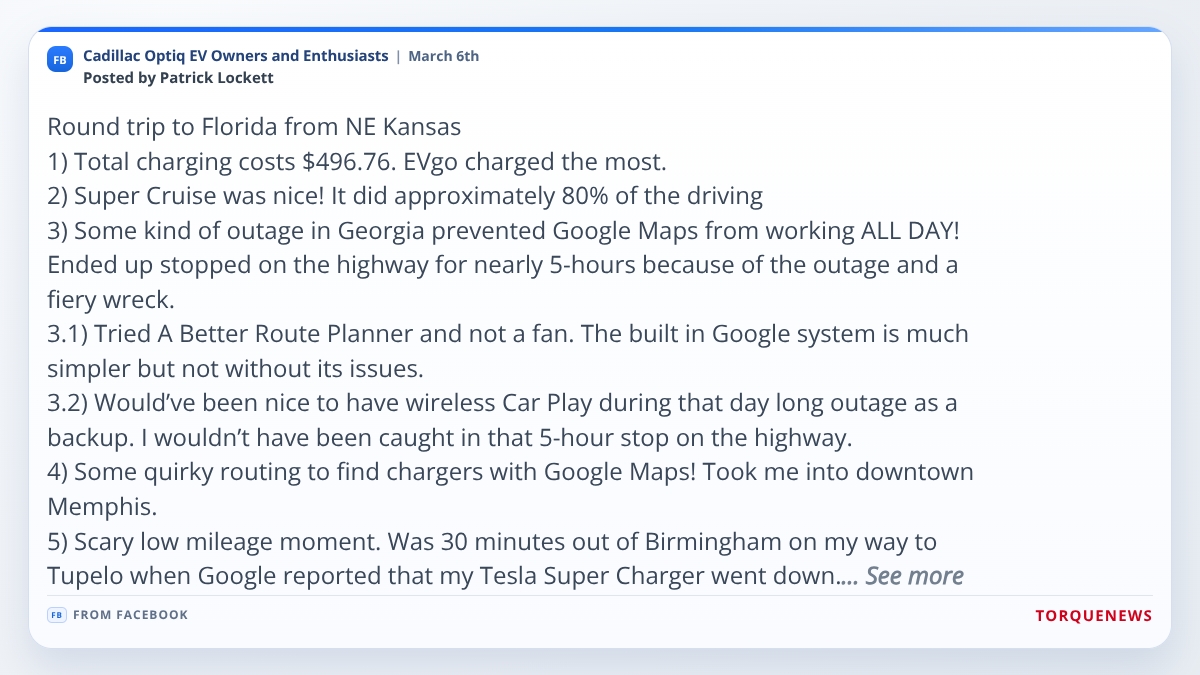
"1) Total charging costs $496.76. EVgo charged the most.
2) Super Cruise was nice! It did approximately 80% of the driving
3) Some kind of outage in Georgia prevented Google Maps from working ALL DAY! Ended up stopped on the highway for nearly 5-hours because of the outage and a fiery wreck.
3.1) Tried A Better Route Planner and not a fan. The built-in Google system is much simpler but not without its issues.
3.2) Would’ve been nice to have wireless CarPlay during that day-long outage as a backup. I wouldn’t have been caught in that 5-hour stop on the highway.
4) Some quirky routing to find chargers with Google Maps! Took me into downtown Memphis.
Advertising
5) Scary low mileage moment. Was 30 minutes out of Birmingham on my way to Tupelo when Google reported that my Tesla Super Charger went down. Google wanted me to do a U-turn, drive 30 minutes to Birmingham, charge 40-minutes, and then head back. I tried using other apps to see if, in fact, the Tesla Supercharger was down and got mixed answers. I decided to go for it. I was prepared to call a flatbed tow truck if the chargers weren’t working. Got to my destination with less than 10 miles of range, and not only was the Tesla network working, but there was a Francis Energy station as well.
6) Wanted to charge at the Mercedes-Benz Chargers at the Buckees in Springfield, MO. Google Maps kept routing me to a Tesla Charger. It wasn’t until I was within 15 miles that the Benz chargers showed up as an option.
7) Not a fan of the drowsy detection. After that 5-hour delay on the Georgia highway (about 10 pm), it kept going off; I wasn’t tired at all. Then, coming home in the mid-morning, I could feel myself fighting to keep my eyes open and NO alerts!”
Patrick Lockett's experience, while unique in its specific incidents, shows systemic vulnerabilities in the EV ecosystem. The $496.76 charging bill for a 2,600-mile trip translates to roughly $0.19 per mile, a cost that rivals or exceeds many internal combustion engine (ICE) vehicles. This directly contradicts the narrative of significant fuel savings often touted by EV manufacturers and advocates, particularly when relying on public fast-charging networks where rates are substantially higher than home charging. The fact that EVgo, a prominent network, was the most expensive reveals the variable and often opaque pricing structures that frustrate owners.
Cadillac Optiq: Real-World EV Road Trip Challenges
- The Cadillac Optiq, based on GM's Ultium platform, is designed for a target range of over 300 miles, yet real-world long-distance travel reveals significant disparities in charging costs and network reliability.
- GM's decision to integrate Google Built-in for navigation and infotainment, while offering deep integration, removes support for Apple CarPlay and Android Auto in newer models like the Optiq.
- The Optiq's Super Cruise system, GM's hands-free driver assistance technology, performed well for 80% of the trip, offering a glimpse into the potential of advanced ADAS for reducing driver fatigue.
- The owner's "scary low mileage moment" near Birmingham, where Google Maps incorrectly reported a Tesla Supercharger outage, shows the fragmented and unreliable nature of real-time charging network data.
This cost calculation immediately drew criticism from Jerry Avergon, who commented, "Not an Inexpensive trip!! You failed to mention the downtime you spent at the chargers…" Avergon's point about downtime is critical; the financial cost is only one component of the total burden of EV road trips. Time spent waiting for a charge, even if used for other activities, is still time not spent driving or at a destination. The industry often glosses over this aspect of EV ownership, focusing solely on the per-mile energy cost.
Brian Ward, however, pushed back on Avergon's assessment, stating, "Jerry, sounds like you are implying you take a 2600+ mile trip without doing anything but stopping for gas. My times at charging is spent stretching my legs, using the restroom, maybe eating, and possibly returning emails. Secondly, if my math is correct, the cost was $0.18/mile. That cost is about the same as my ICE vehicle as well. EVs are not efficient on the highway; that’s just a fact we accept as owners. Lastly, if you have nothing constructive to say, please say nothing at all." Ward's defense, while understandable from an EV owner's perspective, inadvertently confirms a significant problem: the acceptance of higher costs and inherent inefficiencies on long highway drives. The idea that EVs are "not efficient on the highway" is a fundamental challenge to their viability as primary long-distance vehicles, especially when compared to ICE counterparts that maintain or improve efficiency at cruising speeds.
The navigation system's performance, particularly Google Maps, proved to be a critical weak link. An "outage in Georgia" that rendered Google Maps inoperable for an entire day, combined with a fiery wreck, led to a five-hour highway stoppage. The industry's failure to address these fundamental infrastructure and software shortcomings risks alienating early adopters, who expect flawless functionality from their high-tech vehicles. The owner's lament for wireless CarPlay as a backup shows a fundamental flaw in Cadillac's strategy: relying solely on an integrated Google system without offering robust, redundant connectivity options like Apple CarPlay or Android Auto. This decision by GM to move away from these established platforms in favor of their own Google-based system is proving to be a significant detriment to owner experience and safety.
This reliance on a single, potentially fallible system was further exposed by "quirky routing" into downtown Memphis and the "scary low mileage moment" near Birmingham. Google Maps' inability to accurately reflect Tesla Supercharger status, or its preference for Tesla chargers over other available networks (like the Mercedes-Benz chargers at Buckees), points to a severe lack of real-time, comprehensive charging network integration. This is an inconvenience and a safety concern when a vehicle's primary navigation system becomes useless.
The drowsy detection system, a safety feature, also failed to perform consistently. After a five-hour highway delay, the system erroneously triggered alerts, yet failed to activate when the owner genuinely felt tired on the return journey. This inconsistency undermines the system's credibility and effectiveness, turning a potentially life-saving feature into an annoyance at best, and a dangerous omission at worst. A safety system that cries wolf when there's no danger, and stays silent when there is, is worse than no system at all.
The owner's willingness to risk running out of range and call a flatbed tow truck rather than follow Google's U-turn instruction shows a lack of trust in the system's recommendations. It unequivocally shows that the EV ownership experience, particularly for long-distance travel, is still fraught with significant challenges regarding cost, infrastructure reliability, navigation accuracy, and software redundancy. Until manufacturers like Cadillac prioritize a truly seamless, robust, and redundant ecosystem for charging and navigation, the promise of effortless EV touring will remain an unfulfilled marketing fantasy. Buyers must understand that the current state of EV travel demands a higher degree of planning, patience, and risk tolerance than a comparable ICE vehicle.
About The Author
Noah Washington is an automotive journalist based in Atlanta, Georgia, covering sports cars, luxury vehicles, and performance culture. His reporting focuses on explaining the engineering, design philosophy, and real-world ownership experience behind modern vehicles.
Noah has been immersed in the automotive world since his early teens, attending industry events and following the enthusiast communities that shape how cars are built and driven today. His work blends industry insight with enthusiastic storytelling, helping readers understand not just what a car is, but why it matters.
Noah is also a member of the Southeast Automotive Media Association (SAMA), a professional organization for automotive journalists and industry media in the Southeast.
His coverage regularly explores sports cars, luxury vehicles, and performance-driven segments of the automotive industry, including the evolving culture surrounding Formula Drift and enthusiast builds.
Read more of Noah's work on his author profile page.
You can also follow Noah here:
Set Torque News as Preferred Source on Google
Follow us today...




Comments
What a ridiculous article. …
Permalink
What a ridiculous article. How is that an EV issue when Teslas the #1 EVs don't have any such issues.
I round tripped from NC to NYC for FREE with Supercharger charging and no Navigation issues.