
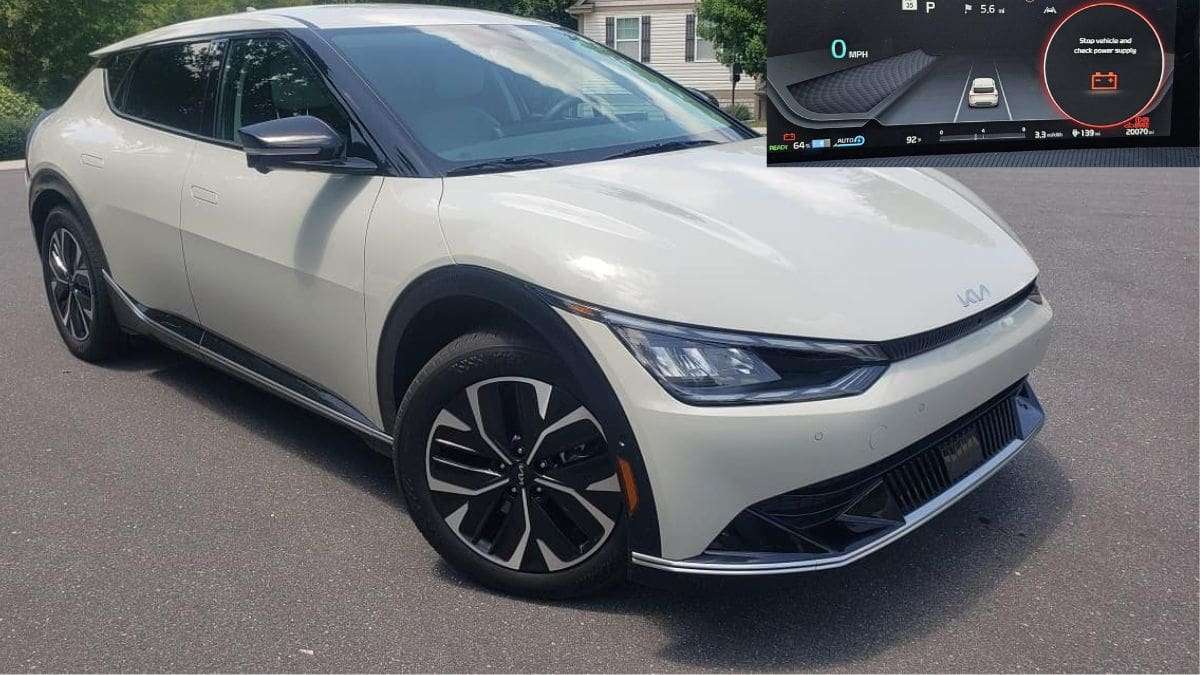

You expect some wear and tear after 20,000 miles on the road, sure. Maybe a tire rotation. Maybe a cabin air filter change if you remembered it. But what you do not expect - especially from a sleek, modern, quiet EV that has been whispering down the freeway for under a year - is to suddenly have to stop the vehicle and check the power supply. That’s the kind of warning that grabs your attention fast, especially when it’s accompanied by a battery icon glowing like it’s trying to signal distress. And for one Kia EV6 owner, that unexpected and unlikeable message turned his smooth 11-month experience into a weeklong series of phone calls, flatbed tows, and what he calls the first time his dealership ever had to replace a certain expensive component.
That owner is DrChris Patterson, who shared his experience in the Kia EV6 Owners USA Facebook group, where a lot of insightful stories and unexpected lessons are surfacing lately. Here’s what he posted:
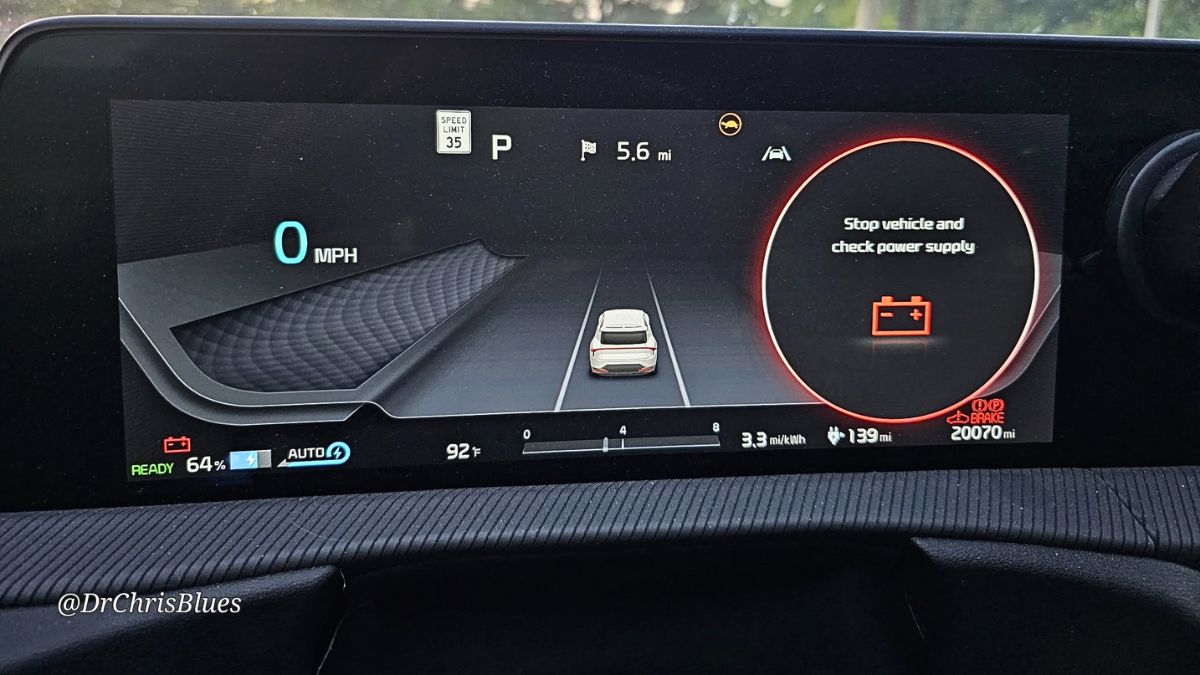
“Just flipped over 20,000 miles on my Kia EV6, after owning it for 11 months and now this (‘Stop vehicle and check power supply’ with a battery image under it). The AAA first said I needed a new battery as the AAA’s test showed one cell failed. Tried that and it didn't fix the problem $250 later. Had to load my EV6 on a flatbed and take to dealer. Part on order per dealer.”
It’s the kind of moment that would rattle anyone. Here you are, driving one of the most talked-about EVs of the last two years, and suddenly your power system throws up a warning like it's bracing for a blackout. AAA tested it and pointed to a failed battery cell. After spending $250 replacing that, the issue still remained. Which meant a flatbed tow and a new layer of uncertainty at the dealership.
But the story takes an even more curious turn. When another group member, Nick Steel, suggested Chris ask for a 2025 version of the ICCU (Integrated Charging Control Unit), which has higher energy density and appears to be part of Kia’s effort to quietly refine their architecture, Chris responded with a detailed update that revealed more than just a mechanical hiccup.
“The dealer is telling me this is the first time they had to replace one. Taking extra time. They worried they will mess up a $2100 part. They had to send a guy to pick up clips from another dealer. They gave me a rental, but the tire went flat as soon as I drove off. I put on the spare and drove back. They gave me a different loaner. Now saying it will be done on Monday.”
Let’s take a moment to unpack that. The ICCU, which plays a key role in controlling the power conversion and charge distribution in Kia’s E-GMP platform vehicles, is evidently not as bulletproof as some might hope. Chris’s post implies the part is scarce and delicate, and that even the dealership is worried about replacing it correctly.
But his story is not an outlier. It is part of a growing chorus of concerns some owners are voicing about early component failures in EV6 models. If you recall this recent case on Torque News, one EV6 owner had their third battery replacement in just 4,500 miles, prompting them to say they’re "waiting for Kia to tell me where to dump it."
This kind of story matters for two reasons: trust and trend. Buyers trust new technology to make life easier, not more complicated. And if these rare but troubling power issues become a trend, Kia may need to address the root design or supplier issues more openly than they have so far.
To be fair, Kia is also getting credit where it’s due. Many dealers are reportedly going above and beyond to support stranded owners. In one story, an EV6 owner was two and a half hours away, and the dealership sent someone to pick up their car and even provided them a different trim loaner with over 300 miles on it. That’s not typical, and it’s a surprisingly pleasant gesture that more automakers should learn from.
This also opens up an important discussion about the emerging gap between EV complexity and service readiness. The ICCU is not a part you can grab from a shelf like a spark plug. Replacing it requires technical skill, specialized tools, and, sadly, a dealership that isn’t operating at capacity. This is a case where product design is outpacing support infrastructure, and customers like Chris are caught in the middle.
To help navigate these murky waters, some owners are adopting a more hands-on approach. For instance, using real-time diagnostic apps and OBD tools to monitor power flow, cell voltages, and temperature variances. While these tools don’t prevent failures, they can provide early warning and potentially reduce time wasted on misdiagnoses. It’s the EV-era version of listening to your engine idle and knowing something's off.
There’s also an ethical consideration here. When we commercialize EVs quickly without investing just as aggressively in long-term support and component availability, we put early adopters in an unfair spot. They're often test pilots for software updates, thermal management quirks, or hidden hardware issues. Transparency matters. So does accountability.
There’s still a lot to like about the EV6, especially the 2024 GT version that continues to impress reviewers with its performance and styling, even if it’s not the range king. But even that doesn’t erase the frustration that comes with feeling like a guinea pig every time the powertrain throws up a warning.
Other owners have chimed in with similar experiences, such as not being able to start the car after 11,500 miles and calling Kia’s roadside assistance, only to hear it’s the fourth or fifth EV that technician had seen with the same issue that week. That kind of pattern is hard to ignore, and it raises questions about software reliability, part quality, and dealer readiness.
Still, there’s something quietly optimistic in stories like Chris’s. Yes, the ICCU failed. Yes, the first loaner had a flat. Yes, the part had to be fetched from another dealer. But Chris kept going. He got another loaner. He waited. And that brings us to the moral of the story - not just about EVs, but about any advanced technology: Being an early adopter comes with risk, and being a responsible owner means being patient, persistent, and occasionally self-reliant. Not for glory, but because progress never comes fully polished.
If you’re planning a road trip or relying on your EV for a daily commute, you might want to consider tools that can help you proactively monitor your battery system and power delivery. It won’t prevent all issues, but it can help you catch a hiccup before it spirals into a full breakdown.
And if you’re wondering whether your range will suffer in snow or high-speed conditions, this real-world EV6 range test on snow mode at varying speeds might give you some helpful insights.
In the meantime, Chris’s experience is a valuable one. It reminds us that even the best-engineered vehicles are still learning. The question is whether we, as drivers and owners, are learning too.
1. What Is the ICCU in the Kia EV6 and Why It Matters More Than You Think
If you have not yet heard of the ICCU (Integrated Charging Control Unit), you’re not alone. But if you drive a Kia EV6 or any Hyundai Group vehicle built on the E-GMP platform (like the Ioniq 5 or Genesis GV60), this silent worker is as important as your steering wheel. It’s the part that helps manage how your car converts and distributes power — from the battery to the motor and even to your 12V system. When it fails, as Chris Patterson found out, it doesn’t matter if your battery’s fully charged. The car may not even start, or worse, it may flash the ominous "Stop the vehicle and check power supply" warning.
Here's why it’s a big deal:
- The ICCU handles both AC-to-DC conversion and battery conditioning.
- It connects the high-voltage system to the low-voltage accessories.
- When it fails, everything stalls, even your ability to charge or power essential systems.
What makes this issue more complex is that the ICCU is still in its early iteration stages. In fact, some owners suggest requesting the 2025 version of the ICCU because it allegedly has higher energy density and better heat management. But until that becomes the standard, early adopters are at the mercy of rare dealer fixes and limited parts inventory.
2. How Prepared Are Kia Dealerships for Complex EV Repairs? Owner Stories Reveal Gaps
As much as Kia deserves praise for launching a compelling and affordable EV lineup, many dealerships are still playing catch-up when it comes to repair readiness for advanced electric drivetrains. Unlike oil changes or brake jobs, diagnosing an ICCU or high-voltage power issue requires:
- Trained EV techs certified to work on high-voltage systems.
- Specialty diagnostic software that most general repair shops don’t have.
- Access to limited, costly components like the ICCU, which can cost over $2,000 and aren’t typically stocked.
In Chris’s case, not only did the dealer say this was the first ICCU replacement they had ever attempted, but they also had to send a staff member to another location just to pick up clips for the repair. That’s not a reassuring sign for someone who just had their vehicle towed in on a flatbed.
Other EV6 owners have faced similar challenges, like the owner with the 11,500 miles on his Kia, which I referenced above.
This raises a very real question: Is your local dealer ready to support your EV ownership? Before buying an EV, it’s smart to:
- Ask if the service team has high-voltage certified technicians.
- Inquire about how many EV repairs they’ve performed.
- Understand what their loaner or rental policy looks like if major components fail.
It’s also worth stepping back and asking whether this type of unexpected tech fragility is a growing pain across the EV world, not just limited to Kia. When new systems are rushed to market, especially those tied to charging, energy management, or thermal regulation, even a minor miscalculation can lead to unusual failure patterns. For example, in a recent 4,700-mile Cybertruck road trip that involved 31 Supercharger stations, only 5 matched what Tesla promised, leading the driver to question not the battery, but the charging infrastructure and communication protocols between car and charger. It’s a revealing look at how unexpected inconsistencies are surfacing even in brands that pride themselves on control of the entire system.
3. Practical Tools and Habits to Monitor Your EV’s Health Before It Becomes a Breakdown
Many EV6 owners are beginning to realize that while the car is packed with advanced tech, it often doesn’t give much early warning before something critical fails. The ICCU, in particular, doesn't degrade in a way that you can feel like a worn brake pad. It just fails. That’s why building your own habits around EV monitoring and preventive care can go a long way.
There are several tools and techniques to catch problems before they strand you:
- OBD-II dongles paired with EV-specific apps (like EVNotify or Torque EV) can help you view real-time battery health, charging performance, and error codes.
- Use apps to log high-voltage system voltages, state-of-charge drift, and sudden capacity drops.
- After charging sessions, review the charging speed and duration. A declining charge rate could indicate thermal issues or power conversion problems.
Also consider doing this regularly:
- Schedule a diagnostic check every 10,000 miles to read stored system alerts.
- Keep a simple power event log on your phone to document anything unusual (noises, warnings, drops in range).
These tools don't eliminate failures. But they give you a chance to catch small signs of electrical or charging stress before the ICCU decides it’s time to give up. Think of it as your EV’s version of listening for a rattle before a suspension bolt snaps.
Have you ever experienced an unexpected system failure in your EV or hybrid that left you stranded or confused? Do you trust your dealer to handle rare EV repairs with confidence? Share your experience in the comments section below.
Armen Hareyan is the founder and Editor-in-Chief of Torque News. He founded TorqueNews.com in 2010, which since then has been publishing expert news and analysis about the automotive industry. He can be reached at Torque News Twitter, Facebook, Linkedin, and Youtube. He has more than a decade of expertise in the automotive industry with a special interest in Tesla and electric vehicles.
Set Torque News as Preferred Source on Google
Follow us today...





Comments
This is a very common…
Permalink
This is a very common problem for people in the Kia EV6 owners group on Facebook, and should be for Kia dealers.
It's a very common problem…
Permalink
It's a very common problem but they all want to deny it. They w say of it doesn't fail, they can't warranty it. Ridiculous. And it's a safety issue! They sent out I. U update recall notices so how can they say they aren't aware. Push for a solution! I had 2 updates. And on 3rd battery because of this problem. It fixed it. But my car had to literally die and could not be jumped to get it fixed.
Also I do love this car,…
Permalink
Also I do love this car, even with that issue it had. It's a great vehicle otherwise. Just stay on it and I'd advise to get a jump starter if you don't already have one. That won't fix a bad ICCU but it saves you if the 12v battery dies and wont change.
There is NO WAY they've…
Permalink
There is NO WAY they've never seen this before. 12v battery, ICCU, and HV battery issues are WELL-KNOWN across the Kia dealer/service landscape.
Probably ICCU needs to be…
Permalink
Probably ICCU needs to be changed.
ICCU , that's what you need…
Permalink
ICCU , that's what you need to change , it took me 3 weeks waiting the part to arrive , just keep in mind that you should pay nothing.
I'm afraid "unknown pop-ups"…
Permalink
I'm afraid "unknown pop-ups" are the bane of modern software-defined vehicles ... because car manufacturers are rarely good at software, and they had to hit the ground running to keep up with "thee who can't be named". I drive a Lexus and am part of one of the Lexus Owners Groups on Facebook. You'd be surprised to see how many "bugs" we found, weeks before Lexus had an answer for them, ranging from
- 12V battery issues (a common problem for EVs and hybrids, the 12V battery is only used to "boot up" the systems and is easily discharged, paralysing the vehicle), to
- user interface peculiarities (for example, the car knows where you are and "could" adjust the clock and the speed limits display, but it didn't automagically until a software update),
- product development omissions (a "luxury" car that has sensors everywhere but not for the screen wash liquid)
- Oh, and mine hadn't been properly initialized after delivery, so I was served with a number of error messages that were meant to be reset before handover.
Now, when I see a pop-up on the screen, unless the car stops or goes into limp mode, I reach my destination, turn the car off, and lock it. Generally, when I return to it, everything is sorted.
Alessandro, you hit on a…
Permalink
In reply to I'm afraid "unknown pop-ups"… by Allesandro Messeri (not verified)
Alessandro, you hit on a really important point about software-defined vehicles and the challenges car manufacturers face! It's wild how common these "unknown pop-ups" and software glitches seem to be, even with luxury brands like Lexus.
Your experience with the Lexus Owners Group on Facebook sounds incredibly valuable. It's fascinating how a community of users can identify bugs and product development omissions well before the manufacturer has official answers. The 12V battery issues in EVs and hybrids, the UI quirks like the clock not adjusting automatically, and even missing sensors for something as basic as screen wash – these are all things you wouldn't expect in a modern car, let alone a luxury one.
It really highlights the steep learning curve for traditional automakers as they navigate the software-defined future of vehicles. Thanks for sharing your insights!
I have a 2024 EV6 with 7500…
Permalink
I have a 2024 EV6 with 7500 miles that has been at the Kia dealer for 4 months waiting for a new high current battery, still no ETA. They won't take the car back and I have to continue making lease payments, insurance, and registration. Kia customer care continues to ghost me; ugh!
Don't they give you a car…
Permalink
In reply to I have a 2024 EV6 with 7500… by Tom Carr (not verified)
Don't they give you a car loaner?