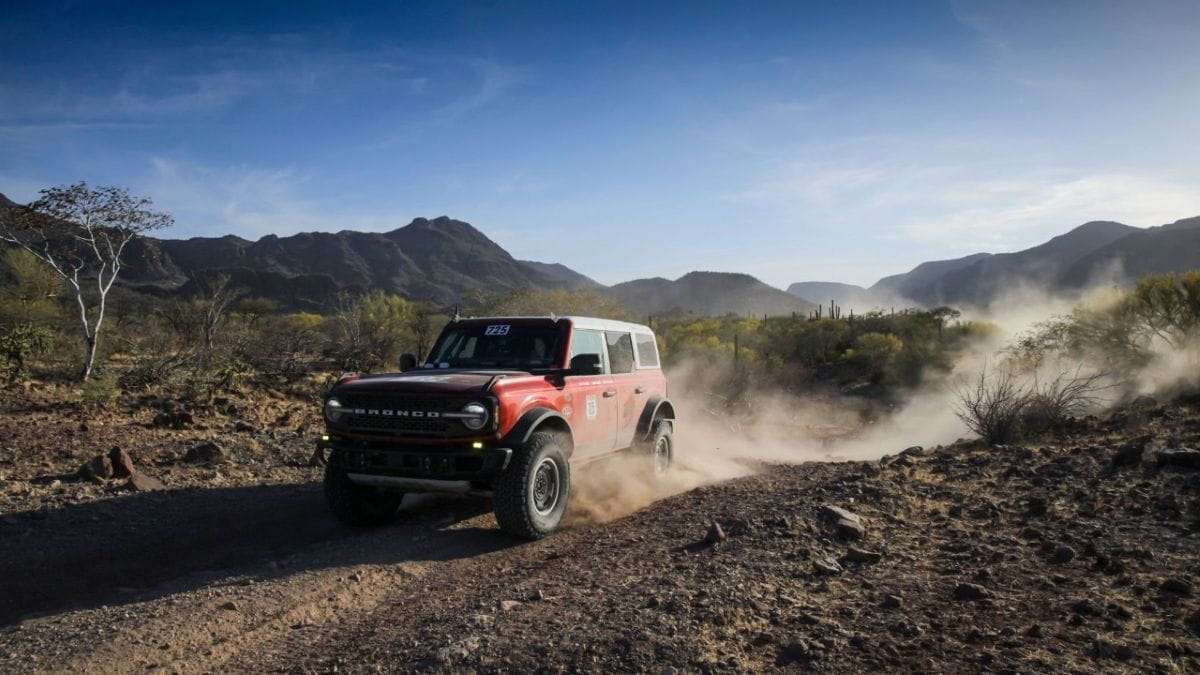

Ford local engineers from the United States are taking some of the company’s newest Broncos off-road racing to build endurance and durability. The one you see in the picture is nearly all stock and one of the vehicles that will race in the 1,200-mile NORRA Baja Mexican 1000, across Mexico’s Baja Peninsula. Ever since the Bronco debuted in 2021, Ford has been doing real world testing. Despite having incredible in-house testing facilities, Ford says off-road experience is the best way to validate the most rugged vehicles like the 2026 Ford Bronco. My personal favorite of the testing chambers is the high wind and wind tunnel facility but the chamber testing vehicles in below zero temperatures is a close second.
Real- World Bronco Testing
The engineers take either a Badlands or Wildtrak model out for the endurance test. The only modification they make is that they have to add race safety equipment. During the last race, engineers performed validation testing on several new parts for the Bronco while finishing 58th place overall out of the more than 150 vehicles that started the race.
The driver and passenger, both Ford employees, split their time driving and navigating while performing real-time data analysis and failure root cause analysis, creating solutions to any issues that arise along the way. Broncos started competing at Baja back in the 1960’s. When Ford brought the iconic vehicle back, the company wanted to make sure that it met all of the durability and endurance of the original. That's why they compete with stock vehicles, particularly the Badlands and Wildtrak trims.
Learning to Handle the Unknown
Everything is controlled in the automaker’s in-house tests. Typically, vehicles are run are huge treadmill-like surfaces while the temperature is raised or lowered to extremes, to see how they function. Does the heat or air-conditioning still work after thousands of miles of testing. Do interior parts melt or crack because of the extreme temperatures? Do tires hold together after tens of thousands of miles in grueling conditions. Similarly, the high wind chambers check to make sure parts don’t come off in the dreadful conditions. Engineers need to make sure windshields and windows don’t shatter.
Off-road racing offers random and variable conditions that just can’t be reproduced elsewhere. These unique cases that arise through real-world scenarios are essential for validating vehicle durability and making sure the Bronco customers get an exciting, quality product that they can rely on out in the desert.
From an engineering standpoint, you want to control all the variables and have consistency. However, off-roading doesn’t let you control any of it. You can’t even run over the same surface twice and get the same result, because the act of running over that surface has modified it. Off-roading, especially at higher speeds, provides extreme cases that we automakers can’t duplicate in-house. The real-world conditions provide the random circumstances that demonstrate what customers might experience.
According to Seth Goslawski,Off-Road and Trailer Tow Team Leader for Ford, “Off-road racing offers random and variable conditions that just can’t be reproduced elsewhere.”
The NORRA Baja Mexican 1000 includes nightly stops which gives the Ford team the chance to inspect the vehicle nightly and do any necessary maintenance. The engineers use what they learn over the race to improve the Broncos that roll off the line at Michigan Assembly Plant. I would imagine the Ford engineers use those same lessons to improve all of their company’s off-road models, from the Bronco Sport to the Explorer, Expedition, Ranger, Maverick and F-150. While the equipment may differ, certainly, the racing races the questions about what the other vehicles may encounter.
Ford's Other Real-World Endurance Tests
The Baja Peninsula is just one location where Ford does the off-road testing. The infamous Johnson Valley in Southern California is another. I’m sure Ford also analyzes what happens at its Bronco Off-Roadeo in Moab, Utah, as well. I’m sure if anyone notices a problem during the extreme off-roading, it gets reported to higher-ups who track any potential faults or weaknesses.
Subjecting stock Broncos to a variety of rocks, sand, silt, and even water crossings gives the Ford employees more experience than they can ever get in a sealed chamber monitoring conditions. Ford uses what it learns from endurance racing to build a better Bronco. I would bet the lessons help the teams build better Bronco Sports, Explorers, Expeditions, Rangers, Mavericks and F-150s, too!
The racers are trained for driving the Baja route by Ford Racing off-road driver Brad Lovell. They also spend hundreds of miles in the passenger seat as navigators, a task that rivals that of driving. The weeklong journey through Baja also yields learnings about the interior of the Bronco. This can lead to improvements with the SUV’s camera and other off-road features.
Endurance off-roading is just one of the ways Ford is making sure its vehicles are equipped to help our customers pursue their passion. It’s important for customers to know they own a product that could go race at Baja, even if they aren’t going to use it that way.
Ford Photo
Mary Conway is a professional automotive journalist and has decades of experience specializing in automotive news analysis. She covered the Detroit Three for more than twenty years for the ABC affiliate, in Detroit. Her affection for the Motor City comes naturally. Her father ran a gas station while Mary was growing up, in Wisconsin.
Follow Mary Conway at @MaryConwayMedia and send her car news tips for future stories.
Set Torque News as Preferred Source on Google
Follow us today...