
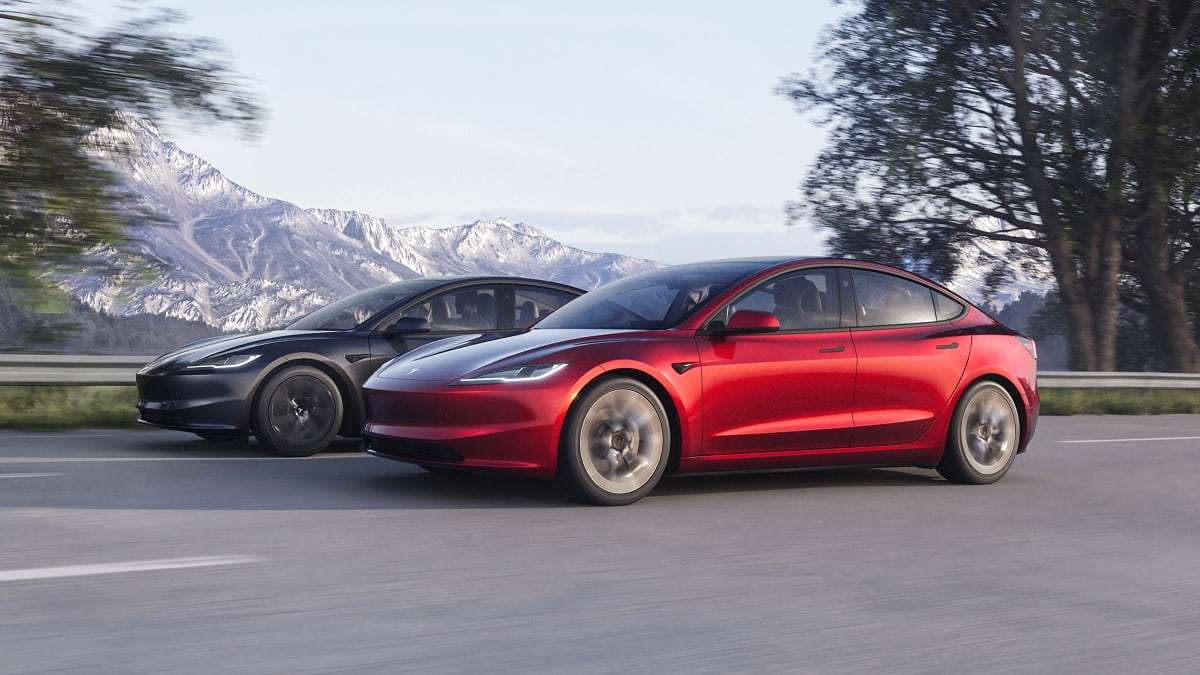

There has been much fanfare about the Tesla Model Y being the world’s best-selling EV and in 2023, the best-selling car in the world. What’s often overlooked is that the Tesla Model 3 is consistently the world’s second-best selling EV. How does it continue to be successful? It consistently outperforms Chinese rivals like the Geely Xingyuan, BYD Dolphin, and the Wuling Mini EV. Over the years, Tesla has slowly perfected the Model 3. We’ve seen range improvements, a quieter cabin, and a sleeker body. For buyers looking for a great bargain, used Model 3s can often be found at a steep discount.
Tesla Model 3 popularity is a popular topic on social media. Here’s a post on the r/electricvehicles subreddit where Fabi0_Z posted an interesting question:
“Why has no one beaten the Model 3 yet?”
He continued with, “To avoid being labelled as a fanboy, I'm simply looking at the market options with wallet in hand, and I’m noticing how difficult it is to justify not buying a Tesla Model 3, especially when considering the used market (which has the bonus of not directly supporting Tesla).
Why does it seem like no one is able to provide a sporty sedan or hatchback with comparable specs to the Tesla Model 3 at a similar or lower price?
Every competitor in the same price range either has less power, less range, or usually both. The ones that can actually beat or compare with the Model 3 are usually double the price.
A lot of people say the reason is that "sporty sedans don't sell," so manufacturers aren't investing in them. Yet, the Model 3 sets sales records every year despite being exactly what the market is apparently not looking for.
Instead, everyone is pumping out electric SUVs. They have huge batteries and high prices, yet often have mediocre range due to low efficiency and poor aerodynamics. Is the profit margin just that much higher on SUVs that they ignore the Model 3 segment?”
Flaky_Views responded with some insights on SUVs and upcoming Model 3 competitors:
“SUVs sell better than Sedans, hence why the Model Y is sold much more than the Model 3. So logically all the car makers will make SUVs first and Sedans later.
After BMW unveiled the iX3 SUV last year, the i3 Sedan was expected within a few months. Same goes for the Mercedes C-class EQ Sedan coming this year after the GLC EQ SUV last year. Audi is expected to premier the A4 E-tron Sedan this year too after the Q6 SUV has been out there for some time now.
Will any of these match or be cheaper than a Model 3 Performance? I'm 99% sure they won't. However, looking at what BMW is going to do with the upcoming M3 EV, they confirmed a four-motor M-drivetrain so it will be well over $100k and make the Model 3 Performance look like a toy.
In Short, there won't be anything similar to the Model 3 performance at a similar price point, unless you hunt for leasing deals.”
CrossingChina suggested looking at Chinese EVs, even though they aren’t available in the U.S.:
“There are tons of Chinese EVs like the Xiaomi Su7, new Xpeng p7, new NIO et5, and Zeeker 007 in Thailand where I live now. I’ve seen a decent amount in Indonesia and Costa Rica as well. We saw quite a few in Europe this past summer. It’s not only China that has these cars, they’re just not in North America.”
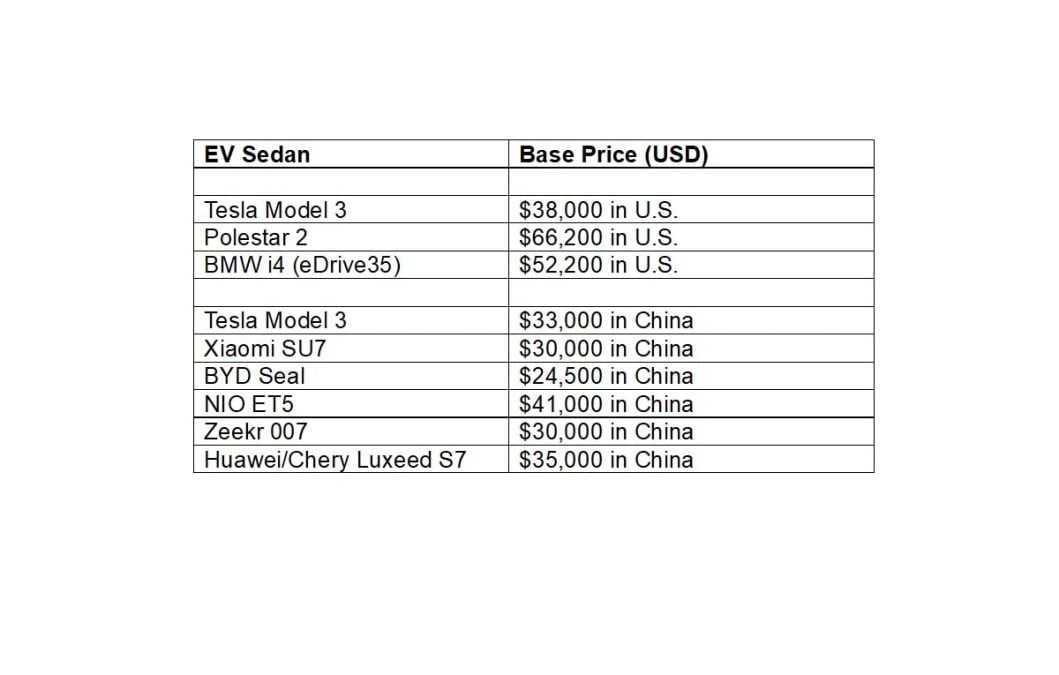
To see if the Tesla Model 3 is the best value, let’s look at approximate base pricing. We thought it would also be helpful to look at how the Model 3 is priced against its Chinese competitors in China.
From the chart, we can see that the Tesla Model 3 is priced significantly less than its two closest competitors in the U.S. They are the Polestar 2 and the BMW i4. When it comes to China, the picture is mixed, and the Model 3 falls into the middle of the pack.
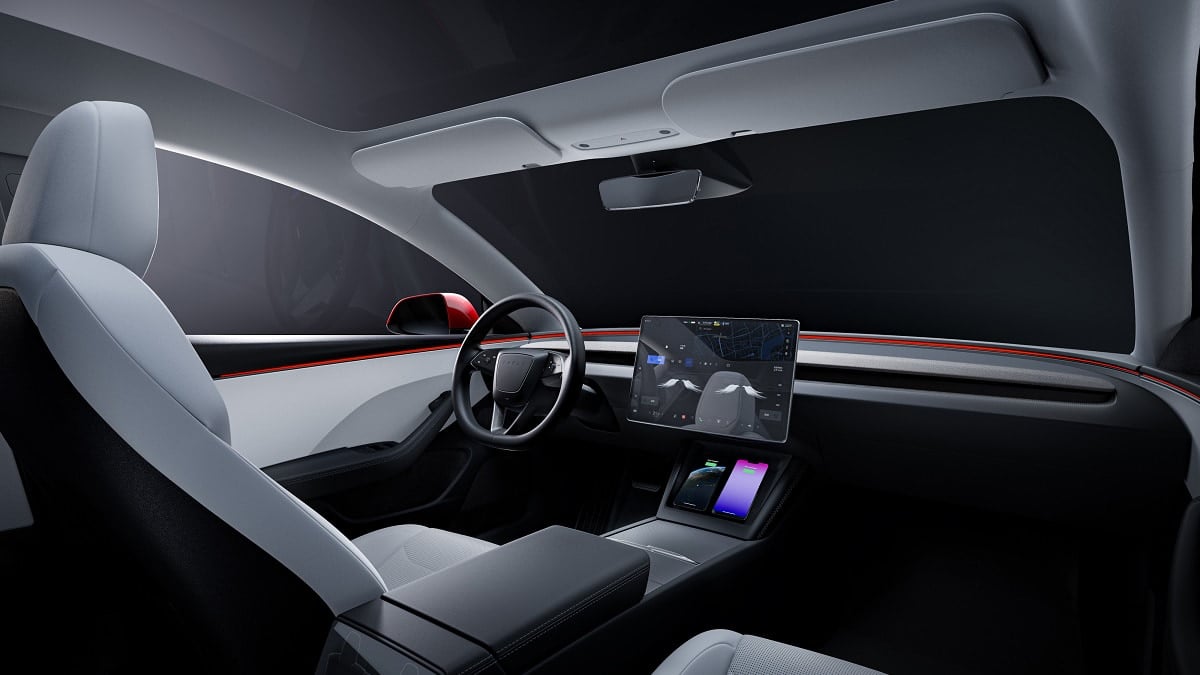
To dig into the U.S. market, let’s compare the Tesla Model 3 to the Polestar 2 and the BMW i4. Specifically, we’ll examine the BMW i4 eDrive35, the Polestar 2 Long Range Dual Motor, and the refreshed Tesla Model 3 Standard Range rear wheel drive. Each aims at a slightly different kind of driver, even when the prices overlap.
Tech specs set the stage quickly. The BMW i4 eDrive35 weighs about 4,553 pounds, uses a single rear motor making 282 horsepower, and packs a 66-kWh usable battery. EPA range lands as high as 276 miles, peak DC charging hits 180 kW, and a 10% to 80% fast charge takes about 32 minutes. Used 2024 models can show up in the mid $30,000 range.
The Polestar 2 Long Range Dual Motor is heavier at 4,740 pounds, makes 421 horsepower from two motors, and uses a 78-kWh usable battery. EPA range is also 276 miles, peak charging is 155 kW, and 10% to 80% takes roughly the mid 30-minute range, with used pricing often around $35,000.
The refreshed Model 3 Standard Range rear wheel drive is the lightest at about 3,881 pounds, uses a roughly 60 kWh battery, and is rated around 272 miles of EPA range. Peak charging is around 170 kW, and 10% to 80% can happen in under 30 minutes, with pricing often in the mid $30,000 range.
Design and aerodynamics reveal three very different personalities. The BMW i4 leans classic BMW with a long hood and smooth lines, backed by a 0.24 drag coefficient and about 4.9 inches of ground clearance. The Polestar 2 goes for Scandinavian minimalism, but it is less slippery with a 0.28 drag coefficient. It counters that with about 5.9 inches of ground clearance and rugged looking lower cladding, plus it rides on a crossover related platform shared with the Volvo XC40 Recharge, which helps explain its taller stance and crossover vibe. The Tesla Model 3 is described as more functional than exciting, but it wins the aero contest with a 0.22 drag coefficient and about 5.4 inches of ground clearance, even if the side profile feels familiar after years on the road.
Cargo space becomes a clear win for the Model 3. The BMW i4 uses a hatch with a power tailgate and about 16.6 cubic feet of rear cargo space, but it lacks a front trunk. The Polestar 2 also has a power liftgate and offers about 14.4 cubic feet in the rear plus a small 1.3 cubic foot frunk, totaling about 15.7 cubic feet. The Model 3 sticks with a trunk rather than a hatch, yet still delivers about 21 cubic feet in the rear plus a 3.1 cubic foot frunk, totaling about 24.1 cubic feet. That total nearly matches some SUVs, which is impressive packaging for a sedan.
Interior feel and build quality split into two different kinds of “premium.” The BMW i4 feels traditional and driver focused, with solid materials, physical controls, three zone climate, and a cabin vibe that fits a performance brand. Rear comfort is limited by a transmission tunnel from the shared platform, which hurts the middle seat. The Polestar 2 has a distinctive cockpit feel that some might love, plus useful physical touches like a volume knob. Some seat materials can feel odd unless the car has the upgraded leather package, and there is more scratchy plastic than expected in spots. The refreshed Model 3 gets a lot of praise for improved quality, more soft touch materials, felt lined pockets, and strong standard features. Heated rear seats, a rear screen, and heated and ventilated front seats come standard, helping the car feel more upscale than older Model 3s.
Software and user experience is where Tesla pulls away. BMW’s iDrive 8 offers a robust mix of touchscreen and rotary control, solid built in navigation with EV route planning, wireless Apple CarPlay and Android Auto, and useful charging settings, plus strong camera features when equipped. Polestar’s system is described as capable and easy enough, with excellent Google Maps integration for route planning, but wired Apple CarPlay feels behind the times and customization is limited. Tesla’s system feels like a fast tablet, with smooth route planning tied into Superchargers, sharp cameras, extra entertainment features, and a strong phone app ecosystem. The minimalism can be annoying for things like mirror adjustments, but the overall experience is still framed as the best of the three.
Charging and road trip ease favors the Model 3, mostly because of the charging network and integration. The i4 and Polestar 2 both land around 276 miles of EPA range, with roughly low 30 minute 10 to 80 percent charging times. The i4 is limited to CCS charging and can only use select Tesla Superchargers with Magic Dock, while the Polestar 2 can use Tesla Superchargers with an adapter. The Model 3 charges from 10% to 80% in about 27 minutes and makes road trips simple with seamless Supercharger routing and billing. The standard range Model 3 uses an LFP battery that benefits from charging to 100% occasionally for accurate state of charge calibration.
Driving impressions highlight three different strengths. As to be expected from BMW, the i4 is playful, quiet, and balanced, with good one pedal driving and a chassis that feels composed on back roads, plus a measured cabin noise level around 64 dB at 70 mph. The downside is that some trim levels lack adaptive cruise and lane centering unless optioned. The Polestar 2 is extremely quick, with strong traction from all wheel drive, solid pedal tuning, and a good standard assisted driving suite on newer versions, plus similar highway quiet around 64 dB, though with a bit more wind noise. The refreshed Model 3 feels noticeably improved in ride comfort versus older versions, keeps sharp handling, and is lighter than the others by a wide margin. Cabin noise is reported around 67 dB at 70 mph, still louder than the BMW and Polestar, but much better than older Model 3s.
Bottom Line
Given all the comparisons, the Tesla Model 3 appears to be the overall winner because it combines strong standard features, improved cabin quality, excellent software, and the easiest road trip experience. The BMW i4 is positioned as the driver’s choice, quiet, classy, and fun in corners, especially if you find one with the right options. The Polestar 2 stands out as the design wildcard, part sedan, part crossover in feel, with big power and solid standard driver assistance. Each one can be a smart buy at around $35,000 (used Polestar 2 and BMW i4), but the Model 3 is framed as the simplest, most complete package for most people.
What Do You Think?
What would actually have to change for you to not buy a Tesla Model 3 at today’s used prices?
Are automakers really avoiding sporty sedans because they “don’t sell,” or because margins are better on SUVs?
Chris Johnston is the author of SAE’s comprehensive book on electric vehicles, "The Arrival of The Electric Car." His coverage on Torque News focuses on electric vehicles. Chris has decades of product management experience in telematics, mobile computing, and wireless communications. Chris has a B.S. in electrical engineering from Purdue University and an MBA. He lives in Seattle. When not working, Chris enjoys restoring classic wooden boats, open water swimming, cycling and flying (as a private pilot). You can connect with Chris on LinkedIn and follow his work on X at ChrisJohnstonEV.
Photo credit: Provided by author, Tesla media
Set Torque News as Preferred Source on Google
Follow us today...





Comments
Some of this isn’t factual…
Permalink
Some of this isn’t factual. The BMW i4 has access to most Superchargers now with an adapter and its Navi also does charger route planning. The i4’s hatchback and fold down seats make up for having less space because the space is very usable. And, subjectively, the BMW is a much nicer looking car.