
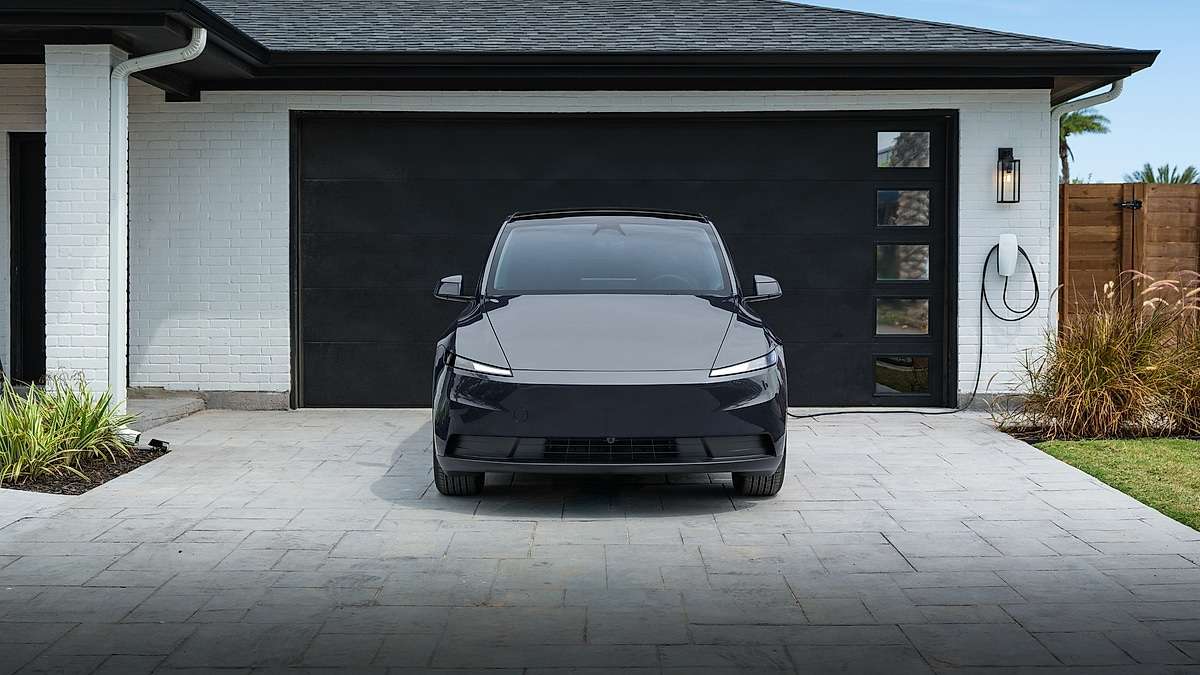

Two-EV households often need a garage that stops making people choose which car gets plugged in first. I checked a Cybertruck charging discussion, Tesla's Wall Connector documentation, Tesla's Group Power Management instructions, and overnight rate math. The useful finding is simple: two Tesla Wall Connectors can make home charging easier, but load sharing is mainly about managing limited power intelligently, not magically charging two vehicles at full speed.
The case came from the Cybertruck Owners Only Facebook group, where Jondell Stephens said one of the best things he had done was buy two Tesla chargers. His household has two EVs, and both vehicles can be plugged in at night without anyone moving cars around later. He said both start charging at 9 p.m., when his rate drops to $0.13 per kWh, and finish by 5 a.m.
The screenshot he shared shows the kind of garage many Tesla families are moving toward: a Cybertruck and another Tesla visible in the Tesla app, with one vehicle charging at 11.7 kW and the other sitting at 80 percent. The point is not that every household will see that exact number. It is so that the cars can stay plugged in while the system handles the charging sequence.
What Torque News Checked
Torque News checked the public owner discussion, the screenshot, and the comment thread. Several commenters said one charger can still work for a two-EV household if someone is willing to alternate cars or swap plugs. One commenter said he charges his Cybertruck until he leaves for work at 3:30 a.m., then plugs in his wife's Model Y so it is ready by morning.
That comment is the whole problem in one sentence. One charger can work. The question is whether a household wants its charging plan to depend on a person being awake at 3:30 a.m.
Torque News also checked Tesla's official Wall Connector support page. Tesla says a Wall Connector can deliver up to 11.5 kW / 48 amps on a 60-amp breaker, depending on the vehicle. Tesla's chart lists Cybertruck at up to 30 miles of range per hour at that 60-amp breaker setting.
Tesla's Group Power Management documentation adds the missing electrical layer. Tesla says the feature allows up to six Gen 3 Wall Connectors to limit their total grid current draw to a specified maximum current, so the electrical service is not overloaded. Tesla also says an electrician needs to determine the correct amperage and confirm the load center has appropriate overcurrent protection.
Multiple Wall Connectors can be set up so the home has more plug-in points without necessarily letting the chargers pull unlimited current.
Tesla's daisy-chain documentation makes the distinction even clearer for Universal Wall Connector installs. Tesla says supported daisy-chained Wall Connectors on a single branch circuit have a maximum current rating of 48 amps on a 60-amp breaker, and all Wall Connectors in that daisy chain must be configured as one group power management unit with a network limit no higher than 48 amps. Tesla also says available current is redistributed when vehicles are plugged in or unplugged.
Two chargers do not automatically mean twice the power. They can mean two places to plug in, with the available current managed between cars.
What can it deliver?
A single Tesla Wall Connector at 11.5 kW running through an 8-hour window can deliver about 92 kWh before charging losses. At Jondell's stated $0.13 per kWh, that energy costs about $11.96 before taxes and fees. Many two-EV households do not need 92 kWh every night. If one car needs 25 kWh and the other needs 35 kWh, the household only needs about 60 kWh before losses. At $0.13 per kWh, that is $7.80 of energy.
The second charger does not make the energy cheaper by itself, nor does it need a special adapter. The second charger makes the overnight window easier to use because both cars can be plugged in when people get home.
What the thread showed
The comment thread showed how much the utility rate matters. One commenter said he has two wall chargers, each on its own 60-amp breaker, and charges at $0.02 per kWh from 11 p.m. to 7 a.m. through Georgia Power's Overnight Advantage plan. Georgia Power says that the plan is designed to help customers shift electric usage, EV charging, or home battery charging to overnight, and says its super off-peak window runs from 11 p.m. to 7 a.m.
That sounds incredible, but the warning is built into the same kind of rate plan. Georgia Power also explains that on-peak hours occur on weekdays from June through September, typically 2 p.m. to 7 p.m., and that super off-peak hours are only part of the Overnight Advantage plan. In other words, the cheap overnight number is not the whole bill. A household has to avoid expensive peak behavior for the plan to make sense.
The lesson and what comes next
That is the real lesson for two-EV homes. The charger hardware, the household schedule, and the utility rate have to line up.
For some families, one Wall Connector is enough. If both vehicles drive modest miles, one car can charge one night, and the other can charge the next. If one driver leaves very early, a manual swap may be acceptable. If the electrical panel is limited, the cheapest smart move may be better scheduling rather than more hardware.

For other families, two Wall Connectors are not a luxury. They remove a recurring household chore. Nobody has to remember which car is lower. Nobody has to walk outside late at night. Nobody has to wake up before dawn to swap a plug. Both cars can sit connected, and the system can allocate power within the limit set during installation.
The practical test is not "do you own two EVs?" It is "how often do both EVs need a meaningful charge in the same off-peak window?"
If the answer is rarely, one charger may be fine. If the answer is several nights a week, a second Wall Connector with proper load sharing can be the difference between home charging feeling effortless and home charging becoming another family schedule to manage.
Questions to ask before buying a second charger
Before buying the second charger, ask five questions. How many kWh do both cars actually need overnight? What is the real off-peak window from the utility? Can the panel support the installation without a service upgrade? Would load sharing solve the problem better than two independent high-power circuits? And is the household paying for speed, or paying to stop moving cars around after dinner?
For a two-EV garage, the smartest charging setup is the one that lets both cars wake up ready without making the people in the house manage the power manually.
If your household has two EVs, would you rather run one charger and swap cars, or install two Wall Connectors with load sharing? Tell us your setup, utility rate, and whether the second charger was worth it.
Let us know in the comments below.
About The Author
Noah Washington is an automotive journalist based in Atlanta, Georgia, covering sports cars, luxury vehicles, and performance culture. His reporting focuses on explaining the engineering, design philosophy, and real-world ownership experience behind modern vehicles.
Noah has been immersed in the automotive world since his early teens, attending industry events and following the enthusiast communities that shape how cars are built and driven today. His work blends industry insight with enthusiastic storytelling, helping readers understand not just what a car is, but why it matters.
Noah is also a member of the Southeast Automotive Media Association (SAMA), a professional organization for automotive journalists and industry media in the Southeast.
His coverage regularly explores sports cars, luxury vehicles, and performance-driven segments of the automotive industry, including the evolving culture surrounding Formula Drift and enthusiast builds.
Read more of Noah's work on his author profile page.
You can also follow Noah here:
Set Torque News as Preferred Source on Google
Follow us today...






