
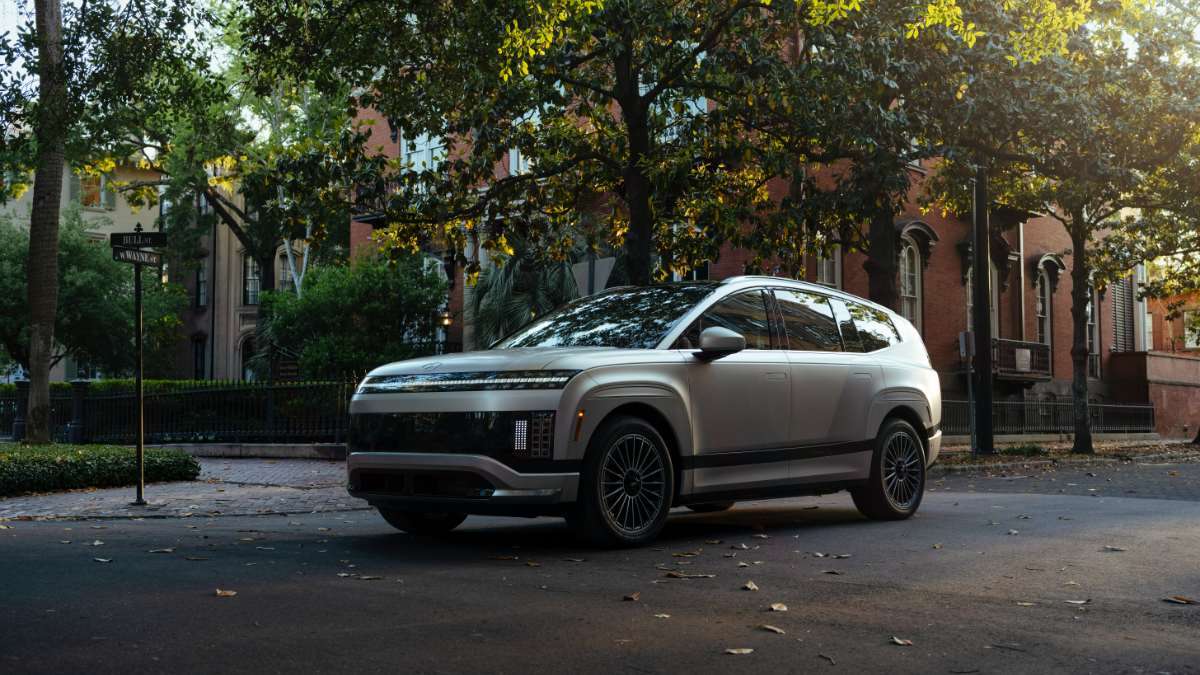

America has always been a place where the weather sets the curriculum, and the highways are the classroom. Any cross-country traveler knows the pattern. Sun over Indiana, sleet in Illinois, then that sideways, vindictive snow in Iowa that makes you question why you ever left the driveway. Ice storms are not exotic here; they are seasonal punctuation marks. Freezing rain and black ice sweep across the Midwest and up through the Appalachians every winter, a reminder that this continent is too big and too varied for a single forecast or a single plan. You learn quickly that you should bring a jacket everywhere, even if it is warm when you lock the front door. Into that reality rolled a Hyundai Ioniq 9, headed from Minnesota to the Smoky Mountains over Thanksgiving, with one family learning in real time what winter does to range, traction, and driver assistance.
The Reddit post went like this:
“We just took our IONIQ 9 on a long trip over Thanksgiving from Minnesota to the Smoky Mountains. We just got home today. Here are a few thoughts, and I’m sure, as a rookie, these thoughts/issues were mainly my fault.
Started out using ABRP, but dumped it pretty quickly. It kept having us stop every 90 miles or so. We felt we were wasting a lot of time stopping so often. I’m pretty sure I had the trip parameters all mixed up. I had my wife drive while searching different apps. The Tesla app works fine, but doesn’t have a trip planner. However, the Tesla Supercharger app has a route planner, but it requires a membership. After logging into the Supercharger app a few times, the app offered me a one-time lifetime membership for $20. I jumped on it. It made planning very easy for most of the trip.
The last part of our trip was going through northern rural Iowa with no Tesla chargers. We used PlugShare and charged at several car dealerships. It worked out well, but we had to check the charge rate closely and the reviews to ensure they were still operational.
We slowed our trip down and stayed behind the storm to allow some time for the roads to be cleared. However, the roads were still icy and slippery. We found out very quickly that I-pedal and ice are a bad mix. The regen would kick in, and we would start sliding. Not good. The lane assist on slippery roads is also not good. When you try to move around icy spots, you are constantly fighting the steering wheel. The same goes for HDA, which automatically turns itself on. Both of those features got turned off.
We tried to allow ourselves a generous 30%-40% SOC at each charging location. On Sunday, the storm had passed, the temperatures dropped, and the wind was howling. We tried to adjust for the reduced range, but severely underestimated it. We picked a closer charger about 100 miles away and charged up to 220 miles of range. I know the vehicle's range is a guesstimate, but I felt we had more than enough charge. We didn’t. We made it to the charger with 8% SOC. It caused considerable anxiety trying to limp to the charger, hoping it would work, or wasting energy trying to find another charger. Today, the vehicle seemed to adjust its guesstimate to a more reasonable guess of range.
Overall, we are happy with the trip, but will definitely be refining it more closely next time. Hope this helps.”
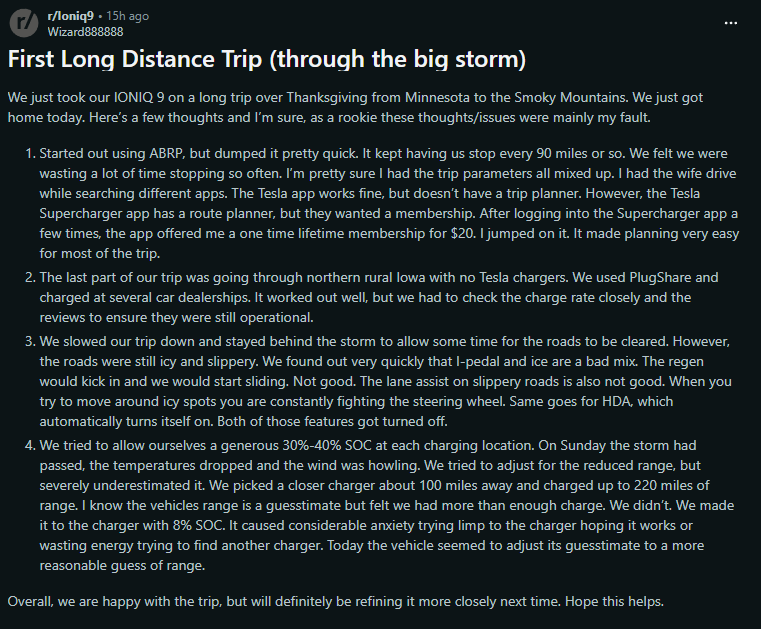
Read carefully, that is not a complaint, it is a field report. The driver slows down to stay behind the storm, finds rural dealership chargers through PlugShare, and learns that regenerative braking on ice is a different animal from regen on dry pavement. Ice storms like the one they skirted around Minnesota and Iowa are part of a broad winter pattern across the northern half of the country, where warm, moist air rides over shallow cold air near the surface, and the result is glaze ice instead of fluffy snow. The same country that can bake a Phoenix parking lot can also polish an Iowa highway into glass. You can start a day in Minnesota in a snowglobe, end in Tennessee among damp leaves and fog, and need that same jacket in both places, for completely different reasons.
Hyundai Ioniq 9: South Korea’s Largest SUV?
- The Hyundai Ioniq 9 is Hyundai’s largest-ever electric passenger SUV: a three-row, mid-size EV built on the E-GMP platform, with seating for six or seven and room to carry more cargo than typical EVs in its class.
- Under the skin, it packs a 110.3 kWh high-voltage battery, the biggest in Hyundai’s lineup, enabling an impressive claimed range that pushes well beyond 300 miles per charge, making it viable for long-distance trips as well as day-to-day commuting.
- Inside, Ioniq 9 doubles as a tech-lounge on wheels: its cabin includes a sweeping dual 12.3-inch digital display setup, ultra-modern voice control assisted by generative AI, wireless connectivity, and creature comforts like a sliding center console and intelligent charging for devices.
- Safety and convenience get equal attention: standard driver-assist systems (adaptive cruise, lane-keep assist, automated braking, blind-spot monitoring) come alongside clever EV-specific touches such as remote smart parking and optional in-car payment, showing Hyundai’s ambition to make Ioniq 9 as advanced as it is roomy.
The heart of this story is not that range dropped in the cold; it is how dramatically it changed. In the comments, another Ioniq 9 owner, posting as pavelbulanov, spelled out the math. In gentle conditions, the car often shows about 4 miles of range per 1 percent of state of charge on the display, which already leans optimistic compared with what he actually sees in real driving. For normal highway travel, around 65 to 70 miles per hour with light climate use, he treats 3 miles per percent as realistic.
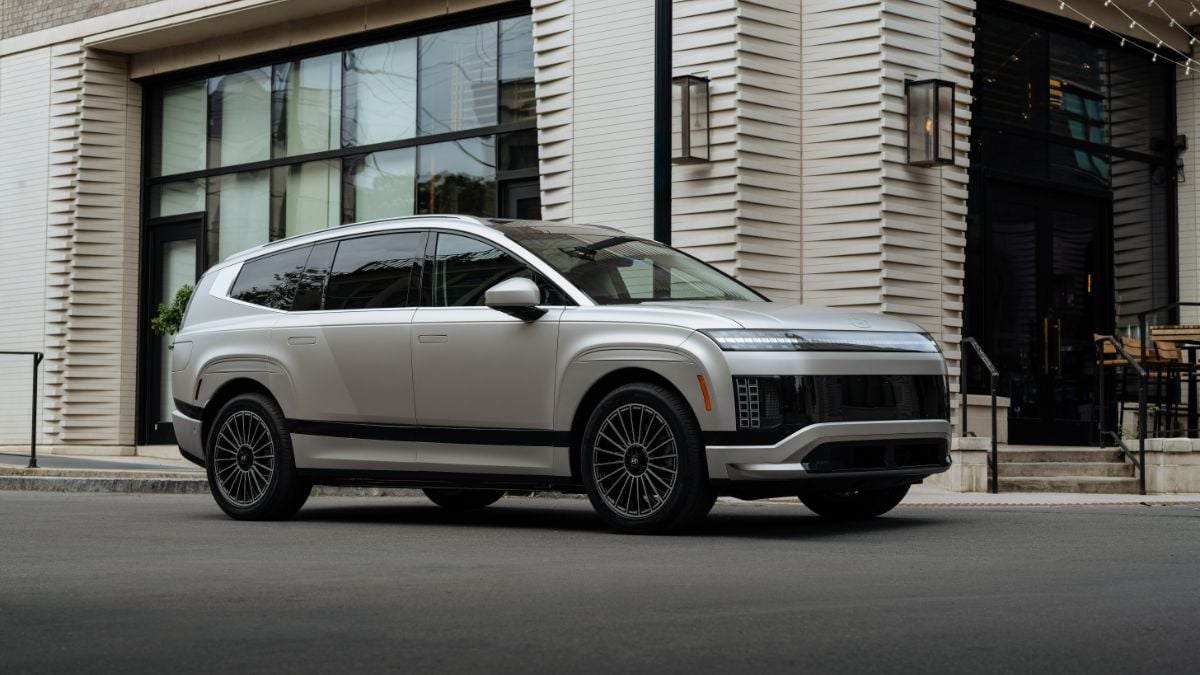
At higher speeds with more heating or cooling, he trims that to about 2.5 miles per percent and warns that in negative temperatures with strong winds, 50 percent of the battery can mean only about 100 miles of highway driving. The original poster replied that he thought he was already being careful using 3 miles per percent, only to discover in heavy wind and below freezing temperatures that he was really getting closer to 2 miles per percent. That is how you end up rolling into a charger with 8 percent remaining and a much deeper respect for both thermodynamics and weather maps.
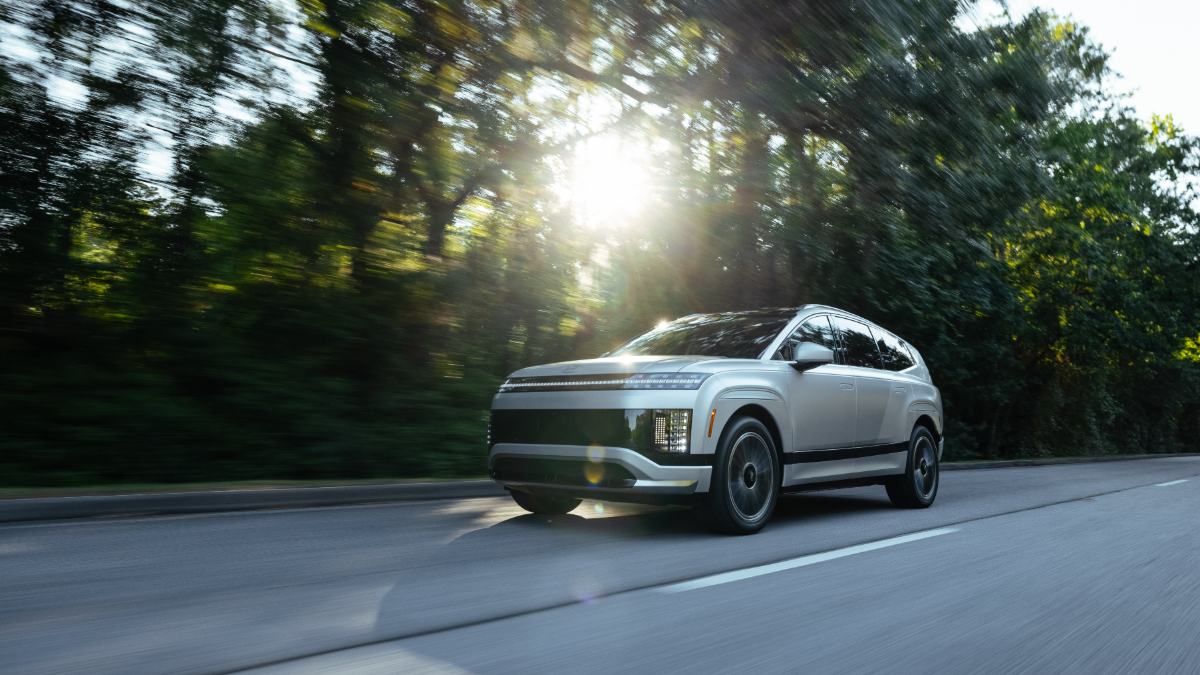
The trip also turned into a case study in what happens when sophisticated driver aids meet physics on the worst day of the year. The owner discovered that the dal and ice did not get along. Regenerative braking is wonderfully efficient when there is grip; it turns momentum back into energy instead of wasted heat, but on slick pavement, any sudden deceleration can upset the balance of the vehicle. The same went for lane keeping and Highway Driving Assist. On a dry interstate,erstate those systems can take some of the strain out of long-haul driving. On an icy road where the safe line means edging away from shiny patches, the steering corrections became something the driver had to fight. He started the storm with a full roster of driver assistance and ended it with most of it switched off, a sensible decision that respected the limits of every sensor and algorithm in the car.
Route planning became its own subplot. The owner started with A Better Routeplanner, then abandoned it when the stops felt too frequent, likely because the parameters were not properly set for realistic winter margins. He bounced between the Tesla app, the paid Supercharger route planner, and the Ioniq’s own navigation system, which insisted on sending them through Chicago when they wanted to avoid it. Commenter ElectroSpore pointed out that the Ioniq 9 built-in planner, assuming the Bluelink subscription is active, can precondition the battery for fast charging and shows three range estimates on the dashboard. The smallest number, the worst case, is the one to obey when the route climbs in el, elevation or the weather turns against you. The advice arrived after the fact, but it fits the spirit of the trip. This was a family learning how to reconcile what the screen says with what the sky says.
Out on those rural Iowa roads, charging infrastructure moved from abstraction to reality. There were no Tesla Superchargers across the last stretch, so the family leaned on PlugShare, sought out dealership chargers, and read recent reviews to make sure each station was alive before rolling in on a cold battery and colder wind. That is modern roadcraft in the center of the country. It is not a failure of the car or the driver; it is simply how unevenly built out the network remains in certain regions and how much more planning winter requires. Reaching one of those chargers with an 8 percent state of charge is not a sign of recklessness; it is the point where caution, calculation,n and a little luck meet.
What stands out in the original post is the tone. There is no blame thrown at the car, no ranting about software, no condemnation of electric travel. The owner calls himself a rookie, accepts that many of the issues came from his own inexperience, and labels the whole journey a success that will be refined on the next outing. That is how all serious long-distance driving skills are built, whether the vehicle burns gasoline or draws current. You go out, you misjudge a headwind, you learn to respect elevation and temperature, you discover which electronic helpers are assets on ice and which ones you prefer to leave off until spring.
The larger lesson here applies far beyond one family, one Ioniq 9, and one Thanksgiving storm. This is a vast country with climates that can flip from shorts weather to parka conditions in a single long day behind the wheel. Ice storms are not rare visitors; they are recurring tests of judgment. Any driver planning a winter run from the upper Midwest to the Appalachians needs three things. A wide margin in the battery or fuel tank, a flexible plan that accounts for weather and topography, and a jacket within arm’s reach,h no matter what the thermometer said when they left home. The road is still the teacher, and it has a way of grading on a curve that always favors the cautious.
Image Sources: Hyundai Media Center
Noah Washington is an automotive journalist based in Atlanta, Georgia. He enjoys covering the latest news in the automotive industry and conducting reviews on the latest cars. He has been in the automotive industry since 15 years old and has been featured in prominent automotive news sites. You can reach him on X and LinkedIn for tips and to follow his automotive coverage.
Set Torque News as Preferred Source on Google
Follow us today...


Comments
Just a completely crazy idea…
Permalink
Just a completely crazy idea… but did you not consider just *not* traveling in such inclement weather? You might think it ‘just a bit of an adventure’ but I can assure you that if things go wrong (which they are apt to do in such conditions, especially when it’s clear you don’t really know what you’re doing) that the emergency services, obliged to come and rescue you, will have a rather different and somewhat negative attitude towards your obvious recklessness.
Never use regen in snow or…
Permalink
Never use regen in snow or ice as it's like having your foot on the brake all the time. Stupidity 1. Route planning on a ev is in your specic ev app indicating by mileage charger availability location and by miles. Stupidity 2. Owners own negligence is stupid 3. At 77 we own 2 ev, 21 mach e GT Performance and 23 model y AWD long which we use the later on long trips. Screen indicates all the info you need at one glance of the route. With 20 rims and a true range on highway speeds of 260 miles charging takes place at 20 to 50% as you travel, pick the charger and that's it.