
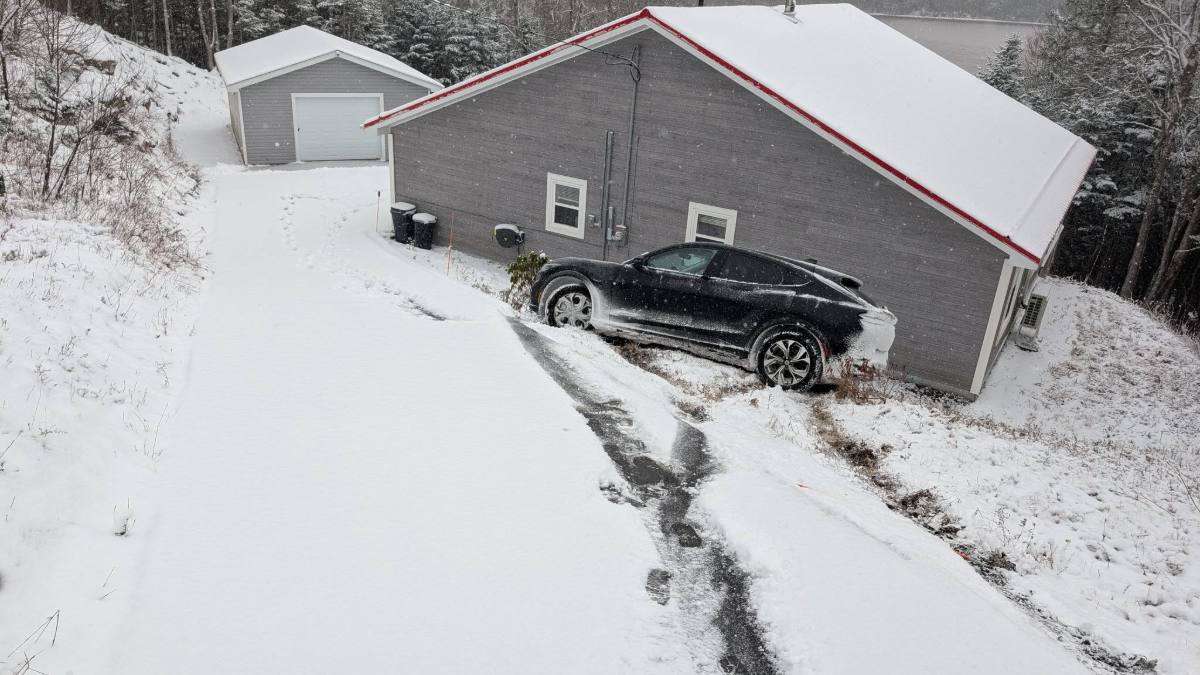

In winter, the automobile has always been a truth teller. Snow strips away marketing claims and glossy impressions, leaving nothing but physics, judgment, and the thin margin between control and consequence. That reality surfaced in a recent Facebook post from a Mustang Mach-E owner in Canada, where modern electric capability met an old, immovable adversary: a steep driveway that does not care how advanced your vehicle may be.
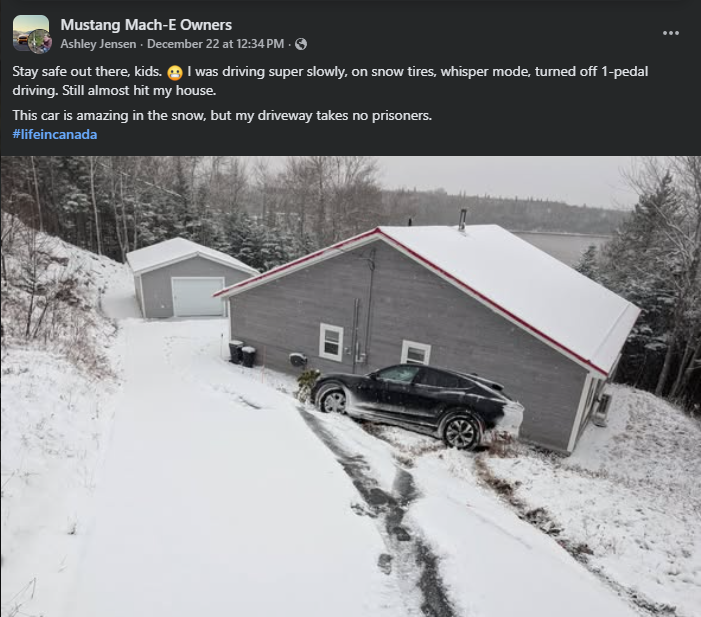
Ashley Jensen shared the moment with disarming honesty. Driving slowly, equipped with snow tires, using the Mach-E’s most conservative “Whisper” mode, and with one-pedal driving disabled, she still nearly slid into her own house. The tone was not accusatory or dramatic, but cautionary.
The car, she noted, was excellent in the snow. Her driveway, however, “takes no prisoners.” It is a reminder that even the most carefully configured vehicle cannot rewrite terrain or weather.
“Stay safe out there, kids. I was driving super slowly, on snow tires, whisper mode, turned off 1-pedal driving. Still almost hit my house.
This car is amazing in the snow, but my driveway takes no prisoners.”
The Mustang Mach-E has earned a reputation for confident winter manners, aided by its low center of gravity, balanced weight distribution, and sophisticated traction control. Those strengths were not in question here. What Jensen’s experience illustrates instead is how driving modes, regenerative braking behavior, and driver expectations interact in low-grip conditions. Snow magnifies every input, including those filtered through software.
Ford Mustang Mach-E: Is it Even a Mustang?
- The Mustang Mach-E adopts a crossover body style that prioritizes passenger space and ride height over the proportions traditionally associated with the Mustang name, reflecting a strategic shift toward broader daily usability.
- Its electric drivetrain delivers smooth, immediate acceleration, though throttle response varies noticeably between drive modes, changing the vehicle’s character from relaxed commuter to firmer, more reactive setup.
- Steering tuning favors stability and predictability rather than sharp feedback, making the Mach-E easy to place in traffic but less communicative on winding roads.
- The interior centers on a large vertical touchscreen that consolidates most climate and infotainment controls, reducing physical switchgear while increasing dependence on menu navigation for routine adjustments.
That nuance quickly emerged in the comments. One owner remarked that using the more aggressive “Unbridled” mode in snow can actually improve braking feel compared to Whisper mode, a counterintuitive observation that reflects how regenerative braking and stability systems are tuned differently across drive modes. Another commenter pushed back on the idea that one-pedal driving helps in snow, underscoring a recurring theme among EV owners: regenerative braking can be both a benefit and a complication, depending on conditions and familiarity.
The discussion then shifted from traction to aftermath. Observers noticed the way the vehicle appeared to be winched or recovered and raised concerns about proper tow points. On vehicles like the Mach-E, where the battery pack is a structural and financial centerpiece, recovery procedures matter. Only specific, manufacturer-approved locations are designed to handle the stress of towing or winching without risking damage underneath. It is the kind of detail few drivers think about until the day they need it.
What makes this exchange valuable is not the disagreement, but the collective problem-solving. No one questioned Jensen’s judgment or the car’s capability. Instead, owners compared notes, corrected assumptions, and filled in gaps that rarely make it into owner manuals in a memorable way. This is how modern car culture functions now, less bench racing and more shared field reports.
There is a broader lesson here, one that extends beyond the Mach-E or even electric vehicles in general. As cars become more configurable, with layers of software mediating throttle, braking, and stability, the driver’s role shifts from purely mechanical input to informed selection. Knowing which mode works best on dry pavement does not guarantee it will behave the same way on ice. Mastery now includes understanding the logic behind the systems, not just trusting them.
Winter driving has always rewarded humility. Jensen’s post captures that spirit perfectly. The car did what it could. The driver did her part. Nature still had the final say. In the end, the value of the story lies not in how close the call was, but in how openly it was shared. In a season where conditions can turn unforgiving without warning, that kind of honesty may be the most useful safety feature of all.
Image Sources: Ford Media Center
Noah Washington is an automotive journalist based in Atlanta, Georgia. He enjoys covering the latest news in the automotive industry and conducting reviews on the latest cars. He has been in the automotive industry since 15 years old and has been featured in prominent automotive news sites. You can reach him on X and LinkedIn for tips and to follow his automotive coverage.
Set Torque News as Preferred Source on Google
Follow us today...


Comments
I have read the article…
Permalink
I have read the article twice and I can't figure out what the point is. What is the correlation between an icy driveway and a Mach E? I am not trying to be rude or difficult, I just don't get it.
Just a cautionary tale. It…
Permalink
In reply to I have read the article… by Dan (not verified)
Just a cautionary tale. It highlighted that caution is needed when driving in snow and other poor weather conditions. It also highlighted that in this age of information, information is being shared more heavily.
This is AI slop. The…
Permalink
In reply to I have read the article… by Dan (not verified)
This is AI slop. The algorithm knew your browser history and created this "article" for similar users. And Google delivered the slop to you
Retarded article. Shovel…
Permalink
Retarded article. Shovel your driveway
If they are allowed where…
Permalink
If they are allowed where you live... with a driveway like that, studded tires might be the way to go.
That's operator error. If…
Permalink
That's operator error. If you have a steep driveway and KNOW there is ice under that snow, you park on the street, remove the snow from the driveway and salt it. THEN drive down it. This had nothing to do with the car or the driveway and everything to do with the driver.
Maybe you should clean and…
Permalink
Maybe you should clean and salt your driveway like any responsible adult would instead of complain.
So true. So true. The…
Permalink
In reply to Maybe you should clean and… by Greg (not verified)
So true. So true. The picture of the 'sliding incident' definitely shows a driveway that needs serious attention in the winter.
All cars have specific…
Permalink
All cars have specific recovery points😅 There are times when they're not accessible or impractical to use. Then you need to make a cost benefit analysis decision.
That line tells the whole…
Permalink
That line tells the whole story. Gotta love when people like this tell a half story lol
Turning off the one pedal…
Permalink
Turning off the one pedal driving was her first mistake. Regenerative braking works a lot like engine braking on an ICE vehicle, where you use the engine and lower gears in the transmission to slow down instead of the brakes, and is preferable in icy conditions. If you don't know how to drive a vehicle in austere weather conditions, then don't. It's safer for everyone else.
Don't have these issues with…
Permalink
Don't have these issues with my 4WD 3/4 Ton pickup! Leave the EV jokers in town for the summer time!
If your driveway is that…
Permalink
If your driveway is that steep you shouldn't be letting it get that covered in snow/ice. Shovel and salt your property ffs,100 percent your fault, nothing to do with the car.
That EV is 4300 to 5000 lbs…
Permalink
That EV is 4300 to 5000 lbs. It's going to have excellent traction in all environments. Definitely a driver skill issue.
You're stupid for driving a…
Permalink
You're stupid for driving a mustang in winter. They should only be driven in nice weather. It is a sports car and not for snow/ice. Smarten up
Okay. So the comments…
Permalink
Okay. So the comments include gatekeeping and some weak representation of the supposed alpha male.
First of all, it's Canada. Shovelling a driveway is insane. Plowing is preferred, but still better traction on snow over ice instead of plowing to warm said snow with the blade scraping to create ice over snow over ice.
Second, Using salt in -40c (that's Celsius not fahrenheit, do the math) is useless. Learn to read the bags. Dirt works better and no one is using that much cat litter.
Third, she... That's all for the third point.
Fourth, she's Canadian. They all have chains. Evidently she didn't receive the welcome package.
Fifth, 3/4 ton pickup guy having to point out the size of his truck proved his own fallacy. Anyone that drives a pointless tank has never seen a hill.
My addition: Besides the lack of chains, it's an EV which are tons heavier than fuel vehicles. People can debate heavy vs light all day, but ice doesn't care if you're Calista Flockhart or a one ton Tania. My biggest point is that driveway. What woman designed this mess? A downward slope pointing at the house with a left bend. I bet it was the same as the OP. Anyone with a brain would have a barrier or natural wall there. People just love to post their ignorance online.
Is the point of this that…
Permalink
Is the point of this that you need to always learn the quirks of how your particular car responds in snowy and slippery conditions?