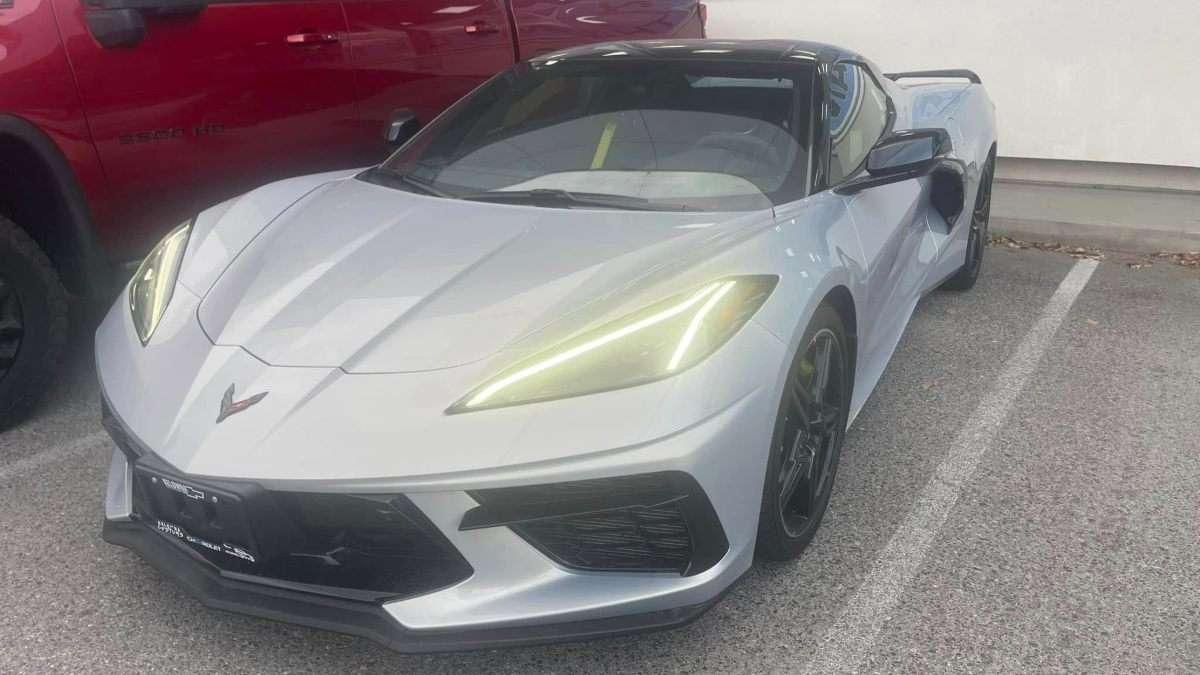

There's something uniquely Canadian about getting a speeding ticket while test-driving a Corvette. Not the speeding part, mind you, but the bureaucratic precision with which the whole affair unfolds, complete with ICBC funding schemes and "ghost trucks" lurking on Highway 33. David Greer's experience is a perfect storm of automotive enthusiasm meeting the cold, calculating machinery of modern traffic enforcement.
The beauty of Greer's story isn't just the ticket itself; it's the theatrical absurdity that follows. After getting nailed for allegedly doing 30 over, he sets his cruise control to a painfully legal 99 km/h in a 100 zone. What happens next is pure comedy: the same officer shadows him, matching his speed exactly, creating a bizarre automotive pas de deux on a two-lane highway where everyone else passes them both.
“Took my first test drive in a C8 yesterday. It was very much fun using the paddle shift, like I am used to in my C7.
Just driving with traffic flow and talking to the salesman about adjusting the climate controls.
I guess I lost my concentration for a few seconds as I automatically slowly cruised into the passing lane and past an ICBC-funded RCMP officer in a black ghost truck.
I told him I was on a test drive, and he said you were speeding.
I asked him what the speed limit was.
He said I was doing 90 in a 60 zone and asked for my driver's license.
I said, “No way I was speeding.”
The passenger also said No way.
Long story short, I was accused of speeding and given a (money grab) speeding ticket on a test drive.
No breaks, driving a Corvette.
After getting back on the road, I went quickly through the gears to 60 km/hr and set the cruise control. Increasing the car to 99 in a 100 kph zone.
Advertising
Who do I see following me but Johnny Law, matching my speed. It was a two-lane part of Highway 33 going uphill. So all the traffic was passing me as I slowly accelerated to 99 using the cruise control, except, of course, for the black ghost truck. He eventually broke off near the top of the hill.
I drove another 10 km before turning around.
Who do I see driving in the other direction, still on patrol, looking for more money for ICBC?
It’s not about safety; it’s all about a pure money grab for ICBC. Where is Premier Doug Ford when you need him?
PS: The Premier of Ontario just banned money-grabbing speed cameras in Ontario.
Cities in Ontario were using the money generated to bolster the city’s coffers. Actually, another tax grab.
BC politicians should do the same. Get rid of the ICBC money-grabbing speed cameras and the money-grabbing scam of funding extra police to write more tickets.
With rising costs and tough economic times, the citizens of BC deserve to be given a break.
I definitely need a financial break.
I am just a poor retired citizen feeling inflation at every turn. My pension does not cover the increased cost of living. Just saying. I hope this post does not violate the group's policies.”
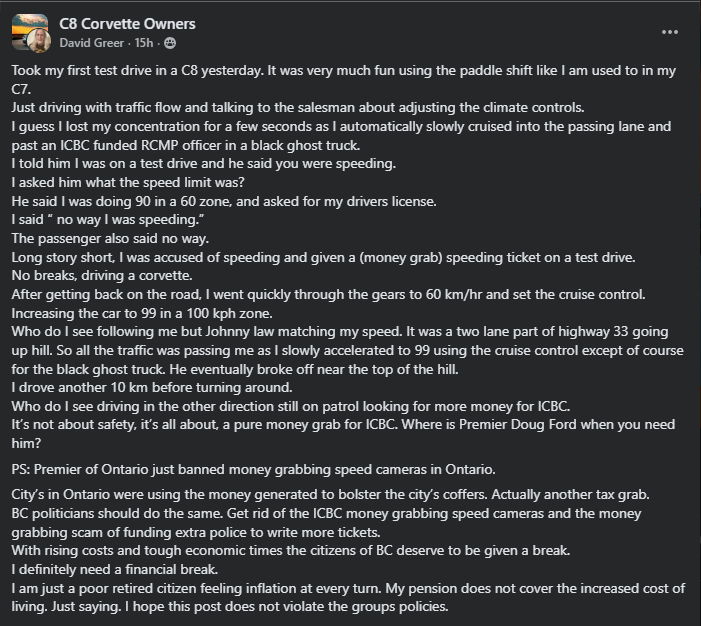
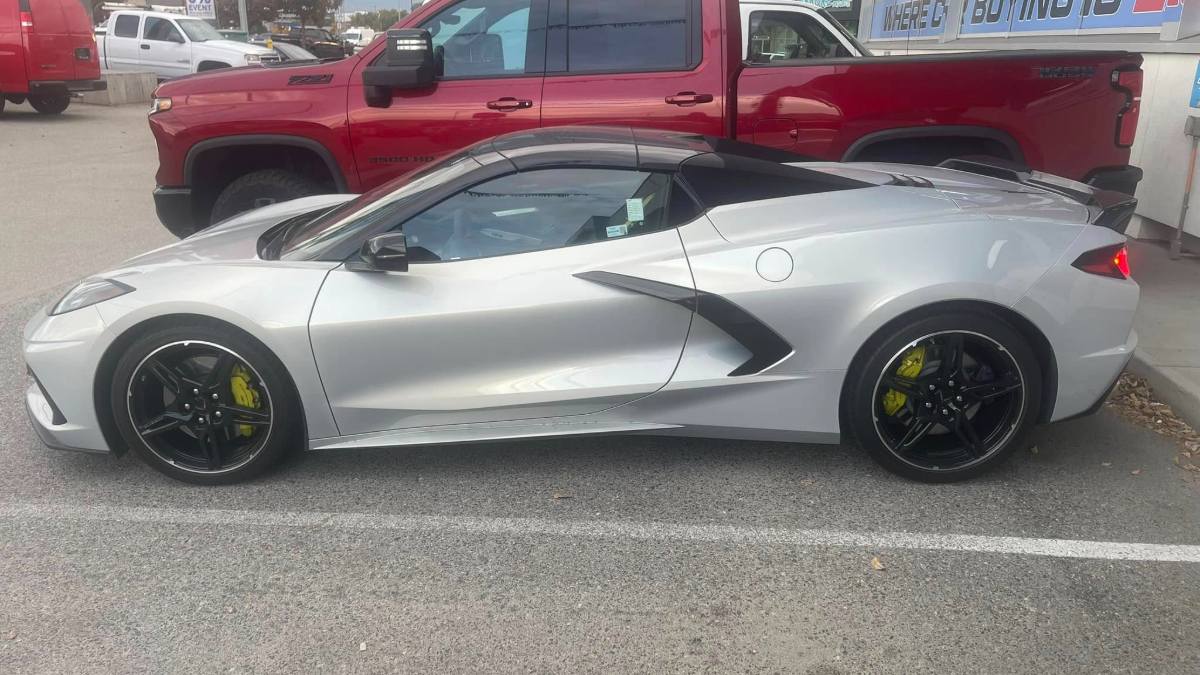
The C8 Corvette is a car that begs to be driven. With 495 horsepower and a mid-engine layout that puts supercars to shame, it's engineered to make ordinary speeds feel glacial. The paddle shifters, the exhaust note, the way it hunkers down and devours pavement, all of this is designed to awaken something primal in the driver. Yet we're expected to pilot these machines in a regulatory environment that treats any deviation from posted limits as criminal behavior.
Greer's experience highlights the fundamental disconnect between automotive engineering and traffic enforcement. The Corvette ownership experience shouldn't include navigating legal minefields during test drives. We build cars capable of 200 mph, then create a legal framework that criminalizes using even a fraction of that capability. The C8 can hit 60 mph in under three seconds, but heaven forbid you accidentally exceed the speed limit while marveling at its capabilities during a test drive.
The ICBC connection adds another layer of institutional cynicism to the whole affair. British Columbia's insurance monopoly has a vested interest in traffic violations because they generate revenue while simultaneously justifying rate increases. It's a beautiful racket: fund enforcement that creates violations, then uses those violations to justify higher premiums.
2025 Chevrolet Corvette Special Features
- The C8 is the first Corvette to feature a mid-engine layout, placing the engine behind the seats for improved balance, handling, and performance dynamics.
- It’s powered by a 6.2-liter naturally aspirated LT2 V8 that produces around 490 horsepower, or 495 hp with the performance exhaust option.
- The car uses an 8-speed dual-clutch automatic transmission that delivers lightning-quick shifts and sends power to the rear wheels only.
- The Corvette C8 Stingray can sprint from 0–60 mph in under 3 seconds, rivaling much more expensive European supercars.
- It offers a premium, driver-focused cockpit with high-quality materials, digital displays, and features like a performance data recorder and customizable driving modes.
What's particularly galling about Greer's experience is the complete absence of actual safety considerations. He wasn't weaving through traffic, racing other cars, or endangering pedestrians. He was momentarily distracted during a test drive of an unfamiliar vehicle, the kind of minor attention lapse that happens to every driver multiple times per day. The difference is that he was driving something that looked fast, making him an attractive target for revenue generation.
The economic reality behind modern traffic enforcement is rarely discussed openly, but it's the elephant in every courtroom. Small municipalities have discovered that aggressive traffic enforcement can fund entire police departments. Speed cameras, red light cameras, and aggressive patrol strategies aren't about safety; they're about balancing budgets on the backs of drivers.
Greer's mention of Ontario Premier Doug Ford banning photo radar reveals the political dimension of this issue. When politicians start recognizing that traffic enforcement has become primarily a revenue tool rather than a safety measure, change becomes possible. But until then, drivers remain cash cows for municipal governments and insurance companies.
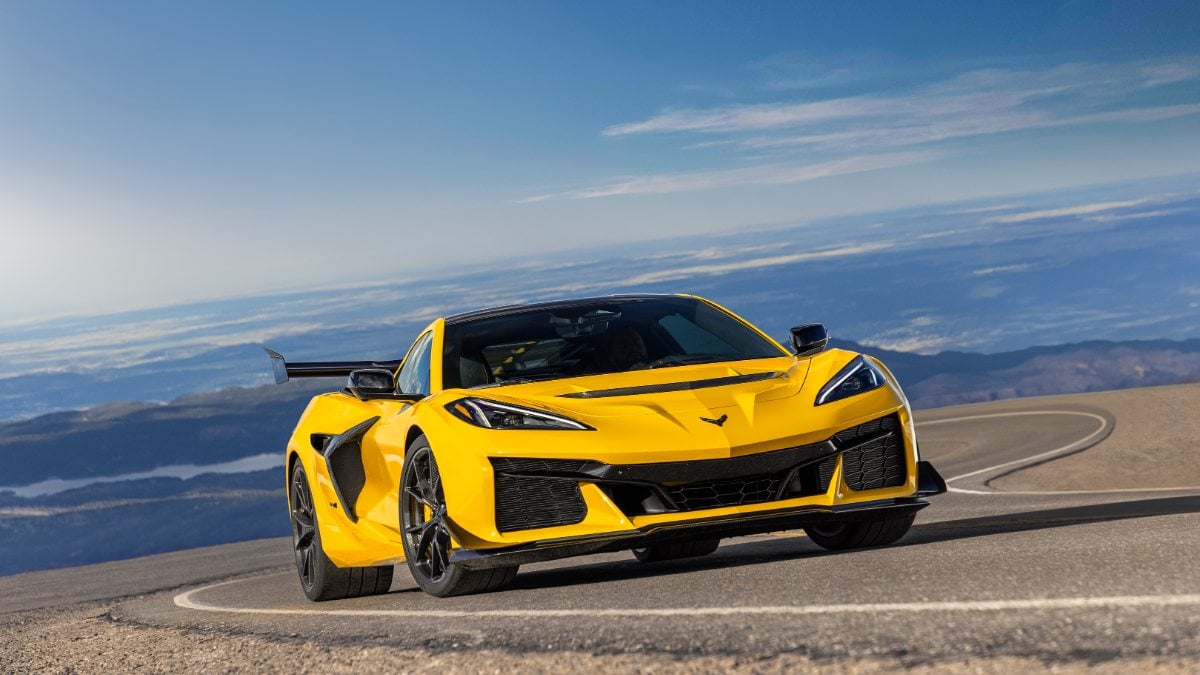
The irony of getting a speeding ticket during a Corvette test drive is almost too perfect. Here's a man considering a significant purchase, experiencing the product as intended, only to be penalized for that experience by a system that profits from his punishment. It's like being arrested for test-firing a gun at a shooting range or getting a noise violation for trying out speakers at an audio store.
The C8 Corvette represents the pinnacle of American automotive achievement, a car that can legitimately compete with European exotics at a fraction of the price. The future of American sports cars depends on creating legal space for performance. But what good is all that engineering excellence if actually using it makes you a criminal? We've created a transportation system where the vehicles far exceed the legal framework governing their use.
Modern sports cars come equipped with launch control, track modes, and performance data recorders, yet we're expected to use them exclusively within speed limits designed for 1970s economy cars. The Corvette's engineering excellence deserves better than a regulatory framework designed to criminalize performance.
Greer's story is ultimately about more than one traffic stop. It's about the systematic monetization of driving, the criminalization of automotive enthusiasm, and the growing disconnect between what our cars can do and what we're legally allowed to do with them. Every sports car owner has a version of this story, and every one of them reveals the same truth: the system isn't designed to promote safety. It's designed to generate revenue.
Have you ever been targeted for driving something that looks fast, regardless of your actual speed? How do we balance legitimate safety concerns with the obvious revenue motivations behind modern traffic enforcement? Share your thoughts in the comments below.
Image Sources: Chevrolet Media Center
Noah Washington is an automotive journalist based in Atlanta, Georgia. He enjoys covering the latest news in the automotive industry and conducting reviews on the latest cars. He has been in the automotive industry since 15 years old and has been featured in prominent automotive news sites. You can reach him on X and LinkedIn for tips and to follow his automotive coverage.
Set Torque News as Preferred Source on Google
Follow us today...