
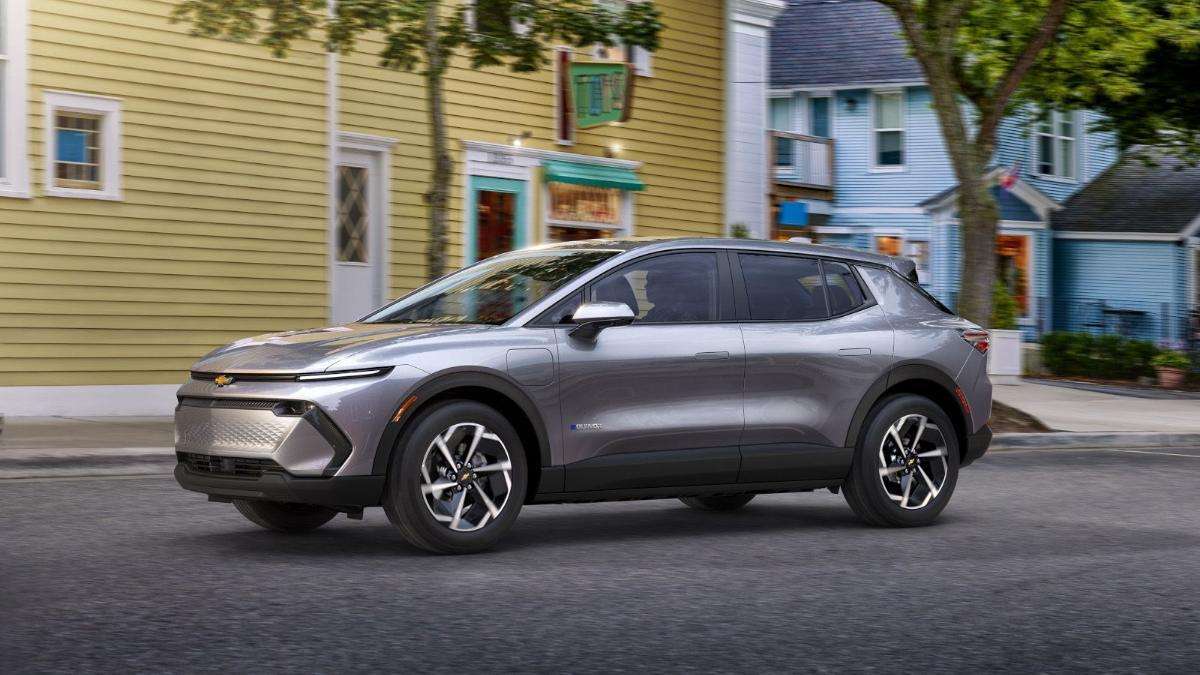

The daily commute is where electric vehicles shine, offering a quiet, efficient, and often delightful driving experience. But the true test for many potential EV owners lies in the long-distance road trip. It’s a scenario filled with questions about range, charging infrastructure, and the real-world impact on travel time. Grant Tucker, a new Chevy Equinox EV owner, recently embarked on a 640-mile round trip and shared his experience, providing a transparent look at the current state of EV travel.
His journey reveals a technology that has come a long way since his first Chevy Volt in 2013, but one that still presents a learning curve.
Tucker’s trip was a tale of two charging networks. His initial experience with Electrify America was less than ideal, a common story among non-Tesla EV owners. The promise of high-speed charging often clashes with the reality of station performance. On the other hand, his decision to use the Tesla Supercharger network on the return trip, armed with an $80 adapter, proved to be a game-changer.
“Took a trip of 320 miles each way. First, let me say that the Electrify America stations were troublesome and didn’t seem to charge at a very high rate, somewhere around 80kW, even using a 350kW station. I didn’t use an app, just a credit card. On the return trip, I used Tesla exclusively with the Tesla app, and it would charge at 150kW almost instantly. I had no trouble with the stations or the $80 adapter I used from Amazon. Before starting the trip, I charged it to 100%, showing about 315 miles. I couldn’t even get close, barely getting to 200. On the return, I started at 80% and had to make three stops to charge. This added about 40 minutes to the normal 5-hour drive. My wife loves the car and drives it every day to work, but she didn’t like the charging stops, the extra time, and the short range driving at 80+ mph. I don’t mind the charging stops, but I was disappointed in the range. Overall, this is not a complaint, just a reality check on the technology today. It is night and day from where it was in 2013 when we bought our first Volt. I love the car.”
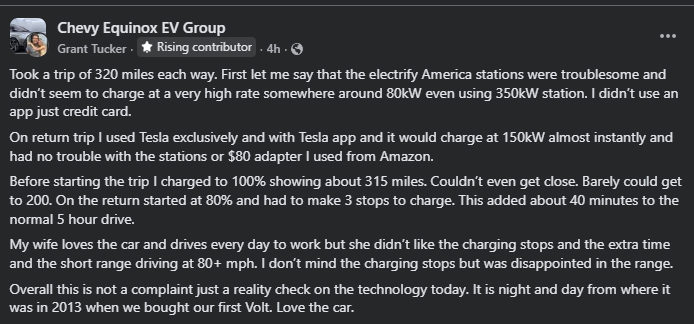
The disparity in charging speeds between networks is a critical point. Another Equinox EV owner, Barbra Bateman, chimed in with her own experience, suggesting that the issue might not just be the charger, but a combination of factors. Her insight highlights the nuances of EV charging that new owners must learn.
"When I had my Equinox, I found that the 150kW EA chargers worked better. The 350kW chargers were disappointing, but the car only handles 150kW."
This detail is crucial; using a 350kW charger doesn't guarantee faster speeds if the vehicle itself has a lower maximum charging rate. This reality check is important for managing expectations on the road, where time is of the essence. The experience underscores a broader trend where Tesla's charging network is often seen as more reliable than its competitors.
The Speed vs. Range Dilemma
Tucker’s disappointment in the Equinox EV’s range while driving at over 80 mph touches on a fundamental law of physics that affects all vehicles, but is especially pronounced in EVs. High speeds dramatically increase energy consumption.
While Tucker’s wife disliked the extra time and short range, another commenter, Dave Massi, pointed out the social pressures of modern highway driving.
"Most spots that are 70-75 mph limit, you have to do 80-85 to pace traffic; otherwise, you’re going to cause an accident."
This comment frames the speed issue not as a choice but as a necessity in certain traffic conditions, adding a layer of complexity to the "just drive slower" argument. The trade-off is clear: maintain speed with the flow of traffic and stop more often, or drive slower to maximize range and potentially create a different kind of hazard. This is a consistent finding across many EVs, where even a small reduction in speed can lead to significant gains in efficiency.
Key Road Trip Realities for EV Owners
- Not all charging networks are created equal; reliability and speed can vary significantly between providers.
- A car's maximum charge rate is a critical factor; a 350kW station won't charge a car faster than its own limit.
- Driving at high speeds (80+ mph) can reduce an EV's estimated range by 30% or more.
- NACS adapters can provide access to the reliable Tesla Supercharger network, but they come with their own considerations.
The Adapter Question: Convenience vs. Caution
The successful use of a third-party NACS adapter was a key part of Tucker's improved return journey. However, this convenience comes with a word of caution from other EV owners. Shawn Moseley offered a critical piece of advice regarding the safety of these high-powered accessories.
"Don't get adapters from no-name brands. There is a lot of current, and therefore heat, that goes through these things. The last thing you want is a fire or the risk of electrocution."
This is a vital reminder that not all adapters are created equal. While the ability to access Tesla's network is a huge advantage, it's crucial to invest in a quality, certified adapter to ensure safety.
The risks associated with uncertified electronics are significant, a lesson some EV owners have learned the hard way with other accessories.
Best Practices for EV Road Tripping
- Charging network apps often provide a more seamless experience and better pricing than credit card readers.
- Understand your vehicle's maximum charge rate to choose the most effective charging stations.
- Factor in speed, terrain, and weather when planning charging stops, as the dashboard range is often optimistic.
- If using a NACS adapter, purchase it from a reputable brand to ensure safety and reliability.
Tucker's journey is a perfect snapshot of the modern EV ownership experience. It's a mix of impressive technology, frustrating infrastructure, and a steep learning curve. While his wife's frustration with the added time is valid, Tucker's perspective as a long-time EV driver shows an appreciation for just how far the technology has come. The Equinox EV is a car he loves for daily driving, and while road trips require more planning, the experience is a world away from the EV landscape of 2013. His story is a valuable "reality check" for anyone considering the switch, confirming that while the future is electric, it still requires a bit of patience. For many, the benefits of electric driving, as one owner on a 1,000+ mile road trip in his Equinox EV discovered, far outweigh the occasional inconvenience. As more drivers share their experiences, the community continues to learn valuable lessons about maximizing EV efficiency on long trips.
What's your experience with EV road trips? Have you found significant differences between charging networks, and what's your strategy for balancing speed with range on long highway drives? Share your thoughts and experiences in the comments below.
Noah Washington is an automotive journalist based in Atlanta, Georgia. He enjoys covering the latest news in the automotive industry and conducting reviews on the latest cars. He has been in the automotive industry since 15 years old and has been featured in prominent automotive news sites. You can reach him on X and LinkedIn for tips and to follow his automotive coverage.
Set Torque News as Preferred Source on Google
Follow us today...





Comments
At the end of August I took…
Permalink
At the end of August I took my 2018 Chevy Bolt on a 2200 mile round trip from Central Kentucky to Palm Beach florida, and back with a stop in Knoxville Tennessee and many other stops along the way.
I was surprised that I was not even tired when I returned from that 10-day driving trip, driving alone. The Chevy Bolt was quiet and smooth and chewed up the miles easily. The slow charging speed was a drawback, but I prepared for that in advance by bringing a pillow and a light blanket, and often taking naps when I would stop at a charging station for 45 minutes to an hour.
Even though I am in my mid 60s now, I wouldn't hesitate to take it on another long road trip east of the Mississippi. But once you get west of the Mississippi, fast DC chargers become a bit more sparse in the Midwest and you have to be mindful and know where charging stations are (the Plug Share app is a lifesaver) but east of the Mississippi it is no problem finding fast charging stations.
My first gen Chevy Bolt was a surprisingly excellent road trip vehicle.
I have a 2024 ID4 Pro RWD. …
Permalink
I have a 2024 ID4 Pro RWD. I went on a 420 mike road trip from NJ to Montreal, Canada. I only required 2 charging stops on EA and the other a Tesla (with Magic Dock). Both charges at max 175kw. My highway speed was a steady 72mph and the car registered 3.9 mi/kWh. It was a flawless experience.