
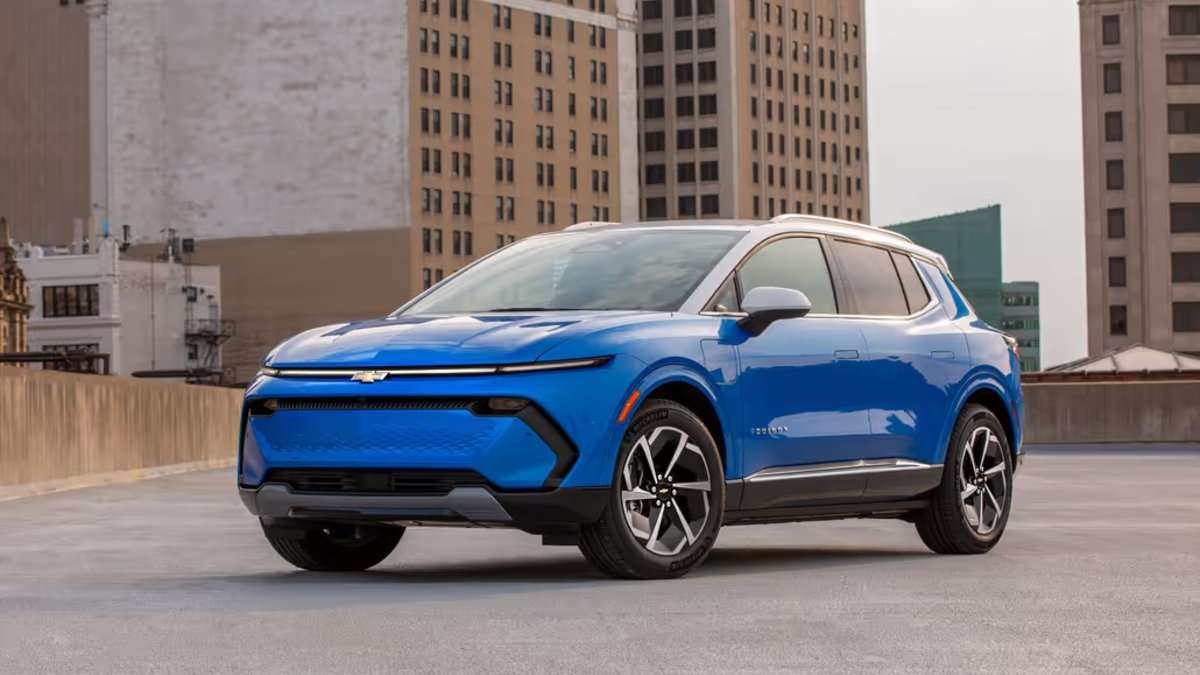

There is a certain boldness required when setting out on an EV road trip, a feeling not unlike the early Cannonball days when the map was more suggestion than certainty and the only real rule was to keep moving. The modern EV traveler experiences a quieter version of that same tension.
A long-distance drive in an electric vehicle still begins with the unknown. Will the charger work? Will the app cooperate? Will the car decide to communicate politely with someone else's hardware? It is in this mixture of curiosity and apprehension that the best stories are born, which is why a simple Facebook post from a Chevy Equinox EV owner recounting his first Tesla Supercharger experience reads like a small but meaningful victory.
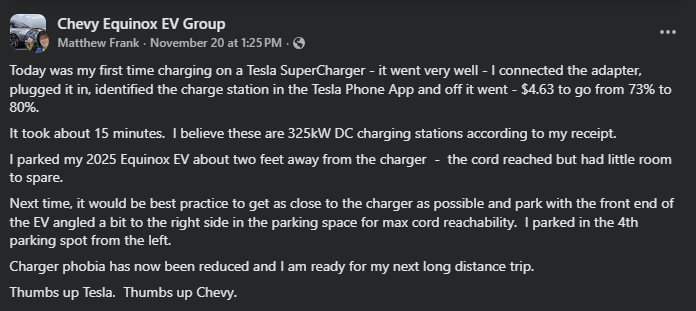
“Today was my first time charging on a Tesla SuperCharger - it went very well - I connected the adapter, plugged it in, identified the charge station in the Tesla Phone App, and off it went - $4.63 to go from 73% to 80%.
It took about 15 minutes. I believe these are 325kW DC charging stations, according to my receipt.
I parked my 2025 Equinox EV about two feet away from the charger - the cord reached, but had little room to spare.
Next time, it would be best practice to get as close to the charger as possible and park with the front end of the EV angled a bit to the right side in the parking space for max cord reachability. I parked in the 4th parking spot from the left.
Advertising
Charger phobia has now been reduced, and I am ready for my next long-distance trip.
Thumbs up, Tesla. Thumbs up, Chevy.”
What Matthew Frank described is ordinary on the surface but significant in context. For a long time, the Tesla Supercharger network stood as a kind of gated utopia for electric drivers. The opening of those stations to non-Tesla vehicles marks a shift in how the EV landscape operates, and Frank's successful session shows that the idea of a shared, interoperable charging network is no longer theoretical. His experience was simple. Drive in. Plug in. Pay a few dollars. Leave with more range than he arrived with. That simplicity matters because it builds confidence, something every EV driver treasures during their first long trip away from home.
The comments on Frank's post deepen the picture. John Veach quickly identified the hardware as a V4 dispenser and noted that the cords on these new units offer generous reach compared to the shorter V3 cables. Dan Carroll confirmed that V4 stations eliminate the awkward parking angles some drivers used to face. These reactions might seem like technical footnotes, but they show a community forming the same sort of shared knowledge that once lived in service stations and late-night diner booths. Except now the topics are kilowatts and cable lengths rather than carburetors and compression ratios.
Practical advice continued to flow. One commenter suggested signing up for Tesla's membership for road trips to save money on charging. Another, Robert Koenn, mentioned planning a test visit to a nearby station to build comfort before attempting a longer journey. These casual remarks represent a new kind of road trip etiquette. Instead of checking tire pressures and topping off washer fluid, today's driver prepares with apps, adapters, and firsthand practice sessions. It is the same spirit of readiness, expressed through new tools.
Then there was the detailed breakdown from Iman Irk. He explained the differences between white 250-kilowatt chargers that require Tesla's built-in adapter and black units that do not. He also pointed out the importance of placing a finger over the green dot on the Tesla charger handle when detaching the connector. These were the sorts of small procedural nuances that manuals rarely mention but that matter enormously in real use. It was advice written by experience rather than by committee, the kind of thing that earns immediate appreciation from anyone who has ever stood at a charger wondering why a connector refuses to release.
What stands out in this exchange is not just the technology but the camaraderie. EV owners compare notes the same way travelers once shared shortcuts and fuel stops. Each successful charge adds another data point and reduces the sense of venturing into the unknown. Frank's accomplishment, modest as it might look, represents one more driver gaining confidence and one more confirmation that the growing network of public chargers is beginning to behave with welcome consistency.
The economics of his session also deserve attention. Four dollars and sixty-three cents for a fifteen-minute stop that provided seven percent more charge is a practical, affordable outcome. The brief wait aligns with the natural rhythm of a road trip. Long enough to stretch and regroup, short enough not to disrupt the flow of the day. This is the sort of real-world performance that dissolves anxiety and replaces it with trust. It does not promise perfection, but it proves that the system works.
That is the transformation at the heart of the modern EV experience. Unfamiliarity gives way to confidence, and the anxiety that once accompanied the first long drive on battery power fades into something else entirely. The dream of a seamless electric road trip is built one small success at a time, and for this Equinox EV driver, a simple stop at a Tesla Supercharger was enough to turn uncertainty into enthusiasm.
Image Sources: Chevrolet Media Center
Noah Washington is an automotive journalist based in Atlanta, Georgia. He enjoys covering the latest news in the automotive industry and conducting reviews on the latest cars. He has been in the automotive industry since 15 years old and has been featured in prominent automotive news sites. You can reach him on X and LinkedIn for tips and to follow his automotive coverage.
Set Torque News as Preferred Source on Google
Follow us today...



Comments
Great post, Noah. I think…
Permalink
Great post, Noah. I think the Equinox owner is confused about what a good result is. "Only" $4.63 for 7% state of charge? That is 21 miles of range. More than gas costs per mile for nearly every five-passenger crossover virtually everywhere in America. And it would have taken about 7 seconds to add that much gas to a hybrid.
You only charged 7% on a…
Permalink
You only charged 7% on a mostly full battery? I guess you were just testing things out, but you’ll get much better results if you run the battery down to like 10% or at least below 20%. Generally the lower the battery percentage the faster the charge.
Also the Chevy Equinox’s peak charging speed is 150kW, so a V4 Tesla Supercharger (350kW) is kind of overkill (ie it’s not really taking advantage of the faster speed). In fact a recent test by Tom of State of Charge says that a 250kW DC fast charger actually charged his Equinox faster than a 350kW DC fast charger.
I have been charging my 2025…
Permalink
I have been charging my 2025 Equinox at a Tesla charger from day one June 18, 2025. Saved 43% compared to all the other chargers near me.