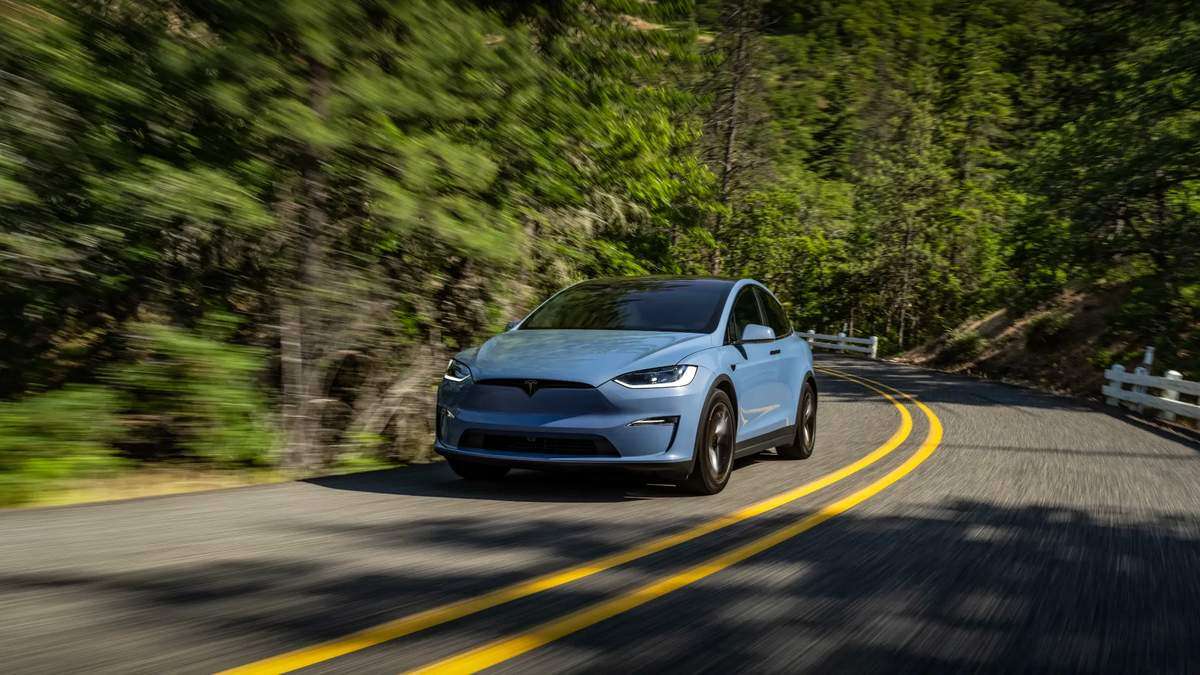

There are few things more stressful for an EV owner than waking up to a nearly empty battery in subzero temperatures, and one Tesla Model X driver in Chicago lived that reality firsthand.
After parking overnight on the street in 9-degree weather with roughly 30 miles of range remaining, he woke up to just 1 percent battery. With nearby Superchargers showing 30-minute waits the night before, he made a decision many urban EV owners have faced, hoping morning charging would be enough to get him moving again. It very nearly was not.
Unable to make it to a Supercharger, the owner plugged in Tesla’s portable 115V charger, a last-resort option in extreme cold. For nearly three hours, the car displayed a discouraging message, charging at zero miles per hour with a warning that less energy was available due to the cold battery. The situation looked bleak, with commenters debating whether the car would ever begin charging at all in those conditions.
“Please don’t judge me!! I had 30 miles of range yesterday, and the superchargers near my house had 30+ minute waits, so I thought I’d be fine to take it in the morning. Parked on the street overnight and woke up this morning to ~1 mile of range thanks to the sub-freezing temps in Chicago. Panicked because I knew I wouldn’t make it to the supercharger, so I used my portable charger (I don’t have a Tesla wall connector) to try to juice up.
It’s been almost 2 hours, and it’s still saying it’s charging at 0 miles/hr. Is it too cold to charge? Not sure what else to do…
Some of y'all on here really had me scared I was going to have to call a tow truck when I posted about my Model X charging from 0% using a portable charger (this one) in sub-freezing temps.
Well... I'm happy to report that it finally started charging after 3 hours! Ultimately, I was able to get to 7% after about 8 hours of charging. I drove to a supercharger, charged to 90% (~50 minutes of charging), and drove back home. 18 hours later, and the battery is holding steady at 89% using low power mode.
Advertising
For additional context, we do have a garage, but it's currently being used as a workroom for some home renovation projects. Parking on the street in our neighborhood is easy, and since we don't have a wall connector, supercharging has always been the most convenient and easy option.
Lastly, thanks to everyone for the advice to use the % as opposed to the mile range for tracking my battery. Will be doing that going forward. Nevertheless, a lesson learned! I definitely won't be playing any games with a low battery this winter in Chicago.”
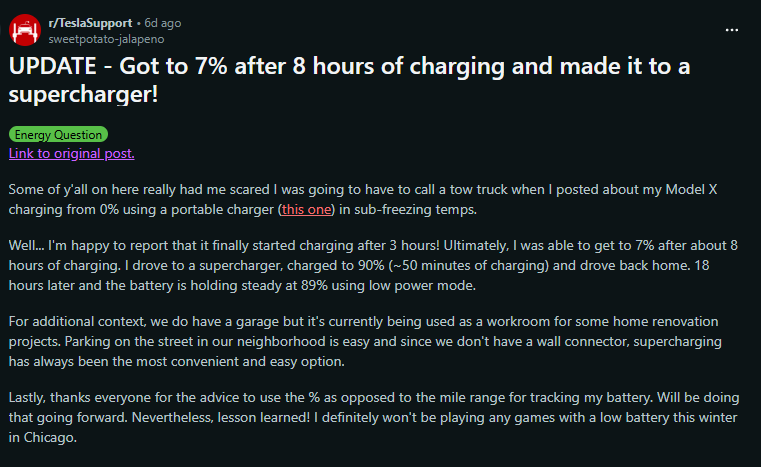
Eventually, patience paid off. After roughly three hours, the battery finally began accepting charge as the pack slowly warmed itself. Over the next eight hours, the Model X clawed its way up to about 7 percent state of charge. That was just enough to make the 2.5-mile drive to a Supercharger, where the owner charged to 90 percent in around 50 minutes and safely returned home.
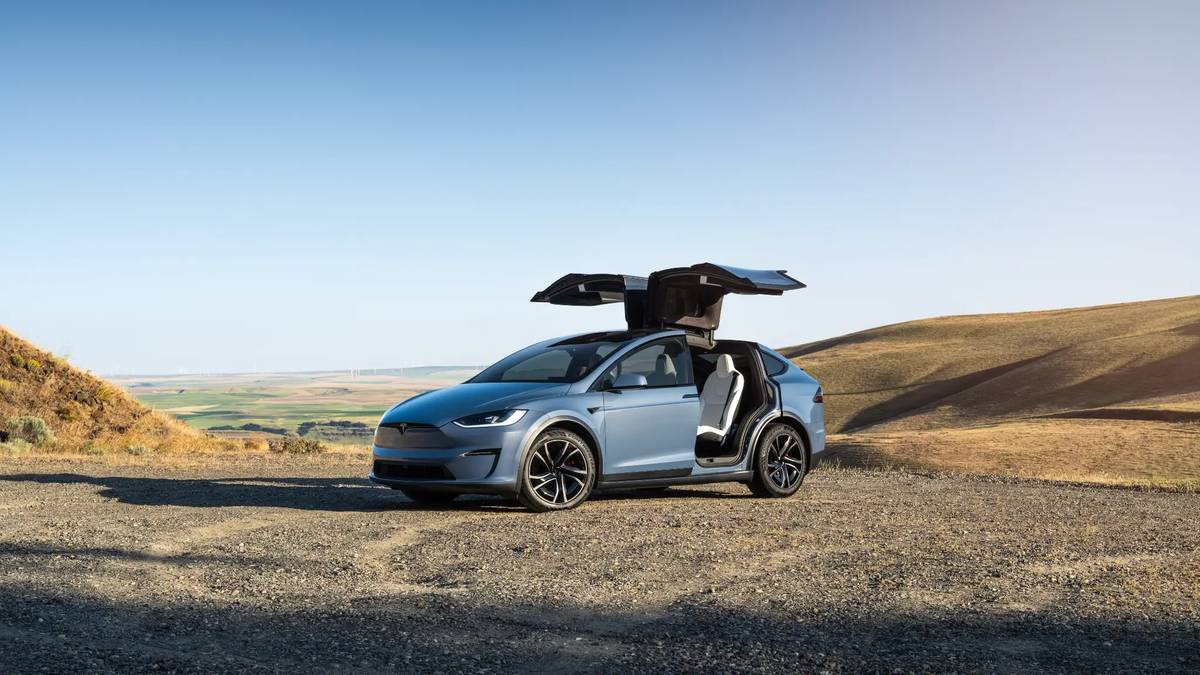
Tesla Model X: Falcon Wing Versatility Meets Touchscreen Simplicity
- The Model X’s battery placement keeps the center of gravity low for a three-row SUV, contributing to stable handling while its mass still shapes braking and cornering feel.
- Falcon Wing doors improve access to the second and third rows, but add mechanical complexity and can be sensitive to clearance in garages and tight spaces.
- Interior layout prioritizes openness and minimal physical switchgear, creating a clean cabin but increasing reliance on touchscreen-based controls.
- Cargo versatility is strong with the rear seats folded and the front trunk available, though third-row use reduces usable rear storage significantly.
The experience highlights a little-discussed but critical reality of EV ownership in extreme cold. At very low temperatures, especially near the empty state of charge, the vehicle may use incoming power primarily to heat the battery before adding usable range. On a low-power 115V outlet, that process can take hours before any visible progress appears, making the situation feel worse than it actually is.
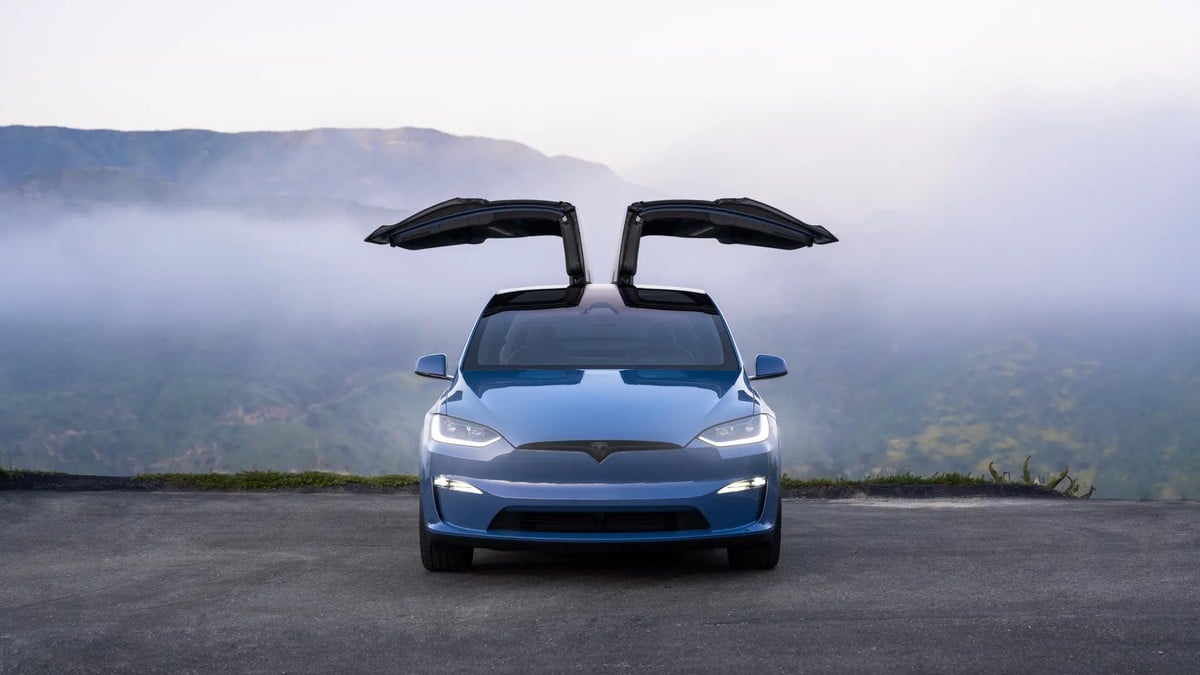
Several experienced Tesla owners chimed in with advice that could have shortened the ordeal. Plugging in immediately after parking while the battery is still warm can dramatically improve charging behavior in cold weather. Even Level 1 charging can help preserve battery temperature and prevent severe overnight losses when connected early enough.
Others pushed back against the idea that a Level 2 home charger is mandatory. Multiple owners shared experiences of surviving harsh winters in cities like Boston and Chicago using Superchargers exclusively, as long as they avoided parking overnight with a low state of charge. The key lesson was not infrastructure, but strategy. Charge higher before parking and do not gamble with low percentages in deep cold.
The owner himself acknowledged the mistake and called it a lesson learned. He also noted a valuable tip he picked up during the ordeal: tracking battery percentage instead of estimated miles, which can fluctuate wildly in cold weather and add unnecessary anxiety. Eighteen hours after returning home, the battery remained stable at 89 percent using low power mode.
This Chicago cold-weather scare ultimately ended without a tow truck, mechanical failure, or permanent damage, but it serves as a clear reminder of EV winter realities. In extreme cold, time, patience, and planning matter just as much as chargers and kilowatts. For Tesla Model X owners and EV drivers everywhere, the story reinforces a simple rule for winter driving. Never go to sleep on a nearly empty battery when the thermometer is working against you.
Image Sources: Tesla Media Center
Noah Washington is an automotive journalist based in Atlanta, Georgia. He enjoys covering the latest news in the automotive industry and conducting reviews on the latest cars. He has been in the automotive industry since 15 years old and has been featured in prominent automotive news sites. You can reach him on X and LinkedIn for tips and to follow his automotive coverage.
Set Torque News as Preferred Source on Google
Follow us today...