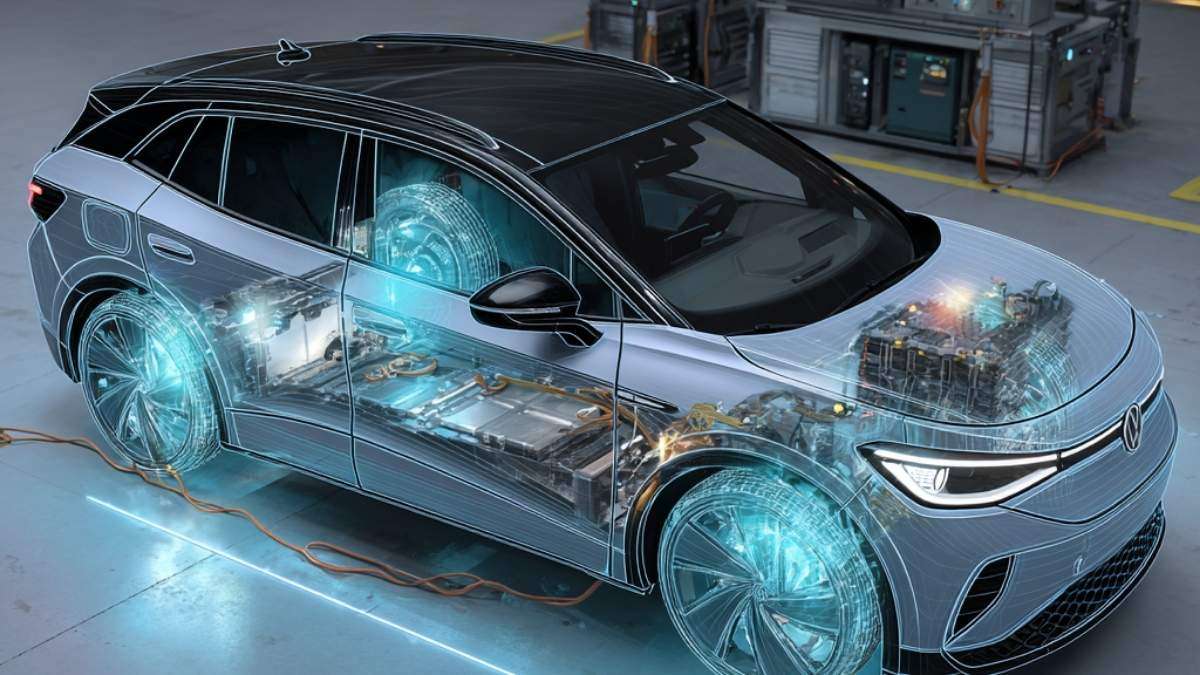

In the ongoing debate about the viability and longevity of electric vehicles (EVs), a recent real-world test provides compelling evidence for the durability of EV batteries and powertrains. Germany’s equivalent to the AA, the ADAC, put a Volkswagen ID.3 through its paces, covering an impressive 107,000 miles. The results were striking: the vehicle reportedly lost only eight miles of usable battery range over that substantial distance. This single test case offers a powerful counter-narrative to common concerns about battery degradation and raises fundamental questions about the long-term reliability of electric cars compared to their gasoline counterparts.
107,000 Miles: A Benchmark of Real-World Use
To put 107,000 miles into perspective, the average American drives approximately 13,500 miles per year. At this rate, an ID.3 covering 107,000 miles would be nearly eight years old (107,000 miles / 13,500 miles/year approx 7.9 years). For many car owners, this mileage represents a significant portion, if not the entirety, of their vehicle's first life cycle. The fact that the battery retained virtually all of its original usable range after such extensive use is a testament to the robust engineering and battery management systems now present in modern EVs. This performance suggests that concerns about rapid battery degradation might be overblown for many contemporary electric models.
Beyond the Battery: EV Reliability Advantages
While battery longevity is a frequent topic, it's crucial to consider the entire vehicle. Electric vehicles inherently possess a simpler mechanical architecture than internal combustion engine (ICE) cars. An EV powertrain typically consists of an electric motor, a single-speed transmission, and the battery pack. In contrast, a gasoline car has hundreds of moving parts in its engine alone, including pistons, valves, spark plugs, a multi-speed transmission, and a complex exhaust system. This mechanical simplicity translates directly into fewer potential points of failure for EVs.
Components like oil changes, spark plug replacements, timing belt services, and exhaust system repairs are entirely absent in an EV. Brake wear can also be significantly reduced due to regenerative braking, which uses the electric motor to slow the car and recapture energy, lessening the reliance on friction brakes. While EVs do have their own specific components that can require attention (e.g., charging ports, power electronics, cooling systems for batteries), the overall consensus among automotive experts is that the reduced complexity of the drivetrain leads to lower maintenance costs and higher reliability over the vehicle's lifespan.
The Lifespan Verdict: EV vs. Gasoline
Given the evidence, it's increasingly likely that electric cars will, on average, outlast their gasoline counterparts. The primary reason for a gasoline car's demise is often engine or transmission failure, or the cumulative cost of maintaining its complex mechanical systems as they age. With EV batteries demonstrating impressive longevity, and the rest of the powertrain being inherently simpler and less prone to wear, the critical components of an EV are built for the long haul. While early EV models might have raised questions, the ADAC's ID.3 test, combined with growing real-world data, suggests that modern EVs are proving to be remarkably durable. The limiting factor for an EV's lifespan may eventually shift from mechanical failure to technological obsolescence or battery degradation that, while slow, eventually makes replacement economically unfeasible for some owners.
Volkswagen's Journey: From Dieselgate to Electrification
Volkswagen, a company with a rich and sometimes controversial history, has faced significant challenges in its transition to electric mobility. Founded in 1937, it rose to global prominence with iconic models like the Beetle. However, the "Dieselgate" emissions scandal, which erupted in 2015, severely damaged its reputation and forced a profound re-evaluation of its corporate strategy. This crisis served as a powerful catalyst, propelling Volkswagen to commit aggressively to electrification as a path to redemption and future relevance.
The company embarked on an ambitious multi-billion-euro investment plan, developing dedicated EV platforms like the MEB (Modular Electric Drive Matrix) and launching a wave of ID.badged electric vehicles. While the initial rollout of some ID models faced software glitches and production hurdles, Volkswagen has shown solid progress. It has become a significant player in the global EV market, particularly in Europe and China, demonstrating a strong commitment to its electric future despite the inherent complexities of transforming a massive legacy automaker.
Global Execution of EVs
Volkswagen's global EV execution has been a mixed bag, but with clear upward momentum. In Europe, the ID.3 and ID.4 have been strong sellers, leveraging the brand's established presence and the region's strong push for electrification. China, the world's largest EV market, is another key focus, with localized production and specific models tailored for Chinese consumers. While the U.S. market has been more challenging, with slower adoption rates for some ID models compared to Tesla or Ford, Volkswagen continues to invest in its American manufacturing capabilities and expand its charging infrastructure partnerships. The company's strategy involves a broad portfolio of EVs, from compact cars to SUVs, aiming to cater to diverse global consumer needs and regulatory environments. This global push, despite initial stumbles, underscores Volkswagen's determination to become a leading force in the electric age.
Wrapping Up
The real-world performance of the Volkswagen ID.3, demonstrating minimal battery degradation after 107,000 miles, offers a compelling narrative for the long-term viability and reliability of electric vehicles. When combined with the inherent mechanical simplicity of EV powertrains, which translates to fewer maintenance needs and potential failure points compared to complex gasoline engines, the evidence strongly suggests that EVs are poised to have longer operational lifespans. Volkswagen's journey from the depths of Dieselgate to its current, albeit challenging, leadership in electrification highlights the transformative power of strategic commitment. While the transition isn't without its hurdles, the data from vehicles like the ID.3 indicates that the future of automotive longevity may well be electric.
Disclosure: Image rendered by Midjourney
Rob Enderle is a technology analyst at Torque News who covers automotive technology and battery developments. You can learn more about Rob on Wikipedia and follow his articles on Forbes, X, and LinkedIn.
Set Torque News as Preferred Source on Google
Follow us today...