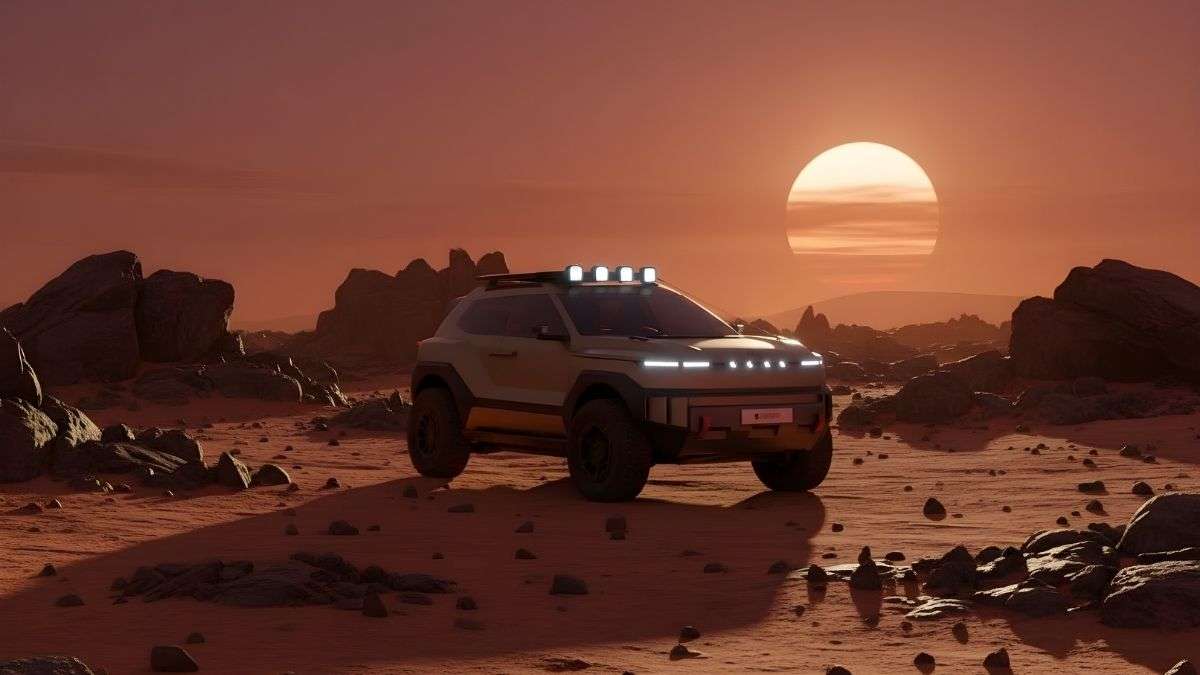

At the Los Angeles Auto Show, Hyundai unveiled something that feels less like a car and more like a distinct challenge to the current brutalist trend in automotive design. It’s called the Hyundai CRATER, and it is a compact, rugged SUV concept that seems to have been forged—quite literally—from the raw ambition to conquer Mars, or at least Moab. While the world has been fixated on the stainless-steel wedge that is the Tesla Cybertruck, Hyundai has quietly entered the chat with a design philosophy they call the “Art of Steel,” and frankly, it makes a compelling argument for why the future of off-roading shouldn’t just be sharp angles and cold metal.
The CRATER was developed at the Hyundai America Technical Center (HATCI) in Irvine, California, and it is a love letter to American ruggedness wrapped in South Korean innovation. As a technology analyst who has watched the automotive industry stumble and sprint toward electrification, I see the CRATER not just as a design exercise, but as a strategic pivot. Hyundai is telling us that the electric future doesn’t have to look like a spaceship; it can look like a piece of heavy machinery that you actually want to drive.
“Art of Steel” vs. The Cybertruck: A Clash of Philosophies
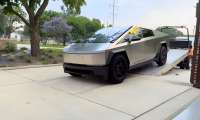
The most striking aspect of the CRATER is its visual aggression. We live in a post-Cybertruck world where “bold” often means “polygonal.” Tesla’s offering is undeniable—a monolithic slab of stainless steel that looks like it rendered on a PlayStation 1. It is brutal, imposing, and unapologetically stark. However, Hyundai’s “Art of Steel” design language takes a different, perhaps more sophisticated approach to industrial aesthetics.
Where the Cybertruck is defined by its planar simplicity, the CRATER is defined by its “shredded” silhouette. It doesn’t just look like a metal box; it looks like a metal box that has been through a war and won. The bodywork is chiseled and complex, featuring a matte “Dune Gold” finish that feels organic to the high desert rather than alien to it. The concept manages to look armored without looking unfinished. This is a critical distinction. The Cybertruck feels like it is trying to repel the world; the CRATER looks like it is built to interact with it, absorb its blows, and keep moving.
The sheer fender design and the protective utility rocker panels suggest a vehicle that isn’t afraid of "contact sports" on the trail. It’s a compelling counter-narrative to Tesla: you can have an industrial, steel-focused design that still retains character, warmth, and intricate detailing. It’s raw, but it’s not cold.
33-Inch Tires and The Geometry of Adventure
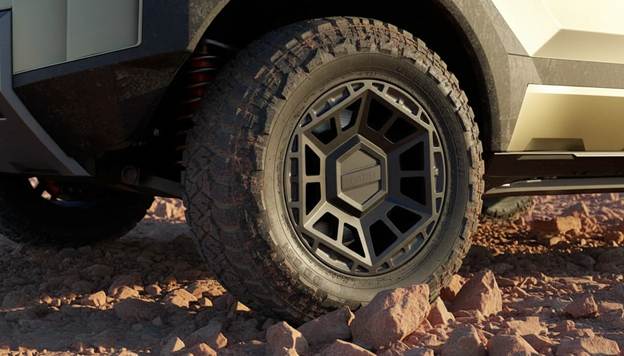
Let’s talk about the stance. The CRATER sits on massive 33-inch off-road tires, which are substantial for a compact SUV footprint. These aren't just for show; they signal serious intent. In the off-road world, rubber matters. The tires are wrapped around 18-inch wheels that feature a design inspired by a hexagonal asteroid impact. It’s a bit of marketing fluff, sure, but visually, it works. It grounds the vehicle and gives it a planted, muscular look that many EVs—which often prioritize aerodynamics over ground clearance—sorely lack.
Is this a game-changer? In the compact electric segment, absolutely. Most small electric crossovers are designed for the urban jungle, terrified of a curb, let alone a rock garden. The CRATER features bold skid plates and steep approach and departure angles that would make a Jeep Wrangler nervous. It includes “limb risers”—cables running from the hood to the roof—designed to push branches out of the way. This is a feature usually reserved for aftermarket modifications on dedicated overlanding rigs, not factory concepts.
Furthermore, the utility is baked into the design. The front recovery hooks aren’t just anchor points; one of them doubles as a bottle opener. The side mirrors are actually camera pods that detach to become handheld flashlights or action cameras. This level of integration suggests that Hyundai isn’t just building a car; they are building a multi-tool on wheels. If they can bring this level of modular utility to production, they will effectively change the game for what consumers expect from an "adventure vehicle."
A "Bring Your Own Device" Interior
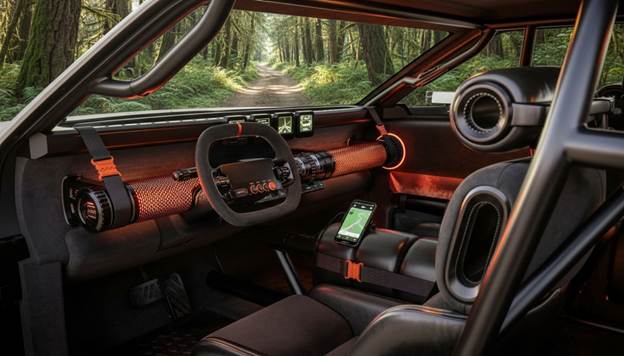
If the exterior is the armor, the interior is the command center. The cabin of the CRATER is designed around a concept Hyundai calls “The Curve of Upholstery,” which contrasts the blocky exterior with softer, inviting shapes. But don't let the softness fool you; the skeleton of this thing is hardcore. A functional roll cage is exposed throughout the interior, doubling as grab handles. It’s a visual reminder that safety and structural rigidity are paramount here.
The dashboard is where the tech analyst in me gets excited. Instead of the massive, pillar-to-pillar screens that have become the lazy default in modern luxury EVs, Hyundai has opted for a Bring Your Own Device (BYOD) philosophy. The main interface relies on the user’s technology, integrated seamlessly into the vehicle. There is a full-width head-up display (HUD) for critical vehicle data, but the infotainment duties are largely offloaded.
This is brilliant for two reasons. First, car computers age like milk; smartphones age (slightly) better. Letting the user drive the computing experience ensures the car doesn’t feel obsolete in three years. Second, it keeps the cockpit focused. The "tech-savvy adventure seekers" this car targets likely already have an iPad or flagship phone they prefer over a proprietary automaker OS.
Who will this impress? Anyone tired of digging through three sub-menus just to turn on the seat heaters. It will impress the overlanding community, who value reliability and simplicity over flash. And it will impress the younger demographic, who see their phone as the center of their digital universe and want their car to be a peripheral, not a competitor.
Why the CRATER Should Be Electric
There is always a debate in the off-road community about gas versus electric. Range anxiety is real when you are fifty miles from the nearest paved road. However, the CRATER makes a strong case for why the future of off-roading is electric.
First, torque. Electric motors provide instant torque at zero RPM. When you are trying to crawl over a boulder or navigate a deep rut, you don’t want to rev an engine and slip a clutch; you want precise, immediate power delivery. The CRATER, presumably built on Hyundai’s E-GMP platform (though specs are unconfirmed), would offer the kind of granular control that internal combustion engines struggle to match without complex gearing.
Second, silence. Nature is quiet. Roaring through a forest in a V8 might be fun for the driver, but it disturbs the very environment you are there to enjoy. An EV allows for a silent approach, letting you observe wildlife and hear the crunch of gravel under your tires. It is a more immersive experience.
Finally, the form factor. Without a massive engine block up front, the CRATER can offer better visibility and shorter overhangs, directly improving its off-road geometry. The "skateboard" battery architecture keeps the center of gravity low, reducing the risk of rollovers on off-camber trails. While charging infrastructure in the wilderness is a hurdle, the vehicle’s design—optimized for efficiency and potentially capable of powering your campsite (V2L)—turns the battery from a liability into a massive portable generator.
Wrapping Up
The Hyundai CRATER is more than just a show car; it is a statement of intent. It challenges the lazy assumption that EVs must be smooth, egg-shaped pods or Brutalist wedges. It proves that "rugged" and "electric" are not mutually exclusive terms. By combining the aggressive, structural aesthetic of the "Art of Steel" with genuine off-road utility and a forward-thinking interior, Hyundai has created a concept that feels genuinely fresh.
It offers a vision of the future where technology supports adventure rather than sanitizing it. If the Hyundai CRATER concept is indeed a preview of the brand’s XRT division moving forward, then the trails are about to get a lot more interesting. Tesla may have started the conversation about futuristic trucks, but Hyundai just might have the last word on what an electric adventurer should actually look like.
Disclosure: Images rendered by Artlist.io
Rob Enderle is a technology analyst at Torque News who covers automotive technology and battery developments. You can learn more about Rob on Wikipedia and follow his articles on Forbes, X, and LinkedIn.
Set Torque News as Preferred Source on Google
Follow us today...