
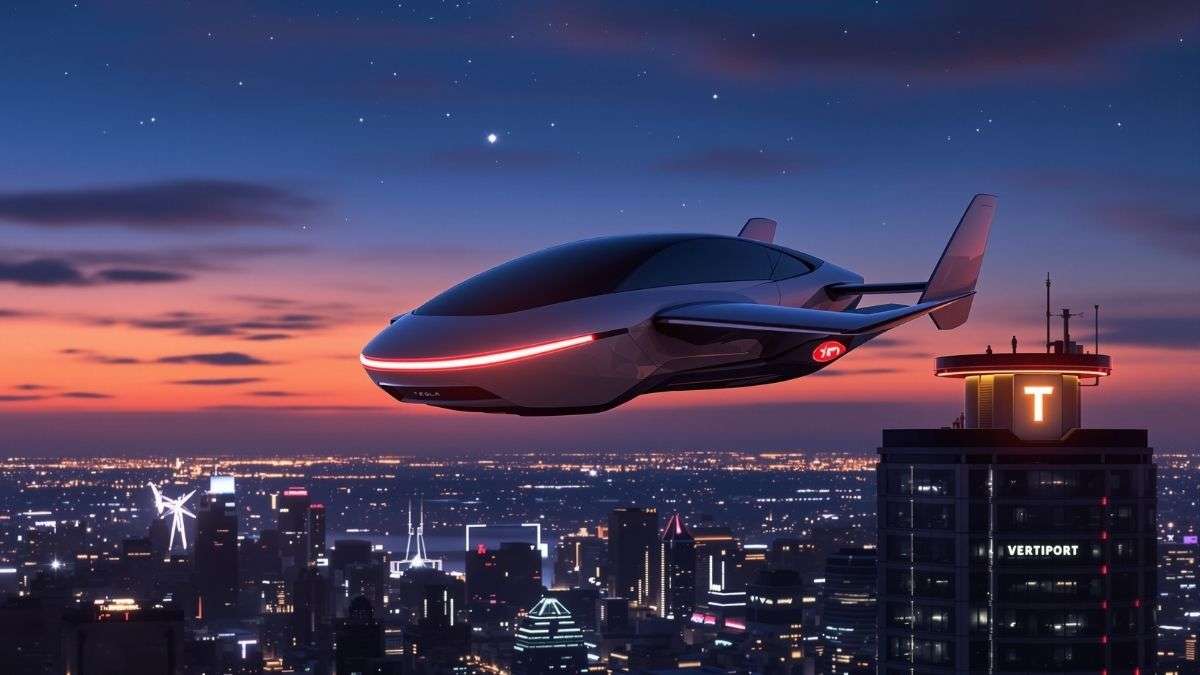

The world of transportation was set ablaze this week by just a few tantalizing words. On a recent podcast appearance, Elon Musk teased that Tesla could unveil a flying car "in a couple of months," calling the project "crazy, crazy technology." For anyone who has followed the auto industry, the "flying car" is the ultimate "boy who cried wolf" story. It’s a promise that has been perpetually "just around the corner" for nearly a century.
I should know. My own fascination with this dream began back in the 1970s when I had the chance to sit in a prototype at Moller International, staring at the rows of fans and truly believing I'd be flying to work by the year 2000. That dream, shared by millions, never materialized. But with this tease from Musk, it feels different. Not because Tesla can build a better car that flies, but because Musk's ecosystem of companies is the only entity on Earth that might be able to solve the real problem: the sky.
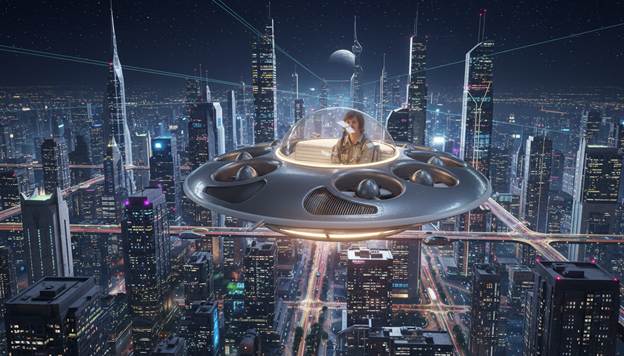
Me In A Flying Car Prototype In The 1970s (background AI-generated, it didn’t fly)
The Graveyard of Dreams: Why Flying Cars Stayed Grounded
History is littered with the wrecks of ambitious flying car projects. Paul Moller’s innovations, which captivated me as a child, were brilliant feats of engineering but never achieved commercial viability. The Taylor Aerocar back in 1949 was a certified "roadable aircraft"—a plane whose wings folded up. More recently, the Terfugia Transition met a similar fate, existing as a niche curiosity for pilots.
These efforts all failed to capture the public's imagination for a simple reason: they were compromised airplanes, not futuristic flying cars. They were designed to solve the problem of "How do I drive my plane home from the airport?" not "How do I get from my 30th-floor apartment to the restaurant downtown?" They never addressed the four insurmountable hurdles that make true urban air mobility a logistical nightmare.
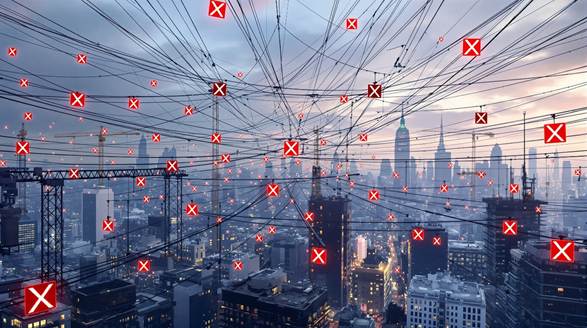
The Four Insurmountable Hurdles (Until Now?)
For decades, the car itself wasn't the main problem. The real barriers have always been infrastructure, noise, and physics.
- Range and Energy: To lift vertically (eVTOL), a vehicle requires an enormous amount of energy, far more than rolling on wheels. This "thrust tax" means battery-electric range for eVTOLs is often abysmal, limiting them to short, impractical hops.
- Safety (The "Falling Toaster" Problem): A car engine failure means you pull over to the shoulder. An eVTOL engine failure means you become a multi-ton lawn dart dropped into a crowded sidewalk. Add bird strikes, mid-air collisions, and weather, and the safety case becomes terrifying.
- Static Obstacles: Cities are a 3D maze of unmapped hazards: power lines, radio antennas, construction cranes, and suspended bridges. Standard GPS isn't accurate enough to navigate these micro-obstacles.
- Air Traffic Control (ATC): This is the ultimate deal-breaker. The current FAA system is designed to handle hundreds of large aircraft in controlled flight corridors, not tens of thousands of autonomous pods zipping between buildings at low altitudes. You can't just have people "flying" VFR (Visual Flight Rules) in a city.
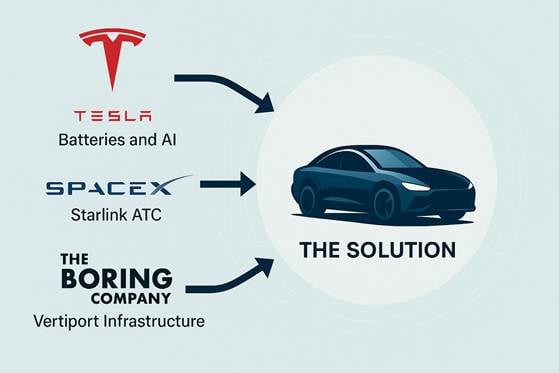
The Musk Ecosystem: Why This Time Might Be Different
This is why the Tesla flying car tease is so compelling. Musk isn't just building a car company; he's building a 21st-century infrastructure stack. When you look at his other companies, he is the only person on Earth who might be able to solve all four problems.
- Tesla (The Car): This is the easy part for him. Tesla has the most advanced, energy-dense batteries and the most efficient mass-production manufacturing in the world. They can solve the car's power and range problem better than anyone.
- Tesla (The Brain): These cars must be 100% autonomous. A human cannot safely pilot a vehicle in a complex 3D urban environment. Tesla's FSD development and massive sensor suite provide the AI "eyes" needed to navigate static obstacles like power lines and buildings.
- SpaceX (The ATC): This is the missing link. How do you manage 10,000 autonomous pods over a city? You can't rely on cell towers. You need a decentralized, low-latency, high-bandwidth communications network that covers every inch of the sky. Musk is the only one who has this: Starlink. A Starlink-based network is the only viable path to creating a robust, autonomous air traffic control system from scratch.
- The Boring Company (The Infrastructure): Where do they land? Rooftops are not enough. The Boring Company’s entire mission is to build high-speed tunnels and compact "Vertiports." Imagine flying from a suburb, landing on a rooftop pad, and having a Boring Company elevator lower your car into the high-speed tunnel network, bypassing surface traffic entirely.
The Real Competitors and What Success Looks Like
Musk isn't alone, but his competitors are still just building cars. China's XPeng has shown a "Land Aircraft Carrier" (a modular truck that launches a drone) and Alef Aeronautics has an FAA-approved (for testing) "Model A" that looks like a car but lifts vertically. These are fantastic innovations, but they all rely on existing, non-existent infrastructure.
For this effort to be successful, Tesla can't just sell a flying car. It must sell the entire transportation ecosystem. This means selling the autonomous car, the subscription to the Starlink-powered ATC network, and access to the Boring/Tesla-branded Vertiports. It's an all-or-nothing proposition that only a vertically integrated ecosystem like Musk's could even attempt.
Wrapping Up
When I sat in that Moller prototype in the 1970s, I dreamed of a future where I could just lift off and fly over traffic. That dream failed, not for a lack of engineering, but for a lack of vision for the ecosystem required to support it. Elon Musk's tease is so tantalizing precisely because he’s the only one who has spent the last two decades building all the non-car pieces needed to make it work. If the $1 trillion pay package shareholders just approved is meant to incentivize him to build an entirely new, multi-trillion-dollar transportation market from the ground up, suddenly it doesn't seem so crazy. This may be the first time in 50 years that the flying car dream actually has a chance to leave the ground.
Disclosure: Images rendered by Artlist.io
Rob Enderle is a technology analyst at Torque News who covers automotive technology and battery developments. You can learn more about Rob on Wikipedia and follow his articles on Forbes, X, and LinkedIn.
Set Torque News as Preferred Source on Google
Follow us today...


Comments
Everyone thinks that Elon is…
Permalink
Everyone thinks that Elon is a genius. He's not.
All of his tech is based on someone else's ideas and inventions. Plus, he's an arrogant druggie with a sense of entitlement.