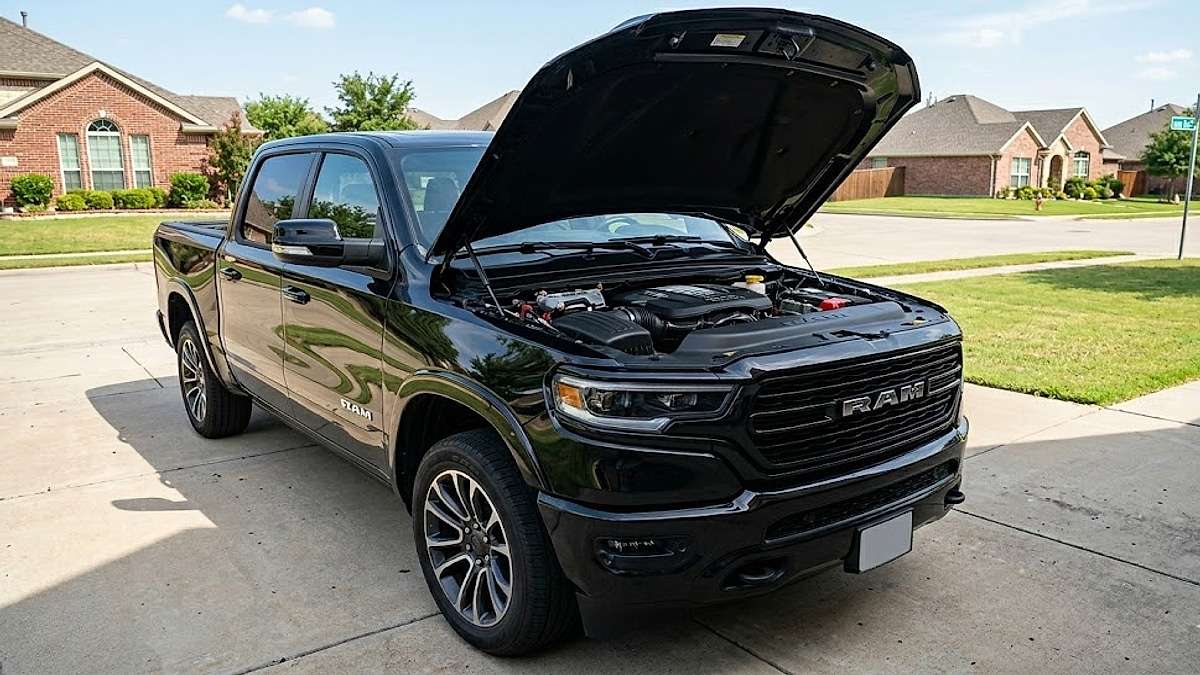

The Hurricane 12V Crisis
This investigative report deconstructs a recurring electrical failure within the 2025 Ram 1500 Hurricane Limited powertrain, specifically focusing on a "parasitic drain" phenomenon that leaves brand-new trucks stranded with less than 4,000 miles on the odometer. Through the lens of decades of automotive consulting and investigative reporting,
I analyze why the dealer "No Fault Found" diagnosis is often a byproduct of outdated testing protocols that fail to capture the 11.7V voltage drop occurring during deep-sleep cycles. We explore the intersection of new proximity sensor technology and the high-output 12V battery requirements, providing owners with actionable technical workarounds and documenting the growing disconnect between manufacturer reliability claims and the reality of the Texas high-heat testing environment.
The 3,728-Mile Mystery in the Lone Star State
When a brand-new $85,000 pickup truck leaves you stranded twice in 24 hours, the word "reliability" starts to feel like a marketing myth. I have spent many years in the trenches of the Rocky Mountains and the service bays of the Southwest, and what I am seeing with the 2025 Ram 1500 Hurricane Limited is a classic case of technology outpacing the electrical architecture meant to support it.
A Texas owner, Ashley Hollins, recently went public on the Dodge Ram 1500 Owner’s Facebook page with a story that should put every Hurricane owner on high alert. Ashley reported that her 2025 Ram 1500 Hurricane Limited, with only 3,728 miles, went completely dead overnight after being locked. After roadside assistance replaced the battery, the truck died again just hours later. The dealer, after keeping the truck for a full weekend of testing, claimed they found nothing wrong.
Ashley’s frustration is understandable when she asks, “Can anyone tell me they have experienced the same issue? I bought a brand new 2025 Ram 1500 Hurricane Limited. It only has 3,728 miles on it. I came home the other night and locked the doors. I went out to go to work at 5:30 am the next morning, and the truck was completely dead. Roadside assist come around again, and another dead battery. They did more tests on Monday, and they told me they couldn’t find anything wrong. Has anyone else experienced these dramas?”

As a professional who has managed territories for car dealers and independent shops, I can tell you that "no fault found" is the most expensive sentence in the English language for a consumer. We are looking at a parasitic load likely tied to the Body Control Module (BCM) or to proximity sensors that never truly "go to sleep," especially in Texas, where heat soak can keep cooling fans or sensors cycling long after the ignition is off.
Why the 2025 Hurricane Electrical Architecture is Faltering
The 2025 Ram is not just a truck; it is a rolling supercomputer. The transition to the Hurricane Twin-Turbo I6 brought increased demand on the 12V system to power everything from active grille shutters to sophisticated engine management software. According to a technical analysis by MotorTrend's experts, the new Hurricane engine's high-pressure fuel systems and cooling requirements demand a level of electrical stability that older AGM batteries struggle to maintain when the alternator isn't providing a constant, high-amperage charge during short trips. You can read their full technical deep-dive into the Hurricane's complexities at MotorTrend’s 2025 Ram Technical Report.
When the dealer says nothing is wrong, they are usually performing a standard "load test" on the battery. My decades of experience tell me that a static load test is useless here. We need to look at the "dark current" draw. If the truck is pulling more than 50 milliamps while sitting, it will kill a battery on a Texas summer night. The issue is often exacerbated when the key fob is stored too close to the vehicle, which keeps the BCM in a "ready" state, preventing the truck from entering deep-sleep mode. This creates an "11.7V Death Spiral" in which the battery lacks the cranking amps to turn over the Hurricane during its high-compression start cycle.
Documenting the Pattern of Component Failure
We are not looking at an isolated incident. I have been tracking the rollout of the Hurricane engine closely, and the electrical gremlins are becoming a signature of this first-year powertrain. I previously reported on how the 2025 Ram's new electronic architecture is sensitive to even minor voltage fluctuations, noting that many owners are seeing "ghost" codes that disappear once a fresh battery is installed, only to return when the parasitic drain takes its toll again. You can see my earlier findings on these specific electrical sensitivities in my report titled "2025 Ram Hurricane Electrical Issues."
Further substantiating this, the team at Car and Driver noted in their long-term testing that the modern Ram’s infotainment and connectivity features can sometimes stay active due to software bugs, leading to unexpected battery depletion that leaves owners puzzled. Their report emphasizes that these "phantom" draws are becoming more common as vehicles become more software-dependent. Their findings are detailed in the Car and Driver 2025 Ram Reliability Update. Integrating these outside perspectives is vital because it proves that Ashley’s experience in Texas isn't just bad luck; it is a data point in a much larger trend of 12V system inadequacy.

Technical Observations from Owner Communities
To get the real story, we have to look at what is happening in the driveways of owners across the country. The "No Fault Found" diagnosis is a common wall that owners hit. In a recent technical discussion on r/Ram1500, one owner noted a specific culprit, stating, "My 2025 would die every three days. Turned out the hands-free tailgate sensor was triggered by a spider web and kept the system awake for 72 hours straight," which you can read in the full discussion.
Another owner highlighted the vulnerability of the new design in a different thread, mentioning, "The new Hurricane trucks have a much higher parasitic draw than the old HEMIs because of the telematics. If you don't drive 20 miles a day, the alternator never actually tops off the battery," found in this Reddit thread.
My Analysis
Based on my 30 years of experience, these community observations align perfectly with how modern Power Distribution Centers (PDCs) function. When an owner like Ashley says the dealer found "nothing wrong," it usually means the technician checked for active codes and did a battery health check. However, they aren't monitoring the BCM's behavior over a 12-hour period. The disconnect between a "dead truck" and a "perfect test result" exists because the fault is intermittent and software-driven. If a sensor, such as the proximity entry or the telematics module, fails to "handshake" with the main computer to shut down, the truck remains in a high-power state. We are essentially seeing a "software-induced heart attack" for the 12V system.
Advice for the Hurricane Owner
If you find yourself in Ashley’s shoes, do not accept "No Fault Found" as the final answer.
1. I recommend investing in a high-quality Bluetooth battery monitor. This allows you to track the voltage drop on your smartphone in real-time while the truck is parked. If you see the voltage dip below 12.1V within four hours of parking, you have hard data to show your service advisor.
2. Check your key fob proximity. If you hang your keys within 20 feet of the truck, the truck may stay "awake" waiting for you to enter. This is a common issue I see in my consulting work with BG Products & Services when troubleshooting electrical gremlins in Colorado repair shops. We often find that simply moving the keys to the back of the house or using a Faraday box solves the "dead battery" mystery.
3. Demand a "Dark Current" test at the dealership. Tell them you want to know the milliamp draw after the vehicle has been off for 60 minutes. If it is over 50mA, there is a module staying active, and they need to start pulling fuses to find which one it is.

The Role of Texas Heat in Electrical Fatigue
We cannot ignore the Texas factor. Heat increases the internal resistance of a battery and accelerates the chemical reaction that drives discharge. A battery that might survive a night in a cool garage will fail significantly faster in a 90-degree Texas evening if there is even a minor parasitic draw. The Hurricane's engine bay is also packed tightly for turbocharging efficiency, meaning heat soak around the battery tray is a real concern. I suspect we will see a TSB (Technical Service Bulletin) regarding battery heat shielding or a BCM software update before the end of the 2026 model year.
Is the Hurricane Engine Worth the Trade-off?
The very next logical concern you will have as a prospective or current owner is: "If the electrical system is this sensitive, does the performance of the Hurricane I6 justify the potential for being stranded?" The answer is complex. While the Hurricane offers superior torque and towing capacity compared to the outgoing 5.7L HEMI, its reliance on a perfect 12V environment makes it a more "fragile" platform in the short term. We are currently investigating whether these electrical issues are precursors to long-term sensor failures in the twin-turbo system. If the voltage is unstable, the sensors feeding data to the turbos can produce inaccurate readings, potentially triggering "limp mode" events that are far more serious than a dead battery.
Deciphering the Dealer’s Silence
In my three decades of automotive journalism, I have learned that "We can't find anything wrong" often translates to "The manufacturer hasn't authorized a warranty repair for this specific symptom yet." Dealerships are caught in the middle. They cannot replace a $300 AGM battery or a $1,200 BCM without a "Fail Code" that Chrysler/Stellantis will reimburse. This is why your role as an "active investigator" of your own vehicle is so important. By documenting the voltage drops and the environmental conditions, you provide the "expertise" the dealer needs to push for a manufacturer-level solution.
Navigating the Road Ahead for Ram Owners
The 2025 Ram 1500 Hurricane Limited represents a bold leap forward in truck technology, but as Ashley Hollins’ experience proves, that leap comes with growing pains. We must remain vigilant and treat these early-mileage failures as the technical warnings they are. I will continue to monitor the Texas reports and the national TSB databases to ensure you have the most up-to-date information to protect your investment. Your truck should work for you, not the other way around.
What Would You Do?
If you were in Ashley’s position, would you keep the truck and fight for a BCM replacement, or would you start looking at Lemon Law options after only 3,728 miles? It’s your turn to join the conversation. Tell us what you think in the comments section below. Please leave a comment in the red Add new comment link below.
About The Author
Denis Flierl is a 14-year Senior Reporter at Torque News and a member of the Rocky Mountain Automotive Press (RMAP) with 30+ years of industry experience. Based in Parker, Colorado, Denis leverages the Rockies' high-altitude terrain as a rigorous testing ground to provide "boots-on-the-ground" analysis for readers across the Rocky Mountain region, California EV corridors, the Northeast, Texas truck markets, and Midwest agricultural zones. A former professional test driver and consultant for Ford, GM, Ram, Toyota, and Tesla, he delivers data-backed insights on reliability and market shifts. Denis cuts through the noise to provide national audiences with the real-world reporting today’s landscape demands. Connect with Denis: Find him on LinkedIn, X @DenisFlierl, @WorldsCoolestRides, Facebook, and Instagram.
Photo credit: Denis Flierl
Set Torque News as Preferred Source on Google
Follow us today...