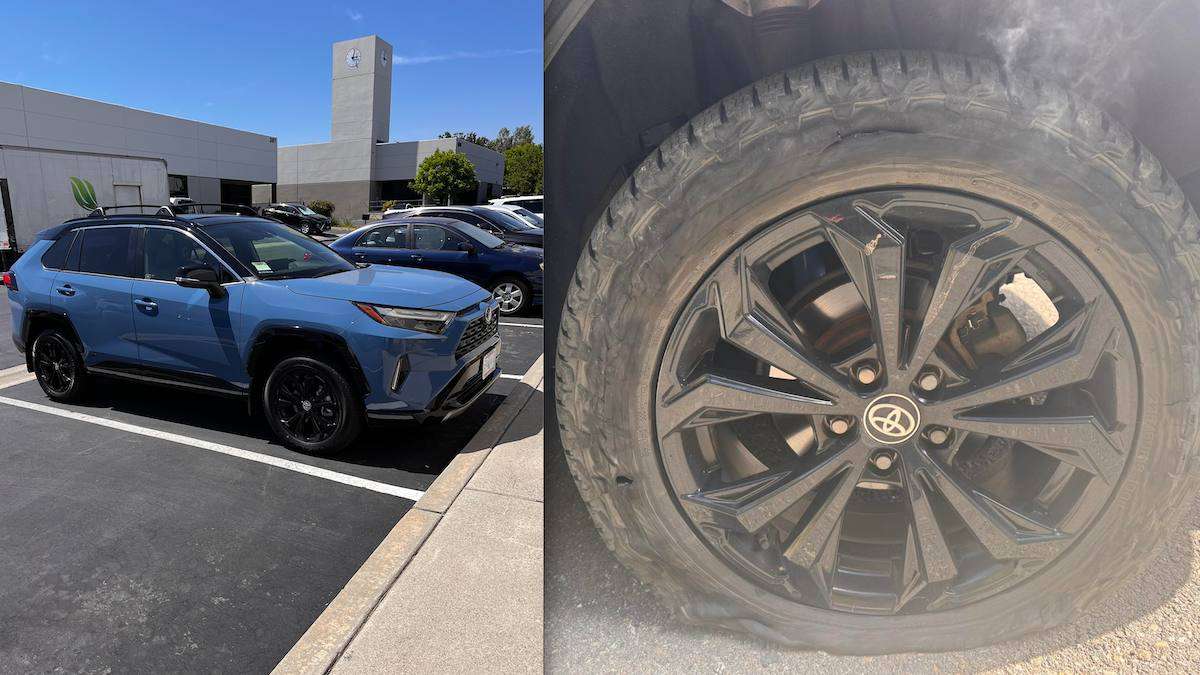

A flat tire, 150 miles on a spare donut at 55 mph. Can a Toyota RAV4 owner push it further? What are the actual limitations? I'll answer those questions, but first, check out this story.
Lucy Marcus on the Toyota RAV4 Discussion Group 2019-2025 - Gas + Hybrid + Prime Facebook page says,
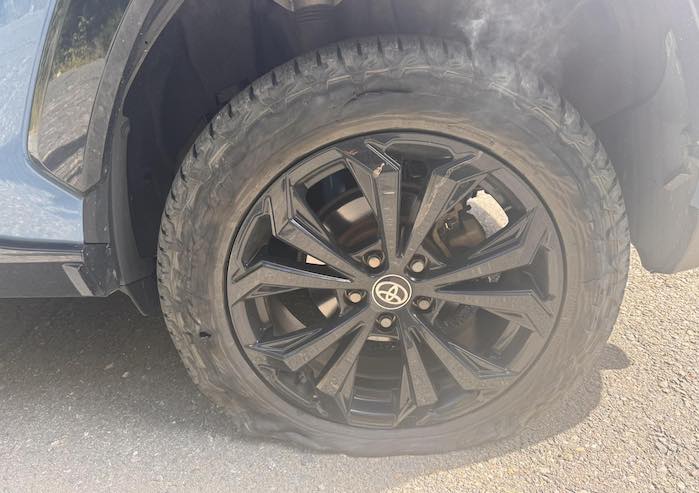
"I have a 2022 Toyota RAV4 XSE Hybrid. I'm driving on Falken Wildpeak AT Trail tires, 225/60R18. One blew out the sidewall. I drove 55 mph on the highway and made it home on the spare donut tire (150 miles) just fine. I made sure the tire pressure was correct. How far can I drive on the spare donut tire?"
Lucy Dodged a Bullet
Let me start by saying: Lucy dodged a bullet. Making it 150 miles at 55 mph on a temporary spare is a little bit of luck, but she pushed that little donut tire far beyond its engineering limits. That's a serious risk, and while I'm glad she got home safely, we need to dive deep into exactly why that 150-mile journey was highly inadvisable and what she needs to check immediately.
This is a critical discussion for tens of thousands of RAV4 owners and all car owners with a donut spare tire. It's a classic real-world dilemma: the panic of a blowout versus the temptation to stretch the limits of a temporary fix.
The Hard Truth on the Donut: Limits and Consequences
Lucy asks, "How far can I drive on the spare donut tire?" There is one standard, non-negotiable answer for nearly every compact vehicle, including her RAV4 Hybrid: 50 miles.
The spare is a temporary, space-saving tire, often called a "donut," and it is fundamentally different from the four full-sized tires it replaces. These spares are designed for one purpose only: to transport your vehicle at low speed to the nearest tire service center.
There are two critical rules you must abide by when using a temporary compact spare, regardless of the vehicle manufacturer:
- Speed: Never exceed 50 mph.
- Distance: Never exceed 50 miles.
Lucy drove 150 miles and briefly hit 55 mph. This significantly exceeds the maximum mileage safety for temporary spare tire mandates—the risk she took centers on two core issues: heat and structural integrity.
Why 50/50 is the Rule:
That a small, thin spare has far less tread depth and a much shallower sidewall than the Falken Wildpeak AT Trail. It is built with lighter materials and designed for minimal friction and short bursts of use. When you maintain highway speed (even 55 mph) for an extended period, you generate immense heat.
A United Tires report says that the long-term effects of driving over 50 mph on compact spare tires often include degradation of the rubber compound, leading to catastrophic failure or sidewall separation. Furthermore, that thin tire is carrying the full weight of the RAV4 over a smaller contact patch, drastically accelerating wear. At 150 miles, the temporary tire may be dangerously close to its wear limits, even if it looks fine from the outside. You must treat it as permanently compromised and unusable for future emergencies.
RAV4 Hybrid Specifics: Protecting Your e-AWD System
Toyota says a critical layer of complexity in the 2022 RAV4 XSE Hybrid is the advanced electronic All-Wheel-Drive (e-AWD) system. This is where the difference between a compact spare and a full-size spare tire becomes a technical liability, though less catastrophic than in a traditional mechanical AWD vehicle.
The Diameter Mismatch
The diameter mismatch between the 225/60R18 tire and the T165/80D17 compact spare forces the donut to rotate faster to cover the same distance. In a traditional AWD vehicle, this speed difference would damage the differentials.
However, the RAV4 Hybrid's e-AWD system—lacking a physical driveshaft and central differential—faces an electronic issue. The varying rotation speed triggers the Vehicle Stability Control (VSC) and Traction Control systems.
The vehicle's computer interprets the fast-spinning spare as a loss of traction, triggering continuous, stressful interventions and the potential for premature component wear or overheating.
The Safety Recommendation:
When safely driving on a donut spare in a Toyota RAV4 Hybrid, you should always try to move the full-sized, good tire from the rear to the front, and place the donut on the rear axle.
The front axle handles steering, most of the braking, and the primary power delivery, making it the most sensitive to changes in diameter. If you can't swap them easily, stick to the absolute lowest speed and shortest distance possible.
Related Reading: See my previous report on the long-term maintenance required for Toyota's RAV4: Bruce just purchased a 2025 Toyota RAV4, and he's ready to trade it in. He has several reasons why he dislikes the new small SUV. Here is what potential RAV4 buyers need to know. Should you wait for the redesigned 2026 RAV4 Hybrid?
The Falken Blowout
Lucy mentioned that the incident involved a sidewall blowout on a Falken Wildpeak AT Trail 225/60R18 tire. The immediate action is to replace all four tires, as it's unlikely she'll find a replacement for just one tire that perfectly matches the wear and age of the remaining three.
Practical Takeaways and Immediate Action:
- Check for Damage: Get your RAV4 to a reputable Toyota service center, not just a tire shop. You need the dealer to check the wheel bearings, suspension alignment, and specifically the VSC/Traction Control modules for stored error codes or signs of strain caused by the 150-mile mismatch.
- Spare Tire Inflation: Lucy mentioned checking the pressure—which is smart—but many owners neglect the spare. The proper inflation pressure for a Toyota RAV4 donut spare is usually stamped directly on the spare tire or listed on the placard inside the driver's door jamb. It's typically much higher than your regular tires—often 60 psi. Always check it monthly; if it loses air, it becomes flat and worthless exactly when you need it most.
- Upgrade: Given your use of A/T tires (Falkens) and your travel habits (150 miles from home), it's strongly recommended to upgrade to a full-sized spare tire kit. While the official RAV4 Hybrid spare is compact, many owners have found that a full-size spare will fit in the spare well if you remove the foam organizer insert.
What the Community is Saying
The consensus is clear. The key takeaway from the owners who have faced similar emergencies is that the risk outweighs the reward:
Social Media Consensus: "I drove 80 miles on my Prime's donut and started getting VSC warning lights after 60 miles. The car felt squirrelly. Never again. Stick to the 50-mile limit."
Many experienced members immediately recommend swapping the donut to the rear axle if a blowout occurs on the front axle. This minimizes interference with steering, braking, and the primary driven axle.
The most frequently shared solution for those who travel extensively is to invest in a full-sized fifth wheel/tire, often an affordable used OEM wheel, and keep it properly inflated and rotated. This eliminates the donut's speed/mileage restrictions.
Conclusion:
Lucy made it home, but her 150-mile trip on that compact spare was a significant gamble.
The takeaway is twofold: first, have the vehicle thoroughly inspected for residual damage from the wheel speed differential. Second, make a long-term investment in safety by acquiring a full-sized spare for your RAV4.
A Question for Readers:
Considering the potential damage to the e-AWD system, should Toyota drop the compact donut entirely in favor of making a full-sized spare standard on all RAV4 Hybrid and Prime models, even if it adds cost and weight? Click the red Add New Comment link below and let us know.
I'm Denis Flierl, a Senior Torque News Reporter since 2012, bringing over 30 years of automotive expertise to every story. My career began with a consulting role for every major car brand, followed by years as a freelance journalist test-driving new vehicles—equipping me with a wealth of insider knowledge. I specialize in delivering the latest auto news, sharing compelling owner stories, and providing expert, up-to-date analysis to keep you fully informed.
Follow me on X @DenisFlierl, @WorldsCoolestRides, Facebook, and Instagram
Photo credit: Denis Flierl via Lucy Marcus
Set Torque News as Preferred Source on Google
Follow us today...