
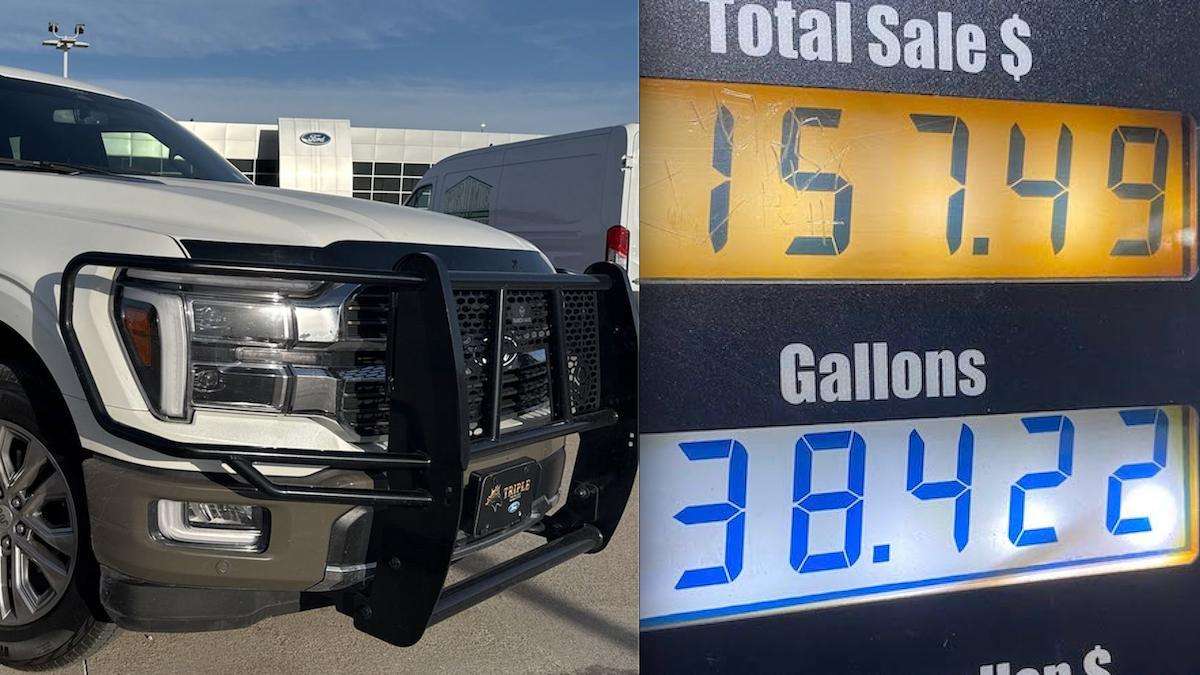

You might think you know your Ford F-150's limits, but one owner’s risky experiment to squeeze nearly 38 gallons into a 36-gallon tank reveals a hidden capacity, and a dangerous habit you need to avoid.
In my daily research into Ford truck owners' experiences, I uncovered a viral debate sparked by an owner determined to prove critics wrong about the F-150’s extended-range fuel tank. As a Senior Reporter for Torque News with 30 years of automotive industry experience, I have seen plenty of fuel disputes, but Tyler Ray’s experiment running his truck dry to squeeze in 38 gallons highlights a critical misunderstanding about usable capacity versus total volume.
"Proof for Crybabies"
There is a long standing argument in the F-150 community regarding the "extended range" 36 gallon fuel tank. Many owners complain they can never put more than 32 or 33 gallons in, even when the gauge screams "Empty." They feel shortchanged, wondering if Ford installed the wrong tank or if the digital gauge is lying.
Tyler Ray, an F-150 owner, decided to settle the score once and for all. He took to the Ford F-150 Owners Facebook page with a provocative post that immediately grabbed attention.
Tyler Ray on the Ford F-150 Owners Facebook page says, “Here’s the proof for all you crybabies. I’ve seen a lot of comments on the Ford F-150 owner’s page saying you can only fit 32 gallons in their 36 gallon tank. Well. I’m here to prove that you can put in 38 gallons.”
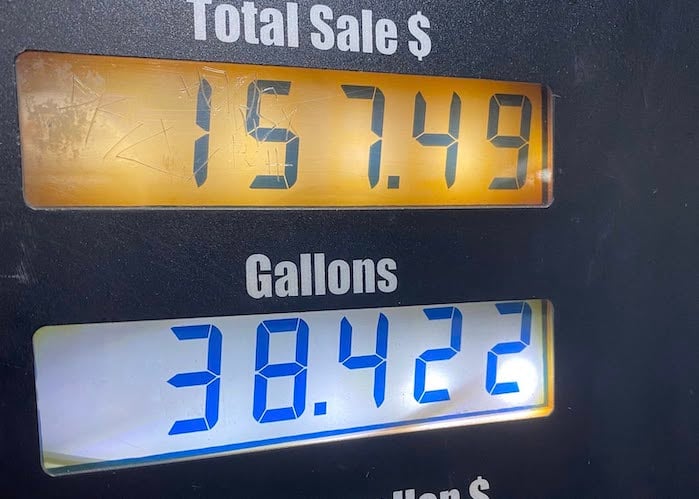
He did not just claim it; he posted a picture of the gas pump display reading a staggering number that defied the factory specifications. But how did he achieve this? By doing something most mechanics, including myself, would strongly advise against.
Running on Fumes
To get that much fuel in, you have to get every drop of the old fuel out. Tyler admits to taking extreme measures to ensure the tank was bone dry before hitting the pump.
In an earlier post, Tyler says, “I ran the truck completely empty. Ran out of gas. Pushed it about 100 feet up into the gas station. No mas gas. Sometimes it goes a while after DTE, sometimes no.”
This is the part of the story where I have to cringe. Running a modern fuel injected truck completely out of gas is like playing Russian roulette with your fuel pump. In modern vehicles, the fuel pump resides inside the tank and relies on the gasoline itself for cooling and lubrication. When you run it dry, you are overheating a sensitive component that costs hundreds of dollars to replace.
However, for the sake of science and internet glory, Tyler pushed on.
Squeezing In Every Last Drop
Once the truck was at the pump, Tyler began the filling process. He did not just stop when the nozzle clicked off. He employed a technique known as "topping off," but took it to an extreme level.
Tyler explains the process: “The 36 gallon tank fits 37.6 gallons. First click was 36.7 gallons, second click was 37.2 gallons. The 10th click was 37.6 gallons, and about a pint went on the floor.”
“No charcoal canisters were harmed in the making of this post. Never a CEL. Only one sharpie was sniffed in its entirety, blue to be exact.”
The comment about the "sharpie" adds some levity, but his mention of the charcoal canister is crucial. The Evaporative Emission Control System (EVAP) uses a charcoal canister to trap gas fumes. When you force fuel past the first click, let alone the tenth, you risk flooding this canister with raw fuel. That can ruin the part, trigger a Check Engine Light (CEL), and lead to expensive repairs. Tyler says his canister was unharmed, but he might have just been lucky.
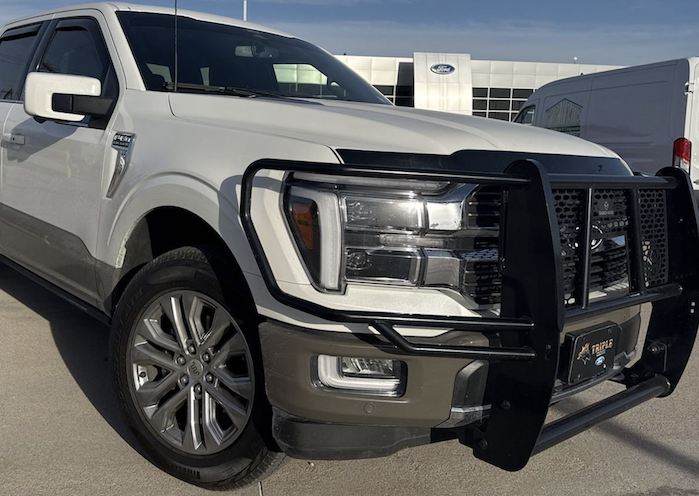
Why Does a 36-Gallon Tank Hold 38 Gallons?
You might be asking how a tank rated for 36 gallons holds 37.6. Is it magic? No, it is physics and safety engineering.
Expansion Room: Liquid gasoline expands as it heats up. Engineers design tanks with an "air gap" or "vapor dome" at the top, usually 10 to 15 percent of the volume, to prevent pressure buildup and spills on hot days. Tyler forced fuel into this expansion space.
Filler Neck Capacity: The pipe leading from your gas cap to the tank holds a significant amount of fluid, often over a quart or two.
Usable vs. Total Capacity: Manufacturers rate tanks based on "usable capacity." There is always a "dead volume" at the bottom where the pump pickup cannot reach, plus the reserve volume I mentioned earlier.
The post created a firestorm of comments, with 841 as of this writing.
Key Takeaways for F-150 Owners
Based on my three decades of experience and this viral case study, here is what you need to know about your Ford truck:
Trust the Reserve: When your gauge hits "0 Miles to Empty," you likely have 3 to 5 gallons of fuel left. This is a safety buffer designed by Ford to keep your fuel pump cool and prevent you from being stranded.
Don't Top Off: Stop at the first click. Forcing extra gas in risks flooding your EVAP canister, which can cost upwards of $400 to replace.
The Tank Is Likely Correct: If you can only put 32 gallons in when the light comes on, you do not have a defective tank. You are simply dipping into the heavy safety reserve Ford programmed into the computer.
What Do F-150 Owners Say?
The debate over fuel capacity is not unique to Tyler. I found numerous discussions online where owners shared similar experiences, often confirming the massive "hidden" reserve in these trucks.
Reddit user 'ZHunna' confirms the reserve theory: "In my 36 gallon tank, I have almost 6 gallons to spare when it hits 0."
Reddit user 'Mobile619' shares a common experience that frustrates many new owners: "I have a 2024 with the 36 gallon tank and usually fill up when it says 40-50miles of range left. Refills end up being 30-31 gallons, meaning there's still 5-6 gallons remaining."
YouTuber 'AutoVlog' actually tested this on video, driving a 5.0L F-150 past zero: In his test, he went significantly past the "0 Miles to Empty" mark, eventually putting in over 36 gallons, proving the reserve is substantial and the "0" mark is a psychological barrier, not a physical one.
The Final Verdict: recommend you replicate. Yes, your F-150 likely holds more than 36 gallons of liquid if you fill every nook, cranny, and filler neck. However, that capacity is not meant for a driving range; it is meant for safety and expansion. Drive your truck, enjoy the range, but when the pump clicks off, hang up the nozzle. Your charcoal canister (and your wallet) will thank you.
It's Your Turn: Have you ever run your truck past "0 Miles to Empty"? How many gallons were you able to fill up? Let us know in the comments below.
Next Up: Is The Ford F-150 The Most Reliable Truck? While fuel capacity is a hot topic, reliability is king. I dive into the latest data comparing the F-150 against the Silverado and Ram 1500 to see which truck truly stands the test of time. Read the full reliability report here.
With over 30 years of industry experience, Denis Flierl brings an insider’s perspective to Torque News, where he has been a Senior Reporter since 2012. Before picking up the pen, Denis consulted for the automotive industry's biggest brands and honed his skills as a test driver. He cuts through the noise to deliver the latest auto news, compelling owner stories, and the expert analysis necessary to navigate today's changing automotive market.
Have a tip or question? Follow me on X @DenisFlierl and @WorldsCoolestRides, or connect with me on Facebook, Instagram, and LinkedIn.
Photo credit: Denis Flierl via Tyler Ray
Set Torque News as Preferred Source on Google
Follow us today...






Comments
Seems like it is very…
Permalink
Seems like it is very expensive to drive a truck like the F150 around. Better start walking places to save money and get some exercise. I get almost 50 mpg (Imperial gallon) with my RAV4 hybrid and because I walk to most places I only put 10,000 km on per year.
What a weird thing to flex…
Permalink
What a weird thing to flex about.
Whatever I buy a new Ford…
Permalink
Whatever I buy a new Ford truck I put a 5 gallon gas can in the back of the bed and drive it past it says empty to see how much fuel I actually have remaining.
I usually go about 100 miles past what fuel gauge said would be empty before I run out of fuel I hadn’t considered the possibility of damaging the fuel pump.
It's there for a specific…
Permalink
It's there for a specific reason called expansion in metal or composoite. In states with high heat the tank will expand considerably, by filling it over capacity is rolling the dice for a cracked tank or worse.