
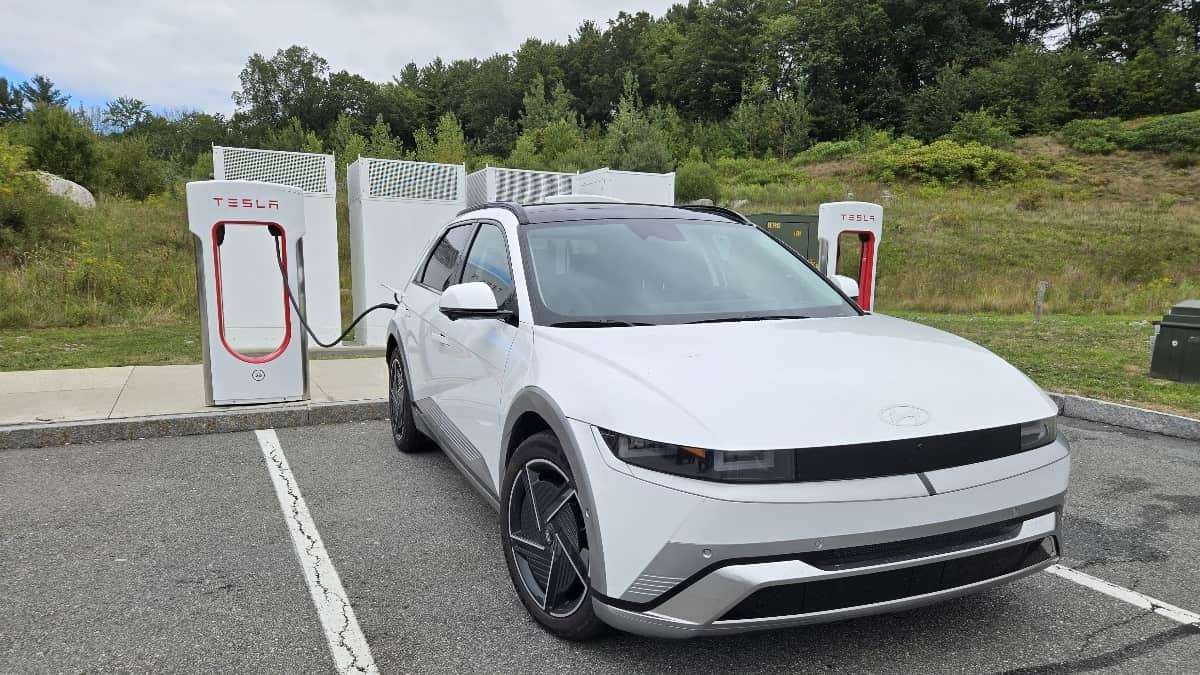

Over the years, we’ve tested dozens of EVs on multiple different DC chargers. None of them has ever lived up to the "fast charger" hype. We don't see the fast rates that are promised, and we observe much lower kW rates than the automakers and charging companies say are possible. This week, we did another test, and we were again disappointed by the rate of charge.
Then we spotted a post in one of our favorite Facebook vehicle clubs, the Ioniq Guy Group. This is an extremely informative and well-run club, started by a content creator whom we follow closely. The post about slow DC charging we spotted had images and descriptions that matched our own experience precisely. Two different tests, with the same model at the same brand DC charger, but by two separate people. The promises and expectations around DC charging are starting to be debunked on a regular basis.
Our story title paraphrases the owner of a 2025 Hyundai Ioniq 5 Limited. We’ll keep this person’s identity protected and call him AB. Here is exactly what AB said about his Supercharging session in a post:
I decided to give Tesla supercharging another shot tonight on my 2025 Limited. It communicated with the car quickly and took off charging pretty fast. My starting battery percentage was about 68% and the battery showed it was adequately warm for charging. It started off and jumped up to about 110 kW, but quickly sank back to 78 or so, and sat there all the way to 82%. (When it started sinking, I figured the complete shutdown was coming). At least I didn’t get an interrupted session this time. But from what I’ve read, it should’ve been charging faster than that. I’d like to just once go to a Tesla charger and have it behave the way it’s supposed to with this car. Other people have reported that I should be getting close to 125 kW flat from a low charge level to near 80%.
The Superchargers say that they can provide “250kW max.” We get it. Under ideal circumstances, they can deliver a lot of power. But isn’t a cool summer day, alone at the charger, with a properly preconditioned battery "ideal?" And what about the Ioniq 5 Limited? On its specification page, Hyundai states that the NACS-equipped Ioniq 5's DC Fast Charge rating is 150kW (400V).
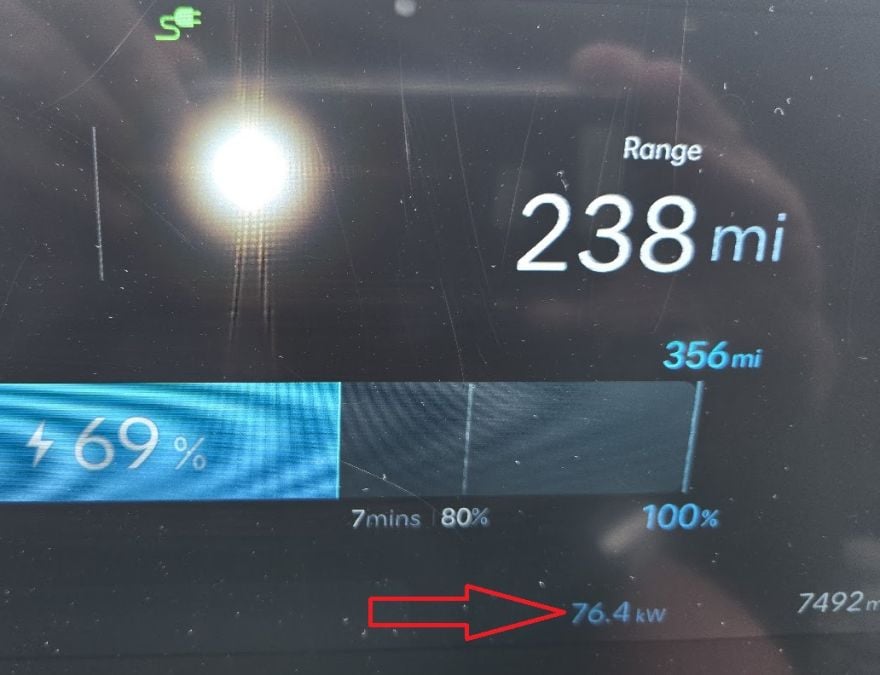
The real question is, why are users only getting half of the rating (or less) that the charging companies and car companies say is the “max rate” when they are charging at SOCs below 70%?
The charging curve is one answer. You see, EVs don’t accept power at a continuous rate as they charge up. At a lower state of battery charge (SOC), they can accept more power than a higher SOC. Manufacturers and DC charging station owners list the most impressive number imaginable. “Max” is the disclaimer. Or “Can.” During charging, the rate at which the power can be absorbed by the battery drops like a rock. In our testing past 80% SOC, we observed rates of around 33 kW. That’s a long way from 240kW.
AB is well aware of this. He said in a follow-up comment in the discussion under the post, “I’m not asking (the car) to do anything that it’s not supposed to be capable of. I fully understand charging curves.” AB also never expected the 240 kW or the 230-350 kW ratings from Tesla and Hyundai to be real. He says, “Getting 75 kW when you’re supposed to be getting around 125 makes the charge station a heck of a lot slower than it is supposed to be.”
Many other owners have observed this less-than-expected charging rate. One owner said, “I've only really ever used EA, but it typically starts slowing down somewhere in the 60-70 percent area, and then to a crawl as it gets to 80.”
We think that one owner nailed the reality of DC charging. He said, “Lower your expectations.”
What’s your take on DC charging? Should owners just accept the fact that the ratings of the chargers and cars seem to be out of touch with the actual charge rates observed in the real world? Tell us your thoughts in the comments section below.
John Goreham is the Vice President of the New England Motor Press Association and an expert vehicle tester. John completed an engineering program with a focus on electric vehicles, followed by two decades of work in high-tech, biopharma, and the automotive supply chain before becoming a news contributor. He is a member of the Society of Automotive Engineers (SAE int). In addition to his eleven years of work at Torque News, John has published thousands of articles and reviews at American news outlets. He is known for offering unfiltered opinions on vehicle topics. You can connect with John on LinkedIn and follow his work on his personal X channel or on our X channel. Please note that stories carrying John's by-line are never AI-generated, but he does employ grammar and punctuation software when proofreading and he also uses image generation tools.
Images in this story by John Goreham.
Set Torque News as Preferred Source on Google
Follow us today...





Comments
I dont think people should…
Permalink
I dont think people should lower their expectations. I think charging companies and car manufacturers should be advertising more realistic numbers.
For instance in my country telcos use to advertise the max possible broadband connection seed but were forced to change to show average download and upload speeds so the customer is more informed. The method for measuring it was decided by our commerce commission.
I think charging and car companies should be made to tell the customer what to expect, for different charge state, and types of charger and not advertise something that literally no one can get.
I use Tesle super charger…
Permalink
I use Tesle super charger for my Ioniq 9 and only get up to 126kw. Is it the car or a slower charge mean more money on the meter?
Maybe has something to do…
Permalink
Maybe has something to do with having the AC on. A few weeks ago I was charging my mom's Cadillac lyric in North Carolina mountains. I don't remember what percentage we were charging to 80% though. It got down to 70 to 90 KW charging and I turned off the AC and the charging rate slowly raise up to about 115 over a couple minutes.
That is very interesting! I…
Permalink
In reply to Maybe has something to do… by John (not verified)
That is very interesting! I figured charging with everything off was the fastest, but perhaps the AC helps? I'll give that a try. Thank you.
Cool, my 2025 limit ioniq 5…
Permalink
Cool, my 2025 limit ioniq 5 always hits over a 100kw on any supercharge drive you used (under 80% charge).
Maybe bring yours back.
My ioniq 5 charged at 125KW…
Permalink
My ioniq 5 charged at 125KW from 10-> ~75% on a V4 supercharger, which, when Tesla is the only option, is a good option. MY only complaint is the price - 0.67/kWh!
The chargers almost always work too and there's usually no wait which is something that can't be said for other fast chargers.
I have no complaints about…
Permalink
In reply to My ioniq 5 charged at 125KW… by tg (not verified)
I have no complaints about 125kW in general. That price is crazy. Just part of EV life. We make it up charging at home, I guess. If you can charge at home...
If you actually pay…
Permalink
If you actually pay attention to the Hyundai/Kia marketing, they claim 18 mins from 20-80%. If it charged at the full amount it would actually finish quicker, but I've found that it very typically starts at 250k and then tapers from there, and actually ends up being pretty accurate.
It's a known issue with the…
Permalink
It's a known issue with the 800v cars and the V3 supercharger. They dont play well together
Use the v4 ones and you'll be fine
Thank you, Martin. That is…
Permalink
In reply to It's a known issue with the… by Martin (not verified)
Thank you, Martin. That is great advice.
On my 2024 IONIQ 5, I can…
Permalink
On my 2024 IONIQ 5, I can max out at 240 kw on a 350 kw EA charger and go from 10% to 80% in 18 minutes as advertised. But not every time. I depends on season, other users, etc. And it does not charge at 240 the whole time. OP is experiencing the normal charging curve. And why are they charging at 69%?
The EGMP platform is…
Permalink
The EGMP platform is designed to perform in an optimal manner on 350kw CCS chargers. You will recieve the 10-80% charge in 20 minutes for a 5 and 24 minutes for a 9 on the 350kw charger. Since tesla super chargers are only 250kw it will inevitably be slower. The adoption of NACS was a business compromise decision and for political reasons not because it was the best option for the product. Use your CCS adapter for best results.
After 80% all chargers charge more slowly for safety and battery life reasons hence why the OEM recommends up to 80% at DC chargers. The last 20% is a slow charge no matter what chargers are used, think of it like a bathtub. You can fill it at full speed until you get to the brim, then you must slow down so you dont overfill it.
If you surge too much energy into the battery you will swell the battery and start to cause degradation and the battery loses the ability to hold charge. This would happen more quickly in a device like a cell phone for reference vs an EV which would need years of prolonged abuse.
Use a level 2 charger (AC: Alternating current) at home to charge to 100% overnight if you absolutely need to and use the DC charges in public as necessary.
25 minutes on a Tesla charger is generally your most cost efficient option based on availability but 350kw on a CCS charger like Charge point, Electrify America, EV Go or IONNA is fastest. Also keep in mind that chargers often split power between cars. If you are the only car on the charger you get the full 250kw but if two cars are plugged in it would split power 125kw per vehicle using the charger.
You dont need to lower your expectations, you just need to make the product and network work for you. Not all DC fast chargers are created equally. Try a resource like plugshare to explore the entire infrastructure around you.
I hope this helps!