
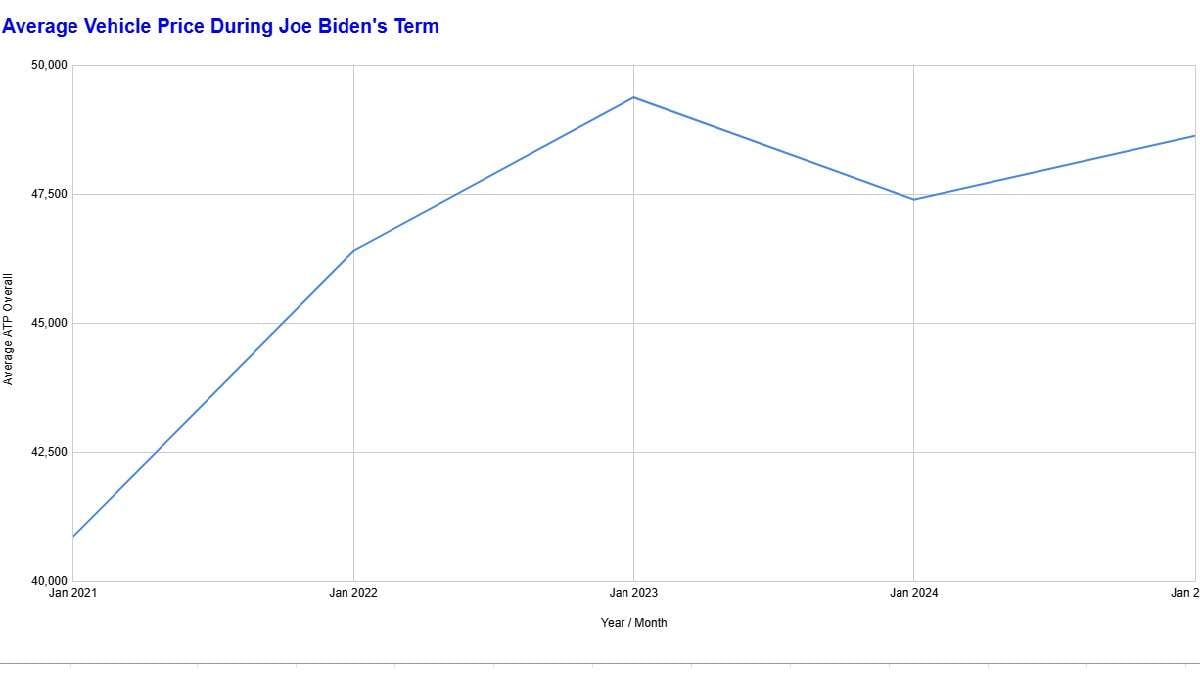

By all accounts, the sky is falling in the automobile industry. President Trump has added to the 100% electric vehicle tariffs President Biden imposed on Chinese EVs and the 25% tariff on imported pickup trucks initiated under the Johnson administration in the 1960s and kept by every following president. We know some vehicle cost increases are on the way, so we wanted to create a baseline of average price data we could easily look back upon as the average vehicle transaction (ATP) prices rise during President Trump in his ‘47 administration.
Where Do We Get This Fantastic Data?
We used KBB/Cox automotive data for all of our averages, and we provide handy links to all of the data tables at the bottom of our story. By using the same source from start to finish, we have minimized any data gathering changes. The data should be pretty solid.
Here is the complete comparison and data analysis of the Biden vs. Trump car price ATP from the Torque News Youtube channel.
What Is “ATP,” and Why Does It Give Us a Useful Tool For Price Comparisons?
Now, the “Average Transaction Price,” also called by industry insiders the “ATP,” is just a big total of the average cost. Don’t be fooled by the high number. Regular folks are not paying this average for their affordable family crossover. The ATP includes the fancy-pants luxury vehicles that are mostly leased and then dumped back into the market with massive depreciation in three years. That skews the ATP upward a lot. Also, pickup trucks are included in the ATP. Pickups are massive, over-priced, gluttonous vehicles for family use, but contractors, municipalities, and fleets need them, and they are lumped in with the ATP.

What Does Our Top-of-Page Graph Mean? How Is It Scaled? What Does the Chart Mean?
To make the data more meaningful, we have created this handy-dandy chart that shows you three breakdowns of the average cost of three different types of vehicles. The first is compact cars. We added these because it provided a baseline for the least expensive type of new car. Next up are compact crossovers. This group is massive. It includes the five-passenger crossover SUVs that make the the single largest group of vehicles by total number purchased. Finally, we added pickup trucks. Pickups are a big part of our economy and the second-largest overall segment by volume.
We scaled our graph’s Y axis showing the starting ATP values and the ending values, rather than use a full-size scale, since no data was outside of the graph's viewing area. This gives the reader/viewer a better understanding of the changes over the period (which is represented on the X axis).
Here are some fact findings of the changes to average vehicle prices during President Biden’s term, which began January 20, 2021.
- Overall ATPs rose by 17.3% over the first 24 months of the Biden presidency.
- Over the full term, ATPs rose 16%, as prices eased in the third year of the term.
- Compact car ATPs rose by 17% over the full term.
- Compact crossover ATPs rose by 16.3% over the full term.
- Pickup truck ATPs rose the most, with an 18.3% rise over the full term.
- Pickup truck ATPs jumped by about 12% in just the first 12 months of the Biden administration.
Incentives and additional dealer markups are not reflected well in the data. During the initial years of the Biden administration, additional dealer markups and sales above MSRP were common. Later in his term, prices moderated, incentives returned, and by the end of his term, low-cost leases, low APRs, and cash on the dash had returned. Average ATP is a handy tool, but we do not wish to give the impression that it tells the whole story in full detail. During the price spike years, there were still deals to be found. During the later years, when prices moderated, full sticker-price sales were also still occurring, particularly for such vehicles as Toyota hybrids.
Manufacturers Offer Deep Discounts On Popular Models In Advance Of Expected Tariff-Related Price Increases
The mass media is having a great fear, uncertainty, and doubt party right now. Scary stories about massive price increases are easy to find. However, that has not actually happened yet. What has happened is that Ford is offering employee pricing to all customers on most of its models, and Nissan has slashed the price of its top-selling vehicle, the Rogue Crossover SUV by four figures. We’re confident that increases are ahead, but as of now, they have not yet happened.
Summary - Double-Digit Vehicle Price Changes Are Not Unusual
As you can see, the prices of automobiles have gone up and down over recent presidential administrations. Double-digit cost increases have happened before and have happened recently. As the changes come during President Trump’s “47” administration, we now have a handy baseline against which to judge the expected changes.
Do you think the increases will be larger under President Biden or President Trump? Tell us in the comments below.
John Goreham is a credentialed New England Motor Press Association member and expert vehicle tester. John completed an engineering program with a focus on electric vehicles, followed by two decades of work in high-tech, biopharma, and the automotive supply chain before becoming a news contributor. He is a member of the Society of Automotive Engineers (SAE int). In addition to his eleven years of work at Torque News, John has published thousands of articles and reviews at American news outlets. He is known for offering unfiltered opinions on vehicle topics. You can connect with John on Linkedin and follow his work on his personal X channel or on our X channel. Please note that stories carrying John's by-line are never AI-generated, but he does employ grammar and punctuation software when proofreading and he also uses image generation tools.
Chart showing Biden-era vehicle price changes by John Goreham uses KBB/Cox Automotive data.
Handy Links to sources:
Set Torque News as Preferred Source on Google
Follow us today...







Comments
What is Trump '47? Why is 47…
Permalink
What is Trump '47?
Why is 47 being abbreviated like it's short for 1947 or something.
I think it means that he is…
Permalink
In reply to What is Trump '47? Why is 47… by Guy McDude (not verified)
I think it means that he is the 47th president of the United States of America.
Guy, thank you for pointing…
Permalink
In reply to What is Trump '47? Why is 47… by Guy McDude (not verified)
Guy, thank you for pointing out that I used a poor abbreviation. Indeed, since this story covers two of President Trump's terms, I use '45 and '47 to differentiate between them. President Biden was the 46th President. We appreciate your comment.
Interesting article, John. …
Permalink
Interesting article, John. It brought some thoughts to my mind, and I have neither the knowledge nor the data access to settle the questions they raise. I don't expect you to answer these, but I put them out there as food for thought.
First, I wonder what impact consumer confidence has on the ATP. If I am confident that my income will continue as is or improve, I may be willing to add more options and accessories to the new car I might purchase than I would if I had doubts about the near future economy. If many people have the same feeling, the ATP seems likely to rise during periods of enhanced consumer confidence.
Second, while I admit to being too lazy to investigate the history of of general inflation (especially due to supply chain issues during and following the COVID pandemic) in automobile prices during that period, my gut tells me that this was a rather strong contributor to the ATP increases you report as well.
Given these thoughts, my guess is that the ATP will remain fairly stable under the Trump 47 administration. I expect that there will be tariff-related inflation that will be offset by erosion in consumer confidence. If I were likely to purchase a car in the next four years (I'm not), I'd be looking to keep it as cheap as possible.
Keep up your great work, my friend!