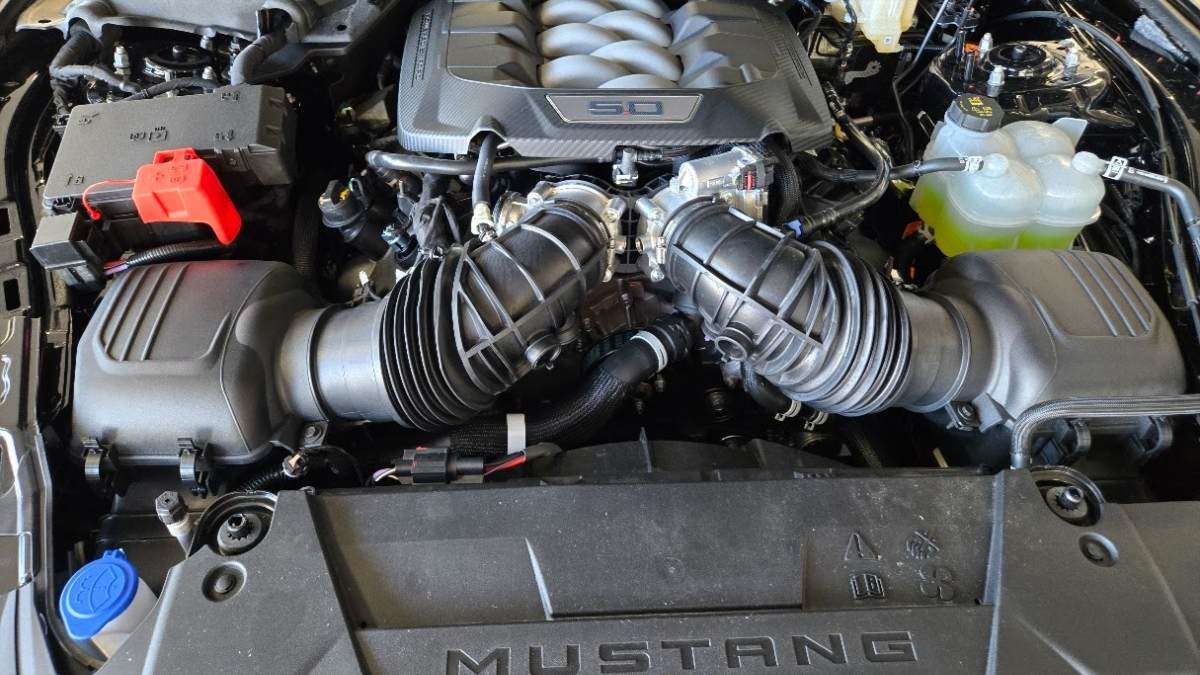

If you are shopping for a rear-drive, 2-door, V8-powered, six-speed manual sports car, muscle car, or pony car for $50K right now, there is one. The Ford Mustang GT. I took my Bronco Sport Badlands in for some maintenance this past week and saw it in all its glory. The car is fantastic. Black on black on black. It just does not get any worse to the bone than this car. Wisely, Acton Ford’s general manager, Chris Abatsis, had the car staged front and center in the showroom with the hood up. Proudly showing off one of the best engines ever placed in an American car.
So, let’s cut to the chase. How about that big, honkin', dual intake manifold and air filter assembly? When I saw it, I thought it looked like the coolest thing since a chrome air filter housing atop a four-barrel back in the late ‘60s. That intake looks like it could hoover up a raccoon. The intake plumbing is so phat you’d need XL hands to connect it.
Up front, Ford has dual - dual filter housing cover clamps so you can quickly swap out the filters without using any tools. Given that Mustang GTs are usually low-mileage cars, the filters should not be a meaningful part of the cost of ownership.
Air intakes serve three purposes in performance cars. First, their job is to ensure that nothing can harm the engine by entering with the intake air. They filter out the nasty stuff and let the cleaned air enter the plenum. Second, their job is to let as much air pass with the least restriction possible. Having two ginormous ones is the trick here. Last, air intakes are partly responsible for the sound of a car’s engine. Sound matters a lot to the folks who plunk down $50K for a V8-powered car, so Ford certainly tuned the entire system to provide aural delights.
My opinion and vote is that this intake system is the best one on any car you can buy today. It not only serves all three of its core functions, but it looks super cool. For a counterpoint, we turned to Torque News alumnus and performance car expert Patrick Rall. He had some very solid arguments as to why Ford should not have put so much effort into the air filter housings and the intake. Here’s his opinion in a quote bubble:
Advertising
That intake system looks cool, but as someone who modifies my vehicles, all I see there is an automaker making it drastically more expensive to add a few extra horsepower. The cold air intake for my SRT Challenger was $700. A cheap intake is around $500. That Mustang owner has to buy two of them. The same is true of upgrading the throttle bodies. The owner now has to buy two. And there's absolutely no reason that engine needs two air paths, when a Dodge 170 can feed a 3.0-liter blower with one path. It's truly needless complexity. And I think that Ford did it to intentionally make upgrading more expensive.
As you can see, there are two sides to every story. Patrick is spot on with regard to performance car owners upgrading intakes and air boxes. It’s like a rite of passage. Owners see a vehicle with a peak horsepower generation of 486 hp and think, “I cannot live another day if that car does not have 493 HP.” Off they run to buy a K&N system.
What say you, performance car enthusiast? Is the Ford Mustang’s dual intake the coolest thing ever, or just a hassle waiting to be replaced? Tell us in the comments below.
Image of Mustang GT engine by John Goreham, taken at Acton Ford.
John Goreham is the Vice President of the New England Motor Press Association and an expert vehicle tester. John completed an engineering program with a focus on electric vehicles, followed by two decades of work in high-tech, biopharma, and the automotive supply chain before becoming a news contributor. He is a member of the Society of Automotive Engineers (SAE int). In addition to his fourteen years of work at Torque News, John has published thousands of articles and reviews at American news outlets. He is known for offering unfiltered opinions on vehicle topics. You can connect with John on LinkedIn and follow his work on his personal X channel or on our X channel. John employs grammar and punctuation software when proofreading, and he sometimes uses image generation tools.
Set Torque News as Preferred Source on Google
Follow us today...