
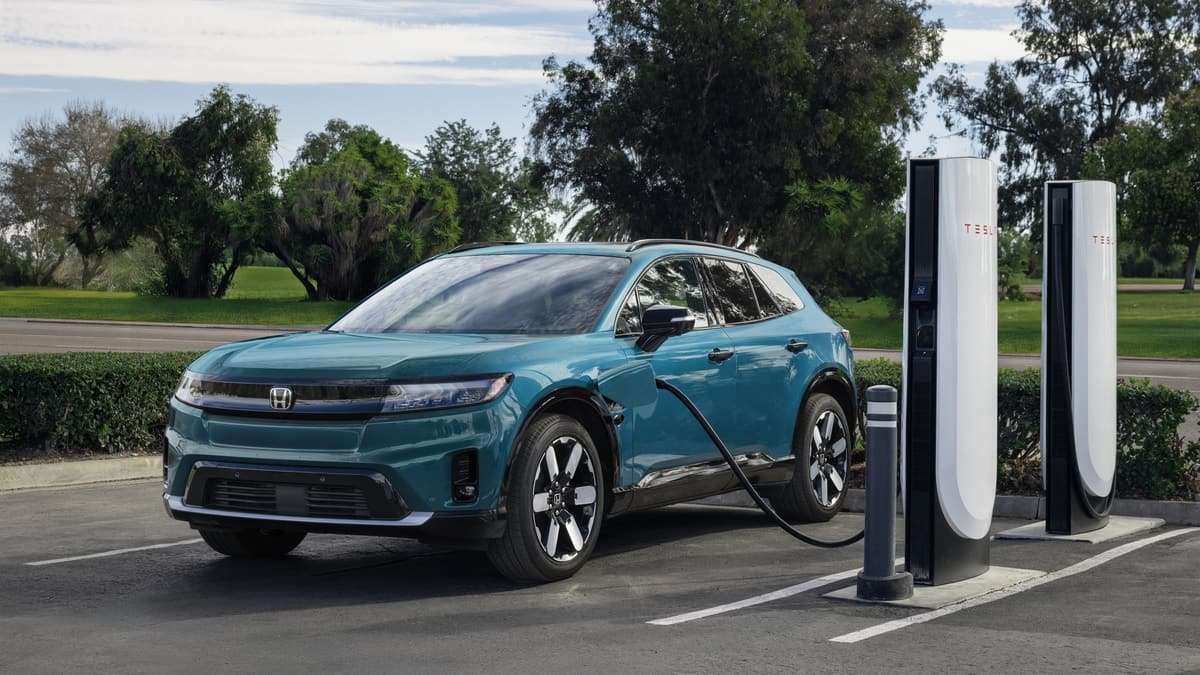

When it seems like the price of everything is getting painfully high, it’s nice to hear about someone finding a way to save big bucks. We often see EV drivers who are grateful that they can avoid paying the huge premium to fill a gas tank. With the massive buildout of the EV charging infrastructure in the U.S. over the last few years, these stories are becoming more common. Here’s a good one from today that was posted by Marcus_Zeno on the r/electricvehicles subreddit. Marcus started by posting:
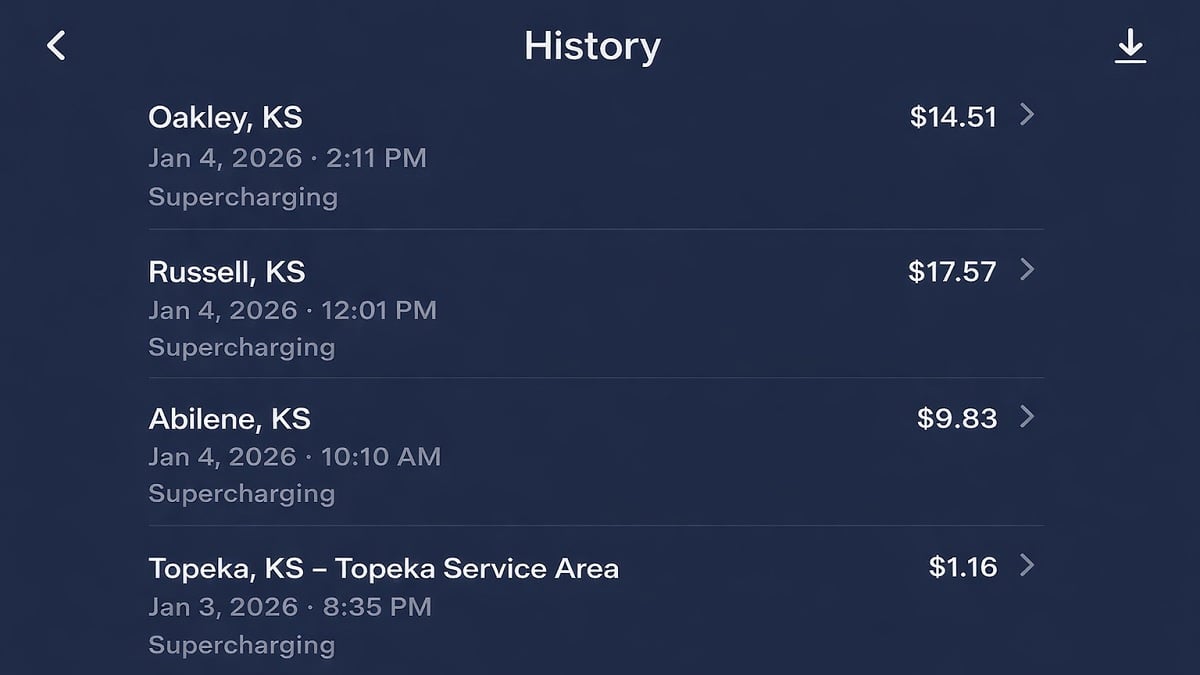
“I drove my 2025 Honda Prologue EV across Kansas. It cost me 50 bucks, and one hour of extra time than ICE car.
With the battery around 30% to 50% charge, the Tesla chargers would charge at around 150 kW curving down to 50 kW when the battery was up to 80% or more.
I purchased a month of the Tesla membership to qualify for their rebate.”
Marcus then added more details about his trip:
“Temperatures started the day in the 40s and rose into the 70s. There was a very strong head/cross wind of 30 to 40 mph at times.
Each of the sessions at Oakley, Russell and Abilene were approximately 30 to 40 minutes. I played it safe and never had the battery below 30%. There were numerous other charging locations (Electrify America, ChargePoint, etc.) where I could have stopped if the Tesla stations weren't working. I estimate that if I was driving a gas vehicle, we would have stopped for 10 to 15 minutes to stretch the legs, so the EV cost us about one hour of our time.”
NS8VN gave some advice for how to reduce charging time:
“The EQEV/Prologue charge curve starts to drop at 30%, so by refusing to go lower than that you were guaranteeing a slower charge than necessary.
It can take twice as long to go from 30%-80% as it does going from 10%-60% while adding the same amount of range.”
Boxsterguy made a comparison go a gas-gauge:
“I've always wondered if the same people that think 30% SoC is "low" also stop and fill their gas tank when it drops below 1/3rd?”
Dirks_Knee commented about how grateful he is to be driving an EV:
“Posts like this reinforce my happiness in choosing a Kia EV6 based on charge speed and range. I just mapped Oakely, KS to Topeka, KS and starting with 100% battery would only have to spend around 18 minutes charging which is a perfect amount of time to get out use the bathroom, stretch my legs a little, and maybe grab a snack.”
Growth of Charging Infrastructure
The biggest factor in making EV road trips cheap and easy is charging infrastructure. Fortunately, EV charging infrastructure has expanded rapidly in recent years and charging is becoming easier as the number of public charging stations continues to rise. Drivers today have far more options than they did just a few years ago. The United States now has more than 100,000 public charging outlets, which makes long trips and daily commuting far less stressful for EV owners. Public charging locations are far more common than they were just a few years ago, which makes owning an electric vehicle feel less risky. The increase in stations helps drivers feel confident that charging will be available during daily driving and longer trips.
State, and local governments are playing a major role in this expansion. Incentives for installing chargers are accelerating deployment. Private investment is also growing, as companies see charging as a long-term business opportunity and a way to attract customers.
Faster and More Convenient Charging
Charging technology has improved alongside network growth. Modern fast chargers can add substantial range in under 30 minutes, compared to older equipment that required hours. Shorter charging times reduce wait periods and make electric vehicles more practical for road trips.
Tesla’s Supercharger network has made major gains in charging power over the past few years. The newest V4 Tesla Superchargers are designed to deliver up to 500 kilowatts, which is double the 250 kilowatts that defined the network just three years ago. Back then, no Superchargers could exceed that level. Today, early V4 sites are coming online, while many locations now support higher peak rates through upgraded hardware. These improvements shorten charging stops, add miles faster, and make long distance electric travel far more practical.
Expanded Access Beyond Cities
Charging networks are no longer limited to major urban areas. Now that U.S. highway corridors are built out, rural regions and are seeing more installations, which helps reduce range anxiety. Broader geographic coverage makes electric vehicles viable for more drivers and more use cases.
Automaker and Network Partnerships
Tesla understood that its success depended on making it possible for its customers to conveniently charge while on road trips. Now other automakers are scrambling to catch up by increasingly partnering with charging providers or building their own networks. These include Mercedes-Benz, Polestar, Volvo, and GM partnering with ChargePoint, and Audi, BMW, Genesis, Hyundai, Kia, Lucid, Mercedes-Benz, Porsche, and Volkswagen partnering with Electrify America. Such collaborations create a more seamless experience, with better reliability, simpler access, and tighter integration with vehicle navigation systems.
Strategies for Continued Improvement
Further progress depends on adding more stations in strategic locations, increasing fast charging availability, and improving reliability. Integrating renewable energy can enhance sustainability. User experience improvements such as simple payments and real time availability data can make charging easier. Cooperation among governments, businesses, and communities remains essential, along with public education about charging access.
Bottom Line
Electric vehicle charging infrastructure is clearly improving, with more stations, faster charging, wider coverage, and stronger collaboration across the industry. Continued investment and thoughtful planning will make charging easier and more reliable, encouraging more drivers to choose electric vehicles with confidence.
The Honda Prologue
The Honda Prologue is Honda’s first mainstream battery electric SUV, launched in 2024 as part of the brand’s shift toward electrification. It stands out for its balanced blend of comfort, practicality, and everyday usability while carrying Honda’s reputation for reliability and build quality. The Prologue offers a spacious cabin, competitive range for daily driving, and a design that feels familiar yet modern compared with other EVs in its class. Typical pricing starts in the mid to upper $40,000 range, depending on trim and options, which places it competitively among similarly sized electric SUVs. The Prologue is sold primarily as a five-seat SUV, appealing to families and commuters looking for a simple, functional EV without sacrificing interior space or features.
What Do You Think?
How low are you personally comfortable letting your battery drop on a road trip, and why?
Would you trade an extra hour of travel time for significantly lower fuel costs, or is time always king for you?
Chris Johnston is the author of SAE’s comprehensive book on electric vehicles, "The Arrival of The Electric Car." His coverage on Torque News focuses on electric vehicles. Chris has decades of product management experience in telematics, mobile computing, and wireless communications. Chris has a B.S. in electrical engineering from Purdue University and an MBA. He lives in Seattle. When not working, Chris enjoys restoring classic wooden boats, open water swimming, cycling and flying (as a private pilot). You can connect with Chris on LinkedIn and follow his work on X at ChrisJohnstonEV.
Photo credit: Honda media kit, Provided by author
Set Torque News as Preferred Source on Google
Follow us today...





Comments
I had severe range anxiety…
Permalink
I had severe range anxiety up until recently. Especially living in the west. I delved into my first EV, a PHEV BMW 530e. It helped alleviate any RA I had. Loved it. Then I came to the conclusion that I stop every 2-3 hours to stretch the legs, etc. anyways. Average 70 MPH it's only 210 miles max. So I went all-in and bought a BMW iX. It has a max range of 330. Road trips are not bad and I always choose hotels that have EV chargers. Easy peasey.
Hi Sam, thanks for reading…
Permalink
In reply to I had severe range anxiety… by Sam Weber (not verified)
Hi Sam, thanks for reading our article and for your comment. Yeah, it’s funny that the people who tend to have EV “range anxiety” are the people who don’t own EVs. Once you own one, you learn that’s it’s really not a problem.
I can drive my gas powered…
Permalink
I can drive my gas powered Honda HRV across Kansas for probably about $30. I don’t see the point of doing it for 50 in an EV.
oh stop.. it's a Chevy in…
Permalink
oh stop.. it's a Chevy in drag.. there's a reason the majors have dramatically scaled back EV production... the American consumer has finally caught on to the EV hoax..
At current gas prices, a…
Permalink
At current gas prices, a conventional, decent mileage internal combustion engine vehicle would cost you less to drive across Kansas. Funny how the article artfully dodges that inconvenient fact.
My 2018 Honda civic EXT…
Permalink
My 2018 Honda civic EXT easily gets 40 mpg. I can get 425 miles on one tank of gas for about $35. So I'm not impressed. Yes I know, at home charging is cheaper, but still, this tech is a few years away from good enough for me.