
There’s something almost meditative about squeezing every last electron from a battery pack, a digital-age cousin of tuning carburetors for peak efficiency. The hot-rodders of yesterday tinkered with jets and timing lights; today’s hypermilers adjust speed, tire pressure, and route planning. Both are cut from the same obsessive cloth. And in the modern landscape of electric vehicles, few machines reward that discipline better than the Hyundai Ioniq 6. It’s a car that doesn’t just move you, it invites you to master it.
One Hyundai Ioniq 6 owner recently chronicled this mastery on Reddit’s r/Ioniq6 forum. His username is dblrnbwaltheway, and his report reads like a field manual for real-world efficiency:
"This year I have driven this car to commute and on a road trip. Efficiency is really solid below 70 mph. Skinny wheels and tires make a huge difference. Temperature and elevation changes also make similarly huge differences. Automatic cruise control is not the most efficient, but it is very convenient to use.
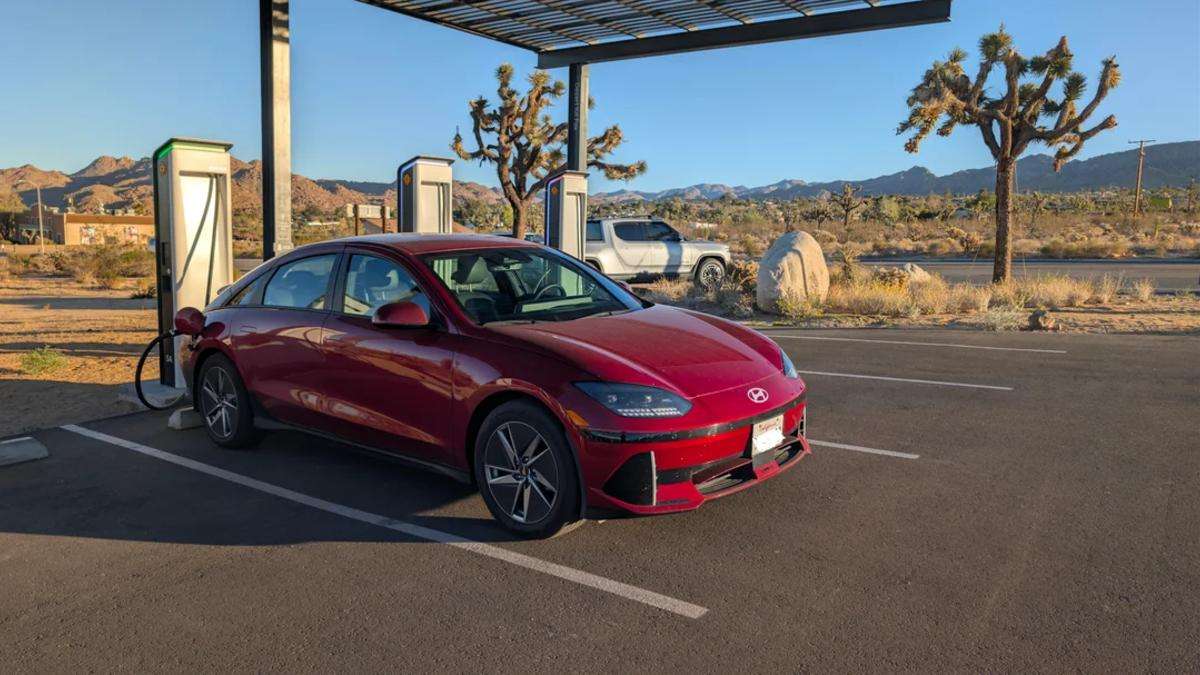
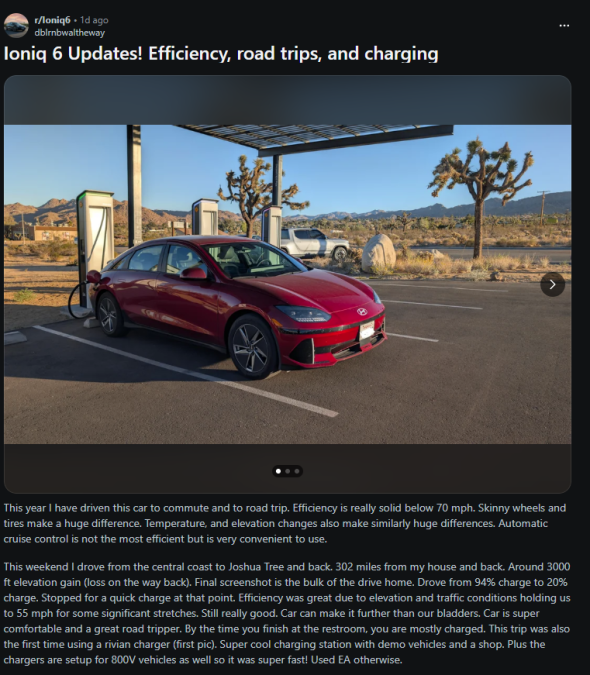
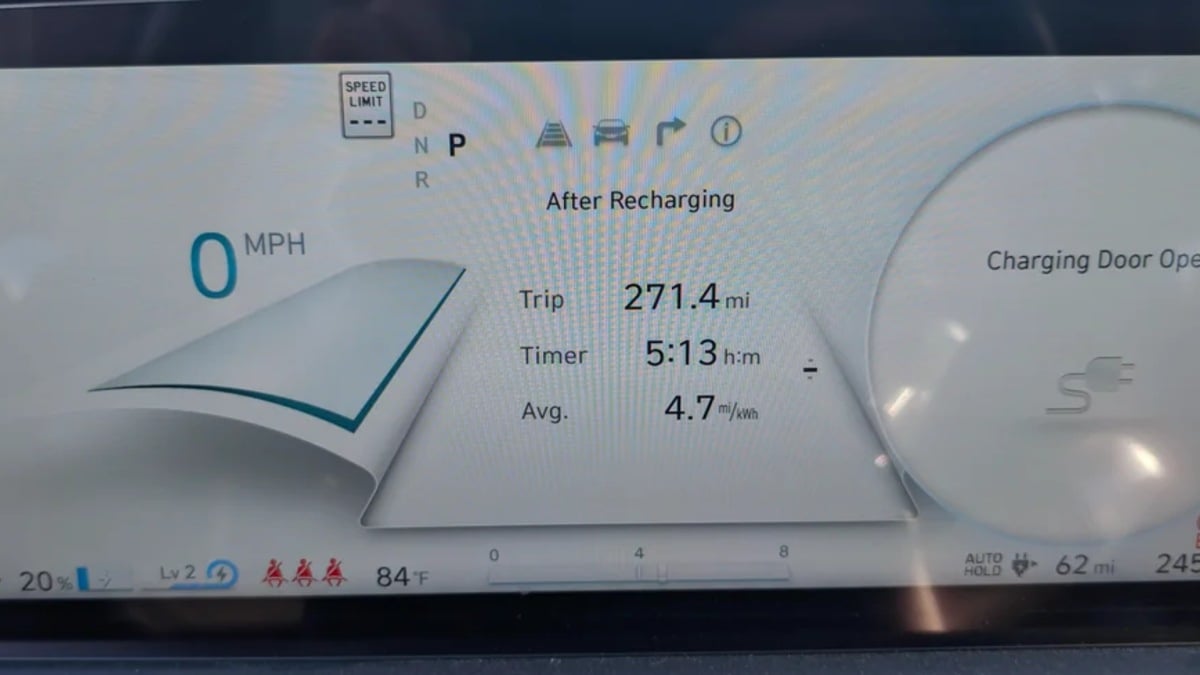
This weekend, I drove from the central coast to Joshua Tree and back. 302 miles from my house and back. Around 3000 ft elevation gain (loss on the way back). The final screenshot is the bulk of the drive home. Drove from 94% charge to 20% charge. Stopped for a quick charge at that point. Efficiency was great due to elevation and traffic conditions holding us to 55 mph for some significant stretches. Still really good. A car can make it further than our bladders. The car is super comfortable and a great road tripper. By the time you finish in the restroom, you are mostly charged. This trip was also the first time using a Rivian charger (first pic). Super cool charging station with demo vehicles and a shop. Plus, the chargers are set up for 800V vehicles as well, so it was super fast! Used EA otherwise.
Also, finally got my NACS adapter in the mail. So I tested that out the other weekend (2nd pic). Works as expected, much slower than other chargers. Wouldn't use unless needed."
What stands out is not the technology, but the technique. This driver understands what old-school mileage freaks knew long before regenerative braking existed: speed kills efficiency. Below seventy miles per hour, the Ioniq 6 becomes an elegant study in aerodynamics and restraint. Drag doesn’t grow linearly with speed; it multiplies. So holding back a few miles per hour pays exponential dividends. One commenter, alemondemon, confirmed this from experience: “During the summer, I can get around 5.5 if I am hypermiling, but it’s difficult.” Difficult, yes, but this is the point. Mastery always is.
Hyundai Ioniq 6: South Korea’s Answer To Tesla
- The Ioniq 6 is built on E‑GMP (Hyundai’s electric vehicle platform), enabling a sleek “electrified streamliner” shape with a drag coefficient as low as 0.21 thanks to flush door handles, active air flaps, and wheel air-curtains.
- In terms of power and range, the long-range version offers a 77.4 kWh battery pack (or equivalent use cases) and RWD or AWD layouts; for example, one AWD variant covers 0–100 km/h in around 5.1 s.
- On the charging & technology front, it supports an 800-volt architecture for rapid DC fast charging, and features such as Vehicle-to-Load (V2L) allow you to power external devices from the car.
- Beyond just being an EV sedan, it uses eco-friendly interior materials, and its design is led by chief designer SangYup Lee at Hyundai; also, its “Electrified Streamliner” aesthetic marks a clear shift for Hyundai’s EV design language
Then comes the rubber-meets-road revelation. Our driver swapped from the wider 245-section tires on the SEL to the narrower 225s from the SE trim. “Huge difference in aero drag,” he wrote, and fellow enthusiast wave_action immediately saw the logic. Narrower tires reduce rolling resistance, unsprung weight, and the wake turbulence that wider rubber drags through the air. It’s not about appearance; it’s about performance through precision.
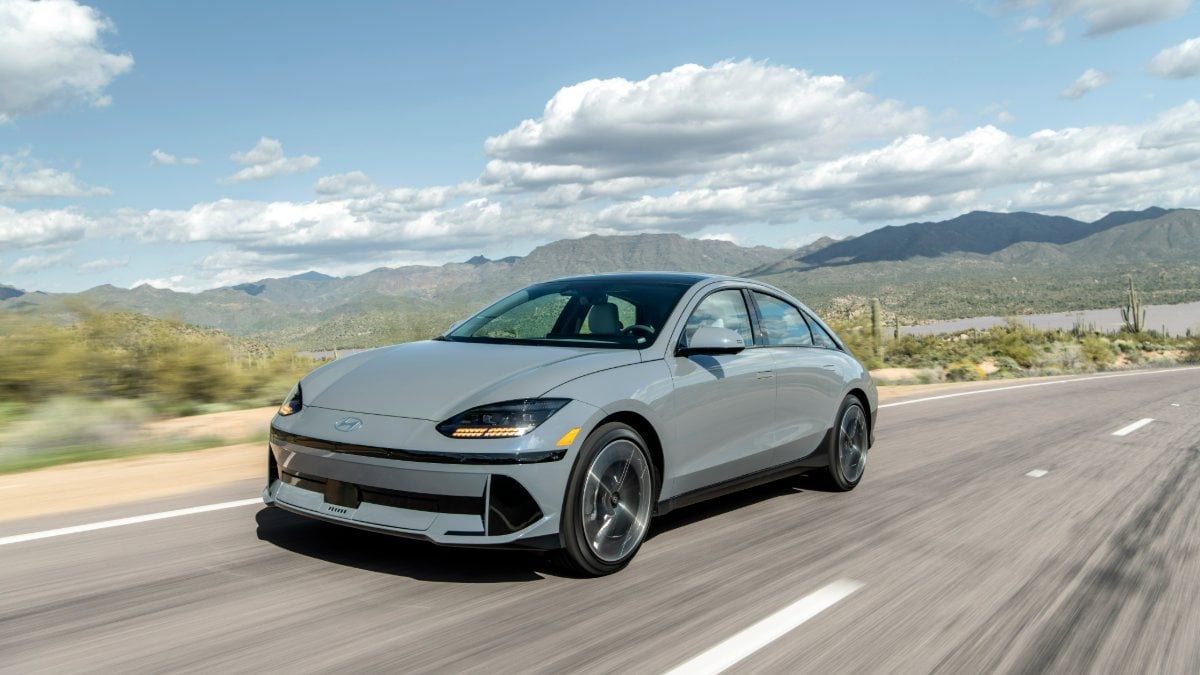
The reliability argument, too, finds quiet strength here. Electric drivetrains thrive in low-stress conditions. When you keep speeds below seventy, the motor hums in its most efficient band, the inverter runs cool, and the battery avoids thermal fatigue. There are no valves floating, no piston rings fluttering, no oil pumps laboring against redline pressure. It’s mechanical serenity. What’s being discovered here isn’t new; it’s a rediscovery of mechanical sympathy, applied to a modern medium.
That 302-mile journey to Joshua Tree wasn’t just a test of range; it was a proof of concept for how the EV road trip can evolve. The Rivian charging station that the driver described, with its demo vehicles, shop, and 800V hardware, symbolizes the next chapter of long-distance travel. Charging stops no longer feel like interruptions but interludes. The simple notion that “by the time you finish at the restroom, you are mostly charged” reframes what convenience means on the open road. It’s road tripping reimagined, where efficiency and leisure find common ground.
The NACS adapter test, brief and candid, adds another layer to the experiment. “Works as expected, much slower than other chargers. Wouldn’t use unless needed,” the driver noted. It’s the kind of firsthand report that gives the EV community real value, data unfiltered by marketing departments. This sort of grassroots testing, shared in real time, is what pushes the ecosystem forward far faster than any press release can.
Ultimately, what this story reveals is that hypermiling is not an eccentric hobby but a genuine skill. It’s as much about the driver as the machine. The Ioniq 6, with its streamlined body, balanced chassis, and sophisticated electric architecture, rewards smoothness, patience, and intent. Beneath seventy miles per hour, it transcends the category of efficient sedan and becomes something greater: a tool for those who drive with curiosity and control. The numbers, 4.7 miles per kilowatt-hour, a 302-mile trip, sub-hour charge stops, are impressive, but they tell only part of the story.
The deeper truth is that we’re watching a new form of automotive artistry take shape. Where once enthusiasts measured mastery in quarter-mile times and lateral Gs, now it’s found in maximizing energy, minimizing waste, and treating the machine with deliberate care. Hypermiling in an Ioniq 6 is not a retreat from performance.
Image Sources: Hyundai Media Center
Noah Washington is an automotive journalist based in Atlanta, Georgia. He enjoys covering the latest news in the automotive industry and conducting reviews on the latest cars. He has been in the automotive industry since 15 years old and has been featured in prominent automotive news sites. You can reach him on X and LinkedIn for tips and to follow his automotive coverage.
Set Torque News as Preferred Source on Google
Follow us today...