


The difference between model years often comes down to microscopic adjustments that manufacturers present as revolutionary improvements.
Sharjeel Ahmad's side-by-side comparison of his 2025 Mazda CX-50 Hybrid Premium Plus with the newly released 2026 model provides a fascinating glimpse into the incremental nature of modern automotive development, where meaningful progress battles against the economics of annual model refreshes.
Ahmad's comprehensive evaluation reveals the subtle but measurable improvements Mazda has implemented for the 2026 model year.
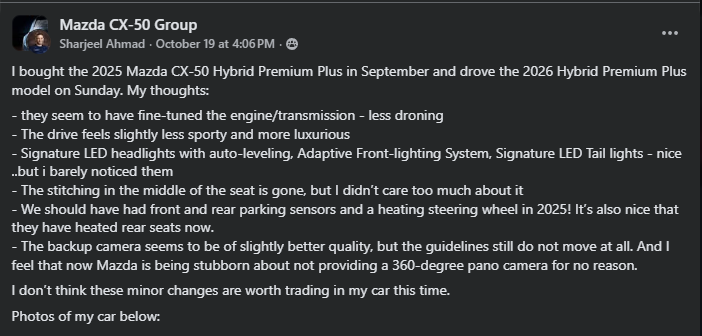
"I bought the 2025 Mazda CX-50 Hybrid Premium Plus in September and drove the 2026 Hybrid Premium Plus model on Sunday. My thoughts: they seem to have fine-tuned the engine and transmission with less droning. The drive feels slightly less sporty and more luxurious. The signature LED headlights with auto-leveling, adaptive front-lighting system, and signature LED tail lights are nice, but I barely noticed them. The stitching in the middle of the seat is gone, but I did not care too much about it. We should have had front and rear parking sensors and a heating steering wheel in 2025! It is also nice that they have heated rear seats now. The backup camera seems to be of slightly better quality, but the guidelines still do not move at all. And I feel that now Mazda is being stubborn about not providing a 360-degree panoramic camera for no reason."
The most significant improvement Ahmad identifies centers on powertrain refinement, specifically the reduction of what he describes as "droning" from the engine and transmission combination. This addresses one of the persistent criticisms of hybrid powertrains, where the constant switching between electric and gasoline power can create an unsettling acoustic experience for drivers accustomed to conventional engines. Mazda's engineers have clearly invested time in smoothing these transitions, creating a more seamless and refined driving experience that better matches the premium positioning of the CX-50 lineup.
The shift toward a "less sporty and more luxurious" driving character represents a strategic repositioning that reflects broader market trends. Contemporary SUV buyers increasingly prioritize comfort and refinement over outright performance, and Mazda's adjustment acknowledges this reality. The CX-50's hybrid system represents Mazda's commitment to efficiency without sacrificing the driving dynamics that define the brand's identity.

Ahmad's observation about the LED lighting improvements highlights the challenge facing automotive designers in an era where premium features become standard expectations. The signature LED headlights with auto-leveling and adaptive front-lighting systems represent genuine technological advancement, yet their impact on the daily driving experience remains subtle enough that owners "barely notice them." This paradox defines much of modern automotive development, where sophisticated engineering improvements operate invisibly in the background.
The interior refinements Ahmad mentions, particularly the elimination of decorative stitching in the seat centers, reflect Mazda's ongoing evolution toward cleaner, more minimalist design language. While Ahmad expresses indifference toward this change, it represents a broader shift in automotive interior design away from ornamental elements toward functional elegance. The addition of heated rear seats addresses a practical concern for families and demonstrates Mazda's attention to passenger comfort across all seating positions.
Mazda CX-50 Engineering Insights
- The CX-50's naturally aspirated 2.5-liter engine traces its lineage to Mazda's Formula One racing program from the early 1990s. This connection to motorsport engineering influences the hybrid system's responsiveness and power delivery characteristics that Ahmad experienced during his test drive.
- Mazda's i-Activ AWD system monitors 27 different sensors every 10 milliseconds to predict traction needs before slippage occurs. This predictive capability contributes to the refined driving dynamics that Ahmad noted in his comparison between model years.
- The CX-50 employs sound-deadening materials originally developed for Mazda's luxury division, including specialized foam that reduces road noise by up to 10 decibels. Ahmad's observation about reduced droning likely reflects improvements to this acoustic package for the 2026 model year.
- Unlike many competitors that compromise cargo space, the CX-50 Hybrid positions its battery pack beneath the rear seats to maintain full trunk capacity. This engineering decision preserves the practicality that makes the CX-50 appealing to families while delivering the efficiency improvements Ahmad values.
Ahmad's frustration with the backup camera limitations exposes a significant weakness in Mazda's technology implementation. While the image quality has improved for 2026, the continued absence of moving guidelines represents a puzzling omission in an era where even economy vehicles include this basic functionality. The stubborn refusal to provide a 360-degree panoramic camera system, as Ahmad characterizes it, places the CX-50 at a disadvantage compared to competitors who have made such systems standard equipment.
The feature disparity between hybrid and non-hybrid variants creates additional complexity for potential buyers. Cheryl McGaughey's comment that her "2025 Turbo Premium Plus has heated seats in back and heated steering wheel and 360 camera" highlights the arbitrary nature of feature distribution across trim levels. This strategy may make financial sense from a manufacturing perspective, but it creates confusion and potential resentment among customers who expect consistent feature availability across similar price points.
Victor Pirsoul's confirmation that his "2025 Turbo Premium Plus has the 360-degree camera and the guidelines move when I turn the wheel" further emphasizes the inconsistent feature implementation that characterizes modern automotive marketing. These artificial distinctions between powertrains serve no technical purpose and exist solely to create price differentiation and encourage upgrades to higher trim levels.
Wotank Dom Metooyam's passionate criticism of Mazda's decision-making process reflects broader frustration within the automotive enthusiast community. His assertion that "Mazda USA headquarters decided to not put in all the features from the non-hybrid top trim" and his question "Is Mazda USA sabotaging sales?" captures the bewilderment many feel when manufacturers make seemingly counterproductive decisions that limit their own products' competitiveness.
The Mazda CX-50's market positioning reflects the challenging balance between premium aspirations and mainstream pricing. Ahmad's experience demonstrates how minor improvements can enhance the ownership experience without necessarily justifying the expense and inconvenience of upgrading to a newer model year.
Ahmad's ultimate conclusion that "these minor changes are worth trading in my car this time" represents the rational response of an informed consumer who understands the true value proposition of incremental improvements. This perspective challenges the automotive industry's annual refresh cycle, which depends on convincing customers that modest enhancements justify significant financial commitments.
The 2026 CX-50 Hybrid's improvements represent genuine progress in powertrain refinement and feature content, but they also highlight the limitations of the annual model year system. Meaningful technological advancement often requires longer development cycles than the traditional automotive calendar allows, leading to the kind of incremental changes Ahmad documents.
The future of hybrid technology in mainstream vehicles depends on manufacturers like Mazda continuing to refine the integration between electric and gasoline power sources. Ahmad's positive response to the reduced droning suggests that these efforts are producing measurable results that enhance the ownership experience.
Advanced CX-50 Technology Features
- The 2026 CX-50's adaptive LED headlights can adjust beam patterns across 24 different segments, providing illumination that follows steering input and road curvature. Ahmad barely noticed these improvements because they operate seamlessly in the background, representing the kind of invisible technology advancement that defines modern automotive development.
- Mazda's engineers spent over 18 months refining the CVT programming to eliminate the rubber-band effect that Ahmad described as "droning." The 2026 model incorporates artificial shift points that mimic traditional automatic transmissions while maintaining hybrid efficiency benefits.
- The CX-50's interior materials undergo a 240-hour UV exposure test to prevent fading and degradation, explaining why Ahmad's 2025 model maintains its appearance despite regular use. The elimination of decorative stitching for 2026 reflects Mazda's shift toward more durable, maintenance-free interior elements.
- The CX-50 shares its underlying architecture with the larger CX-90, allowing Mazda to offer premium features like heated rear seats at lower cost points. This engineering efficiency enables the feature additions Ahmad appreciates in the 2026 model without significant price increases.
The feature availability inconsistencies Ahmad identifies reflect broader challenges in automotive product planning, where marketing strategies often conflict with engineering logic and customer expectations. The arbitrary restriction of certain features to specific powertrains or trim levels serves short-term profit objectives while potentially damaging long-term brand perception and customer loyalty.
Ahmad's detailed comparison provides valuable insight for potential CX-50 buyers weighing the benefits of waiting for the 2026 model year versus purchasing available 2025 inventory. His analysis suggests that while the improvements are measurable and worthwhile, they may not justify the premium pricing typically associated with newer model years.
The Mazda brand's evolution toward premium positioning requires consistent execution across all trim levels and powertrains. Ahmad's experience highlights areas where this execution falls short, particularly in technology features that customers increasingly consider essential rather than optional.
The CX-50 Hybrid's refinements for 2026 represent the kind of continuous improvement that defines successful automotive programs, even when individual changes appear modest in isolation. Ahmad's perspective as an actual owner provides credibility that professional reviews often lack, offering genuine insight into the practical implications of these modifications.
The broader implications of Ahmad's comparison extend beyond the CX-50 to encompass the entire automotive industry's approach to model year updates and feature positioning. His rational assessment of the upgrade value proposition challenges both manufacturers and consumers to consider the true worth of incremental improvements versus the marketing hype that typically surrounds new model introductions.
How do you evaluate the value proposition of minor model year updates versus waiting for more substantial generational changes? What features do you consider essential versus optional in modern vehicles, and how do arbitrary trim level restrictions affect your purchasing decisions? Share your thoughts on the balance between continuous improvement and meaningful innovation in automotive development.
The technological landscape of modern vehicles continues to evolve at a pace that challenges traditional model year boundaries, yet Ahmad's experience with the CX-50 Hybrid demonstrates how meaningful improvements often occur in smaller increments rather than revolutionary leaps. The powertrain refinements he identifies represent months or years of engineering work focused on addressing specific customer concerns and improving the overall ownership experience.
The competitive pressure facing Mazda in the compact SUV segment intensifies with each model year, as rivals introduce new features and technologies that quickly become market expectations. Ahmad's frustration with missing features like 360-degree cameras and moving backup guidelines reflects this reality, where yesterday's luxury features become today's standard equipment across multiple price segments.

The hybrid powertrain's evolution in the CX-50 represents Mazda's broader commitment to electrification without abandoning the driving dynamics that define the brand's identity. Ahmad's positive response to the reduced droning suggests that engineers have successfully addressed one of the primary complaints about hybrid systems while maintaining the efficiency benefits that justify the technology's complexity.
The interior refinements Ahmad documents, while subtle, reflect Mazda's ongoing pursuit of premium positioning in a segment dominated by volume manufacturers. The elimination of decorative stitching and addition of heated rear seats represent different approaches to luxury, one through minimalist design and another through practical comfort features.
The feature disparity between hybrid and conventional powertrains creates artificial market segmentation that may ultimately harm Mazda's competitive position. Ahmad's comparison highlights how these arbitrary restrictions can frustrate customers and complicate the purchasing decision process, potentially driving buyers toward competitors who offer more consistent feature availability.
The annual model year refresh cycle that governs automotive marketing often conflicts with the longer development timelines required for meaningful technological advancement. Ahmad's measured response to the 2026 improvements reflects a mature understanding of this reality and challenges the industry's assumption that customers will automatically upgrade for minor enhancements.
What role should customer feedback play in determining which features are included in specific trim levels and powertrains? Share your experiences with model year transitions and feature availability decisions.
Noah Washington is an automotive journalist based in Atlanta, Georgia. He enjoys covering the latest news in the automotive industry and conducting reviews on the latest cars. He has been in the automotive industry since 15 years old and has been featured in prominent automotive news sites. You can reach him on X and LinkedIn for tips and to follow his automotive coverage.
Set Torque News as Preferred Source on Google
Follow us today...






Comments
CX50 is assembled in USA and…
Permalink
CX50 is assembled in USA and in short supply in Canada for tariff reasons. Be prepared to pay over MSRP for this vehicle.
CX50 is assembled in USA and…
Permalink
CX50 is assembled in USA and in short supply in Canada for tariff reasons. Be prepared to pay over MSRP for this vehicle.
Am i missing something? Who…
Permalink
Am i missing something? Who purchases a new car every year? Unless the current car is a lemon, the price (even if the same) doesn't justify a new car yearly.
The CX-50 shares a platform…
Permalink
The CX-50 shares a platform with the CX-30 and Mazda, not the CX-90. Are some of the Mazda features not offered on the Hybrid because it currently employs leased Toyota technology and they electronics wouldn't work with the shared architecture?
I have the adaptive headlights on my CX-9. If you don't notice the difference driving at night. you might need your eyes checked