
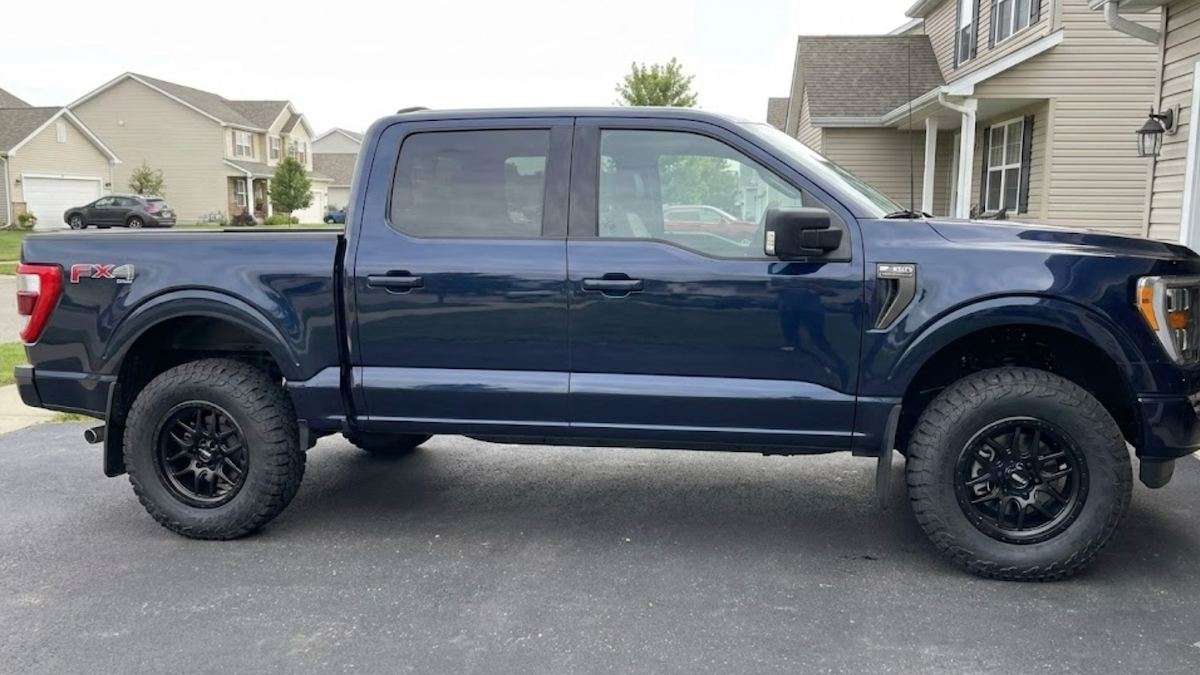

The tire shop says on a Ford F-150, it's a guaranteed rub, but I'll investigate whether you can actually pull off this aggressive stance without breaking out the saw.
I frequently encounter the classic struggle between enthusiastic Ford truck owners who want an aggressive stance and the conservative tire shops tasked with installing the rubber. It is a debate that often pits theoretical clearance numbers against real-world trial and error, leaving the owner caught in the middle of conflicting advice.
The F-150 owner in question is looking to maximize his truck's footprint with a 2.5-inch leveling kit, but he hit a roadblock with the tire installer. Pat Jessup on the Ford F-150 Owners Facebook page says,
"I want to put 295/65 R20 tires on my Ford F-150 with a 2.5-inch level, and no spacers. I just ordered the tires. But now, the guy at the tire shop thinks they will rub because there's not enough clearance. However, I've seen a lot of owners say they won't. Any input? The tires I'm currently running on my truck are 295/70/18."
The Shop vs. The Street
The conflict Pat is experiencing is common in the aftermarket world. Tire shops are notoriously risk-averse; if a tire has even a 1% chance of grazing a control arm or fender liner at full steering lock, they will often advise against it to avoid liability or customer complaints about noise.
The 295/65 R20 tire stands approximately 35.1 inches tall and 11.6 inches wide. It's a significant jump from the stock configurations and pushes the absolute limit of what a 2.5-inch leveling kit can accommodate without modifying the crash bars. While the height is manageable with the level, the width, combined with the factory wheel offset, is where the trouble usually begins.
In similar discussions within the F-150 community, owners often point out that the devil is in the details of the wheel offset. A 295mm section width on a factory rim (typically +44 offset) pulls the tire deep into the wheel well. Users in the thread responding to Pat noted that while the height clears the fender, the sidewall is dangerously close to the Upper Control Arm (UCA).
Some owners report success, but often with a "hair's breadth" of clearance that makes shops nervous. It is similar to the frustrations detailed in my report: "My 2024 Ford F-150 2K Miles In Has Had 8 Different Electrical Issues." Now, after 60 Days, 4 Dealers, and A Buyback, I'm Switching To a Ford Bronco, where the disconnect between what should work on paper and the reality of dealership or shop service leads to major owner dissatisfaction.
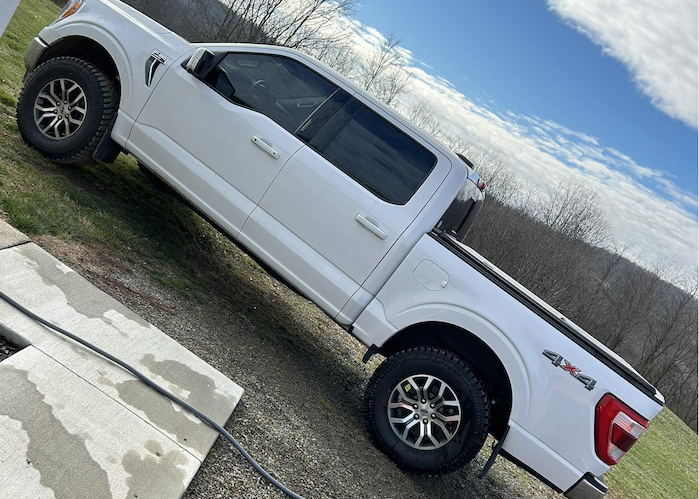
Why F-150 Owners Demand Bigger Rubber
- Aesthetics and Stance: The factory "rake" (where the nose is lower than the tail) and small tires make the truck look less capable. Owners want that filled-out, aggressive look that commands respect on the road.
- Off-Road Ground Clearance: A leveling kit lifts the frame, but only bigger tires actually lift the differential off the ground. Gaining an inch of ground clearance requires a tire that is two inches taller.
- Improved Traction: Wider tires like the 295s offer a larger contact patch, which is crucial for loose surfaces like sand, mud, or deep snow where flotation matters more than biting pressure.
- Personalization: The F-150 is the best-selling vehicle in America, and it is everywhere. Custom tires are the easiest way to distinguish a personal rig from the thousands of fleet trucks on the highway.
Community Feedback on the 295/65 R20
Expanding on the situation, the community's feedback on the 295/65 R20 suggests the tire shop is not entirely wrong, but perhaps too cautious. The consensus among enthusiasts is that this specific size on stock wheels is a "tweener"; it fits on some trucks but rubs on others, depending on the specific tire brand's lug design. Mud-terrain tires with aggressive sidewall lugs are more likely to contact the UCA than an all-terrain tire with a smoother shoulder.
Owners in the thread advised Pat that if rubbing does occur, it is usually minor and happens only at full steering lock. However, ignoring the shop's warning can sometimes lead to disputes later, a feeling I explored in A Ford F-150 Owner Fights a $1,500 Dealer Bill For Snapping Turbo Bolts: Says, 'My Ford F-150 Warranty Repair Became a Nightmare", where the relationship between the service provider and the owner breaks down over expectations and costs.
So What's the Rub?
To understand why the shop is hesitant, we need to examine the suspension geometry of the modern F-150. When you install a 2.5-inch leveling kit, you are changing the angle of the Lower Control Arms (LCA) and the CV axles. While this raises the truck body, it pulls the wheels slightly inward as the suspension droops.
The factory wheels have a high positive offset, designed to tuck the tires inside the fenders for aerodynamics and fuel economy. When you introduce a tire nearly 12 inches wide, the high positive offset forces it toward the frame. The "Rub" usually happens in two places: the crash bars (steel safety beams behind and in front of the front tire) or the UCA.
The tire shop's technician is likely looking at the gap between the current tire and the UCA and doing the math. If Pat is currently running a 295/70/18, that is roughly a 34.3-inch tire. Moving to a 295/65 R20 jumps the diameter to 35.1 inches. That extra radius eats up valuable space in the wheel well.
If the truck is used for any articulation, like entering a steep driveway or light off-roading, that minor rub can become a major crunch. It is a risk calculation. Some owners are willing to trim plastic or even cut metal crash bars to make it work, while others want a bolt-on solution with zero modifications.
Navigating Aftermarket Advice
The reality is that F-150 owners often have to trust the collective wisdom of the community over the textbook answers provided by service centers. It is a recurring theme in truck ownership: the "official" way isn't always the only way.
I highlighted a similar sentiment in my story, They Said I Was Crazy For Changing My Ford F-150's Oil Every 10K Miles Since It Was New, But They Were Wrong, It Has 217K Miles, and Still Going Strong, where an owner defied conventional severe-service maintenance schedules and achieved incredible longevity. In Pat's case, the "crazy" idea of stuffing 35s on a leveled truck without spacers might actually work, provided he accepts that "no spacers" might eventually turn into "I need thin spacers" to clear that UCA.
Ultimately, the decision rests with Pat. The shop has done its due diligence by warning him. If he proceeds, he should be prepared to add wheel spacers to push the tires farther away from the suspension components. In this situation, however, it introduces a new problem: pushing the tires out increases the scrub radius, which swings the tire closer to the crash bars during a turn. It is a game of millimeters.
For owners tired of the constant geometry puzzles and maintenance headaches, the exit strategy is sometimes the only option, as discussed in I Ditched My 2021 Ford F-150 For This Toyota Tundra, Now All My F-150 Repair Problems Are Fixed Forever, Goodbye, I'm Out. For Pat, let's hope the 295s fit, or he might be looking for a new setup sooner than expected.
I'm Denis Flierl, a Senior Torque News Reporter since 2012, bringing over 30 years of automotive expertise to every story. My career began with a consulting role with every major car brand, followed by years as a freelance journalist, test-driving new vehicles, which equipped me with a wealth of insider knowledge. I specialize in delivering the latest auto news, sharing compelling owner stories, and providing expert, up-to-date analysis to keep you fully informed.
Follow me on X @DenisFlierl, @WorldsCoolestRides, Facebook, Instagram and LinkedIn
Photo credit: Denis Flierl via Pat Jessup
Set Torque News as Preferred Source on Google
Follow us today...





Comments
Why don't we all just get…
Permalink
Why don't we all just get tractor tires on it so we won't get stuck in the Costco lot? I wish I had a penny for every clown that has big tires and no legitimate use for them. My retirement would be set.
Does not matter you're still…
Permalink
Does not matter you're still a short douchebag with a baseball hat in Oakley's
They will definitely rub…
Permalink
They will definitely rub when you turn.