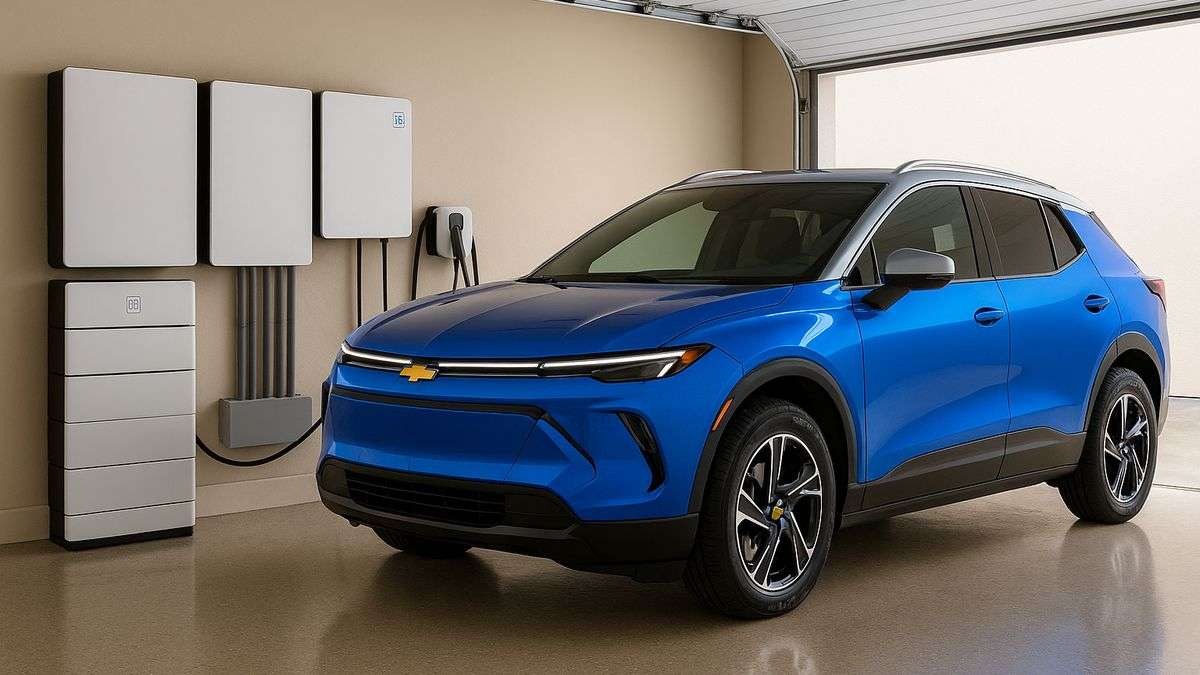

In October, 2022, GM launched a new business unit called GM Energy to develop and offer home energy products and services. The first products for residential customers, including vehicle-to-home (V2H) charging bundles, became available in 2024, with the 2024 Chevrolet Silverado EV being the first compatible vehicle. GM has continued to expand its energy offerings, with new products like the PowerBank energy storage system becoming available in October 2024.
Social media is abuzz with positive comments about the GM Home Energy System. We’ll start with a post from Jason Oswald in the Chevy Equinox EV Facebook Group:
“We got our GM Home Energy System up and running. Vehicle to Home system with 10.6 KW additional storage. Works GREAT with our 2024 Equinox EV 3 LT. Partial Home back-up including HVAC system. Purchased when 20 % off plus energy credits on battery.
It can be moved and original circuits restored to main panel. With $3,000 in battery credits, it cost about $6,800. Also, I used a contractor friend to install where I bought all materials for installation, which saved another $1,000. Then we installed together on weekends. I owe him some reciprocal favors!”
Over in the Cadillac Optiq Owners 4 Enthusiasts Facebook group, Wendy Bierwirth made a post with numerous responses:
“Finally got my GM Home Energy System installed this week. We are still waiting for the town inspector's approval to commission the 17.7 kWh powerbank battery and solar interface but we are loving the system so far. The bidirectional Powershift Level 2 Charger took my Optiq to 80% capacity in a fraction of the time it took before.”
GM’s Entry into Vehicle-to-Home Power
General Motors has entered the vehicle-to-home and vehicle-to-grid (V2G) space with a new bidirectional energy system. The setup allows EV owners to power small devices or even their entire homes using energy stored in the vehicle’s battery. This concept mirrors Ford’s home integration kit, which can power a house through the F-150 Lightning, but GM’s system introduces new flexibility and integration options.
The heart of the GM Energy system is the PowerShift bidirectional charger, capable of handling up to 19.2 kilowatts of alternating current. Homeowners can adjust power delivery based on their electrical capacity, such as lowering output to 48 amps for smaller circuits. The GM system has two other big features. It includes an inverter to convert stored direct current from the EV battery into usable alternating current for home appliances. The system also features a home hub that isolates the house from the grid during outages, allowing users to create a sub-panel for essential loads like refrigerators, well pumps, or Wi-Fi routers.
The GM Energy Home System supports specific GM electric vehicles equipped with Ultium platform-based bidirectional charging capabilities. So far, these vehicles include the 2024 Chevrolet Silverado EV, the 2024 and 2025 GMC Sierra EV, 2024 and 2025 Blazer EV, 2024 and 2025 Chevy Equinox EV, 2024 and 2025 Cadillac LYRIQ. Some 2024 models may require a dealership or over-the-air update to enable this feature.
System Components and Flexibility
GM’s system is modular, built from four primary components: the PowerShift charger, the inverter, the home hub, and a dark-start battery. The dark-start battery keeps the system communication alive during power loss so the inverter and hub can activate automatically. Pricing is competitive, with rebates available to lower installation costs. Customers may be eligible for federal tax credits. Local rebates and incentives can also apply. The GM Energy Home System qualifies for a 30% federal tax credit on the system and PowerBank, if it is installed by December 31, 2025. Customers can also check for specific local and state incentives, such as the significant savings available to PG&E customers through the V2X pilot program. GM states that most homeowners can customize their installation to back up either their entire home or just critical systems, offering both cost and functional flexibility.
Energy Storage and Backup Options
To handle longer power outages or situations where the vehicle is not available, GM offers the PowerBank stationary storage system. It comes in 10.6 or 17.7 kilowatt-hour sizes, and two larger units can be paired for over 35 kilowatt-hours of capacity, enough to power an average home for about a day. These stationary batteries also support energy arbitrage, meaning they can be charged when electricity is cheap and used when rates are high, reducing overall energy costs. When connected to solar panels, the system can move toward full energy independence.
Integration with Solar and Smart Grids
The system’s inverter can integrate with both AC and DC solar arrays, allowing homeowners to add renewable energy to their setup. While the system currently focuses on GM’s ecosystem, future compatibility with other stationary storage systems such as Tesla Powerwalls is expected. The modular design and partnership with professional installers ensure that even complex configurations can be tailored to each home’s electrical layout.
Control and Monitoring Through Software
The GM Energy system connects to the familiar myGMC app, where users can monitor energy flow, switch between backup and time-of-use modes, and track consumption over time. The app displays real-time data such as grid input, vehicle charge status, and estimated backup duration based on the home’s average energy use. This brings a new level of visibility into household energy consumption, helping users better understand kilowatt-hours in the same way they once thought about gallons of fuel.
Demonstration and Real-World Resilience
During a live demo, GM engineers simulated a power outage. The home’s energy flow automatically shifted from the grid to the PowerBank battery, and then to the Sierra EV when selected. This proved the system’s ability to sustain power seamlessly during outages. The demonstration also showed how homeowners could keep essential systems running, even when leaving with their vehicle to recharge elsewhere during extended outages.
GM’s Broader Electrification Strategy
GM Energy’s approach goes beyond hardware. The company is integrating education, partnerships, and charging infrastructure to reduce customer anxiety around EV ownership. Collaborations with companies like Pilot Flying J and EVgo expand public charging, while GM Energy Live helps consumers learn about home and vehicle charging. By 2026, all GM Ultium-based vehicles, including the Blazer, Equinox, Silverado, Sierra, Escalade IQ, and upcoming Bolt, will feature bidirectional capability.
Bottom Line
GM’s Energy ecosystem marks a significant step toward the next phase of EV ownership, where cars are not just modes of transport but integral parts of home energy management. The system’s modularity, solar integration, and user-friendly software position it as a practical bridge to smart grids and energy independence. It reinforces a broader truth emerging in the EV world: electric vehicles are evolving into multifunctional energy platforms that will drive the next wave of home and grid innovation.
What Do You Think?
If you own a Chevy Equinox EV, would you invest in GM’s Home Energy System, or does it seem too complex or expensive right now?
Do you think the cost of the GM system is justified by the backup-power and energy-savings potential?
Chris Johnston is the author of SAE’s comprehensive book on electric vehicles, "The Arrival of The Electric Car." His coverage on Torque News focuses on electric vehicles. Chris has decades of product management experience in telematics, mobile computing, and wireless communications. Chris has a B.S. in electrical engineering from Purdue University and an MBA. He lives in Seattle. When not working, Chris enjoys restoring classic wooden boats, open water swimming, cycling and flying (as a private pilot). You can connect with Chris on LinkedIn and follow his work on X at ChrisJohnstonEV.
Set Torque News as Preferred Source on Google
Follow us today...