
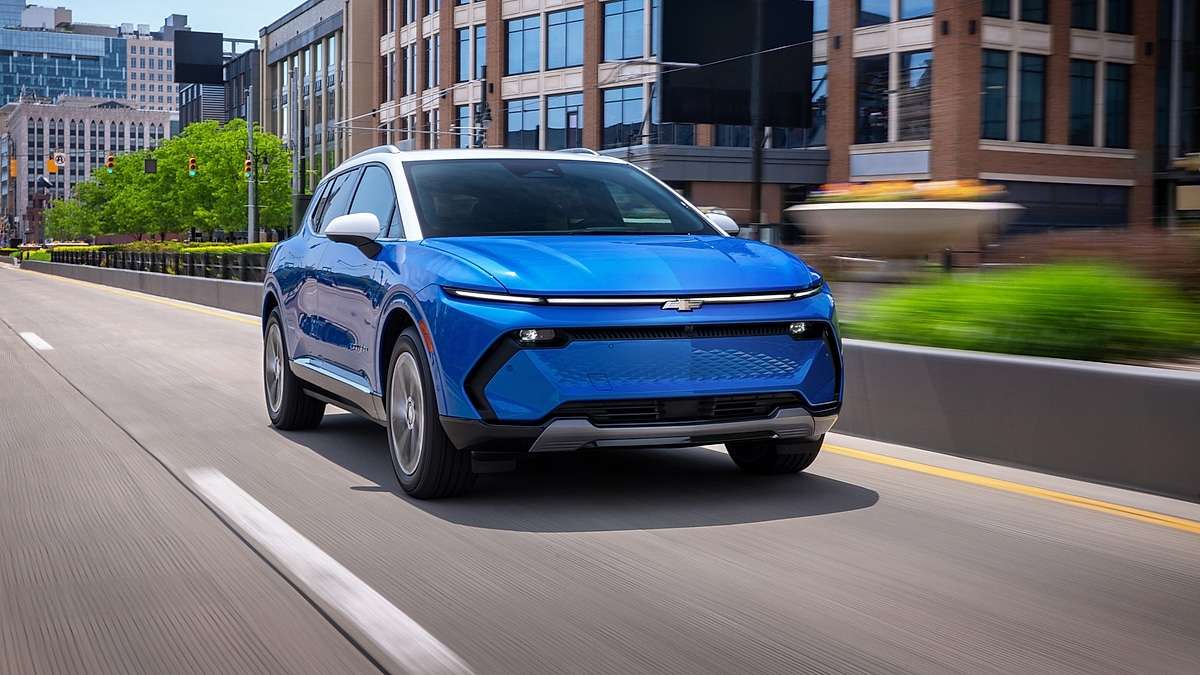

Bruce Wismer plugged his 2024 Chevrolet Equinox EV into a Tesla Supercharger in Kettleman City, California. The station pulled 54.5 kWh into the battery in 32 minutes. The cost: $30.46.
That was one of eight charging stops on a 1,200-mile round trip between Southern California and the Sacramento Valley. Wismer, who posted his charging data to a Facebook group for Equinox EV owners, documented every stop: kilowatt-hours delivered, dollars spent, peak charging rates, and session times.
The total came to $133.62.
Torque News obtained Wismer's charging log and cross-referenced it against public Supercharger pricing data, EPA ratings, and independent range tests. What follows is not a defense of EV road trips or a critique of the Equinox EV. It is a look at what one owner actually spent, what the data reveals about real-world charging economics, and what prospective buyers should know before pulling the trigger on GM's most affordable electric SUV.
What the Charging Log Shows
Wismer's trip ran northbound on Interstate 5 from Los Angeles County to the Sacramento area, then southbound on a mix of I-5 and US-395. The route included mountain passes, Central Valley heat, and elevation changes that affect range in ways EPA combined ratings do not capture.
The charging log records 8 paid DC fast charging sessions plus one free session at a CalTrans-operated charger. Here is the full breakdown:
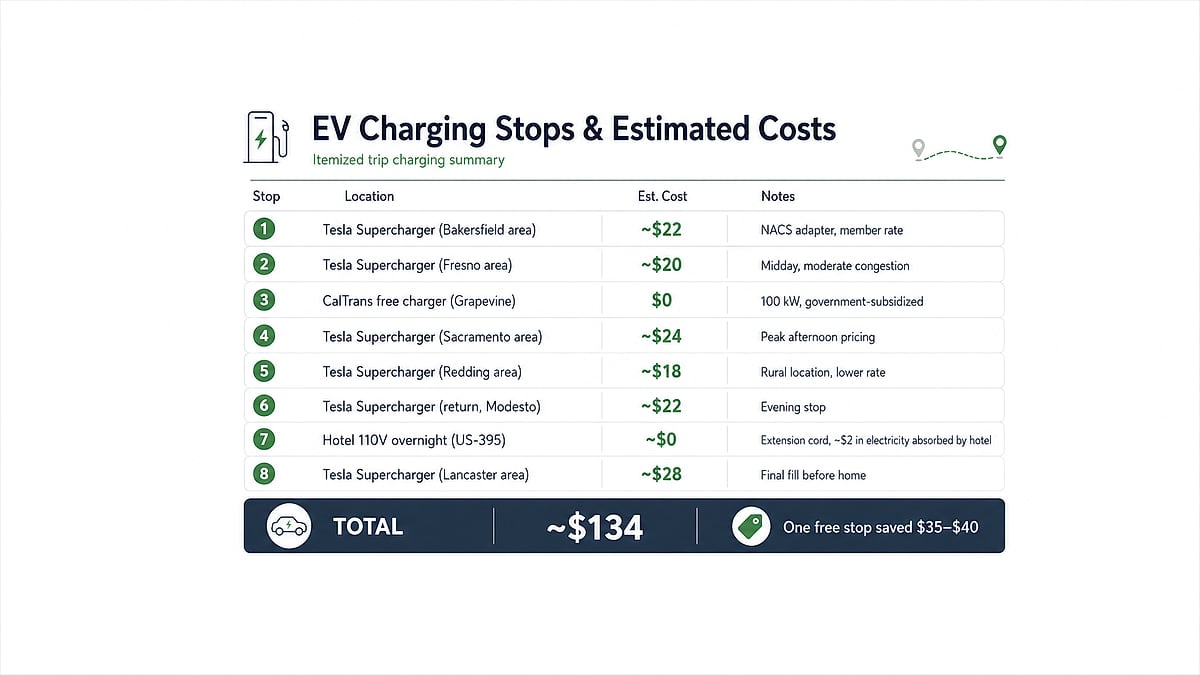
The charging log also records an overnight hotel charge on US-395 using a 110-volt outlet and a 10 AWG extension cord. That session added approximately 88 kWh at no out-of-pocket cost -- the electricity was absorbed by the hotel. GM's owner manual prohibits the use of extension cords for charging. The company states that damage caused by non-compliant charging methods may not be covered under warranty.
What Torque News Checked
Efficiency and Cost-per-Mile
Wismer consumed approximately 368.5 kWh across the round trip, including the overnight hotel charge. At 1,200 miles, that works out to 3.26 miles per kWh. The EPA rates the front-wheel-drive Equinox EV at 3.4 miles per kWh combined. Wismer's highway-heavy driving came in slightly below the EPA combined figure, which is expected.
His average cost per kWh at paid stations was approximately $0.45. With the Tesla Supercharger membership ($12.99 per month), he paid member rates. Without membership, those same sessions would have cost roughly 30 to 35 percent more.
Range at Highway Speeds
EPA rates the front-wheel-drive Equinox EV at 319 miles combined. Car and Driver recorded 260 miles at a sustained 75 mph on their highway range test. Edmunds, using a mixed driving loop, achieved 356 miles.
Wismer's 150-mile average between charging stops is conservative. At 3.26 mi/kWh with an 85 kWh usable battery, his effective highway range was approximately 275 miles. His decision to stop more frequently than necessary reflects a common new-EV-owner pattern -- charging anxiety persists even when range is sufficient.
Cost vs. Gasoline
A gasoline-powered Chevrolet Equinox with the 1.5-liter turbo averages 30 MPG highway. At $3.25 per gallon, 1,200 miles costs $130. Without the free CalTrans session and the subsidized hotel charge, Wismer's trip would have cost approximately $170. The $133.62 figure relies on conditions that not every driver will replicate.
The CalTrans Free Charging Program
CalTrans operates 14 DC fast charging locations at highway maintenance yards, primarily along I-5 and US-395. The program is funded through the federal NEVI program and is free to the public during operating hours. Wismer's stop at Tejon Pass added 7 kWh at no cost.
These chargers are corridor-specific. Travelers on I-40, Route 66, or Sierra backcountry routes will not find them. The program is a useful perk for specific routes, not a general solution for EV road trip economics
The NHTSA Recall
Recall campaign 25V878 affects 81,177 Equinox EVs for a potential failure of the pedestrian alert sound system. The remedy is a software update. GM has stated that most vehicles can receive the fix over the air. Some early-build vehicles require a dealer visit. Wismer's vehicle is included in the recall population. Torque News has not confirmed whether the update has been applied to his specific vehicle.
The Manufacturer's Position on Extension Cords
General Motors explicitly prohibits the use of extension cords for charging the Equinox EV. The owner manual states that damage resulting from non-compliant charging equipment may not be covered by warranty. Wismer used a 10 AWG cord at 8 amps, which limits current to approximately 0.95 kW. He reported no issues. Torque News is not endorsing this practice.
What Equinox EV Owners Report
Forum discussions and owner groups reveal consistent patterns in Equinox EV ownership. These reports are anecdotal and should be treated as signals, not statistics.
Google Built-In replaces Apple CarPlay and Android Auto.
Several owners have reported frustration with this limitation. The system requires a Google account and data connection for full functionality.OnStar telematics module failures have been reported, with replacement parts on backorder. Some owners have experienced extended waits for service.
Super Cruise, GM's hands-free highway driving system, is available as an option on higher trims. It is not offered on the base LT1. The LT1 includes adaptive cruise control. Wismer described the adaptive cruise as maintaining a comfortable following distance.
DC fast charging speeds in owner reports generally align with what Wismer experienced: sustained rates of 80 to 120 kW, with brief peaks near 150 kW under ideal conditions.
What This Means for Buyers
The $133.62 figure is specific to Wismer's route, driving style, and the charging infrastructure he encountered. It is a data point, not a universal rule.
Plan for 220-260 miles between charging stops on highway trips. The EPA combined rating assumes mixed driving. Sustained 70-75 mph with climate control running will deliver less. Car and Driver's 260-mile result at 75 mph is a realistic ceiling.
Tesla Supercharger membership pays for itself on long trips. At $12.99 per month, the member discount saved Wismer an estimated $30-40 on this trip alone.
Free CalTrans charging is route-dependent. Check dot.ca.gov for locations before planning a trip around free charging.
Do not use extension cords for EV charging. GM prohibits this practice. The warranty risk outweighs the minimal range gain. Book hotels with Level 2 charging where possible.
Understand the infotainment system before buying. The Equinox EV uses Google Built-In, not CarPlay or Android Auto. Test it during a dealership visit.
Check recall status. NHTSA campaign 25V878 affects all Equinox EVs. Verify your VIN at nhtsa.gov.
About The Author
Noah Washington is an automotive journalist based in Atlanta, Georgia, covering sports cars, luxury vehicles, and performance culture. His reporting focuses on explaining the engineering, design philosophy, and real-world ownership experience behind modern vehicles.
Noah has been immersed in the automotive world since his early teens, attending industry events and following the enthusiast communities that shape how cars are built and driven today. His work blends industry insight with enthusiastic storytelling, helping readers understand not just what a car is, but why it matters.
Noah is also a member of the Southeast Automotive Media Association (SAMA), a professional organization for automotive journalists and industry media in the Southeast.
His coverage regularly explores sports cars, luxury vehicles, and performance-driven segments of the automotive industry, including the evolving culture surrounding Formula Drift and enthusiast builds.
Read more of Noah's work on his author profile page.
You can also follow Noah here:
Set Torque News as Preferred Source on Google
Follow us today...






