
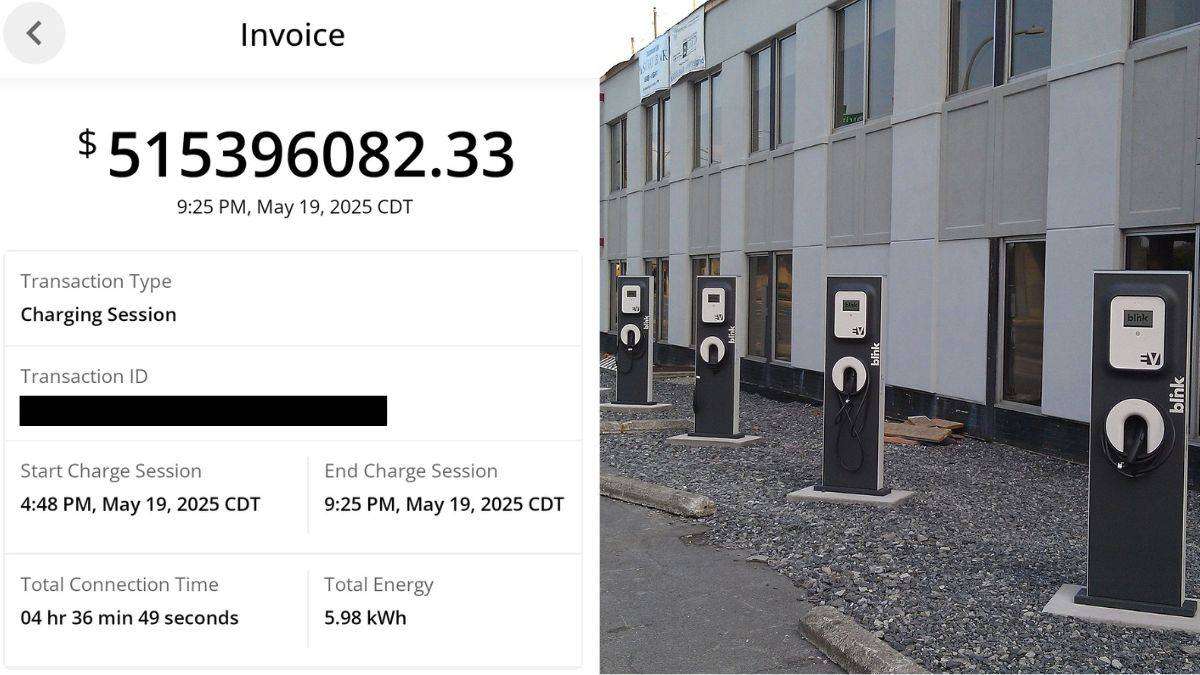

As electric vehicles become increasingly mainstream, public charging networks are under more pressure than ever to deliver a seamless and reliable experience. But as one EV owner recently discovered, even a routine charging session can go off the rails in spectacular fashion.
What should have been a simple 6 kWh top-up somehow turned into a staggering $515 million billing error, an anomaly that raises serious questions about the systems behind the chargers and how they respond when something goes wrong.
How a 6 kWh Session Became a $515 Million Bill
The user, who shared their experience, is now locked in a frustrating back-and-forth with Blink Charging after their support system routed the issue not to billing or technical support, but to the sales department. And with no clear resolution yet in sight, they went to Reddit to let out some steam.
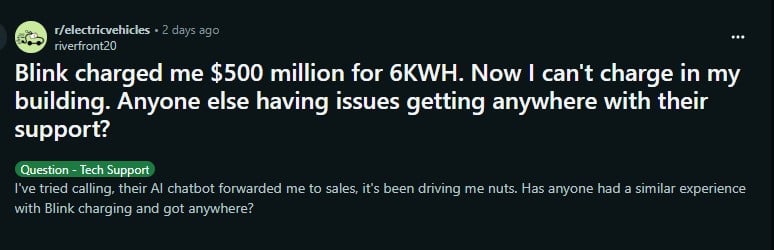
“Blink charged me $500 million for 6 kWh. Now I can't charge in my building. Anyone else having issues getting anywhere with their support?
I've tried calling, their AI chatbot forwarded me to sales, and it's been driving me nuts. Has anyone had a similar experience with Blink charging and gotten anywhere?”
— riverfront20 via Reddit/r/electricvehicles
To say the situation is surreal would be generous. According to the app screenshot shared by user riverfront20, they were billed a staggering $515,396,082.33 for a mere 5.98 kWh of electricity, pricing each kilowatt-hour at over $86 million.
Inside Blink’s 20-Minute Hold and No-Answer Nightmare
What makes this even more maddening is the post-charge experience. Instead of a quick correction or any sign of customer service competency, our Redditor found himself in a farcical loop.
“When I called, I got put on hold for 20 minutes, then it sounded like someone picked up, but they didn't respond when I said hello, and then I got hung up on, so that was fun.”
He later added. For perspective, that’s not just a frustrating interaction, it’s a full-circle nightmare of tech support systems, faceless, voiceless, and soulless.
Blink’s Global Surge: 100,000 Stations, 33% YoY Growth, and a Maryland Manufacturing Boom
- Blink Charging has surpassed 100,000 charging stations worldwide, marking a significant milestone in its expansion efforts. In 2024 alone, the company contracted, deployed, or sold nearly 20,000 chargers globally, with a 33% year-over-year increase in company-owned stations. This growth is supported by Blink's turnkey installation model and a new manufacturing facility in Maryland, which aims to boost annual production capacity from 15,000 to over 50,000 units.
- While competitors like EVgo focus on Level 3 DC fast charging, Blink emphasizes Level 2 chargers, catering to urban and residential areas. This approach allows Blink to target a broader user base, including apartment dwellers and workplaces. Additionally, Blink's integration with ChargeHub enhances its network accessibility, positioning it as the third-largest EV charging network in the U.S.
- Blink's proprietary, cloud-based software platform manages its expanding network, differentiating it from competitors like ChargePoint and Wallbox. In 2024, service revenues, which include charging services, network fees, and car-sharing, grew by 32% to $34.8 million, accounting for 28% of total revenue, up from 19% the previous year. This shift towards recurring revenue streams indicates a move towards greater financial stability.
Meanwhile, Blink Charging’s AI chatbot chose the worst moment to glitch into absurdity and forward the half-billion-dollar billing issue to the sales department.
One can almost imagine the stunned silence on the other end. As Redditor El_Gwero painted it,
“Put yourself in their shoes. You're a call centre minion. As you pick up the call, the case details appear on your screen, which are normally in the order of not understanding the pre-charge, etc. Not this time. Somebody has been charged.... What! You pause. You rub your eyes. Half a million?! Now there's a voice. "Hello?" You side-eye around nervously. No one is close by, and the manager has been in a foul mood today. The adrenaline levels off. Think. Think. Half a million?! That sounds like some serious stress. There will be shouting. Possibly tears. This is beyond your pay grade. This is CEO level stuff. You didn't make this mess. What if you make it worse? "Hello?" They're still there. You wish you weren't.”
And while darylp310 claimed,
“Emailing support seems to work pretty well.”
Blink’s entire market cap sits around $72 million. As DryGeneral990 pointed out, the charge is enough to buy the whole company seven times over.
A $515 Million Bill vs. a $72 Million Market Cap
Even Reddit’s darker humor chimed in with a satirical but technically accurate tax strategy:
“Buy the whole company and write off your bill as a loss to not pay taxes.”
It’s hard to tell where the punchline ends, and with numbers this large.
For all the heat Tesla gets, and there's plenty, from software bugs to long lines at Superchargers, no one has walked away from a charging station with a bill capable of funding a satellite launch. Redditor brwarrior joked,
“You know how many Harrier jets you could get with that?”
There’s something deeply ironic here. Blink's website touts bold revenue growth, big plans for the future, and aggressive scaling across the EV ecosystem.
Blink’s Financial Freefall: 70% Bankruptcy Risk, 20% Workforce Cuts, and a CFO Shake-Up
- Financial analyses indicate that Blink Charging faces a substantial risk of bankruptcy. Macroaxis estimates the company's probability of bankruptcy to be 70%, which is notably higher than the industry average. This elevated risk reflects concerns about Blink's financial stability amid declining revenues and operational challenges.
- In May 2025, Blink announced a strategic restructuring plan that includes reducing its global workforce by approximately 20%. This move is part of the company's "BlinkForward" initiative aimed at enhancing operational efficiency and achieving long-term profitability. The layoffs are expected to result in annualized savings of over $11 million, although the company will incur up to $1.5 million in severance and related costs.
- Chief Financial Officer Michael Rama is set to depart from Blink Charging effective June 2, 2025. Robert Strauss, a Managing Director at FTI Consulting with over two decades of experience in financial restructuring, has been appointed as the interim CFO starting June 3, 2025. This leadership change occurs during a critical period as the company navigates financial uncertainties and implements its restructuring strategy.
But what good are public relations promises when your backend can’t distinguish between six kilowatt-hours and a Manhattan penthouse? As Blink COO Michael Battaglia optimistically declared,
“We are very optimistic about the future.”
(blinkcharging.com). Yet, here in the present, one of their customers is dealing with a glitch large enough to trigger a congressional hearing, and can't even get a human on the phone.
Ultimately, this isn’t just a story about one man’s overcharge. It’s a parable of modern technology’s growing pains. The EV transition is coming, fast and loud, but beneath the headlines and quarterly earnings reports lies a patchwork of services that haven’t yet caught up.
If the future is electric, companies like Blink will need more than press releases and bots to build trust. They’ll need to prove that when the system screws up, and it will, there’s someone on the other end to pick up the call. And if they don’t? Well, next time your EV needs a charge, you might think twice before plugging in, unless you’ve got a hedge fund backing your credit limit.
Update: The issue has been rectified as of 5/25/25
Have you been overcharged when charging your EV? What happened next, and were you able to get a refund?
Let us know in the comments below.
Image Sources: Tesla Newsroom, Wikipedia Images used under CC2 & Modified
Noah Washington is an automotive journalist based in Atlanta, Georgia. He enjoys covering the latest news in the automotive industry and conducting reviews on the latest cars. He has been in the automotive industry since 15 years old and has been featured in prominent automotive news sites. You can reach him on X and LinkedIn for tips and to follow his automotive coverage.
Set Torque News as Preferred Source on Google
Follow us today...






Comments
The problem with Blink has…
Permalink
The problem with Blink has always been quality control. They're always on the Blink.
Yeah! I couldn't agree more…
Permalink
In reply to The problem with Blink has… by Owen H. Morgan (not verified)
Yeah! I couldn't agree more. Hopefully they can do something about it.
The internet/cable company I…
Permalink
The internet/cable company I need to deal with has the similar “what do you mean you want to speak with a person” attitude. It took me three passes through their texting system of support to get to a human. Finally got to a human and I asked why $25 for xFi complete, they said its for the modem rental. Then, they said oh you’ve been renting more than five years, we’ll zero that out. Similar for a different overcharge for a premium channel they say is free with the internet speed they sold me. I think most of America is still post pandemic broken.
Sounds kinda frustrating bro…
Permalink
In reply to The internet/cable company I… by Jeff (not verified)
Sounds kinda frustrating bro! Still glad you finally got through it. And yeah it really does feel like we're all still dealing with the post pandemic customer service hangover. lol
Big numbers like this are…
Permalink
Big numbers like this are usually the results of trying to use software meant to display positive numbers only to display a number that is negative under the hood.
That makes me wonder why this bill would be negative. It may be a realistic possibility if the charge is tied to utility rates. In states with high solar production they sometimes have too much power during the day and have to pay others to take it. Maybe something like this made it to the charger.
In any case, I'd bet this bill is actually negative.
Sounds interesting! If that…
Permalink
In reply to Big numbers like this are… by Rhett (not verified)
Sounds interesting! If that's the case it could definitely explain a lot. Thanks for that insights!
Yet another reason not to…
Permalink
Yet another reason not to get a EV.
Thanks for your insightful…
Permalink
In reply to Yet another reason not to… by John giannattasio (not verified)
Thanks for your insightful input. This is literally a one in... 100 million issue? A system glitch has literally NOTHING to do with EVs. What about the stories of banks that deposit millions/billions of dollars into someone's account accidentally? Yet another reason not to trust banks! Hide your money in a mattress! Seriously, this is about how much a specific company just sucks, unsurprisingly.
Exactly man! This isn’t an…
Permalink
In reply to Thanks for your insightful… by Kevin (not verified)
Exactly man! This isn’t an EV issue it’s a Blink issue. Tech goes sideways in every industry sometimes. Appreciate the perspective!
I got that glitches like…
Permalink
In reply to Yet another reason not to… by John giannattasio (not verified)
I got that glitches like this don’t help the EV case but for most owners charging is smooth and way cheaper than gas
Blink is one of those…
Permalink
Blink is one of those companies you never hear good things about. I've seen many broken chargers they give people the run around about. I suspect they will be out of business or be absorbed by someone just for their sites. The site owners might want nothing to do with anything associated with them. I'm sure many have to deal with people asking why they are always broken or problems with them.
Yeah I've heard some similar…
Permalink
In reply to Blink is one of those… by Auggie (not verified)
Yeah I've heard some similar concerns too. Well I hope the market will push for the better.
That’s why Tesla…
Permalink
That’s why Tesla superchargers are the best. Happens at the gas pumps too. All depends who they use for billing services.
Totally agree! It's hard to…
Permalink
In reply to That’s why Tesla… by G Harada (not verified)
Totally agree! It's hard to beat the experience of having smooth, fast, and seamless billing.
It's actually your fault for…
Permalink
It's actually your fault for saying "hello". Try a "ni hao" instead.
He better get a second job.
Permalink
He better get a second job.
Or cut off Starbucks and…
Permalink
In reply to He better get a second job. by gronder (not verified)
Or cut off Starbucks and Avocado toast #boomeradvice
Lol! I'll try that next time.
Permalink
In reply to He better get a second job. by gronder (not verified)
Lol! I'll try that next time.
I bet! Hopes the refund…
Permalink
In reply to He better get a second job. by gronder (not verified)
I bet! Hopes the refund comes through before it gets to that point. lol
I wonder if they were able…
Permalink
I wonder if they were able to add that charge to accounts receivable to make the end of their fiscal quarter look good.
Good point! Can't say for…
Permalink
In reply to I wonder if they were able… by Ferret (not verified)
Good point! Can't say for certain but it wouldn't be the first time a charge coincided with quarter end timing.