
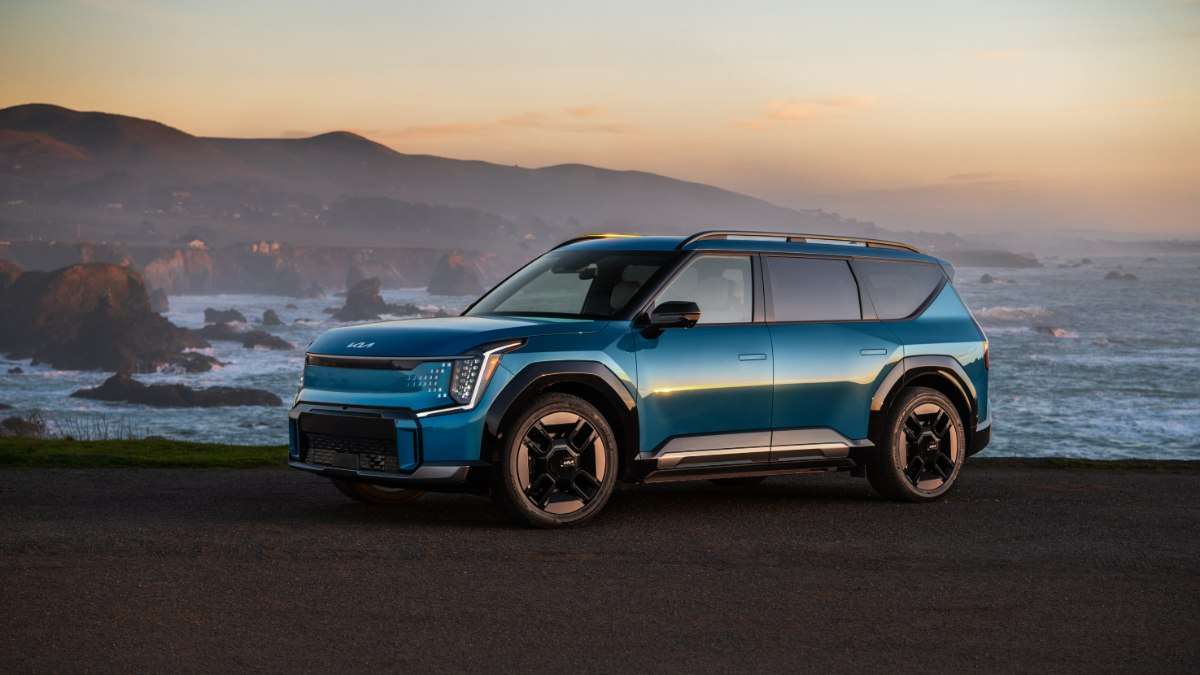

Spend any time in an EV9 owners group, whether in the waiting lounge at a Kia service department or scrolling through social media on a Tuesday night, and you will eventually hear the same question rise above the hum of kilowatts and charge rates. What exactly are you paying for when you buy EV-specific tires? The marketing is clear. Extra range, extra quiet, purpose-built for heavy, high-torque electric machines. The stories from owners tending real vehicles in real places are less tidy. One of those stories belongs to Jeff Bader, and it begins with a simple A/B test between the Kia EV9 in his driveway and the Ford Mustang Mach-E parked next to it.
“So I did a little experiment with tires. When the tires needed to be replaced on the EV9, I bought the exact same Kumho EV tires that were on it, and my Mach-E also needed new tires. I bought standard higher-load tires (non-EV) to see if I could notice a difference. I looked at three factors: tread life, noise, and range.
EV tires are touted to have an extra noise-reducing layer inside them because there is no engine noise to drown out the road noise on standard tires, and the EV tires are also advertised to improve range between charges over a standard tire.
I installed the Kumho tires on the EV9 around July 4, 2025, and I had the standard tires installed on my Mach-E the same week. After almost four months and 5,000 miles of use on the EV9 and 4,000 miles on the Mach-E, here are my conclusions.
I call BS on the EV tire racket. I used to install tires (mounting and balancing) many moons ago, and I noticed zero differences between the EV tires and regular tires when doing a visual inspection. The extra sound absorber that should have been on the inside of the tire (based on videos I watched and illustrations in the videos)? I saw zero evidence that there is anything different in the EV tire technology.
They charge a crapton more money for the same tires and just put an EV label on them.
Noise: I noticed zero difference in noise levels in my Mach-E after switching to a standard tire. In fact, the standard tires were quieter than the EV tires I removed (probably because they were worn out and I needed an alignment).
Ride: The non-EV tires are smooth and handle better than the tires I removed. I expected this to happen because, again, the old ones were worn out; however, the new tires ride better than my old ones did at any time during the 16k miles I drove them before making the change.
Range: If there is a difference here, I have not noticed it. This is affected by the seasons and outside temperature anyway, so it’s impossible to tell for sure, but I never really saw any drop-off in range that I was expecting. Not scientific at all, just my observation.
Advertising
Tread life: The Kumho tires on the EV9 are significantly worn after just 5,000 miles. The rear tires are worn way more than the front tires (I have an AWD Land model, but I know the RWD engages way more often than the front drive). I will likely get about 15k miles or less from these tires (we got 16k+ from the first set).
The tires on the Mach-E look brand new. I was expecting them to have shown more wear up to this point, but they have not. I have not taken any measurements, but they still look new.
I just had the EV9 tires rotated, and the dealership tried telling me the tires need to be replaced. They are smoking some cheap crack, and they claim the rear tires were down to 4/32 of tread. I find this hard to believe at this point, but they are definitely worn more than expected.
My conclusion is that if you are going to invest in tires, don’t let the sales pitch of buying an EV tire at $500–700 more per set, because they are “special tires for EVs”, fool you. Buy a good set of high-load tires instead, and don’t worry about higher noise levels and shorter range, because you will likely never notice the difference anyway.”
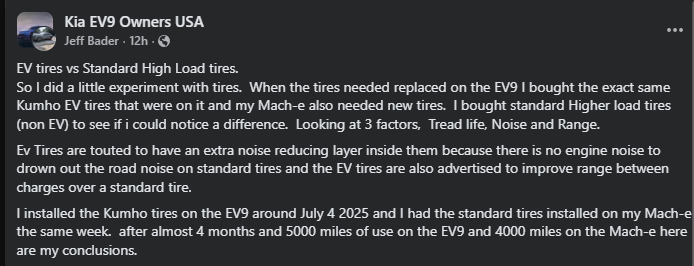
Strip away the Facebook formatting noise, and what remains is a tidy little driveway experiment. Same household, two modern EVs, one on EV-branded Kumho rubber and one on non-EV high-load tires. Jeff looks at three things any owner cares about more than brochure copy. Road noise, range, and tread life.
Kia EV9: Electric Tires & Grip vs. Efficiency
- The EV9’s EV-specific tires are built to handle its substantial weight and torque, using reinforced structures and specialized rubber compounds to maintain stability without wasting energy.
- These tires reduce rolling resistance by using lower-grip compounds and streamlined tread patterns, extending the EV9’s driving range compared with traditional higher-grip tires.
- EV9-optimized tires are engineered to stay cooler under heavy loads, improving efficiency during acceleration and highway cruising.
- Compared with performance tires, EV-specific designs trade some cornering bite and ultimate grip for quietness, durability, and maximum range efficiency.
In his experience, the EV9 eats its EV tires quickly and does not seem quieter or more efficient because of them, while the Mach-E on conventional high-load tires feels smoother, quieter, and looks almost untouched after a few thousand miles. His language is colorful, his conclusion blunt, but the core complaint is straightforward. He does not feel he is getting a clear, measurable benefit that justifies a premium of five to seven hundred dollars per set.
On one side, you have Rick Isenberg, who reminds everyone that subjective impressions are not the same as controlled testing. He notes that some EV tires really are built with different compounds and constructions aimed at lower rolling resistance and, in certain models, extra sound deadening inside the carcass. A couple of percent improvement in efficiency is not something most drivers can see without instrumentation, yet it is the kind of incremental gain that shows up in formal tests from organizations like Consumer Reports and the U.S. Department of Energy over large data sets (Source: Consumer Reports, “EV Tires Explained,” 2023; U.S. Department of Energy, Vehicle Technologies Office, 2022). From that vantage point, the EV label represents real engineering choices, not just a sticker.
On the other side, Jeff remains unconvinced. He has his hands on the tires, his credit card on the counter, and Western Pennsylvania under the tread. He sees rapid wear on the rear axle of an All Wheel Drive EV9 that weighs north of 6,000 pounds, and he sees a Mach-E on standard high-load tires that appears barely broken in. To him, actual ownership experience matters more than any chart. Then there is Brian Sherwood, who calmly reports roughly 35,000 miles out of his original Kumhos on a 2024 Light Long Range EV9 before switching to Michelin Defender 2 tires, with no obvious change in noise or range. Brian’s result stands in stark contrast to Jeff’s 15,000-mile expectation and is a reminder that geography, road surface, alignment settings, and driving style can multiply or divide tread life all by themselves.
Heather Liberadzki adds yet another voice, planning ahead to fit non-EV all-season tires on her GT-Line when the originals are spent and estimating she can coax perhaps another 5,000 miles from the factory set if she behaves with the accelerator. Her position is not anti-EV and certainly not anti-Kia. It is practical. If high-quality, high-load tires deliver acceptable noise, grip, and range at a lower cost and with longer life, they are worth serious consideration. Taken together, the thread feels less like a revolt and more like a maturing owner community starting to question whether the EV label on a sidewall is an absolute requirement or simply one option among several for a heavy electric SUV.
Behind the opinions sits real physics. EVs like the EV9 and Mach-E are heavy, torque-rich machines. They need tires with high load ratings to carry the weight and robust construction to manage instant torque without deforming excessively. Many EV-marketed tires chase low rolling resistance through stiffer tread blocks, specialized rubber blends, and narrower tread patterns, which can indeed help extend range by reducing the energy wasted as the tire flexes. The flip side is that some of those designs can be more sensitive in heavy rain. A harder compound and fewer, shallower grooves can, in certain patterns, evacuate water less effectively at highway speed, which makes hydroplaning more likely than on an aggressively siped, softer compound tire. That does not mean EV tires are inherently unsafe. It means they are a compromise among efficiency, grip, noise, and life, just as every tire has always been.
The EV9 adds another complication. Its curb weight and three-row mission mean the tire is working hard even before you pile in kids, gear, and winter weather. It absolutely requires proper high-load or HL-rated tires, whether they carry an EV marking or not. That is where Jeff’s experience becomes genuinely useful. He is not suggesting people ignore load ratings or run underspec passenger car tires to save a few dollars. His conclusion is narrower. If you match the load rating correctly, a well-engineered non-EV high-load tire can, in his experience, meet or beat the comfort and durability of the Kumho EV tires that came on his Kia, without a noticeable penalty in range or noise.
So what should an EV9 owner do when the factory rubber wears away? The Facebook thread suggests a rational checklist. First, respect the basics. Load rating, speed rating, and size must match the vehicle’s requirements. Second, be honest about how and where you drive. Jeff’s hilly, stop-and-go Western Pennsylvania routes will always be harder on tires than Brian’s presumably flatter, more consistent miles. Third, weigh the tradeoffs. EV-specific tires may offer slight gains in efficiency and sometimes quieter construction. High-quality non-EV high-load all-seasons may last longer and cost less, at the possible expense of a very small hit to range that may be difficult to perceive in day-to-day driving.
The EV tire label represents a set of design priorities that can be useful, especially for engineers trying to eke out every mile in official range testing. What Jeff Bader and the other owners highlight is that, once the vehicle leaves the showroom and rolls into the varied mess of real life, those paper advantages do not always show up as clearly at the driver’s seat or in the checkbook. EVs like the Kia EV9 and Ford Mustang Mach-E are impressive machines on any tires built to handle their weight and torque. The smart move is to treat EV tires as one tool in the box, not a sacred requirement, and to let tread wear, comfort, safety, and cost on your own roads decide whether that extra seven hundred dollars is money well spent or simply a premium you can skip.
Image Sources: Kia Media Center
Noah Washington is an automotive journalist based in Atlanta, Georgia. He enjoys covering the latest news in the automotive industry and conducting reviews on the latest cars. He has been in the automotive industry since 15 years old and has been featured in prominent automotive news sites. You can reach him on X and LinkedIn for tips and to follow his automotive coverage.
Set Torque News as Preferred Source on Google
Follow us today...




Comments
My original Kia EV tire last…
Permalink
My original Kia EV tire last for 35000 mile. You are all wrong.
Just a thought: If HIS tires…
Permalink
In reply to My original Kia EV tire last… by Mark (not verified)
Just a thought: If HIS tires only lasted 15,000 miles before they were worn. But YOURS lasted 35,000 miles, is either of you wrong considering that each of you is sharing your individual experience? He's probably harder on tires than you for any number of reasons such as driving style, road conditions, etc. A person's personal experience can't be wrong. It's just different than another person's.
Its a 5800lb vehicle. It…
Permalink
Its a 5800lb vehicle. It happens. Especially when a cheap company puts cheap tires on a vehicle that are not intended to deal with that level of weight and torque.