
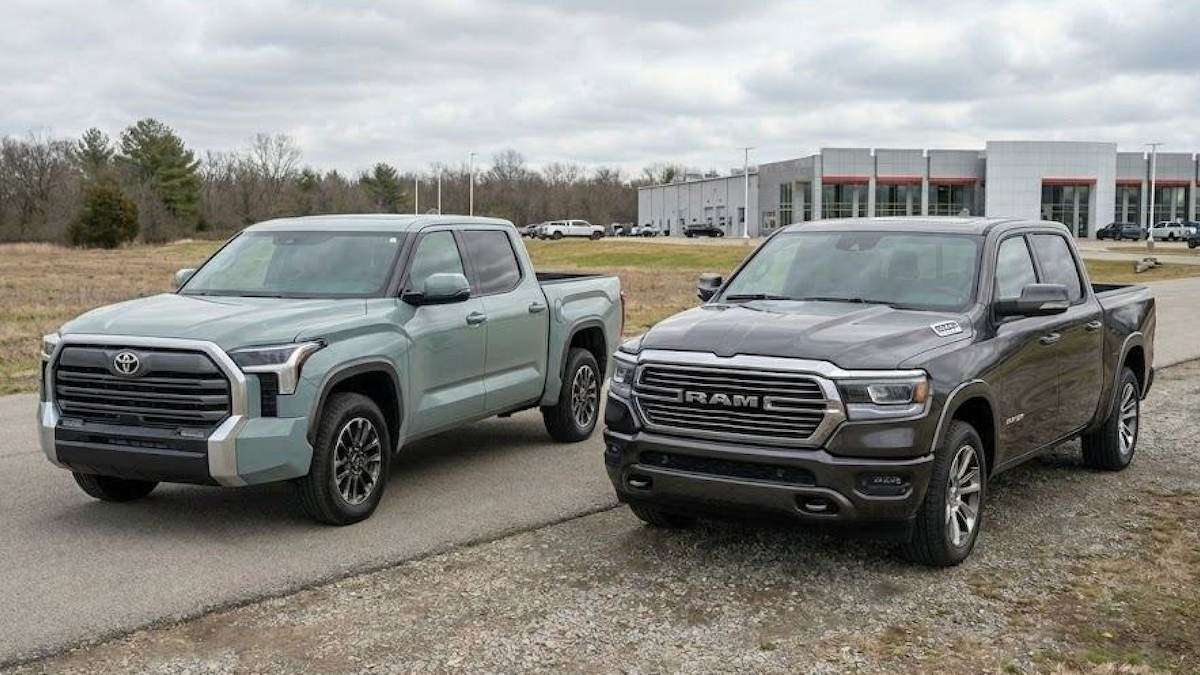

Key Takeaways:
- Price Parity: Both trucks hover around the $65,000 mark, making them direct competitors.
- Luxury Gap: The Ram Laramie offers two features that are not available on the Tundra Limited.
- Verdict: While Toyota wins on reliability, Ram leads in interior comfort.
The $65,000 Dilemma
If you are preparing to drop $65,000 on a new pickup, you expect more than just a steering wheel and four tires; you expect to be wowed. For years, the Toyota Tundra was the safe, conservative bet, but a recent cross-shopping comparison against the 2025 Ram 1500 Laramie exposes a harsh reality: Toyota's "safe bet" might be feeling a little empty.
While the 2026 Tundra Limited brings legendary durability to the table, it is missing key luxury features that Ram owners now consider standard. Just ask Scott Mauller, a truck buyer who recently test-drove the new Tundra and walked away with a brutal verdict: "I wasn’t all that impressed."
He isn't alone. When you line these two trucks up bumper-to-bumper, the Ram 1500 Laramie offers three distinct advantages that the Tundra simply leaves out.
1. The Suspension Gap: Air vs. Coils
The first thing a Ram owner notices in a Tundra is the ride. Toyota made a massive leap forward in 2022 by ditching leaf springs in favor of rear coil springs, vastly improving ride quality over the previous generation. It is composed and stable, and it handles trailers significantly better than the old leaf-sprung trucks.
However, for $65,000, Ram offers something Toyota doesn't: the Active-Level Four-Corner Air Suspension.
Available on the Laramie and Rebel trims (and standard on Limited), this system allows the truck to physically change its geometry. It automatically lowers the truck at highway speeds (Aero Mode) to reduce drag and improve fuel efficiency, a critical feature for the new Hurricane inline-six engine. Conversely, it can raise the truck for off-road clearance or lower it significantly for easy entry and exit.
More importantly, it provides a "cloud-like" ride that isolates the cabin from bumps in a way that standard steel coils, even good ones, cannot. For a buyer used to a Ram with air suspension, the Tundra’s ride, while capable, feels stiffer and more "truck-like." However, as one owner found out, when it goes bad, it's expensive to replace.
2. The Tailgate Tech War
Mauller specifically mentioned the lack of a "bed step button" on the Tundra. This highlights a major disparity in bed utility. The Tundra offers a power-release tailgate on higher trims and a simple deployable bed step, but it lacks the integration found in the Ram.
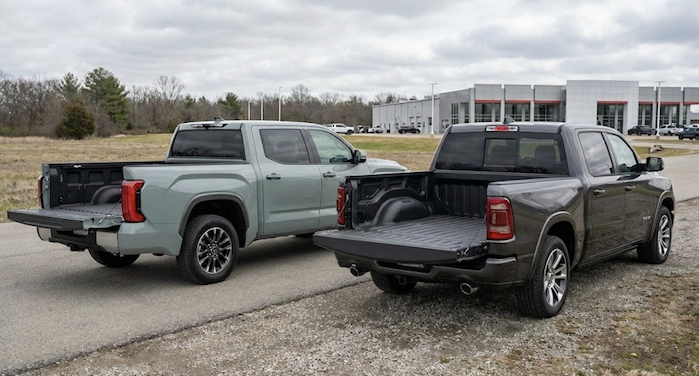
At the $65k price point, Ram offers the Multi-Function Tailgate, the 60/40 split doors that swing open horizontally. This allows you to walk directly up to the bed to load heavy items without reaching over the open gate. It effectively removes the 2-foot barrier between you and your cargo.
Toyota’s counter is a clever "bump switch" near the taillight (on higher trims) and a composite bed that won't rust. While the Sheet-Molded Compound (SMC) bed is a massive long-term durability win for Toyota (no bedliner needed, ever), it lacks the immediate "gadget factor" of the Ram's tailgate.
3. Screen Real Estate and Digital Integration
Toyota boasts a massive 14-inch infotainment screen, which is excellent. It is bright, responsive, and runs the new Toyota Audio Multimedia system, miles ahead of the old Entune software. However, the 2025 Ram 1500 refresh moved the goalposts further down the field.
While the Tundra offers a great primary screen, the Ram 1500 turns the cabin into a digital cockpit. Here is how the tech stacks up at the $65k price point:
Toyota Tundra Limited:
- Center Screen: 14-inch Toyota Audio Multimedia Touchscreen.
- Driver Display: 12.3-inch Digital Gauge Cluster (Effective, but with limited customization).
- Passenger Tech: None.
Ram 1500 Laramie:
- Center Screen: 14.5-inch Touchscreen running Uconnect 5.
- Driver Display: 12.3-inch Digital Cluster (Highly customizable graphics).
- Passenger Tech: 10.25-inch Front Passenger Interactive Display.
The "Game Changer" Feature: The Ram's segment-exclusive passenger screen is a massive win for families. It allows the front passenger to control music, input navigation destinations for the driver, or view exterior cameras—all without distracting the driver or taking over the main screen.
4. The Engine Battle: Hurricane vs. i-FORCE
Perhaps the most controversial change for both trucks is under the hood. Both manufacturers have abandoned the V8 in these trims, leaving buyers to choose between Toyota's V6 and Ram's new Inline-Six.
Here is the "Tale of the Tape" for the standard engines at this price point:
2026 Toyota Tundra Limited:
- Engine: i-FORCE 3.5L Twin-Turbo V6
- Output: 389 hp / 479 lb-ft torque
- Character: Strong low-end grunt, but coarser vibration.
2025 Ram 1500 Laramie:
- Engine: 3.0L Hurricane SST Inline-Six Turbo
- Output: 420 hp / 469 lb-ft torque
- Character: Inherently balanced, linear power delivery, and quieter operation.
The Reliability "Elephant in the Room" Usually, Toyota wins the reliability argument by default. However, the Tundra is currently fighting a stigma that Ram sales teams are happy to exploit. The i-FORCE V6 has been plagued by a massive recall regarding machining debris and main bearings in early models. While Toyota is working hard to resolve this, stories regarding main bearing failures have shaken buyer confidence.
While the Tundra offers slightly more torque (+10 lb-ft), the Ram's Hurricane engine is the superior daily driver. The inline-six architecture is naturally smoother than a V6, making the Ram feel more refined at highway speeds.
5. Interior Ambience and Materials
This is where Ram built its modern reputation, and it hasn't rested since. The Laramie trim features filigree leather stitching, genuine suede inserts, and metal accents that feel substantial. The noise cancellation is superior, creating a library-quiet cabin at 70 mph.
The Tundra Limited is certainly nice; the SofTex and leather options are durable and easy to clean, but hard plastics still exist in the lower door panels and dashboard areas, where Ram uses soft-touch materials. The Tundra feels built to last 20 years of abuse; the Ram feels built to impress you every single day of those 20 years.
The Final Verdict:
Ultimately, the choice between these two $65,000 trucks comes down to one philosophical question: Are you buying for the next 10 years, or for today?
The Case for the Tundra:
If you plan to keep this truck until the odometer hits 200,000 miles, the Tundra remains the smarter bet. Its composite bed will never rust, its coil suspension is easier to maintain than airbags, and despite the early engine hiccups, Toyota has a proven track record of standing behind its product. It is a "forever truck."
The Case for the Ram:
If you want your $65,000 to buy tangible luxury right now, the Ram 1500 is the clear winner. For buyers like Scott Mauller, the lack of Air Suspension, passenger displays, and the multi-function tailgate makes the Tundra feel "de-contented." The Ram offers a library-quiet cabin and a ride quality that Toyota simply hasn't matched yet.
What Do You Think?
Is an air suspension and a passenger screen worth the extra maintenance risk, or is Toyota’s simpler approach the smarter buy? Would you trade "gadgets" for Toyota reliability? Let us know in the comments below.
Up Next: The Reliability Reality Check
Ram 1500 vs. Toyota Tundra: The Showroom Battle vs. The 200,000-Mile War
Now that we know the Ram 1500 wins the battle for showroom luxury, we have to ask the harder question: Which truck will actually make it to 200,000 miles?
In my next report, I dive into the "Hidden Costs" of these two $65k trucks. We analyze the Tundra's recent engine recall drama against the Ram's history of electrical gremlins to see which truck is the safer bet for your wallet over the next 5 years. The winner might surprise you.
With over 30 years of industry experience, Denis Flierl brings an insider’s perspective to Torque News, where he has been a Senior Reporter since 2012. Before picking up the pen, Denis consulted for the automotive industry's biggest brands and honed his skills as a test driver. He cuts through the noise to deliver the latest auto news, compelling owner stories, and the expert analysis necessary to navigate today's changing automotive market.
Have a tip or question? Follow me on X @DenisFlierl and @WorldsCoolestRides, or connect with me on Facebook, Instagram, and LinkedIn.
Photo credit: Denis Flierl
Set Torque News as Preferred Source on Google
Follow us today...



Comments
If you're worried about…
Permalink
If you're worried about longevity? The 26 Ram has a hell of a warranty. They're also willing to make a deal. Use some of that deal to buy a 100k bumper to bumper and you're still cheaper than Toyota. That artifical piped in exhaust from the hybrid tundra is AWFUL.
Toyota Tundra vs Ram 1500: …
Permalink
Toyota Tundra vs Ram 1500: What would I do. This is very easy for me. I would get the top Ram trim level that offers the Hemi. But a stock Hemi will not be reliable as it runs 230 degrees in 100 degrees summer heat in Texas. I know. BUT- it is easy to switch the thermostat to a 160, double the stock tiny thin 1" thick radiator with an all aluminum aftermarket radiator, then add a dual radiator below the stock radiator. Then add American Racing full long tube headers because you know the stock manifold bolts will fail and the headers will add 30 hp and a little better gas mileage. THEN-go get your truck dyno tuned to match your mods so you will have no CEL and the motor will run correctly. In Texas, even small communities like Killeen have a Ram specific dyno tuner- this is how popular this Hemi line of engines is! I would actually do quite a lot more, as I did to my 2015 Ram 1500, but I think you get the idea!
The one thing this article…
Permalink
The one thing this article misses on is the Toyota reliability no longer exists. I've had a 2012 tacoma and a 2015 and 2017 Tundra and there is no comparison in quality in my 2024 tundra. Never claimed any warranty. I have a manufacturers paint defect as pointed out by a 35 year professional painter that my dealer called a rock chip. Toyota wouldn't cover it. When my 3 year lease is up it's going back. Can't wait. No more Toyota's for this once dedicated fan.