
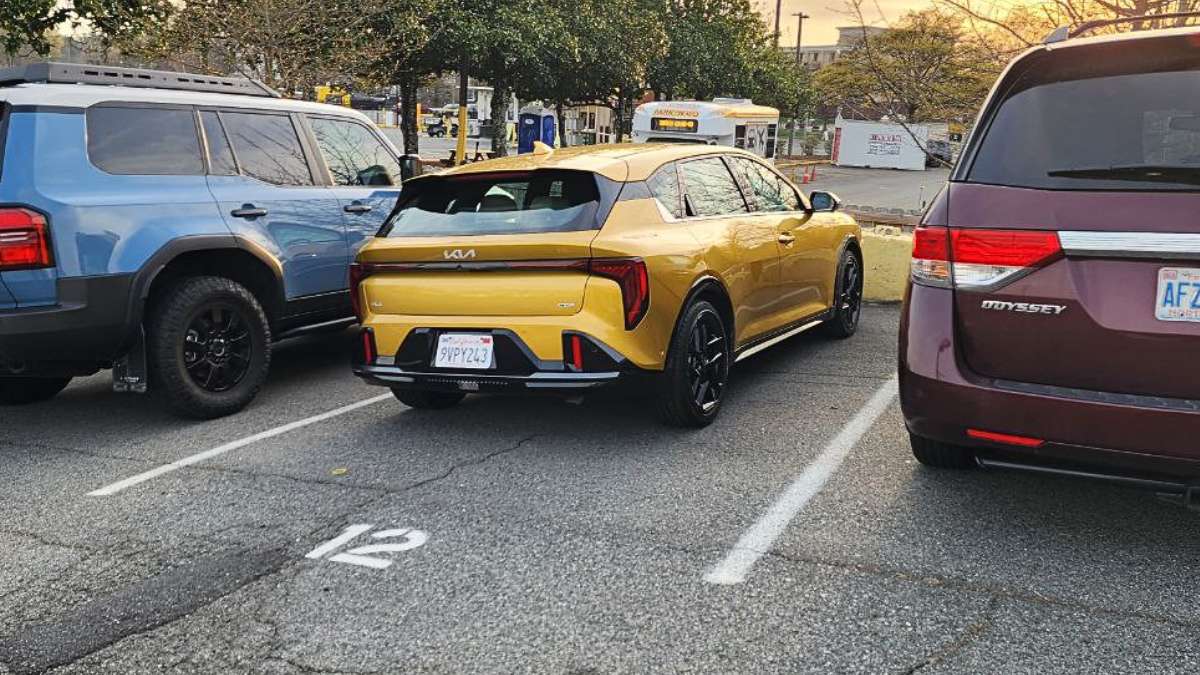

You already know SUVs dominate American roads. You see them everywhere you look, at every stoplight, in every parking lot, in every driveway on your street. So a few days ago when I published my hands-on review of the 2026 Kia K4 GT-Line Turbo Hatchback after test driving it for several days in Charlotte, NC, one question kept coming up in the back of my mind: why is Kia doing this at all? Why would a smart, data-driven automaker launch a brand-new compact hatchback into a market that appears to have moved on? I wanted a real answer, not a press release. So I sent that exact question directly to Kia's corporate communications team. And what came back surprised me and, I think, will surprise you too. It turns out Kia is not betting on a hunch. They have data. Real data. And it tells a story that has enormous implications for every car buyer in America who is quietly suffering from a problem that nobody in the mainstream automotive media is talking about loud enough.
The Pressing Problem Millions of American Car Buyers Are Facing Right Now: Affordability
Here is the problem, stated plainly. Most American car buyers today cannot comfortably afford the vehicles being pushed on them. The average transaction price for a new vehicle in America has hovered around $49,000 for the past several years. That is not the price of a luxury car. That is the average. Compact crossover SUVs, the most popular vehicle type in the country, are averaging over $36,000 according to data reported by Cox Automotive.
The result is a squeeze that millions of buyers feel every time they walk into a dealership. They want something practical, modern, and reliable, but they are being funneled toward vehicles that cost significantly more than they need to spend, often just because the market narrative says SUVs are what you should buy. As we covered in detail right here at Torque News, average transaction prices for compact cars and compact five-passenger crossover SUVs have actually been at three-year lows, which means smart buyers who look beyond the SUV narrative can find real value. But many buyers don't know where to look.
That is exactly the gap Kia is stepping into with the K4 GT-Line Turbo Hatchback.
Here Is Exactly What Kia's National Manager of Product Communications Told Me
After I published the review, I sent an official question to Kia Corporate Communications. The question was direct: SUVs dominate the U.S. market today, yet Kia is introducing a new compact hatchback like the K4 Hatchback GT-Line Turbo. What market data or customer trends convinced Kia there is still strong demand for sporty hatchbacks in North America, and who exactly is the buyer Kia expects to attract with this car?
James Hope, National Manager of Product Communications at Kia, replied with the following points, which I am quoting in full:
- "Affordability crisis: fulfilling a real need for new-car affordability. Hatchback more affordable with average pricing around $2,500 less than equivalent Entry CUV.
- Fun to drive: more engaging, lower, more personal, while offering similar levels of utility as a small SUV.
- Not sacrificing interior room or comfort: surprisingly roomy. Interior: more 2nd row legroom than Honda HRV, Nissan Kicks, Toyota Corolla Cross. Passenger room: more room than Chevrolet Trailblazer, Honda HRV, Nissan Kicks, Toyota Corolla Cross, and nearly the same as the Chevy Trax. Cargo room: more room than nearly all Entry CUVs, including Chevrolet Trailblazer, Honda HRV, Toyota Corolla Cross, and nearly the same as the Chevy Trax.
- Demographics and loyalty: perfect gateway to the brand, anticipating K4 hatchback to draw a more youthful consumer with higher income. Hatchback buyers are more loyal, meaning once they're in the brand, the likelihood of purchasing a future Kia is elevated."
Now let's unpack every single one of those points, because each one is a compelling answer to the problem we just identified.
Why the K4 Hatchback Costs About $2,500 Less Than a Small SUV and Why That Gap Matters More Than You Think
The first thing Kia cited is the affordability gap between a compact hatchback and an entry-level compact crossover SUV. On average, the K4 hatchback costs around $2,500 less than an equivalent entry CUV. That might not sound like a life-changing number, but think about it over a five-year loan. That difference in purchase price, combined with lower insurance premiums that typically follow a lower vehicle value, can represent thousands of dollars in total cost of ownership savings.

The solution Kia is offering here is straightforward: you do not have to climb into an SUV just to get a modern, feature-rich, comfortable vehicle. The K4 hatchback starts at $26,235 and the GT-Line Turbo, which is the version I tested in Charlotte, begins at $28,890. That is the actual solution for buyers who have been told they need a $36,000 crossover but actually do not. Here at Torque News, our reviewer John Goreham made the case compellingly when he wrote that the Kia K4 GT-Line Turbo at $29,285 is so well-equipped it has no business being sold for less than $30,000, and that it feels like a car worth closer to $40,000 in today's market. That kind of gap between price and perceived value is exactly what budget-conscious buyers are searching for right now.
According to Edmunds, a fully loaded GT-Line Turbo test car with the technology package and several options comes in at $32,870, which is less expensive than loaded versions of the Honda, Mazda, and Subaru competing in the same segment.
More Interior Room Than Most Entry SUVs: The Number That Should End the SUV Argument for Many Buyers
Here is where Kia's data gets genuinely interesting and where many buyers will want to pay close attention. Kia's response includes a specific claim that the K4 hatchback offers more second row legroom than the Honda HR-V, Nissan Kicks, and Toyota Corolla Cross, and more total passenger room than the Chevrolet Trailblazer, Honda HR-V, Nissan Kicks, and Toyota Corolla Cross, with room nearly equal to the Chevy Trax.
Think about that for a moment. The reason most people gravitate toward SUVs is the assumption of more space, more practicality, and more room for passengers and cargo. But Kia's own market research says those assumptions are wrong when you put the K4 hatchback next to several of the most popular entry SUVs on the market. You would actually be giving up interior passenger space by choosing some of those crossovers over the K4. That is not a marketing claim. That is a dimension sheet comparison.
As our contributor Dimitar Angelov documented after spending time with the hatchback, the 2025 Kia K4 is the mildly-spicy affordable hatchback that U.S. buyers needed, pointing specifically to how the cargo solutions and interior space make a compelling everyday case. With 22.2 cubic feet behind the rear seats and 59.3 cubic feet with the seats folded, the K4 hatchback also beats the cargo room of the Chevrolet Trailblazer, Honda HR-V, and Toyota Corolla Cross, according to Kia's data. The popular and well-respected outlet Edmunds confirmed in its first drive review that the K4 hatchback's cargo shape is arguably more usable than some rivals even where the on-paper numbers are similar.
For the buyer who genuinely needs to haul groceries, gear, sporting equipment, or the occasional flat-pack furniture run, this car is a more practical choice than many small SUVs that cost significantly more.
Kia Wants a Younger, Higher-Income Buyer Who Will Stay With the Brand for Decades
This is the part of James Hope's response that reveals Kia's long-term thinking, and it is genuinely smart strategy. Kia is not just trying to sell you one K4. They are trying to earn a customer who will buy Kias for the rest of their life.
Hope specifically stated that Kia anticipates the K4 hatchback to draw a more youthful consumer with higher income, and that hatchback buyers show elevated brand loyalty, meaning that once someone buys a Kia through the hatchback, they are more likely to purchase future Kias as they move up in life and purchasing power.
This is the gateway car strategy, and it is one of the oldest and most effective playbooks in the automotive industry. Honda built a dynasty on it with the Civic. Volkswagen built European dominance on it with the Golf. If the K4 hatchback can capture a young professional who appreciates design, technology, and value in 2026, Kia may have a customer who returns for a K5, a Sportage, a Telluride, or one day a luxury Genesis vehicle. The long-term math on customer lifetime value makes the K4 hatchback one of the most strategically important vehicles in Kia's entire lineup, regardless of how many units it sells in year one.
As we wrote on Torque News, the 2025 Kia K4 is the kind of car that used to be the bread-and-butter for companies like GM, an affordable and feature-rich entry point that builds loyalty through genuine value rather than through discounting or gimmicks. GM stopped doing that. Kia has picked up that torch.
Fun to Drive and Lower to the Ground: Why That Actually Matters for Real Buyers
One of the most interesting points in Hope's response is the emphasis on driving engagement. He described the K4 hatchback as more engaging, lower, and more personal than a small SUV, while offering similar utility. In a market where every crossover feels like you are sitting on a raised platform, this is a meaningful differentiator.
Real drivers, especially younger ones, still care about how a car feels to drive. They care about the connection between seat and road. They care about whether the car responds when they want to have a little fun on an empty highway on-ramp. The K4 GT-Line Turbo's sport-tuned multi-link rear suspension and turbocharged 1.6-liter engine with 190 horsepower and 195 lb-ft of torque give it a genuinely sporting character that no entry crossover SUV at this price can match. As I noted when the topic came up in our coverage, the reason a 2025 Kia K4 owner said their car rides better than their previous Elantra came down to the independent rear suspension, which is a feature that matters in real world driving every single day.
Kia also deserves credit for the design itself. If you have not seen the K4 hatchback in person, particularly in the sparkling yellow finish, you might not fully understand the visual appeal. Even JD Power's automotive reviewer noted that the K4 hatchback exhibits style, balance, and good taste, and from a design standpoint looks better than the sedan on which it is based.
The Moral of This Story: Don't Let the Market's Loudest Voices Make Your Decision for You
Here is something worth sitting with. The SUV market is enormous not entirely because SUVs are objectively the right choice for most buyers, but partly because that is where automakers and dealerships have directed attention, marketing budgets, and floor space. Buyers who follow the crowd into a $36,000 crossover when a $29,000 hatchback would serve them equally well or better are paying a real cost: in monthly payments, in insurance premiums, in fuel economy, and in the quiet dissatisfaction of driving a vehicle they bought because everyone else seemed to have one.
The better decision maker is the one who asks whether the assumption is actually true. Does a compact crossover actually give you more room? Not always, according to Kia's data. Is it actually better to drive? Not in most cases. Does it cost more? Yes, reliably. Good decision making means questioning popular consensus and doing the math for your actual life, not for someone else's lifestyle.
As our coverage of whether there are small SUVs buyers should avoid and what to buy instead makes clear, popular does not always mean right for you. The K4 hatchback may be the smarter, more personal, more honest answer to the problem many buyers don't even realize they have.
Kia Made a Calculated Bet, and the Numbers Back It Up
This was not a guess. Kia looked at the affordability crisis, looked at the loyalty data on hatchback buyers, looked at the interior dimension comparisons against popular entry crossovers, and made a deliberate decision to build a car that solves a real problem for a real buyer. That kind of disciplined, data-driven thinking is what separates long-term automotive winners from short-term trend followers.
Whether you are a young professional shopping for your first serious car, a current compact crossover owner wondering why your monthly payment feels higher than it should, or simply a car enthusiast who still believes that lower, sportier, and more engaging is better, the 2026 Kia K4 GT-Line Turbo Hatchback is worthy of a genuine test drive. Not because it is perfect. But because the data behind it is honest, the pricing is real, and the space inside it may genuinely surprise you.
Now, TorqueNews readers, here are two questions for you:
If Kia's data is correct that the K4 hatchback offers more interior room than several popular entry SUVs like the Honda HR-V and Toyota Corolla Cross, does that change how you think about your next vehicle purchase? And have you ever found yourself buying or considering an SUV simply because that is what the market pushed you toward, only to realize later that a well-equipped hatchback might have served your life just as well or better?
Tell us your personal experience in the comments below. We read every single one.
Images by Armen Hareyan.
About The Author
Armen Hareyan is the founder and Editor-in-Chief of Torque News and an automotive journalist with over 15 years of experience writing car reviews and industry news. Now based in the Charlotte region (Indian Land, SC, he founded Torque News in 2010, which since then has been publishing expert news and analysis about the automotive industry. He can be reached at Torque News on X, Linkedin, Facebook, and Youtube. Armen holds three Masters Degrees, including an MBA, and has become one of the known voices in the industry, specializing in the landscape of electric vehicles and real-world stories of actual car owners. Armen focuses on providing readers with transparent, data-backed analysis bridging the gap of complex engineering and car buyer practicality. Armen frequently participates in automotive events throughout the United States, national and local car reveals and personally test-drives new vehicles every week. Armen has also been published as an automotive expert in publications like the Transit Tomorrow, discussing how will autonomous vehicles reshape the supply chain, and emerging technologies in vehicle maintenance.
Set Torque News as Preferred Source on Google
Follow us today...




Comments
I was just in Budapest and…
Permalink
I was just in Budapest and these K4 vehicles are everywhere.