
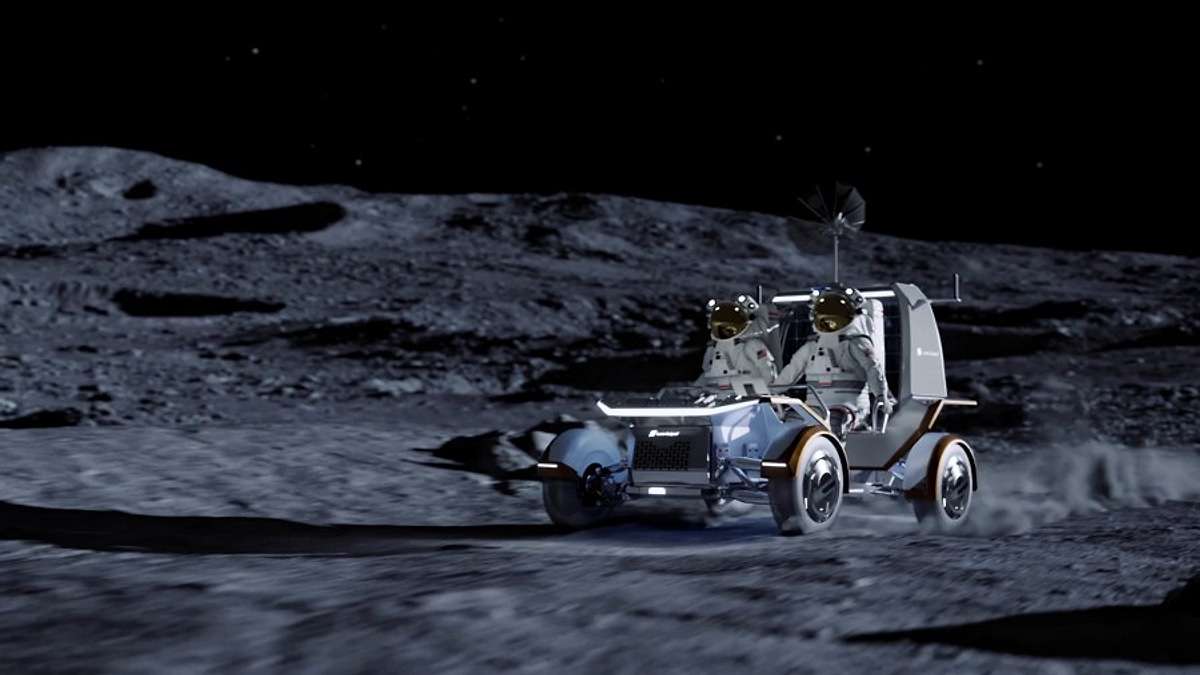

GM has spent billions developing batteries that will function in extreme weather conditions. Researchers are continually working on technology that can be operated remotely whether it powers manned or autonomous vehicles. Much of GM Defense’s battery research is geared toward creating vehicles that support military actions in remote regions. Whether those actions are in the frozen tundra or in mountainous deserts, military vehicles have to be able to function well. That’s one of the reasons GM technology has been chosen help power the lunar vehicle Pegasus for NASA’s Artemis missions.
The NASA Pegasus Program
The Pegasus lunar rover gives Artemis Astronauts safe, reliable, and highly capable mobility to explore and build the first elements of a permanent Moon Base.
NASA has selected Lunar Outpost’s Pegasus for a crewed High Achievability Task Order under its Lunar Terrain Vehicle Services (LTVS) contract. GM is part of the team developing the vehicle for future Artemis missions to the Moon. Astronauts will drive Pegasus on the Moon as soon as 2028.
Pegasus is designed to support operations at the Moon’s South Pole, where rugged terrain, darkness and extreme temperatures pose significant mobility challenges.
GM is producing battery technology for a lunar environment characterized by extreme temperature swings. Long-term reliability and fault tolerance are critical. It’s not like NASA can dispatch an electrician to the moon to fix a short circuit. These components have to be built to function in extreme circumstances for decades.
GM Has a Long History with the Space Program
GM has spent decades involved in space exploration. GM contributed key systems to the original Apollo-era lunar rover, including the wheels, suspension, steering and drivetrain.
“GM’s electrification technology was built to perform in some of Earth’s toughest driving conditions, and adapting it for the Moon with space-rated batteries is an extraordinary technical challenge,” said Stephen duMont, president, GM Defense. “Helping astronauts once again travel safely across the lunar surface will be a proud moment for our team and our country.”
Pegasus is being developed by Lunar Outpost in partnership with GM, The Goodyear Tire & Rubber Company and Leidos.
Lunar Outpost is a space company based in Golden, Colorado. It has been awarded a $220 million contract from NASA to provide transportation for astronauts who could land on the moon as early as 2028. The company’s rover, called Pegasus, can operate autonomously by teleoperation or with people on board driving it.
“We’ve spent the better part of the past decade engineering advanced mobility solutions designed for the realities of operating and building on the lunar surface,” Justin Cyrus, Lunar Outpost CEO and founder, said in a statement.
Pegasus is engineered to withstand the moon’s harshest environments, Cyrus said. The vehicle has advanced thermal management systems, enabling it to operate for prolonged periods through extreme temperature swings.
“Pegasus gives astronauts the range, reliability and flexibility needed to thrive in new terrain as we identify and prepare the sites that will become the first permanent lunar outpost,” Cyrus said.
The Autonomous Rovers Could Start Work Before the Astronauts Get There
The goal is to have the rovers in place before astronauts are expected to land on the moon in early 2028 as part of NASA’s Artemis program. Four astronauts flew around the moon on the Artemis II mission in April, venturing 248,655 miles from Earth.
The lunar rovers could move equipment and supplies into place before the astronauts arrive. GM Defense did not elaborate on how the batteries could regenerate their power. However, GM's work on the batteries for the space vehicles will help fuel future innovations in GM's EVs here on earth. The lunar batteries will help GM improve range and sustainability for the future EVs.
NASA’s plan is to establish a base on the moon starting in 2029, achieving a semi-permanent crew presence by 2032.
Image by GM
About the Author
Mary Conway is a professional automotive journalist and has decades of experience specializing in automotive news analysis. She covered the Detroit Three for more than twenty years for the ABC affiliate, in Detroit. Her affection for the Motor City comes naturally. Her father ran a gas station while Mary was growing up, in Wisconsin. Follow Mary at @MaryConwayMedia on X and on Facebook, and send her car news tips for future stories. Mary Conway is an esteemed automotive and business reporter who was inducted into the Michigan Journalism Hall of Fame in 2019. Mary is a member of the Automotive Press Association, Rocky Mountain Automotive Press, Society of Professional Journalists, and NATAS.
Set Torque News as Preferred Source on Google
Follow us today...






Comments
Then it will lock up, brick,…
Permalink
Then it will lock up, brick, be glitchy and unreliable like my Hummer EV.