
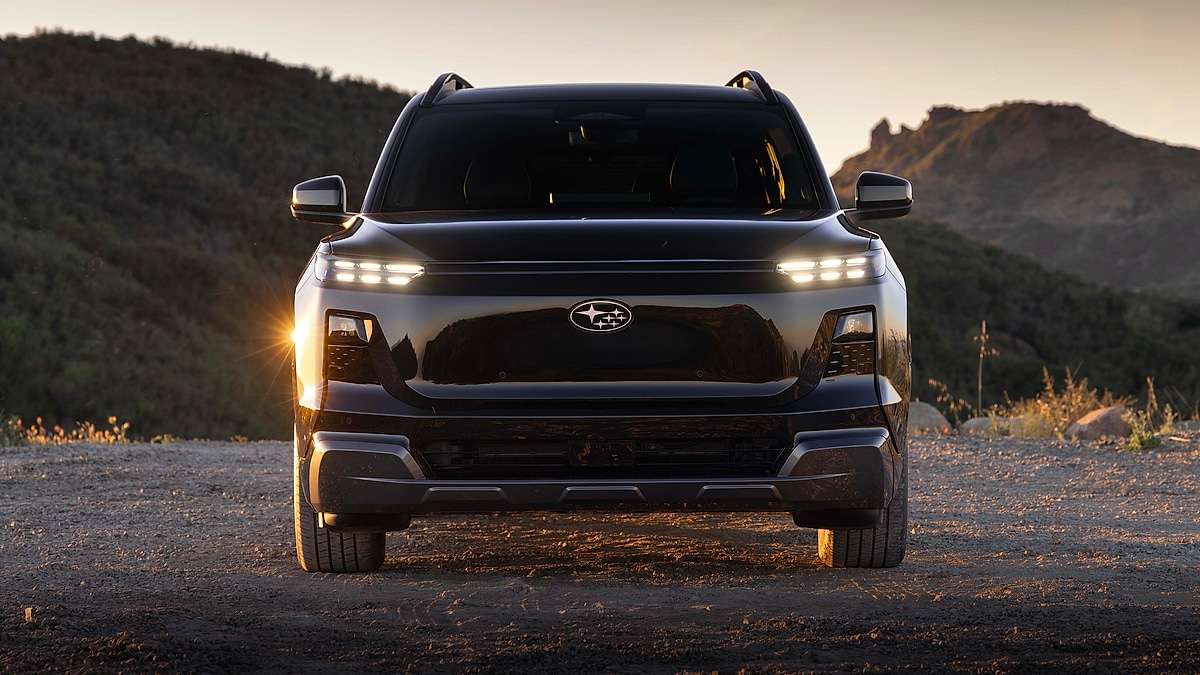

When Subaru announced the 2027 Getaway, a three-row electric SUV built on a shared platform with Toyota, the first question from buyers was not about range or charging speed. It was whether the Getaway is a Toyota Highlander EV with different badging.
In a statement to Torque News, Subaru spokesperson Aaron Cole directly addressed the question that has followed the 2027 Getaway since its announcement: whether the three-row electric SUV, built on a shared platform with Toyota, is a rebadged Highlander EV.
Cole's response is that the two vehicles share a platform and a partnership. What they do not share, he explained, is the engineering approach.
"Subaru and Toyota maintain a strong partnership in EV development and collaborate to bring their respective strengths to each vehicle," Cole wrote. "In terms of what Subaru brings to the table for Getaway, we bring our experience in chassis development, suspension tuning, AWD performance, and driving dynamics."
Subaru lists the Getaway at 420 combined horsepower from dual electric motors on the front and rear axles, more than 300 miles of range, and 8.3 inches of ground clearance. Toyota lists the all-wheel-drive Highlander EV at 338 horsepower. The gap is 82 horsepower. Subaru did not confirm the Toyota figure; he noted that he could not speak for Toyota.
The Platform Partnership
Subaru and Toyota have shared architecture for years. The BRZ and GR86 are the most visible examples. The Forester Hybrid uses Toyota hybrid technology but retains Subaru-specific hardware not found on any Toyota vehicle. Torque News has previously reported on Subaru's position that even when it borrows Toyota components, the resulting vehicle is designed and manufactured by Subaru for Subaru buyers.

The Getaway follows the same approach on a larger scale. It is Subaru's first three-row electric SUV, a segment where the brand has not competed before. Subaru's response frames the partnership as a division of labor. Toyota provides EV architecture and scale. Subaru provides chassis calibration, suspension behavior, and all-wheel-drive expertise.
The Powertrain Gap
The most visible difference between the Getaway and the Highlander EV is the power output. Subaru lists the Getaway at 420 combined horsepower. Toyota lists the AWD Highlander EV at 338 horsepower. Both use dual-motor all-wheel-drive layouts. Both are three-row family SUVs.
Cole did not specify the exact hardware differences that produce the gap. What he did emphasize is that Subaru's version is tuned for a specific kind of driver. "We understand that many of our owners appreciate not only the destination but also the journey," he wrote. "It is a great SUV to drive."
Cole also noted that the Getaway is powered by electric motors on the front and rear axles, producing 420 combined horsepower and returning more than 300 miles of range.
Ground Clearance and Capability
He also highlighted three specifications that appear on the Getaway: standard Subaru Symmetrical All-Wheel Drive, standard raised roof rails on most trim levels, and 8.3 inches of ground clearance.
For context, the current gas-powered Toyota Highlander offers 8.0 inches of ground clearance. The Getaway's 8.3 inches places it slightly above that figure. A significant portion of Subaru owners report taking their vehicles off-road, which is why the company focuses on capability, according to Subaru.
The raised roof rails serve as functional attachment points for rooftop tents, bike racks, kayaks, and cargo boxes. Cole pointed to them as standard equipment on most trim levels, a feature aimed at owners who use their vehicles for outdoor activities.
Visual and Interior Differentiation
Cole also pointed to equipment and visual differences between the two models. The front and rear-end treatments are distinct. Inside, the Getaway features a standard power-folding third row and available Nappa-leather appointed upholstery in black or Moss Gray.

The power-folding third row adds cargo flexibility for families. The Nappa leather in Moss Gray is an interior color option that differs from the tan and beige palettes common in Toyota's three-row lineup.
The Manufacturing Question
Cole noted that for other vehicles in the Subaru-Toyota partnership, such as the Trailseeker, Subaru provides assembly at its own facility. Torque News has previously covered Subaru's manufacturing operations at its Lafayette, Indiana, plant, the automaker's only U.S. production facility.
Cole did not state that the Getaway is assembled at Lafayette. What he did establish is that Subaru's role in the partnership extends beyond tuning and styling. The company is building vehicles. When Subaru assembles a vehicle, it controls tolerances, seam sealing, suspension alignment, and quality verification.
What Buyers Are Asking
The question behind every Getaway inquiry is whether the vehicle is a Subaru in more than name. Cole's answer is that the Getaway is a collaboration in which each company contributes what it does best. Toyota provides the electric architecture. Subaru provides the chassis behavior, the all-wheel-drive calibration, the ground clearance, and the power output.
The 82-horsepower difference between the Getaway and the Highlander EV is one data point in that division of labor. If the two vehicles used identical motor hardware and calibration, the output would likely match. The fact that it does not indicates that Subaru made a different choice about how the Getaway should perform.
For buyers, the choice between the two vehicles will depend on priorities. The Highlander EV offers Toyota's manufacturing scale and service network. The Getaway offers Subaru's Symmetrical All-Wheel Drive, 8.3 inches of ground clearance, suspension tuning, and 420 horsepower. Whether those differences justify choosing one over the other is a decision that rests with the individual buyer and how they plan to use the vehicle.
About The Author
Noah Washington is an automotive journalist based in Atlanta, Georgia, covering sports cars, luxury vehicles, and performance culture. His reporting focuses on explaining the engineering, design philosophy, and real-world ownership experience behind modern vehicles.
Noah has been immersed in the automotive world since his early teens, attending industry events and following the enthusiast communities that shape how cars are built and driven today. His work blends industry insight with enthusiastic storytelling, helping readers understand not just what a car is, but why it matters.
Noah is also a member of the Southeast Automotive Media Association (SAMA), a professional organization for automotive journalists and industry media in the Southeast.
His coverage regularly explores sports cars, luxury vehicles, and performance-driven segments of the automotive industry, including the evolving culture surrounding Formula Drift and enthusiast builds.
Read more of Noah's work on his author profile page.
You can also follow Noah here:
Set Torque News as Preferred Source on Google
Follow us today...






