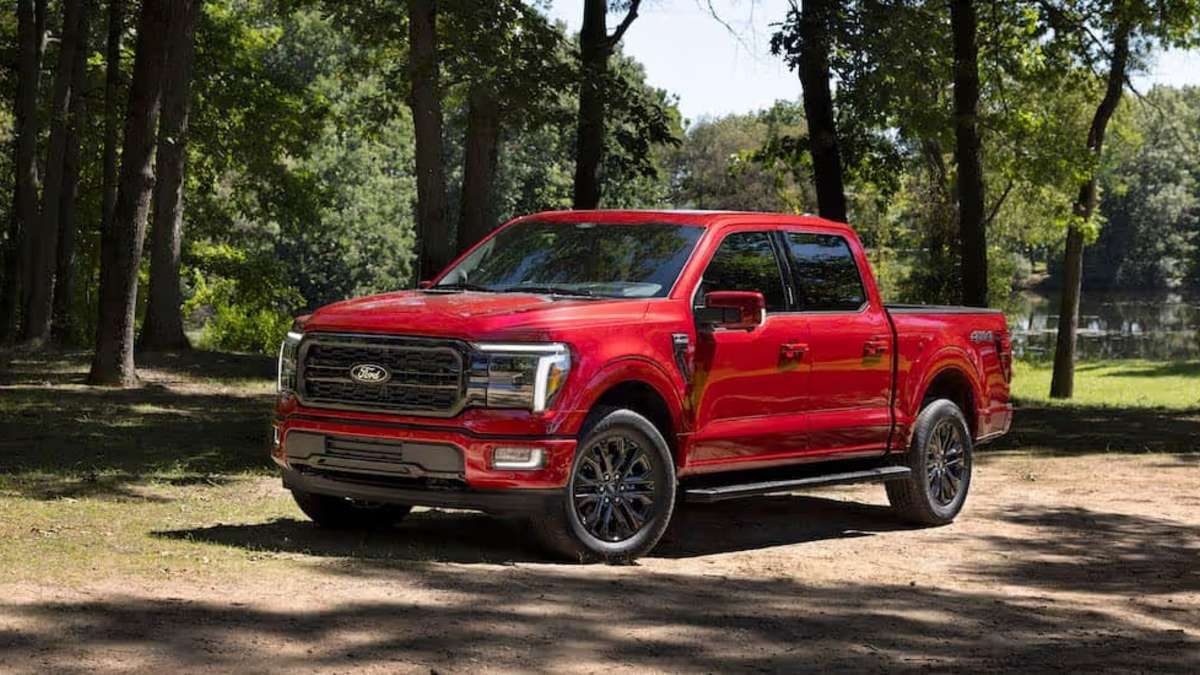

There is a particular kind of American confidence that lives in truck brochures and driveway conversations. It tells us that if the badge on the fender says a half-ton can tow five figures, then whatever we hook to the hitch must be fair game. Most of the time, that bravado never meets reality.
The boat stays in storage, the camper stays on the dealer lot, and the tow rating remains an abstract number. Every so often, though, someone actually loads the trailer, checks the temperatures, and points the rig down the highway. That is what happened when a Ford F-150 PowerBoost owner chronicled his towing experience with a Sea Ray 280 in a Facebook group. The story did not end with broken parts or a viral video, but it did trigger a thoughtful warning from a reader who understood how quickly a stable setup can become a very bad day.
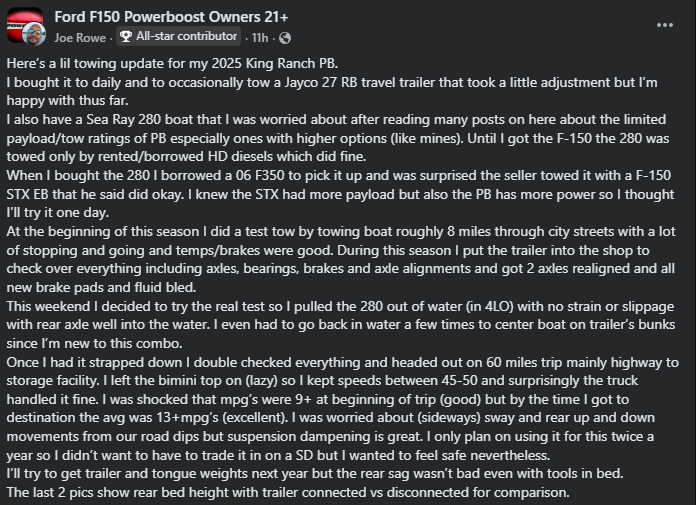
“Here’s a lil towing update for my 2025 King Ranch PB.
I bought it to daily and to occasionally tow a Jayco 27 RB travel trailer that took a little adjustment, but I’m happy with it thus far.
I also have a Sea Ray 280 boat that I was worried about after reading many posts on here about the limited payload/tow ratings of PB, especially ones with higher options (like mine). Until I got the F-150, the 280 was towed only by rented/borrowed HD diesels, which did fine.
When I bought the 280, I borrowed a 06 F350 to pick it up and was surprised the seller towed it with a F-150 STX EB that he said did okay. I knew the STX had more payload, but also the PB has more power, so I thought I’d try it one day.
At the beginning of this season, I did a test tow by towing a boat roughly 8 miles through city streets with a lot of stopping and going, and the temps/brakes were good. During this season, I put the trailer into the shop to check over everything, including axles, bearings, brakes, and axle alignment, and got 2 axles realigned and all new brake pads and fluid bled.
This week, nd I decided to try the realtest, est so I pulled the 280 out of water (in 4LO) with no strain or slippage with the rear axle well into the water. I even had to go back in the water a few times to center the boat on the trailer’s bunks since I’m new to this combo.
Once I had it strapped down, I double checked everything and headed out on a 6060-mile trip, mainly highway, to the storage facility. I left the bimini top on (lazy), so I kept speeds between 45-50, and surprisingly, the truck handled it fine. I was shocked that mpgs were 9+ at the beginning of the trip (good), but by the time I got to the destination, the average was 13+mpg (excellent). I was worried about (sideways) sway and rear up and down movements from our road dips, but suspension dampening is great. I only plan on using it for this twice a year, so I didn’t want to have to trade it in on an SDD, but I wanted to feel safe, nevertheless.
Advertising
I’ll try to get trailer and tongue weights next year, but the rear sag wasn’t bad even with tools in bed.
The last 2 pics show rear bed height with trailer connected vs disconnected for comparison.”
There is a lot to like in that account. No posturing, no burnouts in front of the marina, just a careful owner learning a new combination and giving honest numbers. He checked the axles and bearings, put fresh pads and fluid in the brakes, verified temperatures on a short city run, used four low at the ramp, and kept highway speeds modest with the bimini top acting as a sail. The Ford PowerBoost system, a 3.5-liter twin turbo V6 paired with an electric motor for a total of around 430 horsepower and 570 pound-feet of torque according to manufacturer specifications, did what it was designed to do. Thirteen miles per gallon while pulling a cabin cruiser is nothing to sneer at. In the comments, owners like Chris Neglia asked about tow mode and transmission temperatures, while Billy Hart Jr. and Andy Ramsaran compared airbag setups and Timbren SES kits. Jeremy Jones chimed in to remind everyone that two ratings are a rating, not a breaking point. It felt less like a brag thread and more like a pit lane debrief among people who genuinely wanted to help.
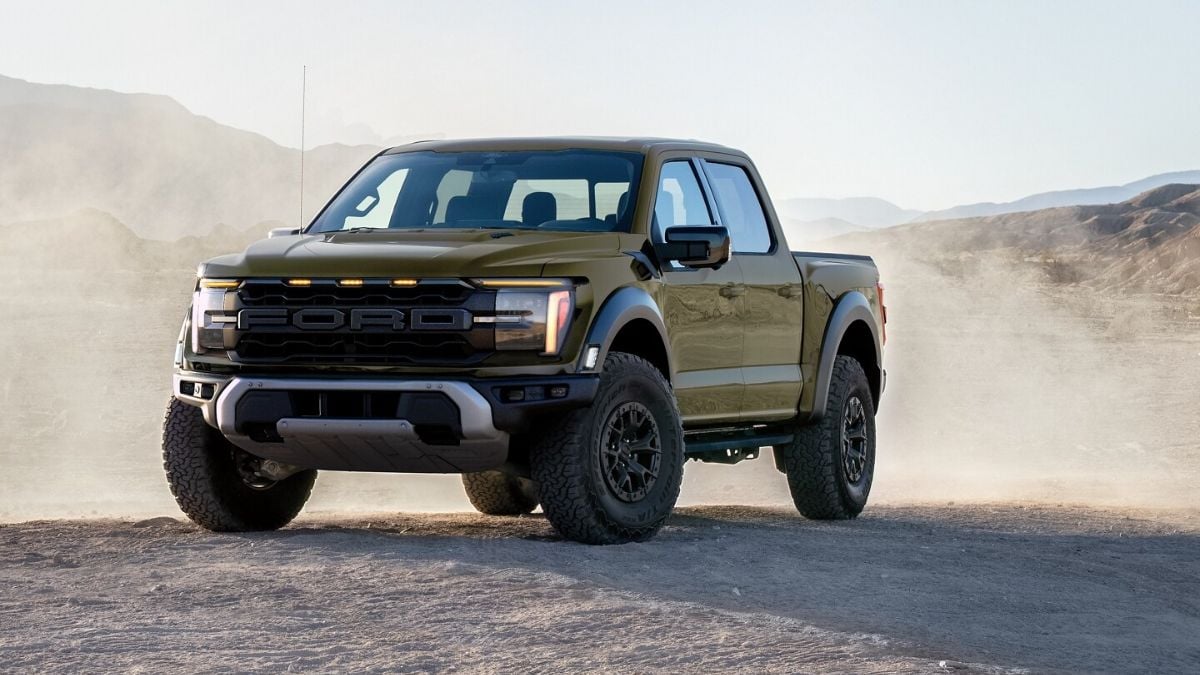
That is why the email that followed stood out. It did not come from someone spoiling for an online fight or trying to score points in a brand war. It came from a reader who signed as “Common Sense” and who had clearly spent time studying the photos and thinking through the scenario. What bothered him was not whether the F-150 had the grunt to move the Sea Ray. That part was obvious. What bothered him was what would happen if anything went wrong while a trailer that likely weighed twice as much as the truck started making demands in a crosswind or on a downhill grade.
“I agree with you on your analysis of the truck's capability to tow this boat. Unfortunately, a boat/trailer this size, and worse yet, something closer to the truck's towing limits, is a danger to everyone on the road around this vehicle. The sheer weight of this boat/ trailer combo well exceeds the weight of the tow vehicle. If he truly was going up and down significant grades, subject to cross winds, or who knows what type of unexpected exception, this setup is an accident waiting to happen.
From the pictures presented in the article, he was not using a load distribution hitch, and if the hitch was loaded to the recommended 10 to 15% of the total weight, the down force on the back of the truck should have approached 1000 lbs. of force. This much weight this far back on the truck dramatically affects the handling capability without a load distribution hitch. This means the truck most likely will not be able to quickly respond to any steering need. And once control is lost, who do you think will win? A ½ ton pickup truck, probably north of 2 tons, or a boat and trailer north of 4 tons?
Advertising
Just because you can doesn't mean you should. I can see this setup taking a boat to the launch 5 miles away at sub 55mph speeds, but what this guy did is just irresponsible.
And you might say, "What about all the semis on the road, their load weight is much greater than the tractor. Very true, but the dynamics are very different. The tractor is very short compared to the trailer. The trailer axles are very close to the back end of the trailer. This means the tractor chassis is carrying a significant part of the load of what's in the trailer. And with the trailer axles set, we'll back from the tractor, nothing to say of the stout connection between the tractor and trailer, the driving dynamics are significantly better than achievable with a pickup truck and trailer combination. So basically, there is no comparison to be made other than that they each are towing a trailer.
I can't tell you the number of setups I have seen when traveling that work as long as everything goes as you would hope. But if anything were to go wrong, they'll never recover, and it will become an accident. Once I see something like this, I usually place myself well in front of or behind something like this to prevent being part of the outcome. The unfortunate part, some people towing don't understand they created an unsafe situation, or worse yet, those that do and do it anyway, or the unfortunate people that are nearby and become part of the fallout when things go south.”
The reader fixated on the absence of a weight distribution hitch, and for good reason. If the combined rig is north of four tons and ten to fifteen percent of that is resting on the ball, that is approaching a thousand pounds hung off the back of a half ton. Without redistribution to the front axle, steering response suffers, and the truck becomes a lever being pulled around by its own trailer. It may feel fine in steady state cruising at 45 or 50 miles per hour, and as the original post made clear, it did. The problem is that the instant an evasive maneuver is required or a gust of wind hits the broad side of that boat, the mass out back gets a vote.
Invariably, someone will point to eighteen-wheelers as evidence that heavy trailers behind lighter tractors are nothing unusual. The email dissects that argument with the patience of a chassis engineer. A tractor is short; its frame is designed to carry a significant portion of the trailer load, and the fifth wheel connection is stout and centralized. The trailer axles sit well back, which calms the system. None of that is true of a consumer pickup with a conventional receiver hitch towing a long, tall boat. Both rigs may be towing, but they are not playing by the same rules. That is why our reader, by his own admission, either drops far back or moves far ahead when he encounters a marginal combination on the interstate. He is not judging the driver. He is getting out of the possible blast radius.
The crucial thing here is intent. The F-150 owner was not grandstanding. He did the preventative maintenance. He consulted other owners. He used two modes. He kept the speeds reasonable. In his mind, he was being careful, and the numbers he reported seemed to validate that care. What the reader highlighted is the blind spot that many of us share when we operate near the margins. We evaluate success based on the outcome we got, not on the set of outcomes that were possible. If a rig comes home in one piece, we chalk it up as appropriate, even if the line between that and catastrophe was a single blown tire or an abrupt lane change away.
None of this is an indictment of the truck or its powertrain. The PowerBoost is exactly the sort of sophisticated tool that makes modern towing possible, with abundant torque, clever transmission mapping, and enough hybrid finesse to return fuel economy numbers that would have sounded delusional twenty years ago. Nor is it a personal attack on an owner who shared his experience in good faith, or on commenters who offered genuine help about suspension aids and best practices. It is a reminder that the most important component in any towing setup is not the turbocharger or the electric motor, but the judgment of the person holding the steering wheel. Sometimes that means looking at a four-ton boat, a two-ton pickup, and a long drive that includes hills and crosswinds, and deciding that the smartest move is to rent the heavier truck, not to prove that the half-ton can do it. Just because it can move the load does not mean it can save you when something goes wrong.
Image Sources: Ford Media Center
Noah Washington is an automotive journalist based in Atlanta, Georgia. He enjoys covering the latest news in the automotive industry and conducting reviews on the latest cars. He has been in the automotive industry since 15 years old and has been featured in prominent automotive news sites. You can reach him on X and LinkedIn for tips and to follow his automotive coverage.
Set Torque News as Preferred Source on Google
Follow us today...