
The art of comparing cars has always lived at the center of automotive passion. In the 1970s, the debate was about power, handling, and the visceral thrum of engines. In 2025, it’s about interface design, over-the-air updates, and whether the navigation system knows where to find the nearest fast charger. Yet the core truth remains: when you compare cars, you must understand what each was designed to do. A recent discussion on Reddit’s r/AudiQ6 community served as a sharp reminder that context, not just capability, defines excellence.
Over on the forum, user GottaLoveBoston shared their weekend drive in a friend’s Rivian R1T after months behind the wheel of their own Audi Q6 e-tron.
They wrote:
“Finally took my friend's car for a spin. What a totally different experience - nothing is familiar, even the steering wheel was adjusted via the screen. I left with a few observations:
1.) The Q6 is unbelievably quiet and smooth compared to. The Rivian felt and drove like a truck - night and day difference. My friend immediately noticed the same thing (and he loves his Rivian).
2.) The setup of the screens and the HUD in the Q6 I liked a lot better. It was much easier to see what I needed and to reach things as the driver. I stand by my belief that the HUD is the best feature of the car.
3.) The design and look, and feel of the Rivian software seemed much better, as well as the customization options. I hope Audi can get it together on this front. It should be something they can fix, and given that the same MMI software is now in almost every new car, they should have a strong incentive to do so.
Advertising
4.) Audi should be embarrassed by how bad the maps are, although I mostly don't care because I use CarPlay. I wish they would share battery data with CarPlay, though, so I truly never have to use the Audi maps. The Rivian maps put them to shame.
I'm quite happy with the Q6, it's still hands down the best car I've ever driven. I hope Audi can learn from Rivian/Tesla in regards to software, but otherwise, I like the approach they took with the design of this car by not fully embracing controlling everything via a screen (and keeping CarPlay).”

It’s a thoughtful post, not a takedown. What makes it compelling is its understanding of purpose. The Rivian R1T and Audi Q6 e-tron represent two philosophies built on the same electric foundation but engineered toward different missions. The R1T is a rugged tool designed to haul, climb, and conquer. The Q6 is a precision instrument, built for quiet confidence and tactile refinement. Comparing them directly without acknowledging their divergent aims would be missing the point entirely.
In the replies, one comment from ExtraGlutenPlzz summed it up with refreshing clarity: “The Rivian is a truck. That’s why it drove like a truck.” Simple, but true. The R1T’s upright stance, long-travel suspension, and squared proportions telegraph its intent. It’s meant to feel commanding. The Audi, riding on the PPE platform it shares with Porsche, seeks balance and composure. Its engineers wanted a crossover that insulates rather than intimidates, that communicates sophistication through silence. Expecting it to behave like a Rivian is like expecting a grand piano to perform like a Stratocaster. Both create music, but through completely different expressions.
How The Rivian R1T Compares To The Audi Q6 e-tron
- The Rivian R1T is a full-electric pickup truck built for adventure and utility: depending on configuration, it can sport very large battery packs (e.g., 135 kWh or more), offer up to 400+ miles of range, and deliver serious towing and off-road capability.
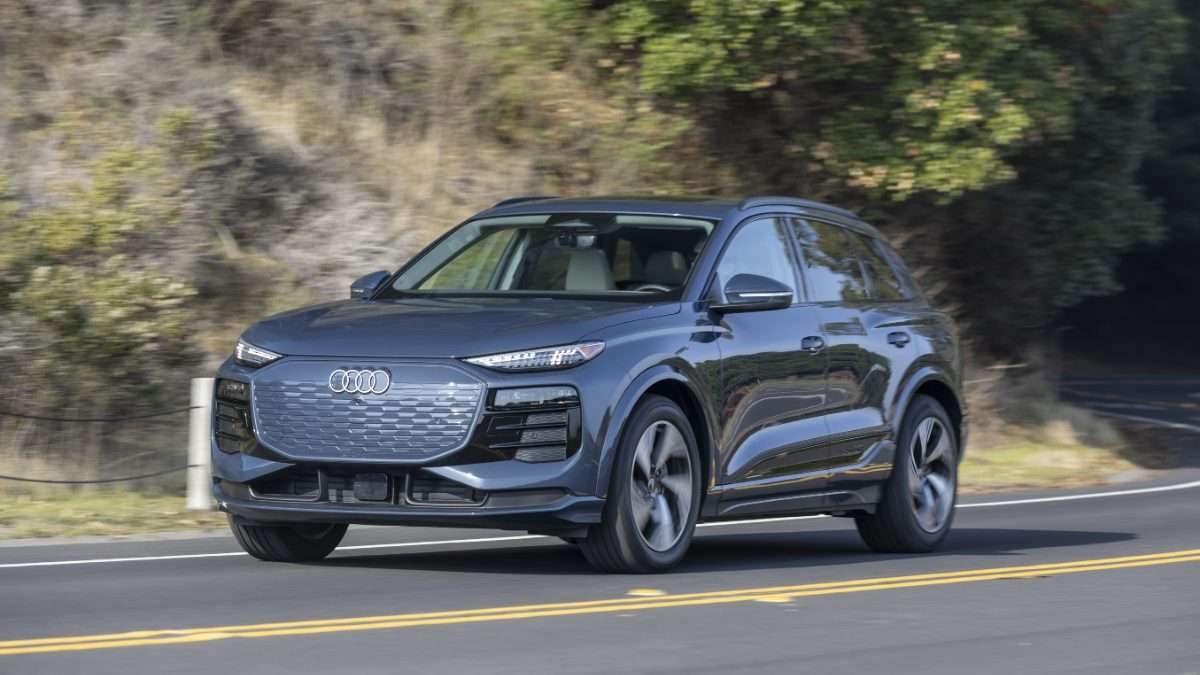
- On the other hand, the Audi Q6 e-tron is a premium electric SUV built on Audi’s new PPE platform, with RWD or Quattro AWD options, a range up to ~321 miles (EPA) in certain trims, fast-charge capability, and luxury tech inside.
- In comparing form and function, the R1T has a rugged truck silhouette, open cargo bed, “gear tunnel” storage, high ground clearance, and off-road features tailored for utility. By contrast, the Q6 e-tron presents a refined SUV aesthetic, focusing more on technology, refined interior finishes, and commuter-driven luxury rather than hardcore utility.
- From a performance/technical angle: the R1T in its performance dual-motor version delivers ~533–665 hp (depending on variant) and 0-60 mph in around 4.5 s or better.
- The Q6 e-tron, for example, the RWD version, achieves up to EPA ~321 miles and 0-60 mph in about 4.9 s in its Quattro form.
- The R1T is oriented toward adventure, utility, and off-road readiness (think pick-up with EV capability), while the Q6 e-tron is oriented toward premium everyday driving with strong electric credentials and luxury features. In short: one is a utility-oriented EV truck, the other is a luxury EV SUV, and your choice depends heavily on whether you prioritise utility vs refinement.
Other owners added valuable perspective. retlod, who has both vehicles at home, wrote that the Q6 “is plusher than the R1T,” while Rivian’s cargo and software systems clearly lead. That contrast perfectly illustrates how context defines excellence. Rivian designed an interface to be the center of the experience, where every control, from suspension settings to charging data, lives in a cohesive, intuitive space. Audi, on the other hand, designed an environment where technology supports rather than dominates. Its head-up display and retained physical controls reflect a brand philosophy that values driver intuition over touchscreen minimalism.

If there was one area where consensus formed, it was software. Navigation, in particular, became a recurring sore point. OrigStuffOfInterest described Audi’s maps as unreliable, while YourHue1 wished for deeper CarPlay integration to display battery state of charge. These are more than minor frustrations. In electric cars, software isn’t an accessory; it’s infrastructure. A poor interface can erode trust as quickly as a bad gearbox once did. Rivian’s system, designed in-house from the start, earned praise for clarity, speed, and charging intelligence. It’s proof that digital fluency has become a core element of vehicle design.

Yet the Audi’s strengths remain unmistakable. Owners consistently praise its serenity, solidity, and ergonomic sensibility. It’s a car that reflects Audi’s century-long devotion to craftsmanship, and that matters. As GottaLoveBoston concluded, “I’m quite happy with the Q6, it’s still hands down the best car I’ve ever driven.” That is the essence of perspective, recognizing another vehicle’s achievements without diminishing your own. It’s a maturity the modern car conversation could use more of.
The best comparisons are not about winners and losers but about philosophy, intent, and execution. When you understand that, you understand the very soul of the automobile, electric or otherwise.
Image Sources: Audi Media Center
Noah Washington is an automotive journalist based in Atlanta, Georgia. He enjoys covering the latest news in the automotive industry and conducting reviews on the latest cars. He has been in the automotive industry since 15 years old and has been featured in prominent automotive news sites. You can reach him on X and LinkedIn for tips and to follow his automotive coverage.
Set Torque News as Preferred Source on Google
Follow us today...