
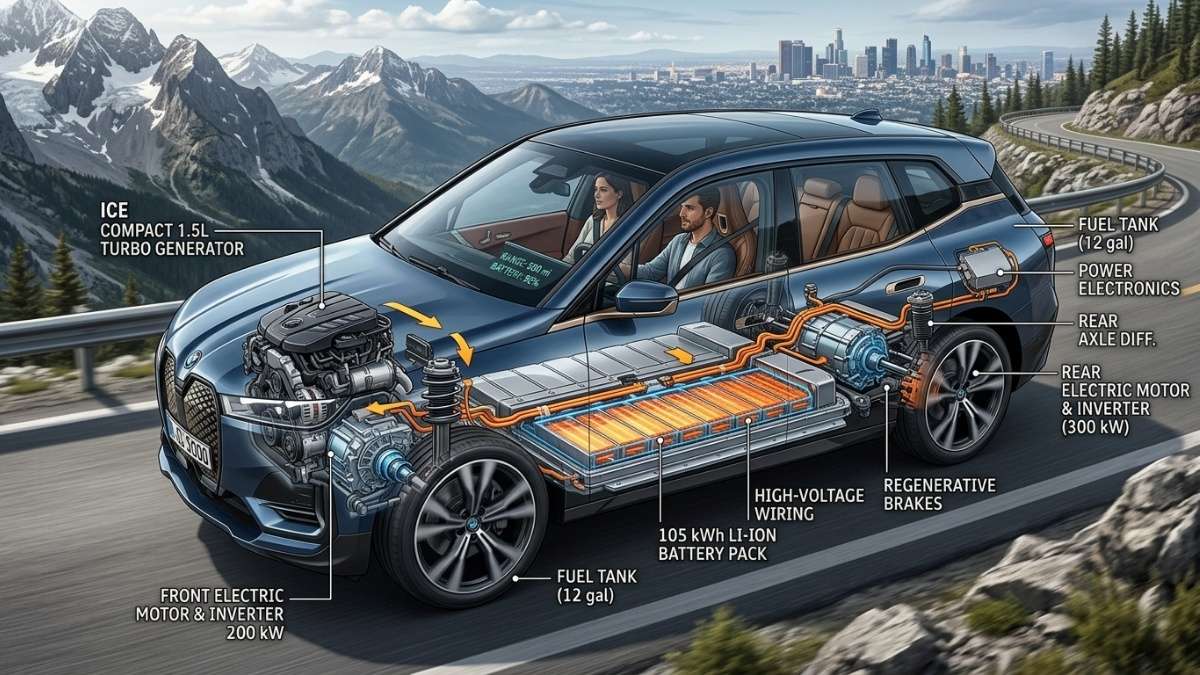

For the last decade, the automotive narrative has been binary: you either burned gasoline in an Internal Combustion Engine (ICE) or you "went green" with a Battery Electric Vehicle (BEV). But as the initial surge of early adopters levels off, the mainstream buyer is expressing a loud, clear hesitation. High price tags, inconsistent public charging, and the chilling effect of "range anxiety" have created a vacuum.
Into this void steps the EREV (Extended-Range Electric Vehicle). While it may seem like a step backward to those dreaming of a tailpipe-free world, it is increasingly becoming the most logical bridge to that future. From the rugged RAM 1500 Ramcharger to premium upcoming offerings from Genesis, the EREV is no longer a niche experiment—it is the real "quiet" market trend of 2026.
What Exactly is an EREV?
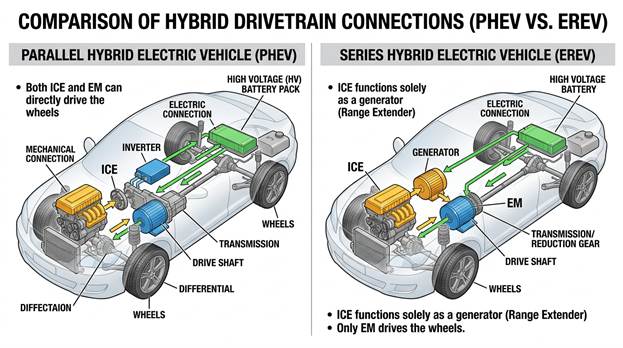
To understand the EREV, you must distinguish it from the standard Plug-in Hybrid (PHEV). In a typical PHEV, both the electric motor and the gas engine are connected to the wheels. When you demand full power, the gas engine often kicks in to provide mechanical drive.
In contrast, an EREV is a series hybrid. The wheels are driven exclusively by electric motors. The internal combustion engine (ICE) on board has no mechanical link to the drivetrain; its sole job is to act as a portable generator to recharge the battery or provide power directly to the motors once the initial charge is depleted. According to McKinsey & Company, EREVs typically offer a "sweet spot" of 100–150 miles of all-electric range, far exceeding the 25–50 miles found in most PHEVs. You get the instant torque of an EV with a gasoline backup that eliminates the need to hunt for a charger on a 500-mile trip.
Global Players: The Hits and the Misses
The EREV landscape is currently a tale of two markets. In China, brands like Li Auto have ridden the EREV wave to massive success, aiming for 550,000 deliveries in 2026 by refocusing on range-extended models. Their L-series SUVs have proven that families want the EV experience for the school run but the security of a gas tank for holiday travel.
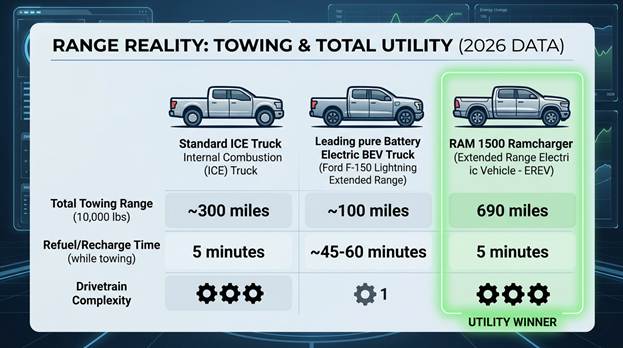
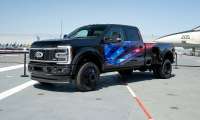
In the West, we are seeing a strategic resurgence. The 2025/2026 RAM 1500 Ramcharger is perhaps the most significant EREV ever conceived. By utilizing a 92-kWh battery paired with a 3.6-liter V6 generator, it targets a staggering 690 miles of total range. Similarly, Genesis has signaled a major shift, with reports suggesting a GV90 EREV variant is expected by 2027 to combat the "EV chasm" and provide a 700-mile luxury cruiser.
However, the road is littered with poor executions. The early BMW i3 REx is often cited as a "well-intentioned miss." Due to regulatory quirks, its tiny fuel tank and underpowered 650cc engine meant that when the battery died, the car often entered a dangerous "limp mode" that struggled to maintain highway speeds on inclines. A "good" EREV requires a generator powerful enough to sustain full vehicle performance even at a low state of charge.
The 2026 Landscape: Economics and Battery Tech
As we navigate 2026, the economic timing for EREVs is uncanny. According to GreenCars, the market is navigating a complex shift where Tesla’s dominance is tested by diversifying consumer needs.
While battery prices have dropped significantly—with pack-level costs nearing $99/kWh—the infrastructure for pure BEVs remains uneven. EREVs shield consumers from this reality. They utilize smaller, more affordable batteries (typically under 100 kWh) compared to the massive 200+ kWh packs needed for a 500-mile pure BEV truck, making them lighter and less reliant on the strained mineral supply chain for lithium and cobalt.
The Heavy-Duty Dilemma: Towing and Reality
Nowhere is the EREV advantage more apparent than in the truck market. A pure BEV truck, while powerful, sees its range catastrophically reduced when towing heavy loads, often dropping by 50% or more. This limitation turns a four-hour towing trip into an all-day ordeal of searching for accessible chargers. The RAM 1500 Ramcharger addresses this precisely by using its 92-kWh battery for emission-free commuting and its 174-horsepower generator to maintain steady power while towing, eliminating charging stops entirely when the ICE is operational.
When Do EREVs Stop Making Sense?
The EREV is a transitional technology. Its obsolescence will be dictated by three specific conditions:
- Infrastructure Ubiquity: When DC fast chargers are as common and reliable as gas pumps in rural areas.
- Energy Density Breakthroughs: If solid-state batteries allow a truck to tow 10,000+ lbs for 400 miles without weighing 8,000 lbs. Currently, towing can slash BEV range by 50% or more.
- Regulatory Shifts: If "Zero Emission" mandates strictly exclude any vehicle with an onboard combustion engine, regardless of its role as a generator.
Until then, the International Energy Agency (IEA) notes that the share of EREVs has more than quadrupled since 2020, signaling their growing role in the global fleet.
Who Should Buy an EREV Today?
If you fit the following profile, an EREV is likely your best purchase:
- The Single-Car Household: If you don't have a second gas car for long-distance travel.
- The Workhorse: If you use your vehicle for heavy towing or hauling, where pure BEVs currently struggle.
- The Apartment Dweller: If you lack reliable overnight charging at home but want to drive "electric" most of the time.
Lease or Buy? Given the rapid pace of battery development, leasing is often the smarter move. In three to four years, pure BEV ranges and charging speeds will likely have jumped significantly, potentially impacting the resale value of "bridge" technologies. Leasing protects you from this depreciation while allowing you to benefit from federal tax credits.
Unique Issues to Consider
Prospective buyers must be aware of "Complex Maintenance." Unlike a BEV, an EREV still has a combustion engine. You still need oil changes and spark plug replacements—even if you rarely use the engine.
Additionally, "Fuel Stale-ing" is a real concern. If you drive on electricity for six months without using gas, the fuel can degrade. Modern EREVs like the Ramcharger include pressurized fuel systems and "maintenance modes" that automatically run the engine to circulate fluids, but it is a layer of complexity a pure BEV owner avoids.
Wrapping Up
The rise of the EREV is a signal that the automotive industry is listening to the consumer. While pure BEVs are the ultimate destination, the EREV provides a high-voltage experience without the "range tether." With the maturation of models from RAM, Genesis, and Li Auto, we are seeing a vehicle class that offers the environmental benefits of an EV for the daily commute while maintaining the "go anywhere" freedom of the internal combustion era. In a world of uncertain charging and volatile energy prices, the EREV isn't a compromise—it's a strategy.
Disclosure: Images rendered by Artlist.io
Rob Enderle is a technology analyst at Torque News who covers automotive technology and battery developments. You can learn more about Rob on Wikipedia and follow his articles on TechNewsWord, TGDaily, and TechSpective.
Set Torque News as Preferred Source on Google
Follow us today...






Comments
I feel like many of the…
Permalink
I feel like many of the concerns about EVs will be over once solid state batteries and sodium batteries become more prevalent. This will shorten charging times and improve cold weather performance.
So the Chevy Volt and BMW i3…
Permalink
So the Chevy Volt and BMW i3 REx?
I owned the i3 for 6 years.... The Model 3 is a better car in most ways, including for road trips.
With most EVs giving 400kms…
Permalink
With most EVs giving 400kms range and most drivers driving less than that in a day, why do you need more range. If you have a home you can charge at?
They will have a use for…
Permalink
They will have a use for some drivers, but I don't feel the added complication is necessary. Battery tech is improving all the time. EREVs are the last throes of ICE manufacturing, a stop gap solution until they get their heads fully around BEVs.