
As an analyst who spends a considerable amount of time evaluating the bleeding edge of automotive technology, I often find myself deep in the weeds of 800-volt electrical architectures, solid-state battery advancements, and the complex integration of agentic AI into next-generation driving platforms. (Though, let me be clear on that last point: using "agentic AI" to describe execution-layer automation like real-time traction control and torque vectoring is fundamentally a conceptual mismatch; true agentic AI handles multi-step reasoning, not split-second physics management). I am personally waiting for the Volvo EX60 P12 to become available in the U.S. market because I appreciate the safety and capability of a modern, full-sized architecture. However, the fundamental crisis in modern mobility isn't necessarily about traveling 400 miles on a single charge in a two-ton luxury SUV; it is about efficiently moving one or two people across three miles of congested urban infrastructure. We are continually using 5,000-pound vehicles to fetch a single bag of groceries, which is a staggering misallocation of energy, space, and capital.
Enter the Fiat Topolino, a vehicle that aggressively challenges the "bigger is better" paradigm that dominates the American market. Stellantis has made the bold move to introduce this vehicle to U.S. shores, and priced at roughly $14,000, this diminutive electric quadricycle represents a fascinating pivot toward hyper-localized mobility. But is it the ideal around-town EV for American drivers? To answer that, we have to look past the spec sheet of traditional automobiles and evaluate the Topolino against the actual physics, economics, and realities of short-hop commuting. When we assess its core design, we see a masterclass in purposeful engineering.

Deconstructing The Fiat Topolino Design And Appeal
To understand the Topolino, one must first recognize what it is not: it is not a traditional passenger car. Legally and structurally, it falls under the European Union’s L6e light quadricycle classification and will enter the U.S. under similar Low-Speed Vehicle classifications. Underneath its charming, retro-inspired exterior, it shares its core platform and engineering DNA with the Citroën Ami and the Opel Rocks Electric, courtesy of the massive Stellantis corporate umbrella. It features a modest 5.5 kWh lithium-ion battery drive train producing a mere 8 horsepower (6 kW). This limits its top speed to a strictly governed 28 mph (45 km/h), with a maximum range that hovers around 47 miles per charge.
Yet, specifications only tell half the story. As someone who builds multiple high-performance PCs every quarter, I deeply appreciate modularity and the intelligent reuse of components to drive down costs. Stellantis took a similar approach here. To save manufacturing expenses, the front and rear body panels are virtually identical. The doors open in opposite directions (suicide on the driver's side, standard on the passenger's side) so the factory only has to manufacture one door panel and stamp it twice.
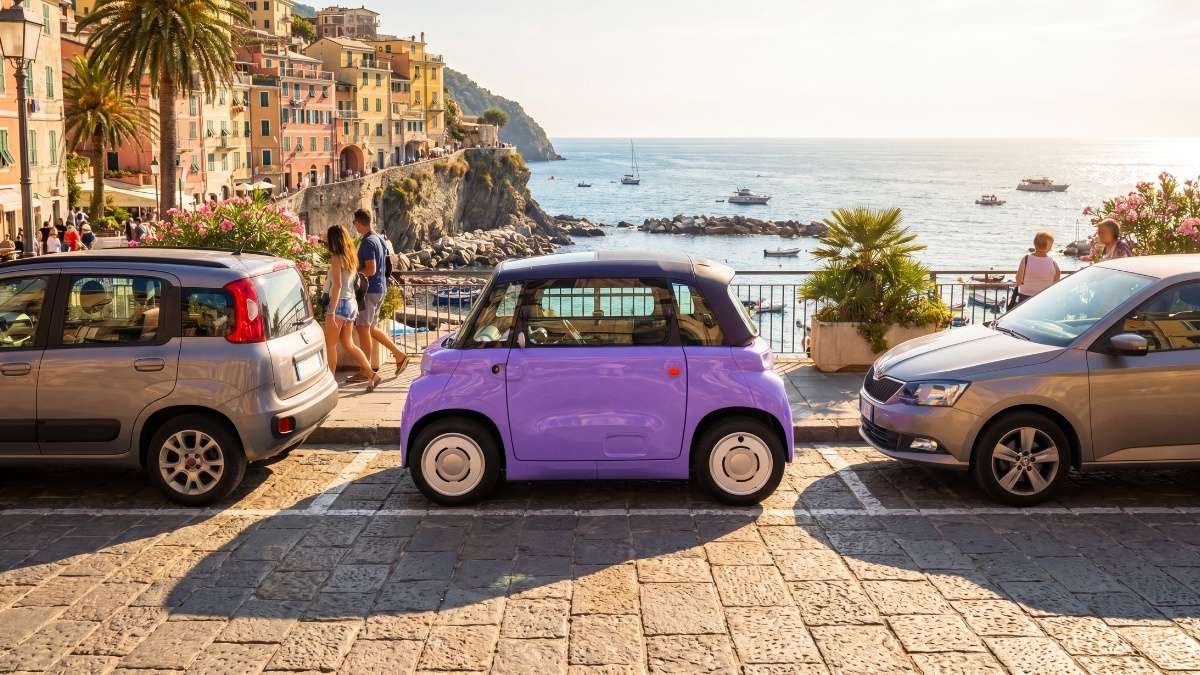
Despite this aggressive cost-cutting, the Topolino leans heavily into Fiat’s heritage, borrowing aesthetic cues from the iconic 1957 original. It features a canvas roll-back roof, vintage-styled circular mirrors, and a symmetrical fascia that results in an undeniably appealing "Dolce Vita" vibe. When you see the Topolino out in the wild, its retro-modern aesthetic immediately sets it apart from the sterile, appliance-like designs that plague modern micro-mobility. It even replaces traditional doors with nautical-style ropes in its Dolcevita trim, creating an open-air experience that feels more like a resort vehicle than a cheap commuter appliance.
Evaluating The Topolino Against Its Microcar Peers
When comparing the Topolino to other vehicles in its specific microcar class, we must carefully evaluate price, performance, and design. The micro-EV market is expanding rapidly, and the Topolino faces direct competition from both its corporate siblings and outside innovators.
In terms of pure performance, the Topolino is identical to the Citroën Ami. Both offer the exact same 28 mph top speed, the same 47-mile range, and identical charging times (roughly four hours from a standard household outlet). However, where the Ami embraces a utilitarian, almost brutalist industrial design language, the Topolino justifies its slightly higher price premium through superior aesthetics, a softer color palette, and premium-feeling touchpoints. It is designed to be seen in, rather than just designed to commute in.
Compared to higher-end microcars like the Microlino Lite—which boasts a front-opening door reminiscent of the BMW Isetta (my father had two of these), a self-supporting steel unibody, and slightly more premium interior options—the Topolino takes a more accessible approach. The Microlino offers fantastic engineering, but it carries a base price that can easily push toward the $20,000 mark depending on the battery configuration. The Topolino strikes a highly calculated balance. It does not pretend to be anything more than a neighborhood runabout, keeping its battery small and its weight under 1,100 pounds. This stringent engineering constraint keeps the purchase price at a highly accessible $14,000, making it an easy secondary vehicle rather than a massive household financial commitment.
Why The Topolino Outperforms E-Bikes And Golf Carts
For short-hop commuters, the default alternatives to full-sized cars have traditionally been battery-driven bicycles (e-bikes) or modified golf carts. While both have their specific merits, the Topolino offers distinct, critical advantages that make it a superior solution for a large demographic of urban and suburban dwellers.
First and foremost is the issue of safety and environmental protection. E-bikes are fantastic for reducing localized traffic, but they expose the rider entirely to the elements and to the severe physical dangers of sharing a lane with 4,000-pound trucks (I was reminded of this last month when I was driving home in my Restomod Jaguar E-Type Speedster, no top, and got hit with a cloud burst creating a very different car pool). A sudden rainstorm, a drop in temperature, or a patch of ice renders an e-bike commute miserable, if not outright dangerous. My wife Mary and I would much rather take a secure, enclosed vehicle to the store on a rainy afternoon than attempt to balance grocery bags on the handlebars of an e-bike. The Topolino provides an enclosed, structural cabin. While it lacks the advanced crumple zones, radar sensors, and airbag arrays of a standard passenger car, its steel tubular frame offers a vastly superior protective shell compared to the exposed handlebars of a bicycle.
Furthermore, golf carts—often utilized in master-planned communities or coastal towns—are inherently compromised for actual street use. Most lack proper DOT-approved safety glass, three-point seatbelts, locking doors, and cargo security. The Topolino features a true cabin that can be secured, allowing a driver to leave a laptop bag, camera gear, or groceries inside without fear of immediate theft. It also features proper automotive-grade suspension tuning. Golf carts are designed for the smooth, manicured grass of a fairway; when subjected to the potholes of a city street, they rattle mercilessly. The Topolino provides far more composed and predictable ride dynamics.

The US Market Launch And Navigating Regulatory Hurdles
The most exciting and pressing development for American consumers is the recent confirmation that Stellantis is officially taking the plunge. According to their official press release regarding the North American expansion, the Topolino is indeed crossing the Atlantic, a move that fundamentally challenges the American market aggressively biased toward massive vehicles. The risks are substantial, and the road to homologation requires a precise strategy.
The primary hurdle is strictly regulatory. To sell the Topolino in the U.S., it operates under the NHTSA's Low-Speed Vehicle (LSV) or Neighborhood Electric Vehicle (NEV) regulations. These federal guidelines strictly restrict such vehicles to a top speed of 25 mph (meaning the EU's 28 mph limit gets slightly governed down for the States) and only permit them to be driven on roads with posted speed limits of 35 mph or less.
Here in Bend, Oregon, taking a vehicle governed to low speeds onto the local highways isn’t the complete non-starter of other cities given our freeway has a posted top speed of 45 and there are bikes on it still I’d likely stay off the freeway with this car (because no one seems to obey that speed limit). This dynamic disqualifies the Topolino from a large swath of American suburban commuting, which heavily relies on 45 mph arterial roads just to get between residential zones and commercial centers. Furthermore, there is an immense cultural barrier. American automotive culture equates physical size with safety, dominance, and status. Driving a 1,100-pound plastic-bodied microcar in a sea of Ford F-150s, Chevrolet Suburbans, and massive EV trucks like the Rivian R1T requires a certain level of spatial awareness and bravery.
However
As an analyst who spends a considerable amount of time evaluating the bleeding edge of automotive technology, I often find myself deep in the weeds of 800-volt electrical architectures, solid-state battery advancements, and the complex integration of agentic AI into next-generation driving platforms. (Though, let me be clear on that last point: using "agentic AI" to describe execution-layer automation like real-time traction control and torque vectoring is fundamentally a conceptual mismatch; true agentic AI handles multi-step reasoning, not split-second physics management). I am personally waiting for the Volvo EX60 P12 to become available in the U.S. market because I appreciate the safety and capability of a modern, full-sized architecture. However, the fundamental crisis in modern mobility isn't necessarily about traveling 400 miles on a single charge in a two-ton luxury SUV; it is about efficiently moving one or two people across three miles of congested urban infrastructure. We are continually using 5,000-pound vehicles to fetch a single bag of groceries, which is a staggering misallocation of energy, space, and capital.
Enter the Fiat Topolino, a vehicle that aggressively challenges the "bigger is better" paradigm that dominates the American market. Stellantis has made the bold move to introduce this vehicle to U.S. shores, and priced at roughly $14,000, this diminutive electric quadricycle represents a fascinating pivot toward hyper-localized mobility. But is it the ideal around-town EV for American drivers? To answer that, we have to look past the spec sheet of traditional automobiles and evaluate the Topolino against the actual physics, economics, and realities of short-hop commuting. When we assess its core design, we see a masterclass in purposeful engineering.

Deconstructing The Fiat Topolino Design And Appeal
To understand the Topolino, one must first recognize what it is not: it is not a traditional passenger car. Legally and structurally, it falls under the European Union’s L6e light quadricycle classification and will enter the U.S. under similar Low-Speed Vehicle classifications. Underneath its charming, retro-inspired exterior, it shares its core platform and engineering DNA with the Citroën Ami and the Opel Rocks Electric, courtesy of the massive Stellantis corporate umbrella. It features a modest 5.5 kWh lithium-ion battery drive train producing a mere 8 horsepower (6 kW). This limits its top speed to a strictly governed 28 mph (45 km/h), with a maximum range that hovers around 47 miles per charge.
Yet, specifications only tell half the story. As someone who builds multiple high-performance PCs every quarter, I deeply appreciate modularity and the intelligent reuse of components to drive down costs. Stellantis took a similar approach here. To save manufacturing expenses, the front and rear body panels are virtually identical. The doors open in opposite directions (suicide on the driver's side, standard on the passenger's side) so the factory only has to manufacture one door panel and stamp it twice.
Despite this aggressive cost-cutting, the Topolino leans heavily into Fiat’s heritage, borrowing aesthetic cues from the iconic 1957 original. It features a canvas roll-back roof, vintage-styled circular mirrors, and a symmetrical fascia that results in an undeniably appealing "Dolce Vita" vibe. When you see the Topolino out in the wild, its retro-modern aesthetic immediately sets it apart from the sterile, appliance-like designs that plague modern micro-mobility. It even replaces traditional doors with nautical-style ropes in its Dolcevita trim, creating an open-air experience that feels more like a resort vehicle than a cheap commuter appliance.
Evaluating The Topolino Against Its Microcar Peers
When comparing the Topolino to other vehicles in its specific microcar class, we must carefully evaluate price, performance, and design. The micro-EV market is expanding rapidly, and the Topolino faces direct competition from both its corporate siblings and outside innovators.
In terms of pure performance, the Topolino is identical to the Citroën Ami. Both offer the exact same 28 mph top speed, the same 47-mile range, and identical charging times (roughly four hours from a standard household outlet). However, where the Ami embraces a utilitarian, almost brutalist industrial design language, the Topolino justifies its slightly higher price premium through superior aesthetics, a softer color palette, and premium-feeling touchpoints. It is designed to be seen in, rather than just designed to commute in.
Compared to higher-end microcars like the Microlino Lite—which boasts a front-opening door reminiscent of the BMW Isetta (my father had two of these), a self-supporting steel unibody, and slightly more premium interior options—the Topolino takes a more accessible approach. The Microlino offers fantastic engineering, but it carries a base price that can easily push toward the $20,000 mark depending on the battery configuration. The Topolino strikes a highly calculated balance. It does not pretend to be anything more than a neighborhood runabout, keeping its battery small and its weight under 1,100 pounds. This stringent engineering constraint keeps the purchase price at a highly accessible $14,000, making it an easy secondary vehicle rather than a massive household financial commitment.

Why The Topolino Outperforms E-Bikes And Golf Carts
For short-hop commuters, the default alternatives to full-sized cars have traditionally been battery-driven bicycles (e-bikes) or modified golf carts. While both have their specific merits, the Topolino offers distinct, critical advantages that make it a superior solution for a large demographic of urban and suburban dwellers.
First and foremost is the issue of safety and environmental protection. E-bikes are fantastic for reducing localized traffic, but they expose the rider entirely to the elements and to the severe physical dangers of sharing a lane with 4,000-pound trucks (I was reminded of this last month when I was driving home in my Restomod Jaguar E-Type Speedster, no top, and got hit with a cloud burst creating a very different car pool). A sudden rainstorm, a drop in temperature, or a patch of ice renders an e-bike commute miserable, if not outright dangerous. My wife Mary and I would much rather take a secure, enclosed vehicle to the store on a rainy afternoon than attempt to balance grocery bags on the handlebars of an e-bike. The Topolino provides an enclosed, structural cabin. While it lacks the advanced crumple zones, radar sensors, and airbag arrays of a standard passenger car, its steel tubular frame offers a vastly superior protective shell compared to the exposed handlebars of a bicycle.
Furthermore, golf carts—often utilized in master-planned communities or coastal towns—are inherently compromised for actual street use. Most lack proper DOT-approved safety glass, three-point seatbelts, locking doors, and cargo security. The Topolino features a true cabin that can be secured, allowing a driver to leave a laptop bag, camera gear, or groceries inside without fear of immediate theft. It also features proper automotive-grade suspension tuning. Golf carts are designed for the smooth, manicured grass of a fairway; when subjected to the potholes of a city street, they rattle mercilessly. The Topolino provides far more composed and predictable ride dynamics.

The US Market Launch And Navigating Regulatory Hurdles
The most exciting and pressing development for American consumers is the recent confirmation that Stellantis is officially taking the plunge. According to their official press release regarding the North American expansion, the Topolino is indeed crossing the Atlantic, a move that fundamentally challenges the American market aggressively biased toward massive vehicles. The risks are substantial, and the road to homologation requires a precise strategy.
The primary hurdle is strictly regulatory. To sell the Topolino in the U.S., it operates under the NHTSA's Low-Speed Vehicle (LSV) or Neighborhood Electric Vehicle (NEV) regulations. These federal guidelines strictly restrict such vehicles to a top speed of 25 mph (meaning the EU's 28 mph limit gets slightly governed down for the States) and only permit them to be driven on roads with posted speed limits of 35 mph or less.
Here in Bend, Oregon, taking a vehicle governed to low speeds onto the local highways isn’t the complete non-starter of other cities given our freeway has a posted top speed of 45 and there are bikes on it still I’d likely stay off the freeway with this car (because no one seems to obey that speed limit). This dynamic disqualifies the Topolino from a large swath of American suburban commuting, which heavily relies on 45 mph arterial roads just to get between residential zones and commercial centers. Furthermore, there is an immense cultural barrier. American automotive culture equates physical size with safety, dominance, and status. Driving a 1,100-pound plastic-bodied microcar in a sea of Ford F-150s, Chevrolet Suburbans, and massive EV trucks like the Rivian R1T requires a certain level of spatial awareness and bravery.
However, Stellantis isn't aiming for the sprawling Midwest highways. The Topolino will thrive as a specialized vehicle in enclosed geographic ecosystems. Coastal beach towns in California or Florida, massive retirement communities like The Villages, or dense, speed-restricted urban cores will adopt them enthusiastically. As a niche mobility appliance in targeted ZIP codes, this U.S. launch could be a highly lucrative venture for Fiat.
Depreciation Dynamics In The Micro EV Segment
One of the most persistent and devastating financial burdens of modern EV ownership today is catastrophic depreciation. Because battery technology is advancing so rapidly, and because software-defined vehicles age more like disposable smartphones than traditional cars, luxury EVs are plummeting in value. According to recent market data analyzed by iSeeCars, the average electric vehicle loses a staggering 57.2% of its value over five years, vastly outpacing the depreciation of traditional gas or hybrid vehicles.
The Topolino, however, possesses a unique economic profile that suggests it will hold its value remarkably well on American shores, completely defying standard EV depreciation curves. The math is largely in its favor. When a vehicle starts at roughly $14,000, there is simply less absolute capital to lose. If a luxury EV depreciates 50%, the owner loses $30,000 to $40,000. If the Topolino depreciates 50%, the owner loses $7,000.
But as an analyst, I suspect it won't even lose that much, for a few key reasons. First, the Topolino is mechanically simplistic. It does not rely on complex, liquid-cooled 800-volt architectures, intricate LiDAR sensor arrays, or massive infotainment screens that render themselves functionally obsolete in 36 months. Its technology is basic, proven, and highly durable. A 5.5 kWh battery is inexpensive to eventually replace, completely removing the "ticking time bomb" fear of a massive battery replacement bill that currently plagues the used market for full-sized EVs.
Second, the Topolino acts more like a high-end consumer appliance or a luxury lifestyle accessory than a traditional commuter car. Its value is tied heavily to its iconic design and specialized utility in specific environments, not its cutting-edge tech specs. Much like how a high-quality gas-powered golf cart holds a steady resale value of $5,000 to $8,000 for years on end in gated communities, the Topolino establishes a hard financial floor for its worth based on its sheer utility as a neighborhood runabout. Because it fills a highly specific niche where extreme range and high horsepower are utterly irrelevant, the standard metrics of EV obsolescence do not apply. A used Topolino will run to the local corner store just as effectively ten years from now as it does today, ensuring steady demand and robust price retention on the secondary market.
Wrapping Up
The global automotive industry is currently locked in an unsustainable arms race of range, horsepower, and software complexity, often producing vehicles that are vastly over-engineered for the daily realities of most consumers. The Fiat Topolino represents a necessary, brilliant correction to this trend. By willingly embracing the regulatory constraints of a low-speed quadricycle and focusing entirely on hyper-local urban and suburban mobility, Stellantis has created a highly practical, aesthetically gorgeous tool.
While the $14,000 entry price might seem steep when compared directly to an electric bicycle, it is an absolute bargain when viewed as a fully enclosed, weather-protected, lockable four-wheeled mobility solution that completely sidesteps the massive depreciation risks of traditional electric vehicles. Now that Stellantis has officially committed to bringing it to the U.S. market, its success will depend heavily on precise geographic targeting and marketing to specific urban cores and retirement communities. However, as our cities grow denser and the friction of navigating them in massive SUVs becomes increasingly unbearable, the Topolino proves that sometimes, the most advanced engineering solution is simply to build less car.
Disclosure: Images rendered by Artlist.io
Rob Enderle is a technology analyst at Torque News who covers automotive technology and battery developments. You can learn more about Rob on Wikipedia and follow his articles on TechNewsWord, TGDaily, and TechSpective.
Set Torque News as Preferred Source on Google
Follow us today...