


In a move that defies the American automotive mantra of "bigger is better," Stellantis has officially confirmed that the Fiat Topolino—a diminutive, retro-styled electric quadricycle—is coming to the United States. Fiat CEO Olivier François broke the news during Art Week Miami, standing alongside a custom "Brittolino" art car designed by Romero Britto.
While the land of the F-150 and the Escalade might seem like hostile territory for a vehicle that measures just over 8 feet long, the arrival of the Topolino marks a pivotal moment for urban mobility in America. This isn’t just a car; it’s a challenge to our very definition of what a vehicle needs to be.
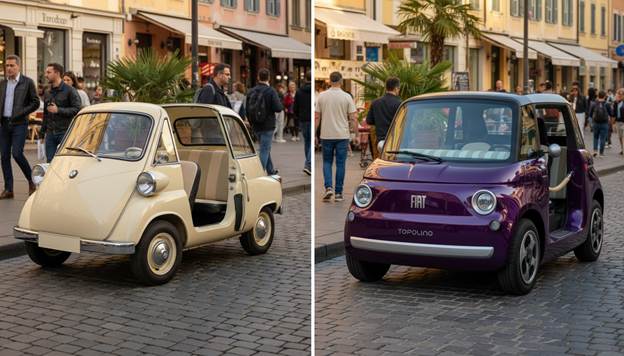
Microcars in America: A History of Big Dreams and Tiny Sales
To understand the gamble Stellantis is taking, we have to look at the checkered history of microcars in the US. Americans have flirted with tiny cars before, but the relationship has rarely been a long-term romance.
- The BMW Isetta (1950s): The original "bubble car" was a novelty, but its lack of power and safety features kept it from mainstream adoption during the V8-obsessed 50s.
- The Smart Fortwo (2008-2019): Perhaps the most relevant cautionary tale. The Smart car failed not just because it was small, but because it tried to be a "real" car. It had a clunky transmission, required premium fuel (in gas versions), and cost nearly as much as a Honda Civic. It occupied an awkward middle ground: too expensive to be a toy, too compromised to be a primary vehicle.
- The Fiat 500 (Modern Era): While successful initially, sales dwindled as gas prices stayed low and SUVs took over.
Why is the Topolino different? Unlike the Smart Fortwo, the Topolino (technically a quadricycle in Europe) isn't pretending to be a highway cruiser. With a top speed capped around 28 mph (45 km/h), it embraces its identity as a Neighborhood Electric Vehicle (NEV). It isn’t trying to replace your family SUV; it’s trying to replace your second car, your golf cart, or your e-bike.
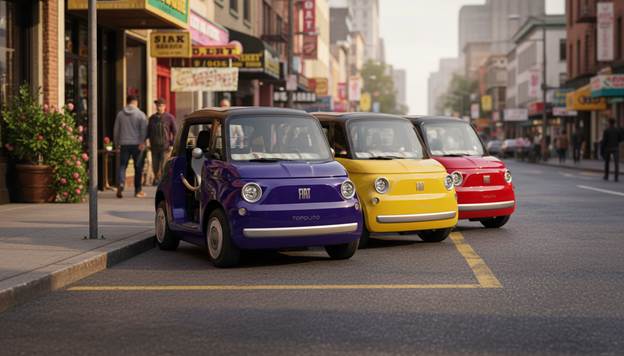
The Urban Parking Savior
If you have ever circled a city block in New York, San Francisco, or Miami for 45 minutes looking for a spot, you understand the Topolino’s value proposition immediately.
At just 2.53 meters (99.6 inches) long, you can fit three Topolinos in a standard American parking space. In densely populated areas where parking real estate is more valuable than gold, this vehicle is a game-changer. It allows for "perpendicular parking" in parallel zones (where legal) and can squeeze into the "dead zones" between driveways and hydrants that a Toyota Camry would never attempt.
Note: The Topolino’s turning circle is incredibly tight (7.2 meters), making U-turns on narrow one-way streets a non-event.
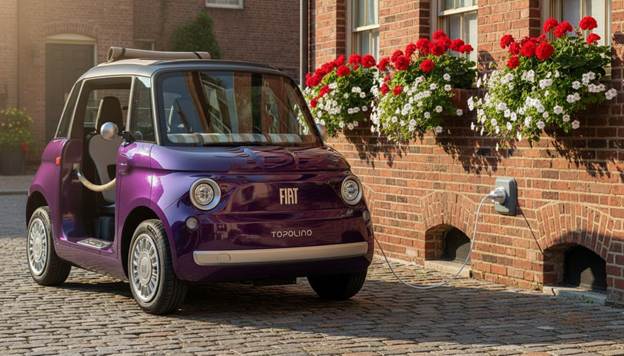
The Charging Paradox: Why Less is More
One of the biggest hurdles to EV adoption in cities is the "charging desert." Apartment dwellers without garages often cannot charge an EV because they lack access to Level 2 chargers or dedicated stalls.
The Topolino flips this problem on its head. Because its battery is small (5.5 kWh) and its energy needs are low, it doesn't require a dedicated wall box or a public charging station.
- The "Toaster" Advantage: The Topolino plugs directly into a standard 110V/220V household outlet.
- Charge Time: It can charge from 0% to 100% in under 4 hours on a standard plug.
For a city dweller, this means you can potentially run an extension cord from a ground-floor window or use a standard outdoor outlet at your workplace. You are no longer tethered to the broken, unreliable public charging infrastructure that plagues many US cities.
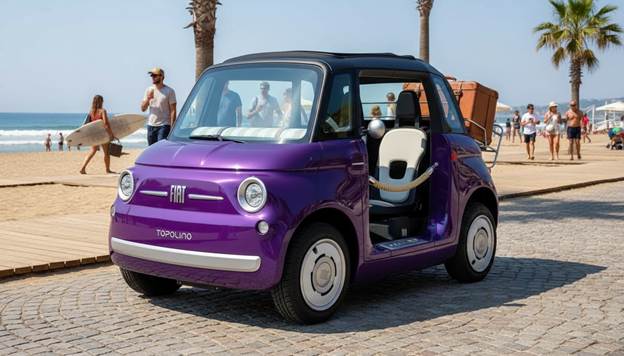
Italian Style on a Micro Scale
Let’s be honest: The Smart car was practical, but it was sterile. The Topolino is dripping with "Dolce Vita." It is based on the Citroën Ami, but Fiat has reskinned it to look like the younger sibling of the classic 1957 Fiat 500.
Design Highlights:
- The Face: Round headlights and a smiling grille that evoke the original 500.
- The Doors (or lack thereof): The "Dolcevita" version comes with ropes instead of doors, perfect for beach towns like Miami or Newport Beach.
- The Interior: Minimalist but chic. It features a "Dolcevita Box" (a fabric strip for storage) and optional quirky accessories like a USB fan or a Bluetooth speaker.
- Customization: It’s designed to be personalized, arguably the most important feature for the Gen Z/Millennial demographic it targets.
It is a fashion accessory as much as it is transportation. In a world of aggressive, angry-looking SUVs, the Topolino is essentially a golden retriever puppy on wheels—everyone who sees it smiles.
Wrapping Up
Stellantis is taking a calculated risk, but the timing might finally be right. As cities become more congested and the cost of owning full-sized vehicles skyrockets, the "micro-mobility" segment is exploding. By bringing the Topolino to the US, Fiat isn't just selling a car; they are selling a lifestyle—one that values freedom, ease, and a bit of Italian joy over horsepower and bulk. If priced correctly (likely under $12,000), it could be the first microcar to truly crack the American code.
Disclosure: Images rendered by Artlist.io
Rob Enderle is a technology analyst at Torque News who covers automotive technology and battery developments. You can learn more about Rob on Wikipedia and follow his articles on Forbes, X, and LinkedIn.
Set Torque News as Preferred Source on Google
Follow us today...







Comments
It transforms into a coffin,…
Permalink
It transforms into a coffin, collapsing like an aluminum beer can in an iron-worker's hand! Death never looked so handsome.
Problem is, all the…
Permalink
Problem is, all the Stellantis products are garbage, or least from a reliability and depreciation perspective.