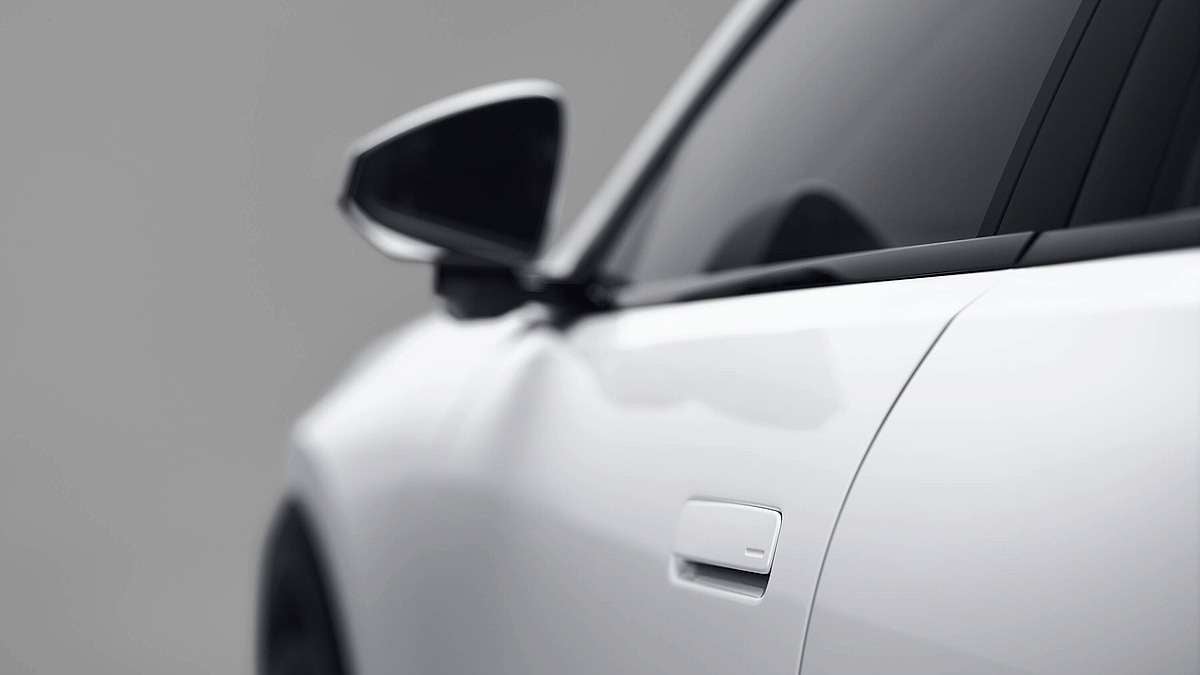

The humble door handle has become an unlikely battleground in the evolution of the electric vehicle. What was once a purely mechanical afterthought now carries the weight of aerodynamic efficiency, brand identity, and regulatory scrutiny. Flush door handles, once a novelty, are now widespread across electric vehicles. Their appeal is not accidental, and their drawbacks are not trivial. The result is a design choice that reveals as much about the priorities of modern automakers as it does about the limits of innovation.
Reduced Drag and Measurable Efficiency Gains
Aerodynamics is the quiet accountant of electric vehicle design. Every protrusion from a vehicle’s surface adds drag, and drag extracts energy. Flush door handles aim to eliminate one such inefficiency.
Testing and modeling suggest that replacing traditional protruding handles with flush door handle designs reduces total vehicle drag by roughly 0.3% to 1.5%. This may sound modest, yet at highway speeds where aerodynamic resistance dominates, even marginal gains matter. Efficiency improvements of about 0.5% to 1% are commonly cited in steady-state driving.
Evidence from controlled comparisons reinforces the point. One study found that retractable handles contributed to energy savings of approximately 0.6 kWh over 62 miles, equivalent to about 38.5 miles. On a vehicle targeting 300 miles of range, such gains translate into an additional 2 to 4 miles. Individually insignificant, but collectively consequential.
This incrementalism defines modern EV engineering. Door handles alone do not transform efficiency. In combination with smoother underbodies, optimized mirrors, and refined wheel designs, they contribute to meaningful gains. The calculus of range leaves little room for aesthetic indulgence that does not pay its way.
Reduced Road Noise in an Already Quiet Cabin
Electric vehicles have a peculiar problem. Their silence exposes new noises. Without the masking effect of an internal combustion engine, aerodynamic disturbances become more noticeable.
Protruding door handles create localized turbulence, producing high-frequency noise near the vehicle’s flanks. Flush handles reduce this effect. Estimates suggest a reduction in sound energy of roughly 20%, corresponding to about a 1 dB decrease at the source. In perceptual terms, this equates to a modest 5% to 10% reduction in perceived loudness.
The cabin-wide effect is subtle. Most occupants would struggle to isolate the contribution of a door handle from other noise sources. Yet automakers do not optimize for dramatic improvements in isolation. They optimize for cumulative refinement. In a vehicle engineered for quietness, small reductions in noise contribute to an impression of sturdiness and polish.
Futuristic Minimalist Aesthetic
Function explains part of the story. Form explains the rest.
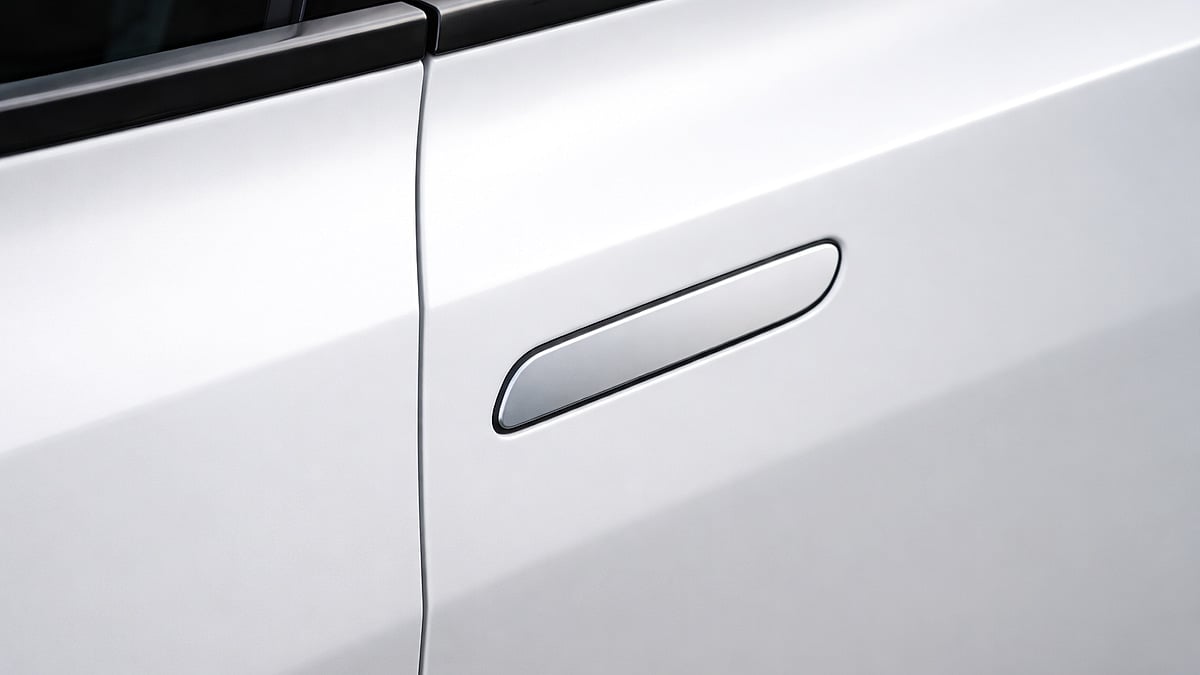
Flush door handles align with a broader design language that emphasizes clean surfaces and minimal visual interruption. The absence of protrusions creates a continuous body line, lending vehicles a sculpted, almost digital appearance. This is not merely aesthetic preference. It is branding.
Electric vehicles are marketed as technological artifacts rather than mechanical ones. Removing traditional elements, or reimagining them, signals progress. A flush handle suggests sophistication in the same way a frameless display suggests modernity in consumer electronics.
The strategy appears effective. Consumer polling indicates that while opinions are divided, a significant portion of buyers associate flush handles with advanced design. At the same time, resistance remains. In one survey, 64% of respondents preferred traditional handles, suggesting that familiarity retains value even in a market driven by novelty.
Reduced Part Complexity Through Electrification
Paradoxically, adding electronics can simplify mechanical systems.
Traditional door handles rely on direct mechanical linkages. Flush systems often replace these with electronic actuation, allowing designers to reduce the number of moving parts inside the door. In theory, this lowers manufacturing complexity and enables more flexible packaging.
The approach also integrates seamlessly with keyless entry systems. Handles can extend automatically when the driver approaches, retract during motion, and coordinate with locking systems without additional mechanical intervention. The result is a system that feels cohesive, if somewhat opaque.
However, simplicity in one domain introduces dependency in another. The reliance on electrical systems, particularly the low-voltage battery, creates a single point of failure. The trade-off between mechanical redundancy and electronic integration lies at the heart of the debate.
The Safety Problem, Access When It Matters Most
The benefits of flush door handles are incremental. The risks, when they materialize, are immediate.
Complaints to regulators highlight a growing concern. Reports of issues with electronically controlled doors and handles rose 65% in 2024 compared to the previous year, with more than 520 complaints filed over the past decade.
The incidents described are not hypothetical. Drivers have reported being unable to exit vehicles after power loss, while others have been locked out entirely. In one case, occupants remained trapped inside a vehicle for two hours following a battery failure. In another, a driver with mobility challenges had to escape through the cargo area, resulting in injury.
These scenarios reveal a fundamental vulnerability. Many flush handle systems depend on the vehicle’s 12-volt electrical system. If that system fails, the handle may not extend, and the latch may not actuate. Mechanical backups often exist, yet they are frequently hidden, difficult to access, or poorly understood by users.
In an emergency, complexity becomes liability. Seconds matter. Confusion costs time.
Inconsistent User Experience and Learning Curve
Even in non-emergency situations, flush handles can introduce user frustration.
Each manufacturer implements its own variation. Some handles pivot when pressed. Others extend automatically. Still others rely on capacitive sensors. The lack of standardization forces users to learn vehicle-specific behaviors for what was once an intuitive action.
Drivers may adapt. Passengers often do not. The result is hesitation at the moment of entry or exit, a small but persistent inconvenience.
Environmental factors add another layer of unpredictability. In cold climates, retractable handles may freeze in place. In such cases, a feature designed to enhance refinement becomes a source of frustration.
Regulatory Pressure and Industry Response
Regulators have begun to take notice. Safety authorities in multiple regions are evaluating whether flush handles should be permitted without clearly accessible mechanical backups.
China has moved decisively, mandating that future vehicles include mechanical door handles that function without electrical power. The policy requires both interior and exterior releases to operate independently of electronic systems. Other markets are considering similar measures.
Automakers have responded, though cautiously. Some emphasize that their systems retain mechanical functionality beneath the surface. Others are redesigning handles to include more obvious fallback mechanisms. Hybrid designs that combine electronic convenience with mechanical reliability are gaining traction.
The pace of change reflects a broader tension. Design trends evolve quickly. Safety standards evolve slowly, until they do not.
A Design Philosophy Under Review
Flush door handles encapsulate the philosophy of modern electric vehicles. They pursue efficiency through incremental gains, aesthetics through minimalism, and functionality through software integration. Each objective is rational. Their interaction is more complex.
The design works well under normal conditions. It delivers small improvements in efficiency, modest reductions in noise, and a distinctive visual identity. These benefits accumulate, enhancing the overall product.
The design struggles under abnormal conditions. Electrical dependency introduces failure modes that mechanical systems largely avoid. Hidden backups undermine usability when clarity is essential. The cost of failure, while infrequent, is high.
Bottom Line
Flush door handles are neither a gimmick nor a panacea. They represent a calculated trade-off. On one side lies a collection of incremental advantages, including a 0.3% to 1.5% reduction in drag, a 0.5% to 1% improvement in efficiency, and a roughly 10% reduction in localized wind noise. On the other lies a set of risks centered on accessibility during power loss or emergencies.
The trajectory of the industry suggests a compromise. Future designs are likely to retain the aerodynamic and aesthetic benefits while restoring more intuitive mechanical access. The lesson is familiar. Innovation advances in steps, occasionally overshoots, and then corrects course.
The door handle, it turns out, is not just a handle. It is a small piece of hardware that reveals the priorities, and the blind spots, of an industry in transition.
What Do You Think?
Have you ever struggled to open a flush door handle, especially in cold weather or low light?
Would you trade a few miles of range for a more traditional and reliable door handle?
About The Author
Chris Johnston is the author of SAE’s comprehensive book on electric vehicles, "The Arrival of The Electric Car." His coverage on Torque News focuses on electric vehicles. Chris has decades of product management experience in telematics, mobile computing, and wireless communications. Chris has a B.S. in electrical engineering from Purdue University and an MBA. He lives in Seattle. When not working, Chris enjoys restoring classic wooden boats, open water swimming, cycling and flying (as a private pilot). You can connect with Chris on LinkedIn and follow his work on X at ChrisJohnstonEV.
Photo credit: Provided by author, Polestar media kit
Set Torque News as Preferred Source on Google
Follow us today...