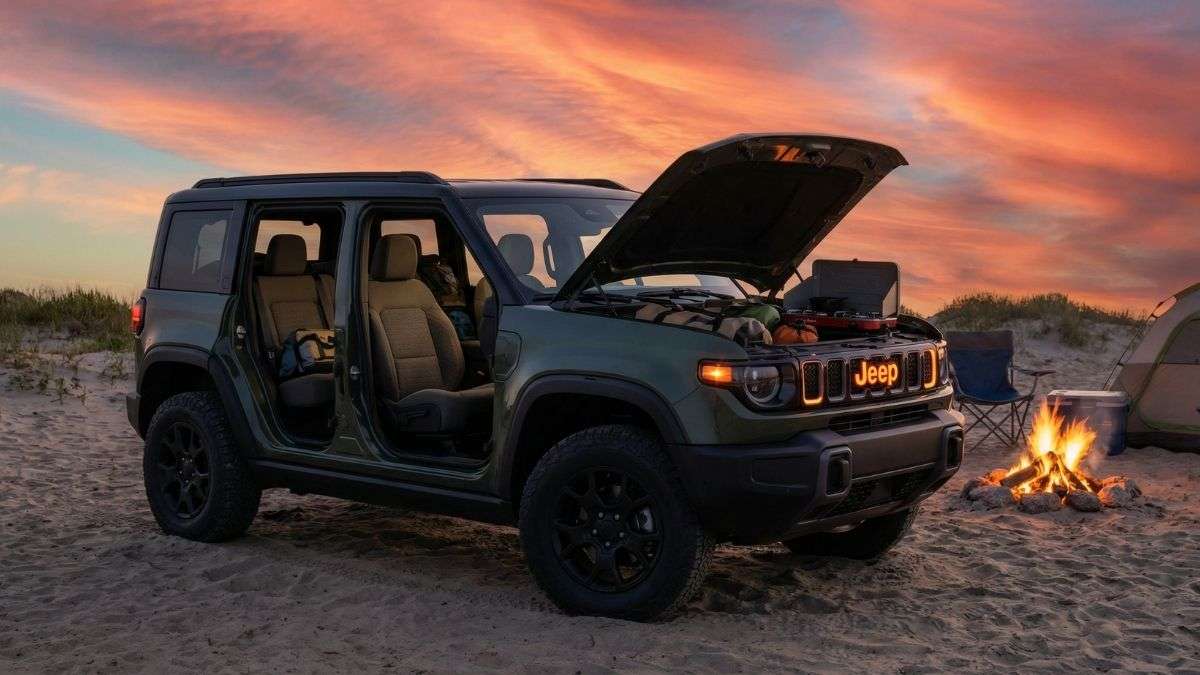

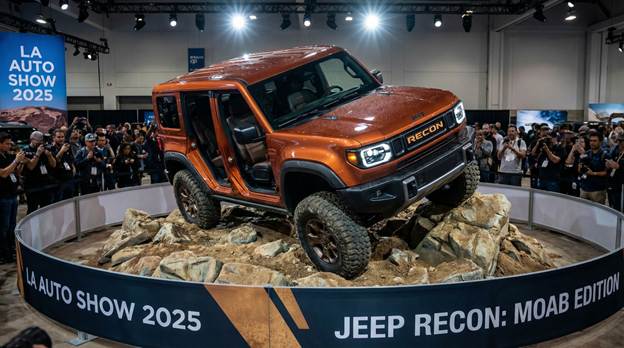
The 2025 Los Angeles Auto Show has come and gone, but the ripples from Jeep’s major reveal are still spreading through the industry. The automaker finally pulled the sheet off the production version of the 2026 Jeep Recon, a vehicle that represents arguably the biggest gamble in the brand’s 80-year history. As the first fully electric SUV in North America to wear the Jeep badge (following the Wagoneer S), the Recon isn't just another EV—it’s a litmus test for the future of off-roading and, more critically, the financial stability of Stellantis.
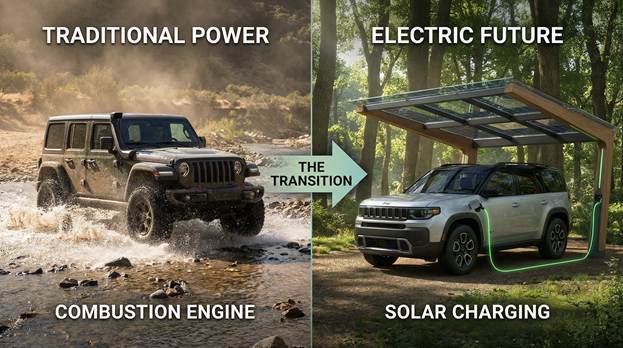
Recon vs. Wrangler: Sibling Rivalry or Tag Team?
The inevitable question for every Jeep enthusiast is simple: Is this just an electric Wrangler? The answer is a complicated "no." While the Wrangler is built on a traditional body-on-frame platform with solid axles—the gold standard for rock crawling durability—the Recon utilizes the STLA Large platform. This means it is a unibody vehicle with independent suspension.
For the purist, this might sound like heresy. However, Jeep has aggressively engineered the Recon to bridge the gap. It comes standard with Selec-Terrain traction management, e-locker axle technology, and substantial underbody protection. More importantly, it retains the "Jeep DNA" that the brand knows is non-negotiable: the doors come off, the glass is removable, and the roof opens up.
Where the Wrangler can be a bear to drive on highways due to its solid axles and aerodynamic profile of a brick, the Recon promises a civilized on-road experience. With 650 horsepower and 620 lb-ft of instantaneous torque, it will vastly outperform a standard V6 Wrangler in acceleration. However, the trade-off is clear: the Wrangler remains the king of articulation and modification, while the Recon is the daily driver that can still conquer the Rubicon Trail on the weekend—provided there is a charger waiting at the end.
Jeep’s Image and the Stellantis Lifeline
To understand the weight resting on the Recon’s square shoulders, one must look at the parent company. Stellantis has had a tumultuous 2024 and 2025. After a difficult first half of 2025 where North American revenues dipped, the company saw a significant rebound in Q3 2025, driven almost entirely by the strength of the Jeep and Ram brands.
Jeep is currently the "cash cow" of the conglomerate. With the Chrysler brand struggling for identity and Dodge in a transition phase, Jeep’s ability to pivot to EVs without alienating its core fanbase is existential for Stellantis. If the Recon fails, it leaves the company with billions in sunk R&D costs and a gaping hole in their regulatory credit strategy. Conversely, if the Recon succeeds, it proves that a legacy automaker can successfully electrify an emotive, lifestyle-focused segment that Tesla and Rivian have been eyeing.
The Charger Daytona Warning: What Jeep Must Avoid
The Recon’s launch strategy must carefully navigate the potholes hit by its stablemate, the Dodge Charger Daytona. The electric muscle car arrived earlier this year to a decidedly mixed reaction. Critics and fans alike bemoaned its excessive weight, high price tag, and the "Fratzonic" exhaust sound that many found gimmicky.
Jeep needs to ensure the Recon does not feel like a synthesized version of the real thing. To succeed where the Daytona stumbled, the Recon must:
- Prioritize Utility over Gimmicks: Off-roaders don't care about fake engine noises; they care about approach angles and torque vectoring.
- Manage Weight: EV batteries are heavy. If the Recon is too heavy, it will sink in mud and sand where a lighter Wrangler would float.
- Deliver Value: With a starting price around $66,995, it is significantly more expensive than a base Wrangler. It needs to justify that premium with superior tech and comfort.
The Recipe for a Successful EV Off-Roader
Making a successful electric off-roader requires solving physics problems that combustion engines ignore. The primary hurdle is range anxiety in the wilderness. A gas Jeep can carry jerry cans of fuel; an electric Jeep cannot easily carry extra electrons.
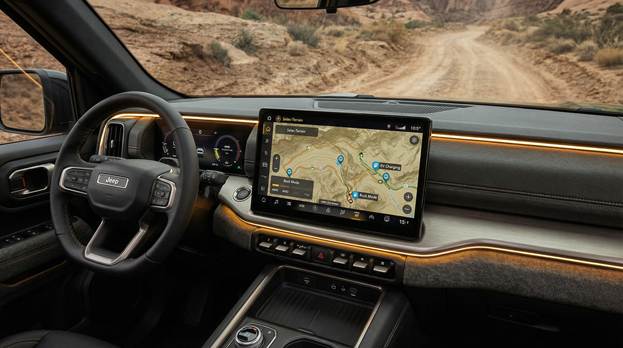
To succeed, the Recon needs to deliver real-world range that holds up under strain. The announced ~250-mile range is adequate for city driving, but off-roading drains batteries rapidly. Jeep’s decision to include "Trail Rated" charging infrastructure maps in the navigation system is a smart move, but the vehicle’s thermal management must be bulletproof. Rock crawling requires high power output at low speeds with little airflow, a scenario that can overheat lesser EV powertrains.
Furthermore, torque application must be precise. Electric motors provide instant torque, which is great for climbing, but can easily break traction on loose surfaces if not modulated correctly. The Recon’s software must be tuned to mimic the crawl ratios of a mechanical low-range transfer case.
The Competitive Landscape
The Recon is entering a segment that is about to get very crowded. Its primary rival is the Rivian R2, also slated for a 2026 release. The Rivian offers a cleaner, more futuristic aesthetic and likely better range, but it lacks the "brawler" image and the removable doors of the Jeep.
Then there is the looming threat of the Scout, Volkswagen’s revived off-road brand. The Scout Traveler SUV targets the exact same nostalgia-meets-future demographic as the Recon. And we cannot ignore the Ford Bronco, which, while currently hybrid/ICE focused, remains the Wrangler’s chief nemesis and will inevitably move toward full electrification.
The Recon has one massive advantage: the dealer network. While Rivian and Scout struggle with service centers and direct-to-consumer logistics, a Recon owner can get their vehicle serviced at any of the thousands of Jeep dealers across America.
Wrapping Up
The 2026 Jeep Recon is more than just a new model; it is a bridge to the future for a brand steeped in history. It attempts to marry the open-air freedom of the Wrangler with the inevitability of electrification.
If the Recon offers genuine capability without the "science project" feel of early EVs, it will secure Jeep’s dominance for another decade. If it fails—plagued by the same weight and pricing issues as the Dodge Daytona—it could force Stellantis into a frantic strategic retreat. For now, the Recon looks the part. The real test will come when the pavement ends and the battery percentage starts to drop.
Disclosure: Images rendered by Artlist.io
Rob Enderle is a technology analyst at Torque News who covers automotive technology and battery developments. You can learn more about Rob on Wikipedia and follow his articles on Forbes, X, and LinkedIn.
Set Torque News as Preferred Source on Google
Follow us today...