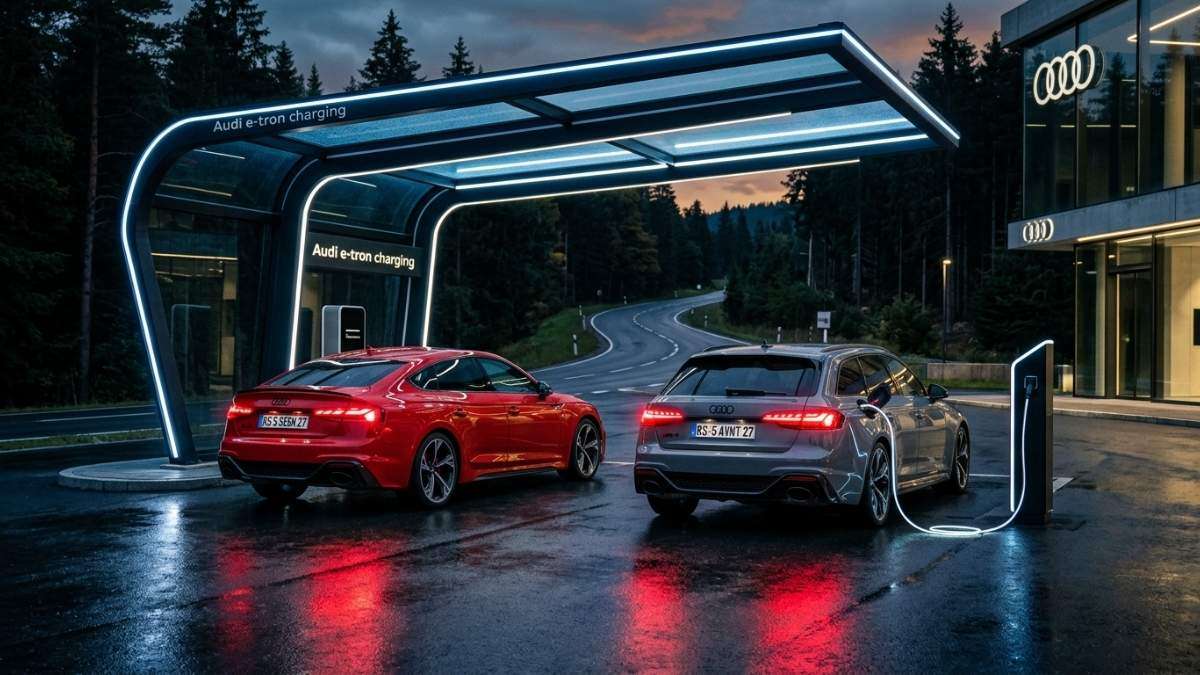

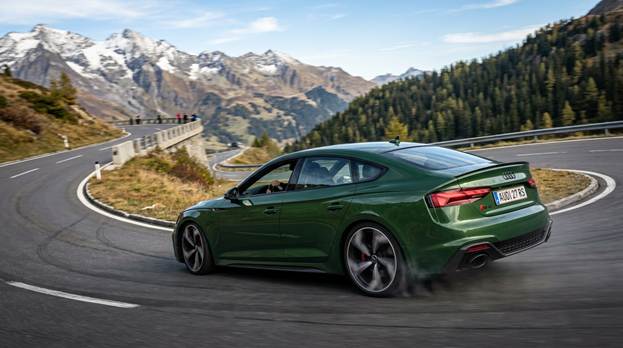
The landscape of performance sedans is undergoing a seismic shift. For decades, the "Four Rings" of Audi stood for a specific blend of understated elegance and all-wheel-drive dominance. Now, as the brand pivots toward a fully electric future, it has unveiled a bridge that is as technologically dense as it is controversial: the 2027 Audi RS 5.
By ditching the pure internal combustion setup for a high-output 630-hp plug-in hybrid (PHEV) system, Audi is attempting to satisfy both the environmental regulators in Brussels and the speed demons on the Autobahn. But in a world where battery technology is moving at light speed, is this hybrid bridge built on solid ground or sinking sand?
A Legacy of All-Wheel Drive Dominance
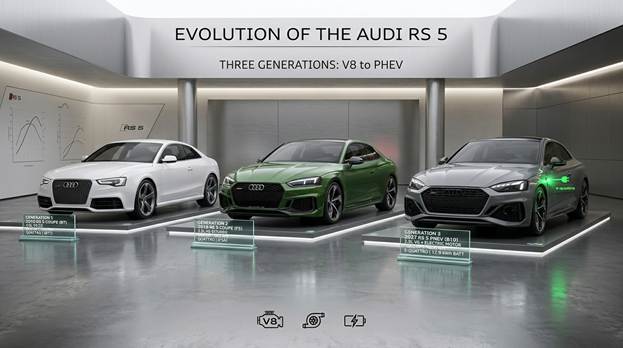
The RS 5 has always been the "thinking man’s" muscle car. Since its inception in 2010, it transitioned from the high-revving, naturally aspirated 4.2L V8—a motor that sang a mechanical opera—to the surgical 2.9L twin-turbo V6 found in the second generation. While enthusiasts initially missed the V8's soul, the V6 delivered the mid-range punch and tuning potential that kept the RS 5 competitive against the BMW M3 and Mercedes-AMG C63.
Historically, the RS 5 has succeeded by being the most "livable" of the German trio. Its Quattro system provided a safety net that rear-wheel-drive-biased competitors couldn't match in the wet. However, as the industry enters the 2027 model year, "livable" now includes the ability to crawl through zero-emission city zones silently.
The 630-HP Technical Marvel: How It Works
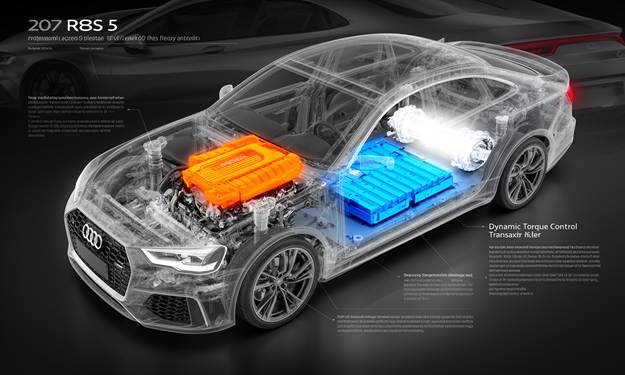
Underneath the wider, more aggressive "hatchback-style" sedan body lies a familiar friend: the 2.9-liter twin-turbo V6. However, it’s been heavily reworked with water-to-air intercoolers and higher injection pressures to produce 503 horsepower on its own. The real "magic"—or "mayhem," depending on your view of physics—comes from a 174-hp electric motor integrated into the eight-speed automatic transmission.
Combined, the system thumps out 630 hp and 609 lb-ft of torque. More impressive than the raw numbers is the Quattro with Dynamic Torque Control. This system uses a water-cooled electric actuator on the rear axle to shuffle torque between the wheels in just 15 milliseconds. As highlighted in this deep-dive technical review, the system is designed to kill traditional Audi understeer, literally "pushing" the car into the apex.
Is the Timing a Tech Gamble?
The 2027 launch window is curious. We are currently seeing a massive influx of Solid-State Battery breakthroughs and high-density cells that promise lighter, faster-charging EVs. By opting for a 25.9-kWh (22-kWh usable) lithium-ion pack, Audi has added over 1,300 pounds to the car compared to the outgoing model.
The 2027 RS 5 tips the scales at a staggering 5,192 pounds.
Critics argue that Audi is betting on a "transitional" technology that is already becoming a liability. While the 52-mile electric range is respectable, the weight penalty is the "elephant in the room." If battery energy density doubles by 2028, this RS 5 could quickly look like a heavy relic. However, for a market not yet ready to give up the roar of a V6, this PHEV setup offers a safety net that pure EVs like the Audi A6 e-tron cannot: infinite range for cross-continental sprints.
The Battle of the Titans: RS 5 vs. The World
How does it stack up against its arch-rivals? It is a game of "pick your poison":
- BMW M3: Currently the "lightweight" of the group (approx. 3,900 lbs), sticking to a pure straight-six. It’s more agile but lacks the RS 5's brute torque.
- Mercedes-AMG C63 S E Performance: The most direct rival. It uses a 2.0L four-cylinder hybrid. While the AMG has more peak power (671 hp), the Audi keeps its V6 soul, which may be the deciding factor for purists who find the Mercedes' four-pot "heart" a step too far.
Market Share and Future-Proofing
Audi’s strategy with the RS 5 is clear: defend the high-margin "RS" turf while the Premium Platform Electric (PPE) matures. By offering a car that can commute silently but still dominate a track day, Audi is casting a wide net. It appeals to the corporate executive in Munich who needs to enter "Green Zones" and the enthusiast in America who wants to embarrass supercars at stoplights.
Enhancing or Detracting from the RS Legacy?
The success of the RS 5 has always been its balance. This new iteration stretches that balance to the breaking point. On one hand, the 3.6-second 0-62 mph sprint and the trick rear diff make it the most capable RS 5 ever. On the other, the weight gain—which makes it heavier than a V8 Ford F-150—is antithetical to the "Sports" in "Sportback."
Wrapping Up
The 2027 Audi RS 5 is a polarizing masterpiece of engineering. It successfully bridges the gap by retaining a charismatic V6 engine while offering enough electric range to satisfy modern regulations. While the massive weight gain is a legitimate concern and the timing puts it at risk of being eclipsed by rapid battery advancements, the sheer level of chassis tech—specifically the electromechanical torque vectoring—suggests Audi hasn't forgotten how to make a heavy car dance. It is a high-stakes bet that "having it all" is better than going "all-in" on electric too soon.
Disclosure: Images rendered by Artlist.io
Rob Enderle is a technology analyst at Torque News who covers automotive technology and battery developments. You can learn more about Rob on Wikipedia and follow his articles on TechNewsWord, TGDaily, and TechSpective.
Set Torque News as Preferred Source on Google
Follow us today...