
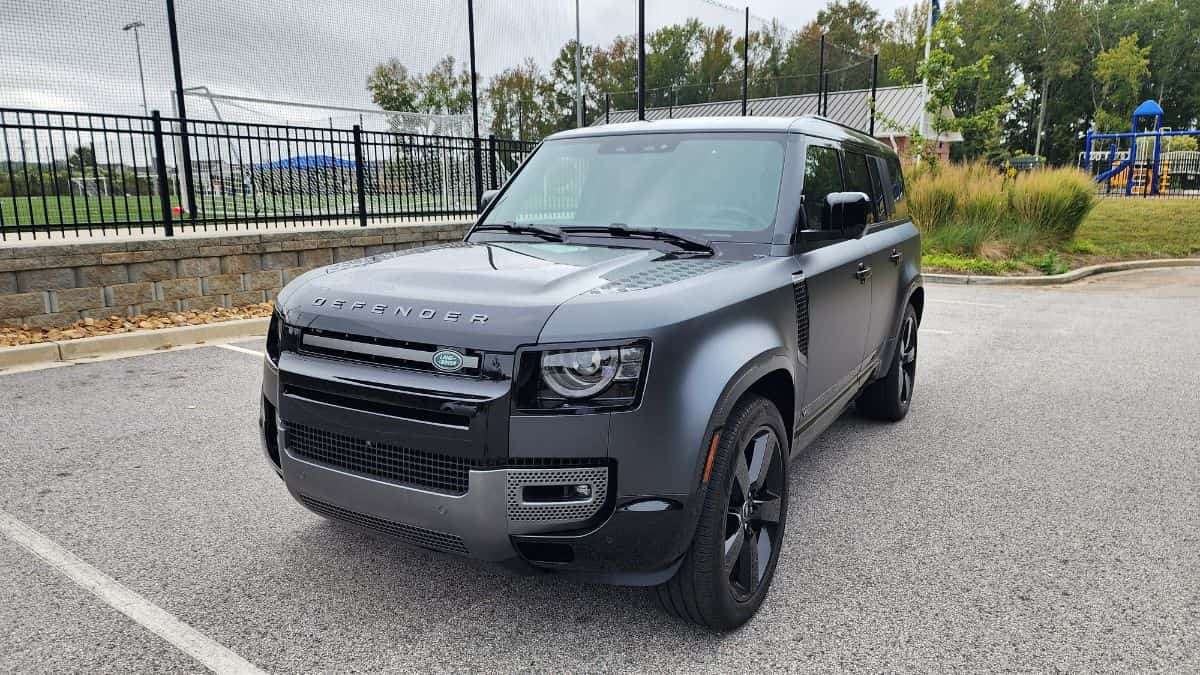

When the 2025 Land Rover Defender 130 V8 showed up in my driveway, the first assignment wasn’t glamorous or planned. I was asked to drive to Costco to pick up a mountain of pizzas for our church festival. It turned out to be a perfect real-world test for one of the largest, most capable SUVs I have driven all year. The pizzas stacked neatly behind the second row after I folded the third-row seats flat, and it instantly revealed one of the Defender 130’s hidden strengths, its everyday practicality beneath all the rugged British flair.
That first trip set the tone for my seven days with the Defender 130 V8. I would come to see that this isn’t a vehicle built merely to turn heads or crawl up rocks for social media clips. It is a genuine adventure SUV that combines the off-road legacy of Land Rover with the on-road comfort of a luxury tourer. If the American Suburban is our country’s symbol of spacious strength, the Defender 130 is its British counterpart, polished with an aristocratic edge but engineered with mud under its fingernails.
What’s New for 2025
The 2025 Defender lineup doesn’t reinvent its core formula but refines it. The Defender 130 continues as the longest variant, stretching more than 211 inches from bumper to bumper, offering seating for up to eight passengers. The major update for this year is the expanded availability of the supercharged V8 across trims, along with new interior materials and an upgraded infotainment interface that now feels quicker and more intuitive.
Land Rover has also added subtle enhancements to cabin insulation, giving the 130 a quieter highway ride, something I immediately noticed on my first freeway stretch. If you followed my earlier coverage of the 2024 Defender 130 Outbound review, a car built to explore and not commute, you’ll remember how it felt like a wild explorer. The 2025 model, in contrast, feels like a matured version of that spirit, with better sound damping and smoother throttle calibration.
Trims and Prices
For 2025, the Land Rover Defender lineup offers a wide range of trims and prices, reflecting its versatile character as both a rugged adventure SUV and a premium luxury vehicle. The base Defender S starts at $58,750, while the 110 S costs $62,425. Stepping up to the X-Dynamic SE trim brings more refined materials and features at $70,350, with the 130 S variant priced at $71,325. Many buyers will likely gravitate toward the 110 X-Dynamic SE, which Land Rover itself recommends, starting at $73,725. The larger 130 X-Dynamic SE pushes the price to $83,025. For those seeking something distinctive, the Sedona Red Edition is priced at $85,350, followed by the adventurous Outbound model at $87,350. The Defender X trim begins at $93,650, while the longer 130 X reaches $102,525. Moving into the high-performance realm, the V8 models start at $111,650 for the standard Defender, $115,125 for the 110 V8, and $120,525 for the 130 V8. At the top of the range sits the all-new Defender OCTA, starting at $153,850, with the ultra-exclusive OCTA Edition One commanding $169,650. This pricing structure clearly separates the Defender into three worlds: the capable and affordable base models, the luxurious mid-trims, and the powerful V8 and OCTA performance flagships, giving buyers a Defender for nearly every purpose and budget.
Exterior Design Of The 2025 Defender Is Like Heritage That Commands Attention
The Defender 130 V8 carries that unmistakable silhouette, square, upright, and proud. It is instantly recognizable as a Defender, from its short front overhang to its elongated rear section that houses the third row. What makes it more intriguing in person is how its proportions seem to balance utility and style. The extra length could have made it look ungainly, but Land Rover’s designers have cleverly managed to keep it cohesive. The extended roofline, raised beltline, and signature floating roof effect make the 130 look muscular rather than bloated.
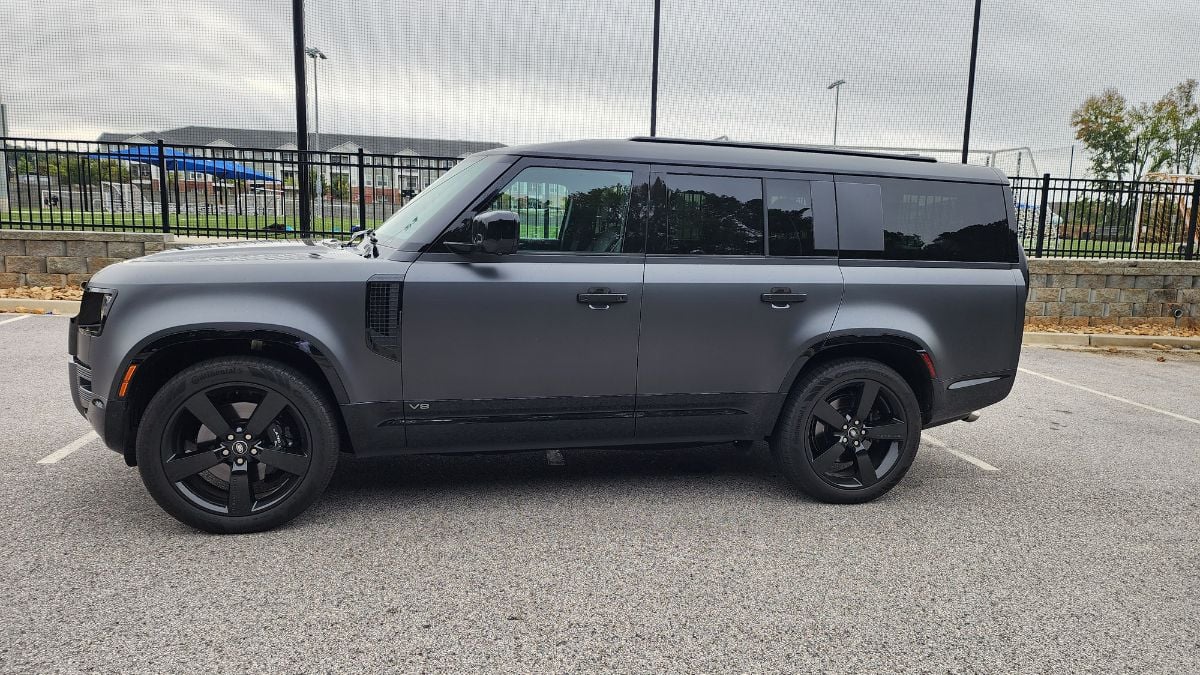
The V8 trim adds a few subtle cues, like quad exhaust tips, black contrast elements, and unique badging that quietly remind you this is the top dog. The 22-inch wheels wrapped in all-season rubber give it presence, but what stands out more is the stance, tall, confident, and commanding. It doesn’t try too hard, yet you know it means business.
Interior: Utility Meets Comfort
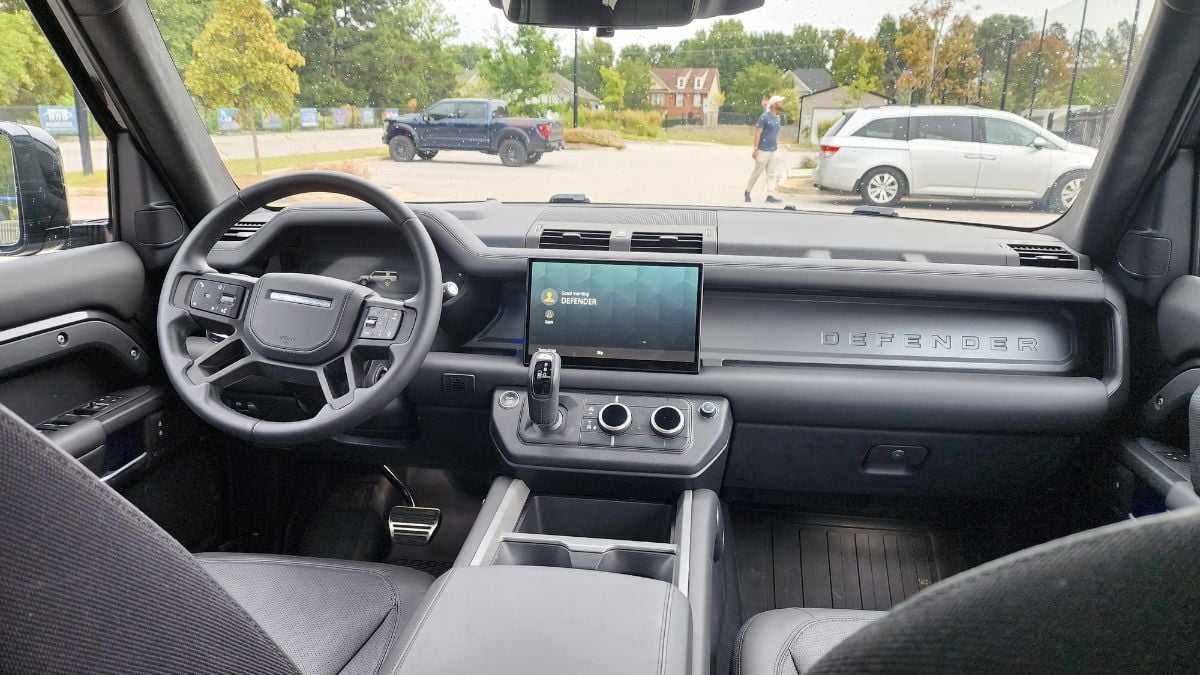
Inside, the Defender 130’s cabin manages to be both utilitarian and refined. It’s not dripping in chrome or delicate piano black finishes, and that’s a good thing. Instead, you get durable materials, rubberized textures, and soft leathers that make sense for an SUV that might actually go off-road. The design is clean, almost architectural, with exposed fasteners reminding you that this cabin was built with purpose.
Seating comfort is superb. The front seats are wide, supportive, and heated and ventilated, and visibility is commanding. The driving position is upright, and everything feels substantial, from the steering wheel to the door handles. My test model had a mix of Ebony Windsor leather and Resist upholstery, a synthetic material that feels rugged yet premium. Compared to what I saw last year in the Defender 110 X-Dynamic SE, a rugged and ready utility vehicle, the 130 V8 takes refinement a notch higher without losing that functional soul.
Infotainment and Tech
Land Rover’s latest Pivi Pro infotainment system runs on an 11.4-inch curved display that sits prominently at the center of the dashboard. The interface is straightforward and snappy, with crisp graphics and responsive touch controls. I appreciated how it quickly adapted to wireless Apple CarPlay and Android Auto. The screen also displays off-road information, including suspension height, differential lock status, and pitch and roll angles.
The Meridian surround sound system fills the cabin with rich audio. Whether you’re listening to a podcast or a live concert recording, it brings out depth and clarity. Even at low volume, the system sounded balanced and clean, which is something not every SUV in this segment can claim.
Second-Row Comfort
The second row of the Defender 130 is where the SUV truly shines. The seats recline slightly and slide forward or back to balance space between rows. There’s ample legroom, even for tall passengers, and the wide door openings make ingress and egress easy. Climate controls, USB ports, and seat heating make it an inviting place to spend time.
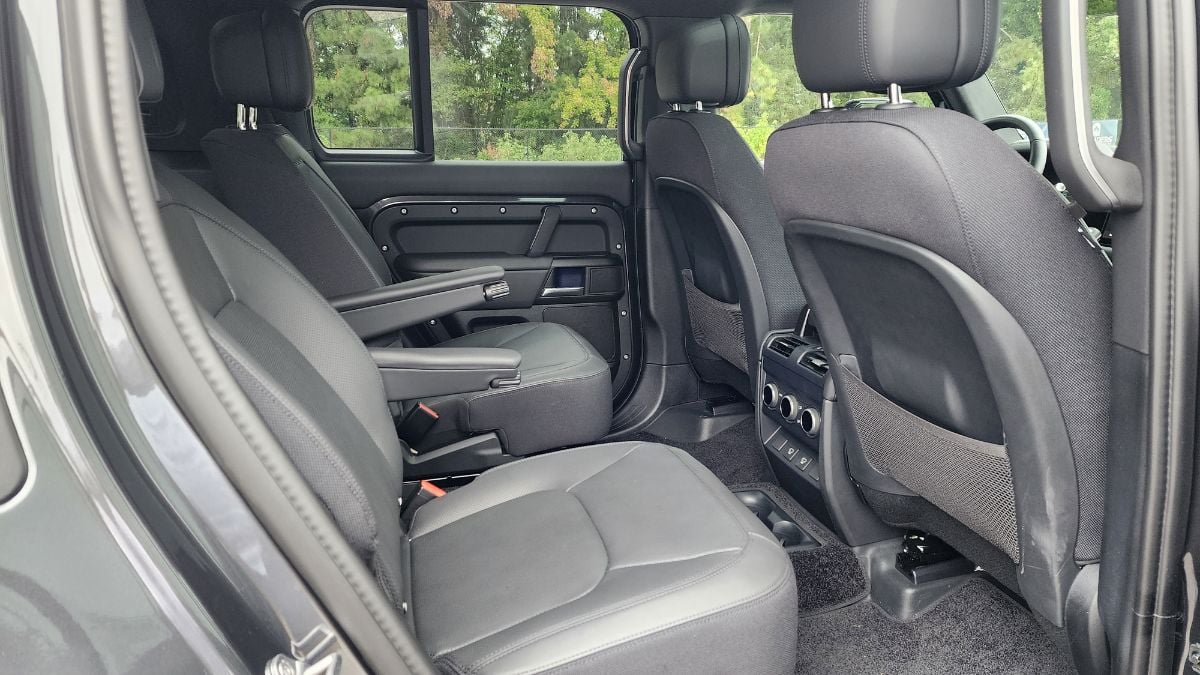
When I carried several volunteers from our church later in the week, everyone commented on how quiet and composed the ride felt, even on rough patches of road. It reminded me of my impressions when testing the Lexus GX 550, one of the best-looking SUVs on the market and exceptionally smooth to drive. The Defender 130 isn’t quite as plush as that Lexus, but it achieves a balance of durability and comfort that suits its adventurous personality.
Third-Row Usability and Cargo Space
The third row is more than a marketing checkbox. Adults can actually sit there, though it’s best suited for medium-height passengers or teenagers on longer trips. Access is easy thanks to the sliding second row. With all rows up, cargo space is decent, enough for a few grocery bags or small luggage.
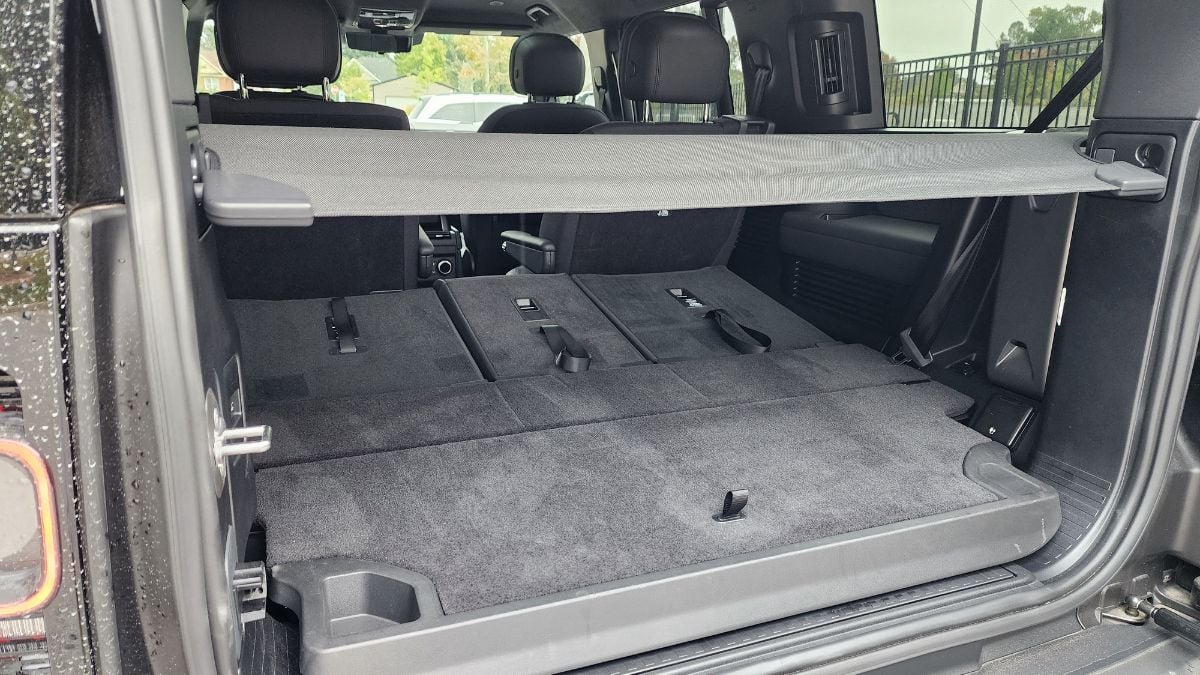
Fold the third row, and the Defender 130 transforms into a cargo-hauling champion.
That Costco pizza run put this space to the test. With the third row folded, I had a flat loading area and room for stacks of pizza boxes, soda crates, and supplies. The air suspension’s height adjustment made loading easy. When you lower the rear, it sits at a comfortable height, perfect for bulky items.
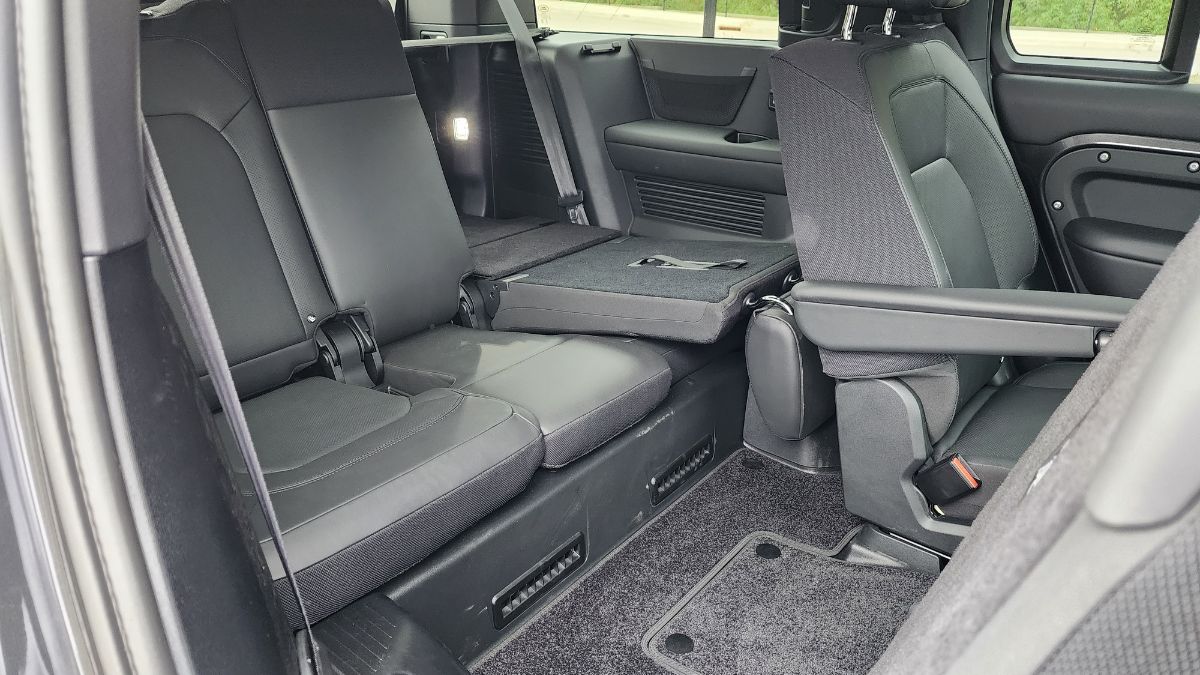
If you’re considering a family vehicle with real flexibility, the Defender 130 makes a strong argument. Compared to vehicles like the Jeep Wrangler 4xe, which some find overpriced for its limited practicality, as I discussed in this analysis of the $73,000 Wrangler Willys 4xe with cloth seats, the Defender 130 feels worth its price in usability alone.
Engine and Transmission
Under the hood lies a 5.0-liter supercharged V8 producing 493 horsepower and 461 lb-ft of torque, paired with an eight-speed automatic transmission. It’s the same engine found in the Defender 90 and 110 V8 trims, and it gives this big SUV a surprisingly brisk personality. Despite weighing over three tons, it can sprint to sixty in around 5.4 seconds. The sound is addictive, a deep, refined growl that feels both civilized and muscular.
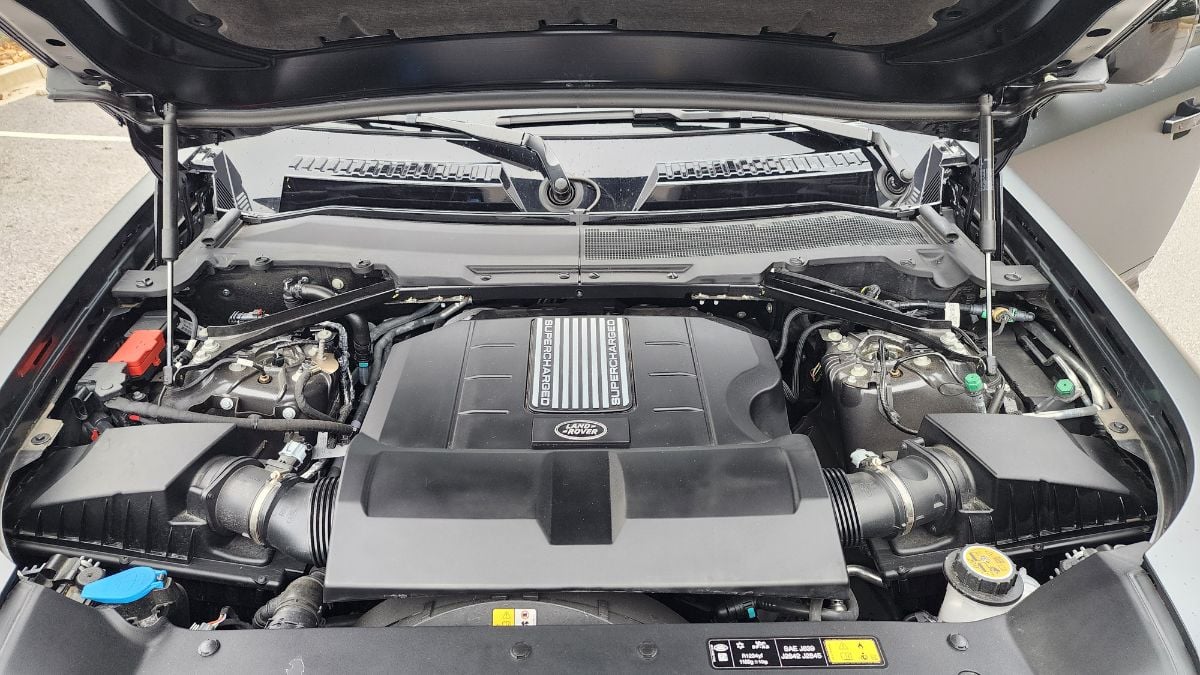
The transmission deserves praise for its smoothness. Gear changes are seamless, and the torque converter knows when to hold or shift based on throttle input. It feels well-tuned for everyday driving, responsive but never jerky. Of course, this performance comes with a price at the pump. Expect to average around 15 miles per gallon in mixed driving, maybe less if you use that V8 often, but you knew that before you started reading this far, didn’t you?
Driving and Handling: A Two-Sided Personality
On the road, the Defender 130 V8 feels like two vehicles in one. In town, it is calm, composed, and surprisingly easy to maneuver for its size thanks to light steering and excellent visibility. The air suspension soaks up potholes and speed bumps gracefully. On the highway, it glides quietly with only a gentle hum from the tires.
Push it on a winding backroad, and the Defender 130 reminds you it’s no sports car, but the body control is commendable for such a tall vehicle. The steering is precise enough, and the V8’s torque makes overtaking effortless. When you leave the pavement, the transformation is remarkable. Engage the Terrain Response system, and it becomes a mountain goat in a tailored suit. It climbs, wades, and descends with absolute confidence.
During my mild off-road tests on a gravel access trail, it breezed through ruts and inclines that would make many crossovers hesitate. I raised the suspension, selected the mud and ruts mode, and the Defender walked through obstacles like it was built for them, because it was.
People who can afford to buy this SUV probably don't worry about the gas mileage, but I thought I would mention it anyway. The 2025 Defender 130 V8 gets 16 MPG combined and 14/19 city/highway, respectively.
Land Rover Defender vs. Toyota Land Cruiser: Which Is the Better Modern Adventure SUV?
As the 2025 Toyota Land Cruiser makes its comeback, shoppers are naturally comparing it to the Defender. Both SUVs have legendary off-road pedigrees, yet they take distinctly different paths to modernize that legacy. The Land Cruiser now embraces a turbocharged hybrid four-cylinder powertrain, prioritizing efficiency and reliability, while the Defender still offers multiple engine choices, including a robust inline-six mild hybrid and the brawny supercharged V8. Inside, the Defender feels more upscale and adventurous, while the Land Cruiser’s interior leans toward rugged simplicity. The difference lies in the attitude: the Defender is an explorer dressed in fine leather, the Land Cruiser a minimalist expedition tool built to last decades.
From a buyer’s standpoint, the choice often comes down to lifestyle. If you plan to explore remote trails and want a vehicle that doubles as a statement piece in the city, the Defender delivers that luxury-off-road balance. If your goal is long-term dependability with a smaller environmental footprint, the new Land Cruiser’s hybrid system makes a compelling case. According to MotorTrend and Car and Driver early drives, the Defender still feels more composed and engaging on the highway, while the Land Cruiser retains the edge in durability and long-term ownership costs. The good news for buyers is that this competition is pushing both brands to perfect the formula for the modern adventure SUV.
How Reliable Is the 2025 Land Rover Defender Compared to Previous Years?
Reliability has historically been the Defender’s Achilles heel, and many potential buyers still hesitate over whether the 2025 model finally turns the page. Land Rover has made clear strides over the past few years, particularly by simplifying certain electronic systems and improving the build quality at its Nitra, Slovakia plant. Reports from owners of 2022–2024 models on Defender forums suggest fewer mechanical issues but continued sporadic complaints about infotainment glitches and minor electrical faults. These are not uncommon in premium SUVs loaded with tech, but it’s something buyers should still keep in mind.
According to J.D. Power’s Vehicle Dependability Study and anecdotal data from Consumer Reports, Land Rover continues to trail Japanese brands in overall reliability but has shown incremental improvements year over year. The Defender benefits from Land Rover’s new warranty support and over-the-air updates, which can resolve many system bugs remotely. In short, the 2025 Defender is more reliable than its predecessors, but still not trouble-free. Buyers who prioritize worry-free ownership might consider an extended warranty or Certified Pre-Owned coverage, especially if they plan to keep the SUV beyond its factory warranty period.
The Future of Electrification: What Comes After the 2025 Land Rover Defender?
With electrification spreading across every corner of the SUV market, the logical question for Defender fans is what comes next. Land Rover has already confirmed plans for an all-electric Defender, likely arriving in 2027 as part of its broader transition toward a zero-emissions lineup under the “Reimagine” strategy. According to Autocar and Top Gear UK, the EV Defender will ride on the MLA platform shared with upcoming Range Rover models, offering both dual- and tri-motor configurations with serious off-road torque. Expect roughly 300 miles of range and the same boxy, heritage-inspired look that defines today’s Defender.
This shift toward electrification will not just redefine performance, but also the brand’s identity. The electric Defender is expected to maintain its off-road prowess through advanced torque vectoring and adjustable ride height, while using recycled materials and more efficient packaging to meet sustainability goals. For many buyers, the move could make the Defender more appealing—quiet, powerful, and emission-free—while still capable of climbing muddy trails. Until then, the 2025 Defender stands as the last fully internal-combustion model before that major turning point, offering traditionalists one final chance to enjoy Land Rover’s off-road power before the electric era begins.
Why The Defender 130 V8 Matters At All
The 2025 Land Rover Defender 130 V8 matters because it bridges two worlds, luxury and utility, in a way few SUVs can. It is unapologetically big, unmistakably British, and uncommonly capable. It’s a family hauler that can tackle the same trails as a purpose-built off-roader, and it does so while keeping everyone comfortable and entertained.
Land Rover has faced its share of criticism for reliability in the past, and I’ll admit, that reputation lingers. But after a week with this machine, it’s clear the Defender 130 V8 represents the brand’s best foot forward, a serious piece of engineering that feels both modern and soulful.
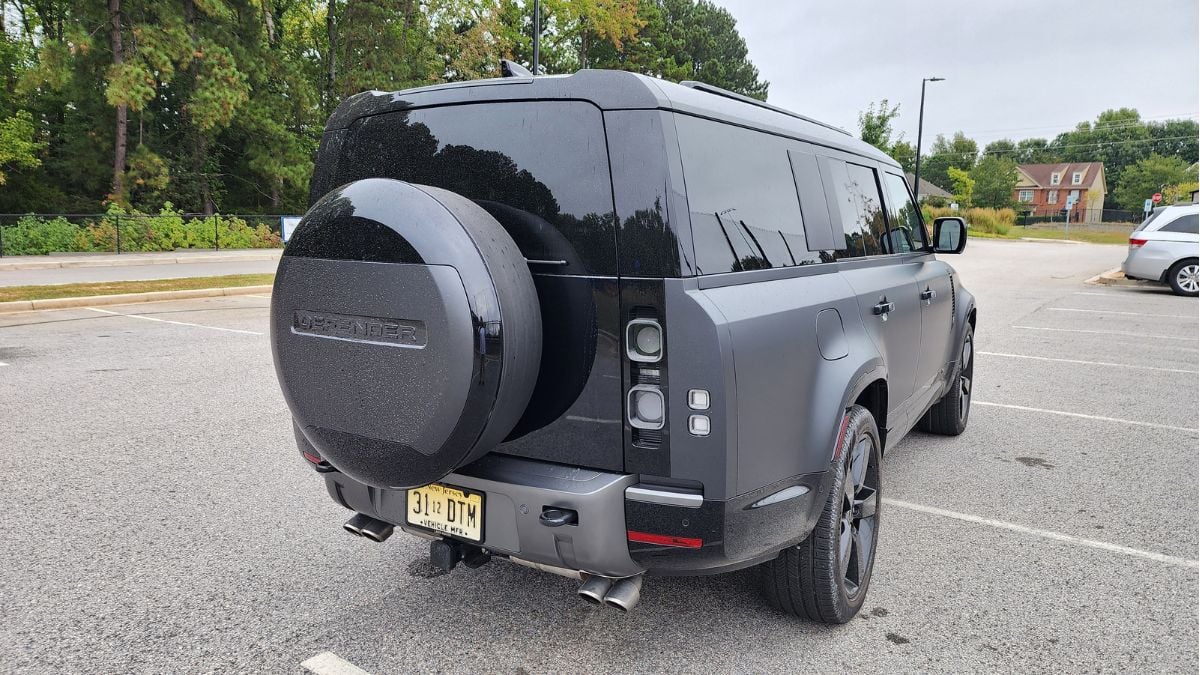
As I parked it one last time before handing back the keys, I realized something. The Defender 130 V8 is not about efficiency or subtlety. It’s about capability, character, and presence. It’s a British interpretation of what Americans have long loved in their big SUVs, with a sense of adventure that feels authentic rather than performative.
Now I want to hear from you. Would you choose the Defender 130 V8 over a traditional American SUV like the Chevy Suburban or GMC Yukon? Or would you rather go for a plug-in hybrid like the Jeep Wrangler 4xe for better efficiency? Share your thoughts and tell us what matters most to you, capability, comfort, or economy, in the comments below.
Armen Hareyan is the founder and Editor-in-Chief of Torque News. He founded TorqueNews.com in 2010, which since then has been publishing expert news and analysis about the automotive industry. He can be reached at Torque News Twitter, Linkedin, and Youtube. He has more than a decade of expertise in the automotive industry with a special interest in Tesla and electric vehicles.
Images by Armen Hareyan.
Set Torque News as Preferred Source on Google
Follow us today...






Comments
This P-O-S doesn't even…
Permalink
This P-O-S doesn't even deserve to clean the Suburban's jock strap.
This will not replace a…
Permalink
This will not replace a Suburban. But they are different animals. Having owned and loved my Suburban the 130 is a different beast. I think of it more in the X configuration as a more capable off roader ,pulling an Airstream base camp X into to more remote locations than what the big gm iron would find challenging.