

CATL's founder just told the world that the US EV market is essentially dead on arrival without his company's batteries — and honestly, it made headlines for a reason, because right now, today, he's not entirely wrong. But here's the thing about "right now": it isn't forever. When I posted about CATL founder Robin Zeng's bold claim on LinkedIn this week, I wasn't expecting a former systems engineer from the Cal Tech Jet Propulsion Laboratory - the people who land rovers on Mars - to walk into the comments and quietly drop what may be the most important EV battery response of 2026. If you care about whether American automakers can ever stop genuflecting to Chinese battery supply chains, and if you've been wondering what the EV market dropping back to 2022 levels in the US actually means for the future, you need to read what this engineer said, because the broader global EV landscape where China controls 70% of EV production is not a fixed picture, and GM is quietly working to change it.
What CATL's Robin Zeng Actually Said, And Why It Got Attention
Let's set the stage. In an interview with The Wall Street Journal, Robin Zeng, who is China's fourth richest man and founder of CATL, said the American EV market is essentially doomed without his company. While both the Biden and Trump administrations have imposed prohibitive tariffs on Chinese-made EVs and batteries, treating CATL as a national security threat, Zeng is confident the tide will turn. He expects the US EV market to remain small "for several years. But after that, it'll have to be booming, because it is the trend. It is the future," and building that future without CATL, he said, would be both "difficult" and carry costs that are "too high."
Now, I posted about this on LinkedIn. And I made the point that while CATL's leverage is real, it isn't one-way. As of early 2026, China accounts for roughly 61% of the total global EV fleet, and over half of all new cars sold in the country are electric or plug-in hybrids. China needs large, wealthy customer bases to absorb its manufacturing capacity. Without the American market, the math gets much harder for Chinese EV makers and their battery suppliers. This is mutual dependence, not a one-way street: even if Zeng would rather not frame it that way.
The JPL Engineer Who Stopped the Narrative Cold
That's when David Rossing, a former systems engineer at the Cal Tech Jet Propulsion Laboratory, replied in my LinkedIn comments. And I'm going to quote him in full, because he deserves it:
"GM's LMR (lithium manganese rich) battery uses far less expensive cobalt and lithium than its predecessors and is going through testing of production-equivalent units at the moment to verify production units work as well as the prototypes. If so there will be a significant reduction in cost over the prior generation battery, fit in the same pack as the Ultium cells, keep the same range (400 mi per charge on my EV) and (I think) charge at high rates. So, sure, hubris China all you want but things aren't completely static on this side of the pond."
There it is. A man who's spent his career doing precision engineering calmly telling the world: GM is working on it, and it's further along than you think. The phrase "things aren't completely static on this side of the pond" is the kind of understatement that only people who actually know things say. And it's the exact counter-narrative that the media cycle keeps missing.
The Pressing Problem: Why Battery Cost Is the Real Enemy of American EV Adoption
Before we get into what GM's LMR battery actually is and why it matters, let's talk about the real problem that sits underneath this entire debate because it affects you directly if you've been thinking about buying an EV.
Battery cost is the single biggest reason electric vehicles remain out of reach for most American families. According to BloombergNEF, lithium-ion battery pack prices dropped to a record low of $108 per kilowatt-hour in 2025, an eight percent decline year-over-year. CATL's LFP packs averaged an even lower $81 per kilowatt-hour. Those prices reflect the Chinese supply chain's massive scale advantage. American automakers either swallow steep tariffs to access those cells, or they pay more for domestic alternatives that aren't yet at the volumes needed to compete on price.
The result is visible in real-time sales data. Battery-electric vehicle deliveries remain deeply depressed in America. With the US now in its fifth month since federal EV subsidies ended on September 30, 2025, any hangover effect of the "pull-forward" into Q3 should be long over. What we're now seeing is the considerably smaller market potential for EVs without massive price supports. That's not a China problem, but rather a battery cost problem, and it's the same problem GM's LMR chemistry is specifically designed to solve. This is why our writers have been tracking what happens when EV market share drops toward 5% in the US and what it would take to reverse the trend. The answer almost always comes back to price, and price comes back to batteries.
The solution is not more tariffs. Tariffs are a wall, not a factory. The solution is American-engineered batteries that are cheap enough to make EVs affordable without a government subsidy propping them up. That's exactly what LMR chemistry is chasing.
What GM's LMR Battery Is, And Why It's Different From What China Is Doing
Let me break this down in plain English, because the chemistry matters.
GM's LMR battery (lithium manganese-rich) uses an approach that aims to address the shortcomings of current batteries. The key feature is that it promises a significant increase in energy density compared to traditional graphite anode setups, meaning more miles in the same-sized battery pack, or a smaller, lighter pack with comparable range. More critically, manganese is dramatically cheaper and more abundant than cobalt or nickel. That's the fundamental cost lever: swap out expensive materials for abundant ones, without sacrificing the performance numbers that American truck and SUV buyers actually care about.
GM has been shifting to a more tailored mix of chemistries, including LFP and different cell formats, for cost and model-specific design. The flexible architecture and Ultium Cells LLC joint venture will continue under GM's broader EV strategy, even as the "Ultium" public-facing branding is phased out. This is important context: GM isn't abandoning its battery ecosystem; it's evolving it. The LMR cells that Rossing described are designed to fit inside the same pack architecture as existing Ultium cells, meaning GM doesn't have to rebuild its entire manufacturing setup from scratch when LMR goes to production.
And the target specs Rossing mentioned - 400 miles of range per charge, high-rate charging, in the same physical pack - are not pipe dreams. GM's Ultium battery platform was engineered with ranges from 50 to 200 kWh, which could already allow up to 400 miles of range in certain configurations, along with Level 2 and DC fast charging capability. GM Authority LMR is designed to hit those same numbers at meaningfully lower material cost.
This is also not something that exists only on a whiteboard. As Rossing pointed out, GM is currently running production-equivalent units through testing. That's a very specific engineering term. It doesn't mean lab prototypes. It means units built the way they would be built on a production line, being validated against production-level specs. That's a late-stage milestone. It's the step that happens right before you start talking about launch timelines.
Autoblog, which has been covering the CATL story closely, reported that GM is importing CATL-sourced LFP battery cells from China for the new Chevy Bolt under a temporary arrangement designed to maintain a low purchase price for its entry-level EV before it shifts to domestic LFP cell production. Doing so while paying a 60% tariff, even as its two billion-dollar US battery plants sit idle. That's the uncomfortable short-term reality. But the keyword is temporary. LMR is the exit strategy from that arrangement. The moment GM can produce competitive cells domestically at competitive cost.
Why CATL's Confidence Has a Shelf Life
Let's give credit where it's due. CATL's batteries power roughly one in every three EVs globally. The company posted more than $10 billion in profit last year, even without a meaningful presence in the US market. And it has also developed fast-charging batteries capable of delivering up to 320 miles of range in just five minutes. That's a legitimate technological edge, and nobody who's paying attention is dismissing it.
But confidence is not the same as permanence. Robin Zeng himself is telling you the window is finite. Zeng said that things may change come 2028, the last full year of Donald Trump's second term, "because business relationships are always stronger and longer-lasting than politicians." In other words, he's giving America roughly two years in his own timeline. Two years in battery development is not a small gap to close, but it's also not an infinite one.
We've covered before how CATL's own chief has been candid about the limits of solid-state battery commercialization, saying it remains years away, even for a company with CATL's resources. Meanwhile, the sodium-ion batteries CATL is now scaling up to challenge the LFP segment represent a real competitive move in the budget EV space. But GM's LMR isn't targeting budget city cars. Instead, it's targeting the highest-volume, highest-margin segment in the American market: full-size trucks and SUVs. That's where LMR chemistry is designed to win.
CATL's edge comes from its cheaper iron-based LFP batteries, a chemistry that was actually invented in the US but commercialized in China, along with electrochemistry expertise that Zeng argues can't be found in the US. Zeng has said batteries are considered "a very stupid industry in the US," where people "all go to chips, software, AI" because they "get a lot of money." That's a pointed observation. But David Rossing is a counterexample: a precision engineer who clearly followed the battery chemistry and knows exactly what GM is building. And he's not alone.
What GM's Supply Chain Investments Tell You About Their Confidence
Here's something worth knowing as you evaluate whether LMR is real or just a press release: GM has been putting its money where its mouth is on battery raw materials for years. GM invested $650 million in Lithium Americas' Thacker Pass mine in Nevada, reportedly the largest known source of lithium in the United States and the third largest in the world, with production projected to begin in the second half of 2026. GM has the rights to the first phase of production and first refusal on Phase 2. Ford Authority
A company that doesn't believe in its own domestic battery future doesn't write a $650 million check for a domestic lithium mine. And GM's commitment to securing battery materials for up to one million EVs annually in North America is the infrastructure logic behind why LMR can eventually be manufactured at scale domestically rather than imported at a tariff penalty.
Cobalt will come from mines in Australia for use in GM's current Ultium battery cathodes, powering vehicles like the Chevrolet Silverado EV and Cadillac LYRIQ. GM's VP of Global Purchasing and Supply Chain noted the company is focused on sourcing critical raw materials in a secure and sustainable manner. LMR dramatically reduces the cobalt requirement in future chemistry, which means GM is simultaneously building the supply chain for today's batteries while developing chemistry that relies less on the raw materials it just locked up. That's real strategic layering.
What Smart EV Shoppers Should Actually Do With This Information
So what does all of this mean for you if you're thinking about buying an EV in the next year or two?
First, don't let the geopolitical noise between Zeng's claims and GM's counter-strategy paralyze your decision. The technology available right now, even the models currently using CATL-sourced cells is far better than what existed three years ago. EV battery costs have dropped over 90% since 2008, and they are still dropping, driven by both Chinese scale and American innovation.
Second, if you're on the fence and your current vehicle is running well, w,aiting until 2028 is a very reasonable strategy. By then, GM's LMR battery should be in production, the Chevy Bolt with its new LFP architecture will be well-established as an affordable option, and the broader GM Ultium platform evolution across the Silverado EV, Blazer EV, and Equinox EV lineup will have matured through its first generation of real-world ownership data.
Third, if you need something now and the price is right, buy with confidence. The CATL LFP and similar chemistries that power today's affordable EVs are proven, durable, and improving. The supply-chain politics don't change how well the battery works in your driveway.
The Moral of the Whole Story
I want to leave you with something that goes beyond cars and batteries, because I think there's a genuinely useful lesson here for how we make decisions: in the market, in business, and in life.
Robin Zeng is a brilliant man who has built one of the most consequential companies on Earth. His confidence is earned. But earned confidence has a way of sliding into hubris when it stops accounting for what the other side is doing while you're celebrating. The history of technology is full of leaders who confused today's dominance with tomorrow's guarantee. Take Kodak in film, Nokia in mobile phones, Blockbuster in home entertainment. Each of them was correct about the present tense and catastrophically wrong about the future.
David Rossing wasn't arguing with China's current lead. He was pointing at a laboratory in Michigan and saying: look closer. The people who change industries are rarely the loudest voices in the room. They're usually the ones heads-down in the work, testing production-equivalent units, running the numbers, and letting the results do the talking.
That's the disposition worth cultivating whether you're managing a battery program, building a business, or deciding whether to buy an EV right now. Don't mistake someone else's confidence for your own inevitable defeat. And don't mistake your current advantage for a permanent one. The pond on this side is not as still as it looks.
Two questions for you, and I really do want to hear your answers in the comments below: If GM's LMR battery delivers the promised 400-mile range at a significantly lower price than today's batteries, would that finally push you toward buying an American-made electric truck or SUV? And for those of you already driving a GM EV - does knowing that the next battery generation is in production-equivalent testing right now change how you feel about your current vehicle, or does it make you want to wait?
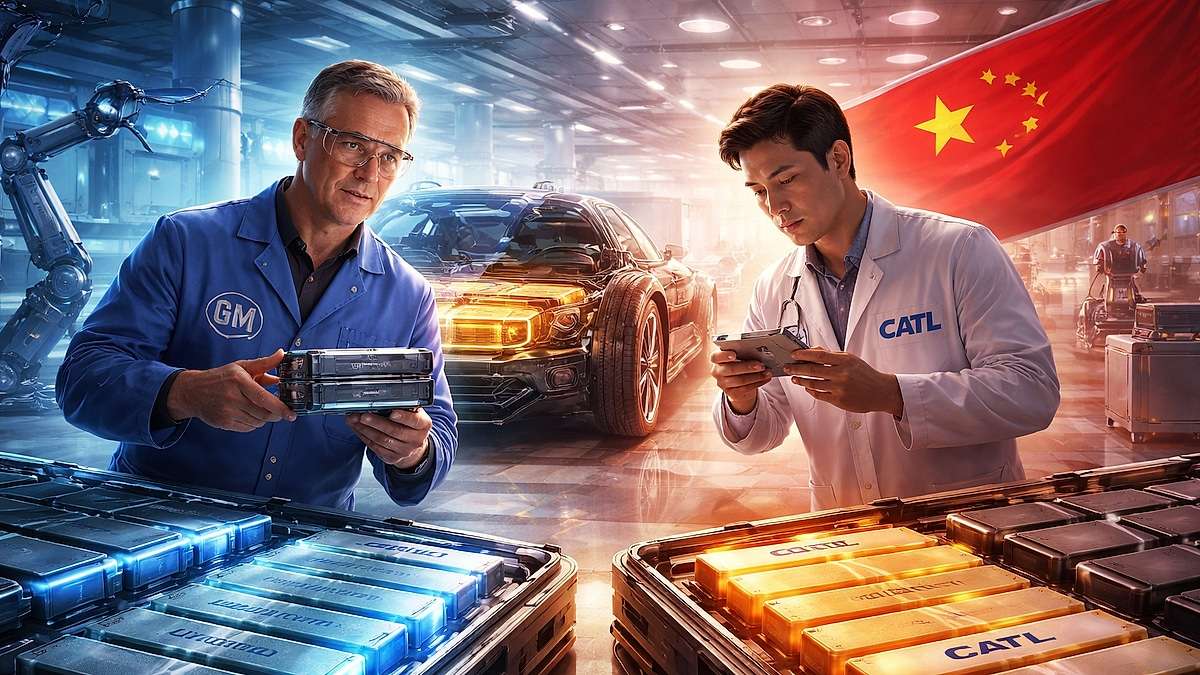
The image for this story is as sited by AI displaying GM and CATL battery engineers working on an EV Battery.
About The Author
Armen Hareyan is the founder and Editor-in-Chief of Torque News and an automotive journalist with over 15 years of experience writing car reviews and industry news. Now based in the Charlotte region (Indian Land, SC, he founded Torque News in 2010, which since then has been publishing expert news and analysis about the automotive industry. He can be reached at Torque News on X, Linkedin, Facebook, and Youtube. Armen holds three Masters Degrees, including an MBA, and has become one of the known voices in the industry, specializing in the landscape of electric vehicles and real-world stories of actual car owners. Armen focuses on providing readers with transparent, data-backed analysis bridging the gap of complex engineering and car buyer practicality. Armen frequently participates in automotive events throughout the United States, national and local car reveals and personally test-drives new vehicles every week. Armen has also been published as an automotive expert in publications like the Transit Tomorrow, discussing how will autonomous vehicles reshape the supply chain, and emerging technologies in vehicle maintenance.
Set Torque News as Preferred Source on Google
Follow us today...






Comments
Excellent article! I hope…
Permalink
Excellent article! I hope GM can steal a march in this contest! Aside: I also hope GM will reverse its CarPlay/AA decision so I can consider a GM replacement for my’23 Bolt down the road.
I truly hope GM can make…
Permalink
I truly hope GM can make this leap reality! The US needs an edge like this to be competitive.
Well written & interesting article.
2025, GM and Ultium made…
Permalink
2025, GM and Ultium made further adjustments, including temporary idling/pauses at battery plants, layoffs (hundreds to thousands across EV and battery operations), and retooling some facilities for battery energy storage systems rather than solely vehicle batteries. A separate GM-Samsung battery project in Indiana also saw construction slowdowns and layoffs.
We have all the tech we need…
Permalink
We have all the tech we need and now that there is serious market potential the battery technology will evolve... Most people don't know it take about 30 years to bring exotic technology to scalable market or shrink down to die form. (To which integrated circuits are made).
American battery…
Permalink
American battery manufacturers have already tested batteries with 600 mile range.