

One of the biggest car debates of late is between the Nissan Z and Toyota GR Supra. They are both some of the best Japanese sports cars you can currently buy, but they go in completely different ways when it comes to delivering performance. The Nissan uses an old (but proven) chassis, dating back to the 350Z, while the GR Supra is essentially a BMW Z4 with a few tweaks done by Toyota’s engineers.
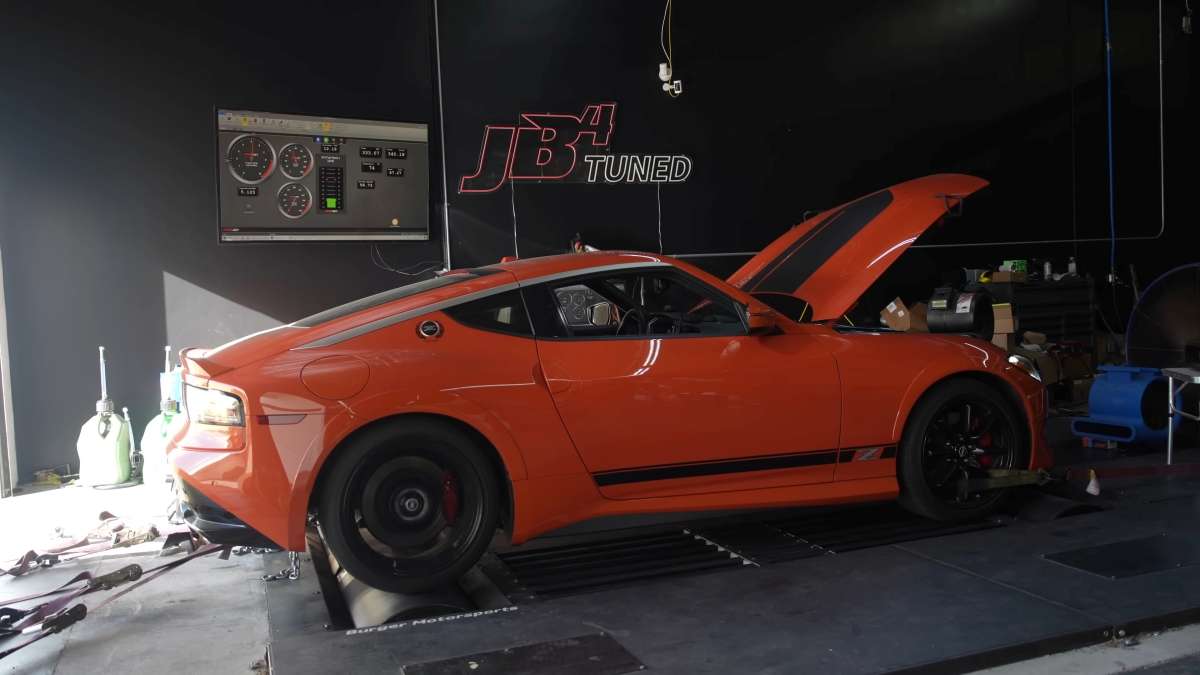
Burger Motorsports frequently uploads dyno runs on their YouTube channels, and they recently had the opportunity to put a Nissan Z Heritage Edition on the dyno for some before-and-after action. Stock numbers are already impressive. The VR30DDTT makes 400 horsepower and 350 pound-feet out of the box. The NISMO Z bumps those figures to 420 horsepower and 383 pound-feet, while the Heritage Edition retains the power output of the regular Z.
The baseline dyno run shows interesting results.
It is worth noting that the Nissan Z is equipped with the six-speed manual transmission and runs on 91-octane fuel. The first run shows 347 horsepower and 351 pound-feet to the rear wheels. Mechanical loss for an FR platform is typically between 12 and 20 percent. The “guesstimator” shows that the dyno numbers translate to 406 horsepower at the crankshaft.
As for the torque, the 351 pound-feet wheel torque is already more than the advertised torque at the flywheel/crankshaft. If the dyno run was done in the gear that has a 1:1 ratio (which is how dyno runs are typically done), the actual torque is around 410 pound-feet - 60 more than the advertised figure at the flywheel.
The video also shows the results from a Toyota GR Supra baseline dyno run, which show 375 wheel horsepower and 412 pound-feet of torque to the wheels. However, the specialists bought a manual 2024 GR Supra, and the dyno run showed slightly different results - 368 wheel horsepower and 380 pound-feet. This may have something to do with how the manual GR Supra is mapped compared to the automatic ones, or simply a difference from one car to another.
JB4 really wakes up the VR30, but torque gains on the B58 are insane.
On map one, the VR30 already gained around 40 wheel horsepower and 54 pound-feet of wheel torque. The real surprise is the map 2 setting on 93 octane, which shows over 409 horsepower and 450 pound-feet to the wheels.
To put things in perspective, the GR Supra achieves similar results on map one and 91-octane. The manual GR Supra made 404 horsepower and almost 452 pound-feet to the rear wheels. With a simple fuel-pressure connector upgrade and on map two, the GR Supra output jumps to 407 horsepower and 483 pound-feet at the wheels.
Eventually, the Nissan Z ran on map four and an E30 blend. This resulted in 437 horsepower and 472 pound-feet at the rear wheels. After adjusting for mechanical loss, this comes up to 539 horsepower and around 555 pound-feet on the engine. In other words, the Nissan Z’s VR30DETT V-6 gains 133 horsepower and 62 pound-feet.
Meanwhile, the six-speed manual GR Supra manages 457 horsepower and 501 pound-feet at the wheels, on map five and E34 blend. While the extra ethanol might be what gives the B58 a slight edge here compared to the VR30, there is a clear pattern - the VR30DETT loves to gain horsepower, but the B58 gains a lot of torque. With an intake on top of all that, you are looking at 462 wheel horsepower and 523 pound-feet from the Supra’s B58.
The Nissan V-6 seems to like making power at higher RPMs, while the German B58 engine loves dishing out “fat” mid-range torque, which is sustained all the way to high RPMs. Of course, the engine tells only part of the story, so let me know which one you would go for. The rev-happy Japanese twin-turbo V-6 or the smooth, torquey German inline-six?
Related stories:
-
Advertising
-
I Think These 5 Brand-new Cars Make The Mk4 Toyota Supra Sound Unreasonable
-
Here's Why Toyota GR Supra Will Not Ever Appreciate To Mk4 Supra Levels
About the author
Dimitar Angelov has been an automotive journalist since 2014. His passion for cars and motorcycles led him to take up classic car restoration at the Classic Car Museum in Malta. While living there, he also graduated with a Master's in Media and Communications. Aside from Torquenews, his work can also be seen on Topspeed.com, HotCars.com, Motorheads.com, Jalopnik.com, and his own website, Ridereverie.com, where he also includes motorcycle content.
Image source: Burger Motorsports on YouTube
Set Torque News as Preferred Source on Google
Follow us today...






